What you'll learn
- How to build a clear, high-scoring essay argument on The Joy Luck Club.
- How to use short, accurate quotations in a closed-book exam.
- How to connect Amy Tan’s characters and structure to context without bolting it on.
- How to write model paragraphs using point → evidence → method → effect → context → link.
The exam task: what your essay needs to do
For Pearson Edexcel International GCSE English Literature, The Joy Luck Club is studied in Component 1: Poetry and Modern Prose. This component is closed book, so you must know a small bank of precise quotations.
For modern prose, your response is mainly assessed through:
- AO1: your knowledge of the novel, your argument, and your use of references.
- AO4: your understanding of context — the relationship between the novel and the world it presents.
Context
Context means the social, historical, cultural or biographical ideas that help explain the text. In The Joy Luck Club, useful context includes Chinese immigration to America, mother-daughter expectations, patriarchal traditions, war, displacement, and bicultural identity.
You do not need to write a history essay. The best answers keep context tied to Tan’s presentation of characters and relationships.
What makes a model essay “model”?
A model essay is not just “well-written”. It has a clear line of argument from start to finish.
The golden rule
Every paragraph should answer the question, use evidence from the novel, and explain how Tan shapes the reader’s understanding of identity, family, memory or culture.
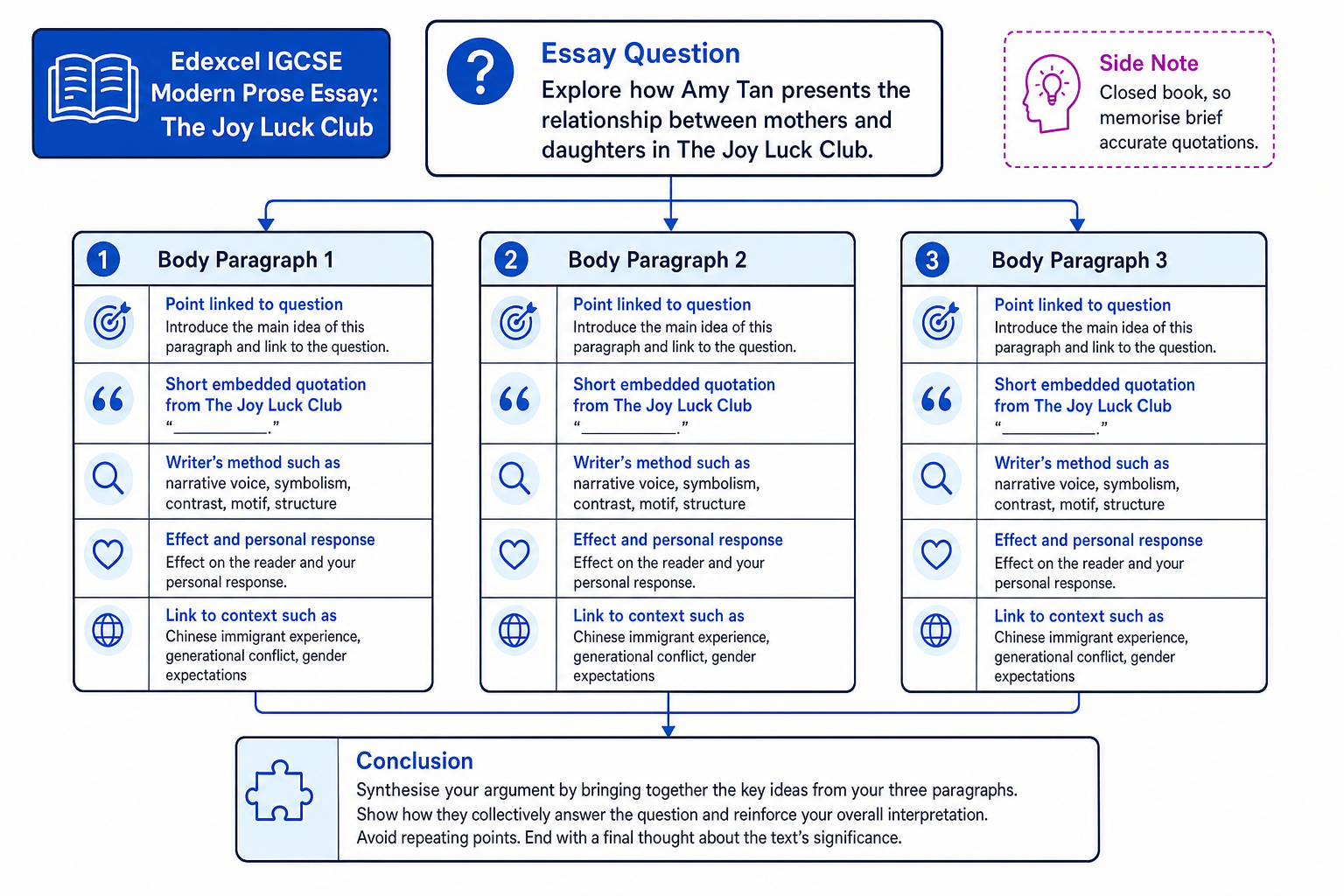
A strong paragraph usually contains:
- A point that directly answers the question.
- A brief quotation or textual reference.
- A comment on Tan’s method — for example, narrative voice, symbolism, contrast, motif, structure or imagery.
- An explanation of effect: what the reader understands or feels.
- A relevant link to context.
- A final link back to the question.
Here is a visual reminder of how the whole essay should fit together:
Start with an argument, not a plot summary
A common question might ask:
Explore how Amy Tan presents relationships between mothers and daughters in The Joy Luck Club.
A weak opening would simply retell the story: “The novel is about four mothers and four daughters. They often argue.”
A stronger opening gives an interpretation:
Tan presents mother-daughter relationships as painful but deeply loving bonds, damaged by language barriers, cultural difference and hidden trauma. Through the novel’s interwoven narratives, she shows that daughters can only understand their mothers when they begin to recognise the histories that shaped them.
That is better because it gives the examiner a clear direction.
Building a thesis
-
Identify the key focus of the question: the phrase “relationships between mothers and daughters” means you need to discuss both conflict and connection, not just one character.
-
Choose a judgement: Tan does not present these relationships as simply negative; she shows misunderstanding, but also inheritance, love and eventual recognition.
-
Link the judgement to the novel’s structure: because the novel is made of multiple voices and linked stories, Tan gradually reveals what the daughters do not initially understand.
-
Add context carefully: the mothers’ experiences of China, migration and patriarchal expectations explain why they often communicate through warning, pressure or silence.
Model essay plan: mothers and daughters
Introduction
Your introduction should be short and purposeful. You do not need to list every character.
Model introduction:
In The Joy Luck Club, Amy Tan presents mother-daughter relationships as emotionally complicated bonds shaped by love, cultural difference and unspoken suffering. The American-born daughters often experience their mothers’ advice as criticism or control, while the Chinese-born mothers are trying to pass on survival, memory and identity. Through the novel’s fragmented structure and shifting narrative voices, Tan suggests that understanding between generations is difficult, but possible when the daughters learn to listen to the stories behind their mothers’ behaviour.
Paragraph 1: conflict and miscommunication
Use Jing-mei and Suyuan as your central example.
Jing-mei admits, “My mother and I never really understood one another,” adding that they “translated each other’s meanings”. The verb “translated” is important because it suggests that the problem is not just language, but interpretation: mother and daughter attach different meanings to the same words and actions.
This connects strongly to context. Jing-mei grows up in America, while Suyuan carries memories of China, war and loss. Suyuan’s hopes can therefore seem excessive to Jing-mei, especially when she believes America offers endless possibility: “My mother believed you could be anything you wanted to be in America.”
Retelling the piano argument
Do not spend a whole paragraph narrating the events of “Two Kinds”. The examiner already knows the story. Focus on what the conflict reveals: pressure, ambition, shame, love and the difficulty of translation between generations.
Paragraph 2: mothers’ control as protection
Tan often presents maternal control as harsh on the surface but protective underneath.
Waverly describes how Lindo teaches her “the art of invisible strength”. This phrase works as a motif, a repeated idea that gains meaning across the text. It suggests hidden power: silence, strategy and self-control. Lindo’s lessons come from a world where women often had limited open power, so survival required indirect forms of strength.
Motif
A motif is a repeated image, phrase or idea that helps develop a theme. In The Joy Luck Club, repeated ideas such as translation, silence, food, names and “invisible strength” help Tan explore inheritance and identity.
In an essay, this paragraph could argue that the mothers’ behaviour is not simply controlling. It is shaped by past experiences of restriction, migration and fear. Tan asks the reader to see the emotional history behind what the daughters interpret as criticism.
Paragraph 3: storytelling and reconciliation
The daughters begin to understand their mothers through stories. Jing-mei’s journey to China at the end of the novel is especially useful.
The final recognition that “Together we look like our mother” suggests that identity is shared and inherited. Jing-mei does not become her mother, but she finally sees herself as part of Suyuan’s story. Tan uses the family reunion to make personal identity collective: Jing-mei understands herself through mother, sisters and ancestry.
You can also link this to the novel’s structure. Because the book is divided into interlocking stories, the reader experiences understanding gradually, just as the daughters do.
Conclusion
A strong conclusion should not repeat every point. It should sharpen your overall argument.
Model conclusion:
Overall, Tan presents mother-daughter relationships as strained by cultural difference, silence and painful memory, but also held together by deep love. The daughters often misunderstand their mothers because they see only pressure or criticism, not the histories of loss and survival behind them. By the end of the novel, especially through Jing-mei’s recognition of her mother’s legacy, Tan suggests that identity is not individual alone: it is inherited through family stories, language and memory.
Model paragraph: close analysis in action
Here is a full paragraph you could adapt.
Writing about Jing-mei and Suyuan
-
Make a direct point: Tan presents Jing-mei and Suyuan’s relationship as one damaged by miscommunication, but not by lack of love.
-
Use precise evidence: Jing-mei says, “My mother and I never really understood one another,” and explains that they “translated each other’s meanings”.
-
Analyse the method: The metaphor of translation suggests that even when mother and daughter speak, meaning changes between them. Their conflict is emotional and cultural, not only linguistic.
-
Explain the effect: The reader understands Jing-mei’s frustration, but also sees the sadness of Suyuan’s position: her hopes are being misunderstood by the daughter she wants to protect.
-
Link to context: As a Chinese immigrant mother in America, Suyuan believes opportunity must be seized, while Jing-mei experiences this ambition as pressure.
-
Link back to the question: Tan therefore presents the mother-daughter bond as loving but strained, shaped by the gap between immigrant experience and American childhood.
Using quotations well in a closed-book essay
Because the exam is closed book, memorise short quotations that can work for several questions.
Useful examples include:
- “My mother and I never really understood one another” — miscommunication, generation gap, mothers and daughters.
- “translated each other’s meanings” — language, culture, misunderstanding.
- “you could be anything you wanted to be in America” — immigration, hope, pressure, the American Dream.
- “the art of invisible strength” — female power, strategy, inheritance.
- “two halves of the same song” — reconciliation, identity, mother-daughter connection.
- “Together we look like our mother” — family, heritage, belonging.
Quotation strategy
Learn flexible quotations rather than long ones. A short quotation like “translated each other’s meanings” can support paragraphs on language, identity, conflict, immigration and family.
How to make context feel natural
Context should explain Tan’s presentation, not interrupt it.
Weak context sounds like this:
In Chinese culture, daughters must obey mothers.
This is too broad and risks stereotyping.
Stronger context sounds like this:
Tan presents Suyuan’s expectations as partly shaped by her immigrant belief in American opportunity; her pressure on Jing-mei comes from hope and fear, not simply cruelty.
This is better because it links context to character, theme and authorial purpose.
Avoid sweeping generalisations
Do not write as if all Chinese families, mothers or daughters behave the same way. Tan presents specific characters with individual histories, even while exploring wider ideas about immigration, gender and cultural inheritance.
A second essay angle: identity
Another likely question could focus on identity.
A clear argument might be:
Tan presents identity as something inherited, translated and gradually understood. The daughters begin by seeing themselves as separate from their mothers’ Chinese pasts, but the novel shows that family history continues to shape them.
Possible paragraph route:
- Jing-mei’s uncertainty about being Chinese-American.
- Waverly and Lindo’s conflict over pride, shame and “invisible strength”.
- Jing-mei’s final recognition in China that identity is connected to family memory.
The key is to keep returning to the question. If the question says identity, do not drift into a general essay about mothers and daughters unless you explain how that relationship shapes identity.
In the exam
-
Spend a few minutes planning three main paragraphs before you write; each paragraph should have a different angle on the question.
-
Use brief, accurate quotations and embed them smoothly into your own sentence.
-
Keep context attached to Tan’s characters and choices: explain how immigration, gender expectations or family history shape meaning.
-
End each paragraph by linking back to the exact wording of the question.
Check yourself
-
Can you write a thesis about mother-daughter relationships without retelling the plot?
-
Which three quotations could you use for a question about identity?
-
Does your context explain Tan’s presentation, or is it just background information?
