What you'll learn
- How to shape a Things Fall Apart essay for Edexcel IGCSE English Literature.
- How to move from a question to a clear argument.
- How to write analytical paragraphs using short, accurate quotations.
- How to integrate context without turning your essay into a history lesson.
The exam situation: what your essay is really testing
Things Fall Apart appears in Component 1, Section C: Modern Prose. This component is closed book, so you must know a small bank of short, accurate quotations and key moments from the novel.
For this section, your main jobs are AO1 and AO4.
AO1
AO1 means showing close knowledge and understanding of the text, writing in a critical style, and using textual references to support an informed personal response.
AO4
AO4 means exploring the relationship between the text and its context — for example, Igbo society, colonialism, missionary Christianity, and Achebe’s purpose in challenging colonial stereotypes.
You may still comment on Achebe’s methods — such as narrative voice, symbolism, contrast, proverbs, irony, and structure — but always tie them to the question and to meaning. Do not list techniques for their own sake.
The core of a strong essay
A strong Things Fall Apart essay makes an argument about Achebe’s message, supports it with brief evidence, and links that argument to the novel’s cultural and historical context.
The model essay shape
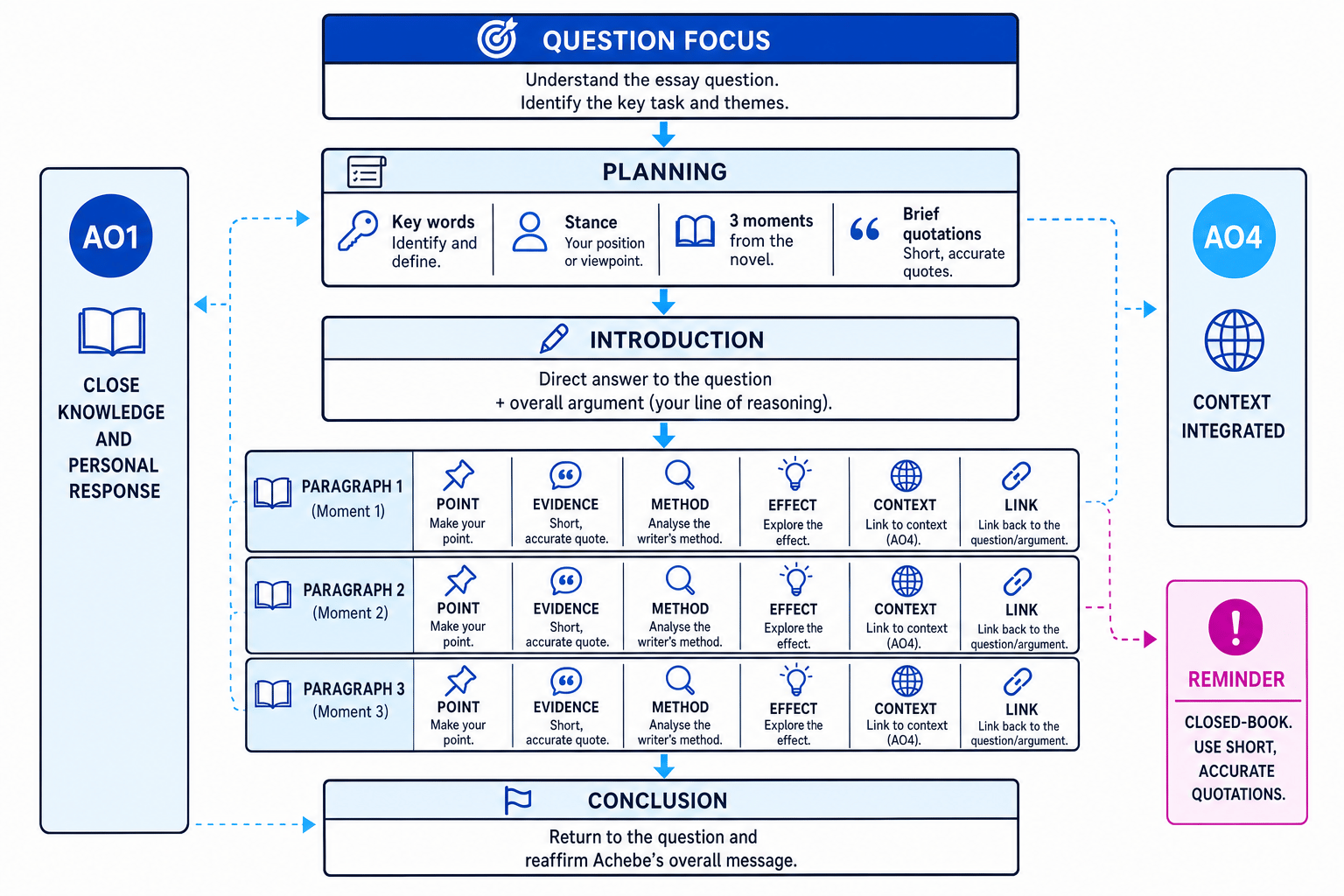
A good essay is not a list of everything you know. It is a guided argument. You begin with the question, decide your view, choose three or four precise moments, and then build paragraphs that prove your interpretation.
Thesis
A thesis is your overall argument in answer to the question. It should be specific enough that every paragraph can link back to it.
A weak thesis says: “Achebe presents Okonkwo in many ways.”
A stronger thesis says: “Achebe presents Okonkwo as both admirable and deeply flawed, showing how his fear of weakness makes him a tragic figure within a society already under pressure.”
That second version gives you a clear direction: admiration, flaw, fear, tragedy, and social change.
Turning a question into an argument
Most essay questions will ask you to “explore” or “examine” how Achebe presents a character, theme, relationship, or idea. The word how matters: you are not just naming events, but explaining how Achebe shapes the reader’s response.
Turning a question into a thesis
Question focus: How does Achebe present the impact of colonialism in Things Fall Apart?
-
Identify the central idea in the question. Here, the focus is not simply “white men arrive”; it is the impact of colonialism, so the essay needs to discuss consequences for Umuofia, family relationships, religion, law, and identity.
-
Choose a balanced stance. Achebe does not present colonialism as a simple background event. He shows it as clever, disruptive, and dehumanising, but he also shows that Igbo society already contains tensions that make some people open to change.
-
Select three moments that prove the stance. Useful choices include Nwoye’s attraction to Christianity, Obierika’s explanation that “the clan can no longer act like one,” and the District Commissioner reducing Okonkwo’s life to a “reasonable paragraph.”
-
Form the thesis. A strong version would be: Achebe presents colonialism as a destructive force that divides Umuofia from within, replacing complex Igbo systems of belief and justice with a shallow colonial narrative that refuses to understand them.
Model essay route 1: Okonkwo as a tragic character
A question on Okonkwo often asks how Achebe presents him, how far he is responsible for his downfall, or how he represents ideas about masculinity and power.
Tragic character
A tragic character is a character whose downfall creates pity or sadness, often because their strengths are connected to their flaws.
Okonkwo is not simply a villain. Achebe introduces him as a man of achievement: “Okonkwo was well known throughout the nine villages.” His “fame rested on solid personal achievements,” which immediately makes the reader recognise his strength, discipline, and status.
However, Achebe also reveals the emotional pressure behind that success. Okonkwo’s “whole life was dominated by fear, the fear of failure and of weakness.” The abstract noun “fear” changes how we judge him: his violence is not just confidence, but insecurity.
Possible plan
Introduction:
Achebe presents Okonkwo as a tragic figure because his admirable determination is inseparable from his destructive fear of weakness. Through Okonkwo, Achebe explores both individual failure and the pressures of a masculine warrior culture in Umuofia.
Paragraph 1 — status and achievement:
Use the opening description: “well known throughout the nine villages.” Link to Igbo values of titles, wrestling, farming, and reputation.
Paragraph 2 — fear of weakness:
Use “dominated by fear” and “To show affection was a sign of weakness.” Explain how Achebe exposes the emotional cost of Okonkwo’s masculine ideal.
Paragraph 3 — Ikemefuna:
Use “He was afraid of being thought weak.” This is a crucial turning point because Okonkwo kills the boy who calls him father, choosing reputation over affection.
Paragraph 4 — downfall and colonial change:
Link Okonkwo’s rigidity to the changed Umuofia. Obierika’s judgement, “You drove him to kill himself,” shows both personal tragedy and colonial destruction.
Model paragraph
Achebe presents Okonkwo’s tragedy as rooted in his fear of appearing weak. Although Okonkwo’s status seems to show strength, the narrator explains that his “whole life was dominated by fear, the fear of failure and of weakness.” The repeated noun “fear” suggests that Okonkwo is controlled by anxiety rather than true confidence. This becomes most destructive when he kills Ikemefuna: Achebe states plainly that “He was afraid of being thought weak.” The simplicity of this sentence is shocking because it strips away any heroic motive. Okonkwo acts not out of justice or necessity, but because he cannot bear the judgement of other men. In the context of Umuofia’s patriarchal values, strength and honour are highly prized, yet Achebe shows how these values become dangerous when taken to extremes. Therefore, Okonkwo’s downfall is tragic because the qualities that make him respected also make him emotionally brutal.
Make your Okonkwo argument balanced
The best essays avoid calling Okonkwo either “good” or “bad”. Instead, argue that Achebe makes him complex: impressive, violent, insecure, culturally shaped, and personally responsible.
Model essay route 2: colonialism and cultural destruction
For questions about colonialism, do not begin as if Umuofia is perfect before Europeans arrive. Achebe’s novel is more subtle than that. Igbo society has order, art, justice, religion, and community — but also exclusions and harsh customs. This complexity is part of Achebe’s challenge to colonial writing.
Colonialism
Colonialism is when one country or power takes control of another place, often exploiting its people, land, laws, and culture.
Achebe’s context matters here. He was writing in 1958, just before Nigerian independence in 1960, and his novel responds to European texts that presented African societies as primitive or voiceless. In Things Fall Apart, Igbo life is shown from the inside before the colonial officials arrive.
Possible plan
Introduction:
Achebe presents colonialism as intellectually arrogant and socially destructive. It succeeds not only through force, but by dividing the clan, misunderstanding Igbo culture, and replacing complex human stories with racist simplifications.
Paragraph 1 — Igbo society before colonial rule:
Use “proverbs are the palm-oil with which words are eaten” to show sophistication, oral culture, and communal values.
Paragraph 2 — religion and division:
Nwoye’s conversion shows that Christianity appeals to those hurt or excluded by Igbo customs. This makes the impact of colonialism internal as well as external.
Paragraph 3 — Obierika’s explanation:
Use “He has put a knife on the things that held us together and we have fallen apart.” The metaphor of the “knife” suggests violent division.
Paragraph 4 — the ending:
Use “The Pacification of the Primitive Tribes of the Lower Niger.” The title exposes the District Commissioner’s racist and reductive viewpoint.
Model paragraph
Achebe presents colonialism as destructive because it breaks the unity of Umuofia from within. Obierika explains that “the clan can no longer act like one,” showing that colonial power has damaged the community’s ability to respond collectively. His metaphor, “He has put a knife on the things that held us together,” is especially powerful because a knife cuts what was once joined. Achebe therefore presents colonialism not only as political control, but as a force that severs religious, legal, and family bonds. This is linked to the historical context of British imperial expansion in Nigeria, where missionaries and colonial administrators often worked together, replacing indigenous authority with European systems. Obierika’s voice is important because he is thoughtful and critical; through him, Achebe shows the reader that the tragedy of Umuofia is not that it lacked culture, but that its culture was deliberately misunderstood and divided.
Bolting on context
Do not add context as a random sentence like “This was during colonialism.” Instead, connect it directly to Achebe’s point: colonial power matters because it changes law, religion, language, and who gets to tell the story.
How to use quotations in closed book conditions
You do not need long quotations. In fact, short quotations are usually better because they are easier to remember and analyse accurately.
Good short quotations include:
- “well known throughout the nine villages”
- “dominated by fear”
- “To show affection was a sign of weakness”
- “He was afraid of being thought weak”
- “proverbs are the palm-oil”
- “the clan can no longer act like one”
- “put a knife on the things that held us together”
- “like a dog”
- “reasonable paragraph”
- “The Pacification of the Primitive Tribes of the Lower Niger”
Do not misattribute the title
The phrase “Things fall apart” comes from W. B. Yeats’s poem “The Second Coming”, which Achebe uses as an epigraph. It is not spoken by Okonkwo or Obierika in the novel, although Obierika’s “we have fallen apart” clearly echoes the idea.
What makes a model conclusion?
A conclusion should not repeat the whole essay. It should return to the question and sharpen your overall argument.
For an Okonkwo essay, you might write:
Ultimately, Achebe presents Okonkwo as a tragic character because his downfall is both personal and historical. His fear of weakness leads him to brutal choices, but the arrival of colonial power also destroys the world in which his identity made sense. Achebe therefore makes Okonkwo’s death a symbol of a wider cultural collapse.
For a colonialism essay, you might write:
Ultimately, Achebe presents colonialism as destructive because it refuses to understand the society it claims to “pacify”. By ending with the District Commissioner’s planned book, Achebe exposes the violence of reducing African lives to colonial stereotypes, and his own novel becomes an act of correction.
In the exam
- Spend a few minutes planning a thesis and three main moments before you start writing.
- Use short, accurate quotations and analyse what they prove about Achebe’s message.
- Integrate context into your argument rather than adding it as a separate history paragraph.
Check yourself
- Can you write a one-sentence thesis about Okonkwo that is more precise than “he is tragic”?
- Can you explain how the “knife” metaphor helps Achebe present colonialism?
- Can you connect one quotation to context without drifting away from the question?