Welcome to your study of Arthur Miller’s powerful mid-century drama, A View from the Bridge. Set in the 1950s Italian-American tenement community of Red Hook, Brooklyn, this play tells the story of Eddie Carbone, a longshoreman whose protective love for his orphaned niece, Catherine, spirals into an obsessive, destructive passion.
By exploring the play’s structural foundation, its key characters, and its narrative techniques, you will build a solid foundation for your Edexcel IGCSE English Literature exam.
What you'll learn:
- The core plot dynamics, character relationships, and cultural conflicts of the play.
- How Arthur Miller adapts classical Greek tragedy to a modern, working-class setting.
- The unique structural role of Alfieri as both narrator and dramatic chorus.
The World of Red Hook: Plot and Cultural Clash
To understand the trajectory of the play, you must first understand the tight-knit community in which it is set. Red Hook is a slum on the Brooklyn waterfront, populated largely by Sicilian immigrants.
The community functions under two distinct, often conflicting, systems of law:
- American Law: The formal, written, state-enforced legal system. It is cold, literal, and often unable to resolve deeply personal human disputes.
- The Sicilian Code of Honor: An unwritten, ancient set of community rules based on loyalty, family, and masculine pride. In this code, betrayal—especially of fellow immigrants—is the ultimate sin, punishable by exclusion or violence.
At the start of the play, Eddie Carbone and his wife, Beatrice, have raised Catherine as their own daughter. When Beatrice’s cousins, Marco and Rodolpho, enter the country illegally to find work, Eddie gladly shelters them. However, as Catherine and the young, artistic Rodolpho fall in love, Eddie’s protective affection for Catherine transforms into a toxic jealousy.
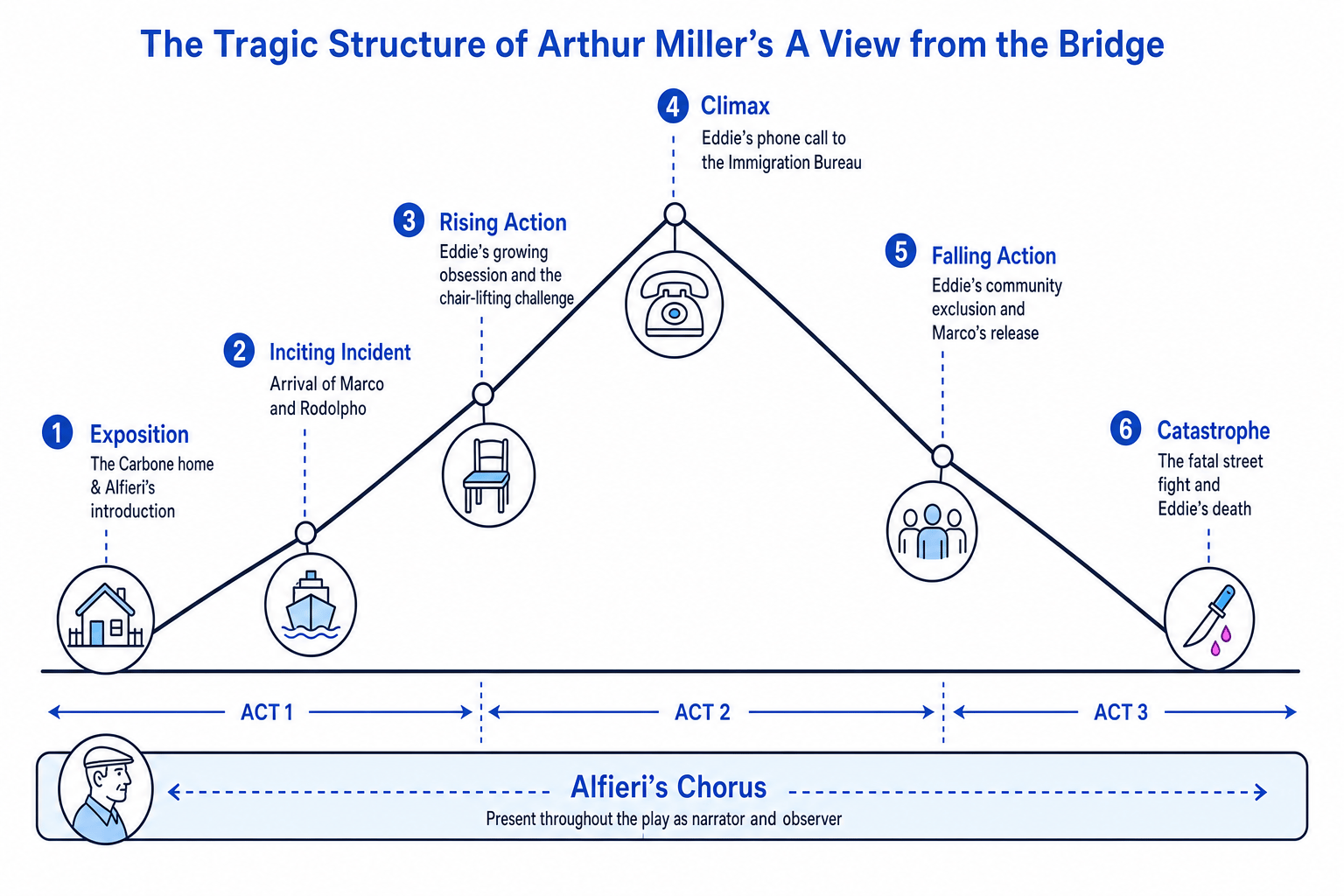
This jealousy drives Eddie to commit the ultimate betrayal: reporting the brothers to the Immigration Bureau. In doing so, Eddie violates his community's sacred code to protect his own private obsession, setting off an unstoppable chain reaction.
The Central Conflict
The tragedy of the play does not just stem from Eddie's obsessive jealousy, but from the irreconcilable clash between formal American law and the ancient Italian community code of honor. When Eddie uses the American law to solve a personal dispute, he destroys his standing in the community and seals his own fate.
The Structure of Modern Tragedy
While the play features ordinary, working-class characters, Miller deliberately modeled its structure on Classical Greek Tragedy. Understanding this generic form is crucial for your analysis of the play's structure (AO2).
Tragedy
A serious drama depicting the downfall of a noble or well-intentioned protagonist (the tragic hero) due to a fatal flaw and external pressures, ending in a catastrophic resolution.
Miller uses several classical theatrical devices to elevate Eddie Carbone's domestic struggle into an epic, timeless tragedy:
- Hamartia (Tragic Flaw): The protagonist's fatal error in judgment. Eddie’s hamartia is his unacknowledged, incestuous desire for Catherine, combined with his total lack of self-awareness.
- Hubris (Excessive Pride): The arrogance that leads a character to believe they can bypass the natural order or community rules. Eddie exhibits hubris when he calls the Immigration Bureau, believing he can retain his respect while betraying his family.
- Catharsis (Purging of Emotion): The release of pity and fear felt by the audience at the end of a tragedy. When Eddie dies in the final confrontation, the audience experiences a mixture of horror at his actions and pity for his self-destruction.
- The Chorus: In Greek drama, a group of actors who do not participate directly in the main action but observe, comment on the themes, and warn the audience of impending doom. Miller translates this ancient device into a single modern character: Alfieri.
The diagram below maps out how these tragic elements unfold across the play’s three-act structure:
Alfieri as the Dramatic "Bridge"
Alfieri is a lawyer who acts as the literal and metaphorical "bridge" in the play. He is situated at the intersection of several opposing forces:
- The Bridge between Cultures: As an educated lawyer, he represents American law. As an Italian immigrant, he deeply understands the ancient Sicilian blood-codes of Red Hook.
- The Bridge between the Stage and the Audience: He steps out of the action to address the audience directly, operating as a narrator who looks back on these events with historical hindsight.
- The Bridge between Free Will and Fate: Alfieri can foresee the inevitable catastrophe but is completely powerless to prevent it. This creates intense dramatic irony, as we watch Eddie stumble toward a disaster that we—and Alfieri—already know is coming.
Analyzing Alfieri's Language
Whenever you quote Alfieri, look for vocabulary associated with the law, ancient history, destiny, and inevitability. He often uses dark, prophetic imagery (e.g., describing the "smell of salt" and "green sea" of Red Hook, or warning that Eddie's path will "run its bloody course").
Worked Example: Analyzing Dramatic Irony in the Prologue
Let's look at how to construct a high-scoring analytical paragraph (AO1/AO2) analyzing the dramatic function of Alfieri in the opening scene of the play.
Our focus is on how Miller establishes a sense of inevitable tragedy right from the start.
Analyzing Alfieri's Prologue
Analyze how Arthur Miller uses the character of Alfieri to establish the theme of fate in the prologue of A View from the Bridge.
-
State your analytical point clearly (AO1): In the prologue, Miller uses Alfieri as a modern dramatic chorus to establish an atmosphere of inescapable doom and show that Eddie's tragic trajectory is already predetermined.
-
Introduce and embed a precise quotation (AO1): Alfieri confesses to the audience his historic sense of helplessness when observing Eddie’s life, admitting that he could only "watch it run its bloody course" while feeling a profound sense of "powerlessness."
-
Identify the literary methods and analyze their linguistic effects (AO2): The verb "run" suggests an unstoppable momentum, implying that the tragic events possess their own autonomous energy that cannot be halted by human intervention. This is reinforced by the gory adjective "bloody," which functions as a structural foreshadowing of Eddie's violent, physical demise at the end of the play.
-
Analyze the dramatic form and impact on the audience (AO2): By framing Alfieri's perspective as someone who was "powerless" to intervene, Miller strips the characters of their agency and aligns the audience with Alfieri's own passive, agonizing position. This use of dramatic irony intensifies the audience's engagement, as we are forced to watch Eddie's domestic collapse unfold with a sense of tragic inevitability.
The Context Trap (AO4)
In the Edexcel IGCSE specification, Component 2 Section A (Modern Drama) does NOT assess AO4 (Context).
Do not waste valuable exam time and word count writing long paragraphs about the 1950s McCarthy trials, Arthur Miller's personal life, or the history of Italian immigration. Every mark you receive in this section is based purely on your knowledge of the text (AO1) and your close analysis of language, form, and structure (AO2). Keep your focus entirely on the dramatic choices Miller makes on the page!
In the exam
When answering a question on A View from the Bridge in Component 2, Section A, keep these strategies in mind:
- Leverage the Open Book format: Since you have a clean copy of the play in the exam, do not guess your quotations. Find precise, short quotes (2–5 words) that contain rich literary devices (such as metaphor, motifs, or dramatic irony) to maximize your AO2 analysis marks.
- Focus on Dramatic Structure: Don't just analyze characters as if they are real people. Always frame them as constructs of the playwright. Use structural terms such as catalyst, exposition, climax, foreshadowing, and tragic resolution to show you are analyzing the text as a play script.
- Analyze Alfieri's placement: If you are discussing any key event (like Eddie calling the immigration officers or Eddie's confrontation with Marco), think about how Alfieri frames that moment. Does he introduce it? Does he comment on it afterward? Linking the action back to Alfieri’s perspective always demonstrates high-level structural understanding.
Check yourself
- Why does Alfieri call himself "powerless" in the opening of the play, and how does this set the mood for the audience?
- What are the major differences between "American law" and the "Sicilian code of honor" as shown in the Red Hook community?
- Can you identify the exact point in the dramatic arc that acts as the inciting incident of the tragedy?