When you sit down to write your Edexcel IGCSE English Literature essay on Things Fall Apart, you are facing a closed-book exam. This means you do not have the novel in front of you. Success depends on how effectively you can organize your thoughts, recall precise textual evidence, and weave in historical context within the 45-minute limit.
A well-crafted essay plan is your roadmap. It ensures you do not run out of time, lose your train of thought, or forget to hit the key Assessment Objectives.
What you'll learn
- How to decode an exam prompt to formulate a sharp, argumentative thesis.
- How to structure a three-part plan that satisfies both AO1 (textual knowledge) and AO4 (contextual understanding).
- Practical strategies to recall and organize key quotations under exam pressure.
The Core Principles of Essay Planning
For Component 1, Section C (Modern Prose), your essay is evaluated on two primary Assessment Objectives:
- AO1: Demonstrate a close knowledge and understanding of the text, maintaining a critical style and an informed personal response.
- AO2: Analyze the language, form, and structure used by the writer to create meanings and effects.
- AO4: Explore the links and connections between the text and its historical, social, and cultural contexts.
Thesis Statement
A thesis statement is a one- or two-sentence summary of your main argument. It directly answers the exam prompt and outlines the conceptual journey your essay will take, moving beyond simple plot description to address the author's deeper thematic intentions.
To secure top-band marks, you must avoid simply retreiving plot points. Your plan must show why Achebe structured the novel the way he did, and how the tragedy of Umuofia reflects the broader historical tragedy of late 19th-century British colonization in Nigeria.
Plan the Argument, Not the Plot
Never structure your essay chronologically just because it is easy. Structure your essay around thematic arguments. Each paragraph should explore a distinct dimension of your thesis statement, integrating context (AO4) and close textual analysis (AO2) naturally.
The Visual Structure of a High-Scoring Plan
Before diving into the writing, you should spend 5 to 7 minutes sketching out a structural map. The flowchart below illustrates how your thesis statement should govern the entire layout, ensuring every paragraph connects back to your central argument while balancing evidence and context.
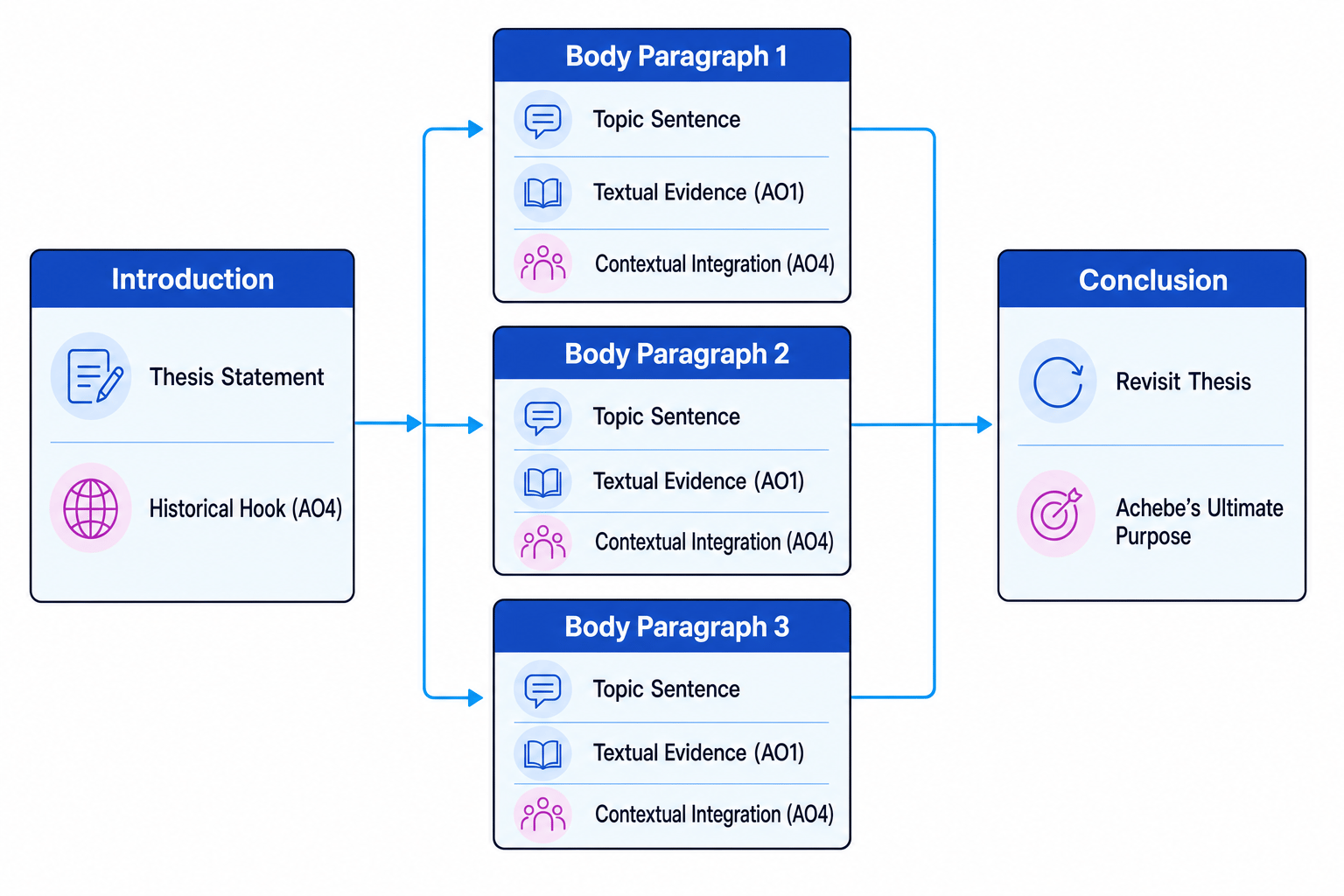
How to Deconstruct an Exam Prompt
When you read your exam question, you need to identify the core theme and the underlying tension the writer is exploring.
For instance, if a question asks you to look at "the role of change," you are not just listing things that change. You are analyzing the tension between Igbo traditionalism and Western encroachment, and how Achebe uses this tension to challenge Eurocentric colonial narratives of Africa as a "primitive" continent.
Achebe's Purpose
Always keep Achebe's purpose in mind: he wrote Things Fall Apart in 1958 to "write back" to racist colonial literature, such as Joyce Cary's Mister Johnson, by showing that Igbo society was complex, structured, and deeply religious before the British arrived.
Planning an essay on the clash of cultures
Explore how Achebe presents the clash between traditional Igbo culture and Western colonialism in Things Fall Apart.
-
Formulate a dual-focused thesis statement. Synthesize the literary conflict with Achebe's cultural purpose. Draft: "Achebe presents the clash of cultures not as a simple battle between good and evil, but as a tragic collision between a complex, deeply structured indigenous society and an unyielding, imperialist colonial force, ultimately exposing how internal vulnerabilities within Umuofia accelerated its external collapse."
-
Establish Three Thematic Anchor Points. Divide your argument into three distinct, progressive phases that avoid chronological retelling and instead analyze thematic shifts.
- Paragraph 1: The integrity, complexity, and internal flaws of pre-colonial Igbo culture (showing it was not a cultural "void" before the British).
- Paragraph 2: The insidious nature of colonial encroachment, focusing on how the British exploited existing social divisions in Umuofia (attracting outcasts, the osu, and women).
- Paragraph 3: The tragic fragmentation of the clan and Okonkwo’s suicide as a symbol of the death of traditional society.
-
Map Evidence (AO1/AO2) and Context (AO4) to Each Anchor Point. Brainstorm specific, memorable quotes and historical details for each section.
- For Paragraph 1: Recall the phrase "the drums beat and the flutes sang" to show vibrant cultural life. Contrast this with the killing of Ikemefuna and the abandonment of twins in the Evil Forest (showing internal flaws). Contextualize this with the pre-colonial, decentralized political structure of the Igbo people.
- For Paragraph 2: Focus on Obierika’s vital quote: "He has put a knife on the things that held us together and we have fallen apart." Analyze the metaphor of the "knife." Connect this to the historical reality of the British using missionary work as a precursor to administrative and military control (the "civilizing mission").
- For Paragraph 3: Select Okonkwo’s final act of despair—his hanging—which is considered an "abomination" against the Earth goddess, Ani. Explain the irony that Okonkwo, who lived his life to be a cultural champion, dies as an outcast. Link this to Achebe’s critique of the District Commissioner’s reduction of Okonkwo’s life to a mere "paragraph" in his colonial book, representing the erasure of African history by Western writers.
Critical Pitfalls to Avoid
Planning helps you avoid the most common traps that students fall into when writing about Things Fall Apart under timed conditions.
The Context Dump
Do not write long paragraphs about 19th-century British colonialism or Nigerian history without linking them directly to Achebe's structural and character choices. Context is only valuable if it explains why a character acts a certain way or how a theme develops.
Ignoring Obierika
Many students focus entirely on Okonkwo and miss the vital role of Obierika. Obierika acts as Achebe's intellectual surrogate—he is the character who questions the harsh laws of Umuofia (such as Okonkwo's exile) while remaining loyal to his culture. Your plans should almost always feature Obierika to demonstrate a sophisticated, top-tier understanding of the novel's internal critiques.
In the exam
- Spend 5–7 minutes planning. Do not skip this step to start writing immediately; an unplanned essay almost always wanders off-topic or degenerates into a plot summary.
- Write your thesis statement out in full at the top of your planning page. Keep it visible so you can check every paragraph against it.
- Select 2-3 short, highly flexible quotes per paragraph. Focus on short, 3- to 5-word phrases (like "the white man's fetish", "abomination", or "led by fear") that are easy to remember and analyze.
- Weave AO4 context directly into your topic sentences. Instead of saying "The British colonized Nigeria," write: "Through the introduction of the Christian church, Achebe demonstrates how colonial forces disrupted the spiritual hegemony of Umuofia."
Check yourself
- Can you draft a three-part essay plan for the prompt: "To what extent is Okonkwo the master of his own destiny?"
- Does your current essay plan structure actively balance textual evidence (AO1), linguistic/structural analysis (AO2), and cultural/historical context (AO4)?
- Are your memorized quotations short enough to be recalled easily in a closed-book environment, yet rich enough to support close analytical interpretation?