To score top marks in your Edexcel IGCSE English Literature exam, you must look beyond what happens in Things Fall Apart and analyze how Chinua Achebe tells the story. In your exam, you will be assessed on AO2: your ability to analyze how language, form, and structure shape meaning and influence the reader.
What you'll learn:
- How Achebe bends the English language to reflect an authentic African experience.
- The cultural and literary significance of Igbo proverbs and oral storytelling devices.
- How the novel adapts the classic tragic form to a communal, postcolonial setting.
- Why the distinct three-part structure of the novel is vital to its political and emotional impact.
1. Language: Creating an "Africanized" English
When Chinua Achebe wrote Things Fall Apart in the late 1950s, most literature about Africa was written by European colonial outsiders who portrayed Africans as silent, "uncivilized" caricatures. Achebe chose to write in English to reclaim the narrative, but he did not write in standard British English. Instead, he forged a new, bilingual linguistic style.
Postcolonial Writing
Postcolonial writing refers to literature produced by authors from nations formerly colonized by European powers. It often seeks to reclaim local histories, challenge colonial prejudices, and subvert the language of the colonizer.
Integrating the Igbo Vocabulary
Rather than translating every cultural concept into English, Achebe sprinkles authentic Igbo words directly into the text.
- Examples: chi (personal spirit), egwugwu (ancestral spirits), obi (living quarters), ogbanje (a wicked child who dies and is reborn).
- The Effect: By refusing to translate these words, Achebe forces you, the reader, to enter the Igbo world on its own terms. It signals that these cultural and spiritual concepts are complex and cannot be neatly packaged into Western equivalents.
The Art of the Igbo Proverb
Achebe famously writes in Chapter 1 that "proverbs are the palm-oil with which words are eaten."
Palm-oil and Proverbs
Just as palm-oil is an essential culinary ingredient used to make food smooth, digestible, and rich in Igbo cuisine, proverbs are used in conversation to make speech elegant, persuasive, and socially respectful.
When characters use proverbs, they are not just speaking; they are participating in a highly sophisticated oral tradition. This directly disproves the colonial myth that pre-colonial Africans were devoid of culture or complex intellect.
- "Our elders say that if a child washed his hands he could eat with kings." (Chapter 1)
- Meaning: In Umuofia, respect and status are earned through personal achievement, not inherited privilege. This explains Okonkwo’s rapid rise despite his father Unoka's debts.
Agrarian Imagery and Similes
Because Umuofia is an agricultural society dependent on the land and seasons, the novel's imagery is drawn directly from the natural world.
- Example: Okonkwo’s fame grew like "a bush-fire in the harmattan."
- Analysis: The "harmattan" is a dry, dusty wind that blows across West Africa. A fire in this season spreads rapidly and uncontrollably. This simile shows that Okonkwo's legendary status is powerful, natural, and fiercely swift.
Analyzing a key quotation
Analyze the language and meaning of the following quotation: "He [Okonkwo] became cold and dry like a severe harmattan wind." (Chapter 4)
- Identify the language device: The writer uses a simile ("like a severe harmattan wind") to compare Okonkwo's emotional state to a harsh meteorological event.
- Contextualize the imagery (AO4): The harmattan is a dry, dusty, cold wind that strips moisture from the air and leaves the landscape barren. It is a time of harshness, associated with discomfort and withered growth.
- Analyze the deeper effect (AO2): By comparing Okonkwo to this wind, Achebe highlights how Okonkwo's toxic obsession with masculinity has desiccated his capacity for empathy, warmth, or emotional flexibility. His internal emotional landscape has become as hostile and unyielding as the worst of the dry season.
2. Form: Postcolonial Tragedy
While Things Fall Apart is a modern postcolonial novel, its form is deeply rooted in the traditions of classical Greek and Shakespearean tragedy.
Tragic Hero & Hamartia
A Tragic Hero is a protagonist of high status who falls from grace due to a fatal flaw or error in judgment, known as hamartia.
Okonkwo is presented as a classic tragic hero. His hamartia is his crippling, obsessive fear of weakness and failure, which manifests as anger and a rejection of anything soft or "feminine" (like music, gentleness, or his father Unoka).
The Shift in Focus: From Individual to Community
In classical European tragedy, the fall of the hero is the ultimate focus. In Achebe's postcolonial adaptation, however, Okonkwo’s personal downfall is inextricably linked to the downfall of his entire community.
Okonkwo's suicide is tragic, but the ultimate tragedy is the destruction of Umuofia's social fabric. The title of the novel—taken from W.B. Yeats’s poem The Second Coming ("Things fall apart; the centre cannot hold")—underlines this structural fragmentation.
Achebe's Tragic Hybridity
Achebe combines the Western structure of tragedy with the oral storytelling techniques of Igbo culture to show that African history is worthy of the same epic, tragic treatment as the histories of ancient Greece or Rome.
3. Structure: The Three-Part Arc
The novel is strictly divided into three distinct parts. This structural layout is highly deliberate and serves a powerful political purpose.
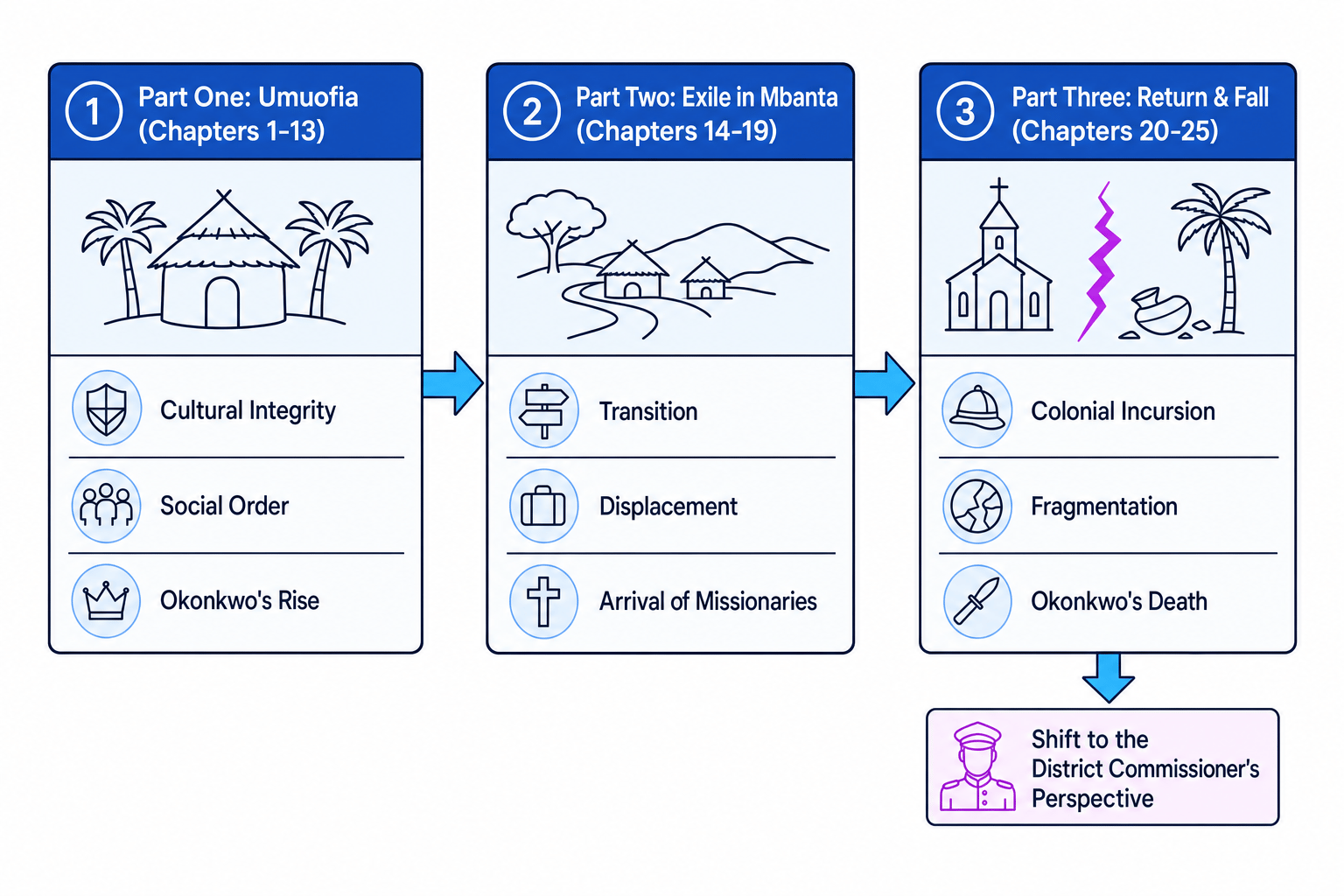
Part One (Chapters 1–13): The World That Was
Part One is the longest section of the novel, taking up more than half of the book. It details the day-to-day life, customs, trials, and triumphs of Umuofia before the arrival of white colonizers.
- Why is it so long? If the novel began with the arrival of the British, we would only see a society in crisis. By spending thirteen chapters showing us the judicial system (the egwugwu), the farming cycles, the marriage customs, and the religious rituals, Achebe forces us to recognize Umuofia as a fully functioning, complex, and coherent civilization.
Part Two (Chapters 14–19): The Exile
Okonkwo is exiled to his motherland, Mbanta, after accidentally killing Oduche's son.
- The Structural Function: This part represents a transitional phase of waiting and displacement. While Okonkwo is away from the center of power, the white missionaries arrive. The "centre" begins to loosen, and we see the first cracks in the Igbo society as marginalized tribal members (like the osu, or outcasts) convert to Christianity.
Part Three (Chapters 20–25): The Fall
Okonkwo returns to an Umuofia that has been fundamentally changed by the British administration and church.
- The Climax and Resolution: The pace of the narrative accelerates rapidly here. The tension between the traditionalists and the converts culminates in the burning of the church, Okonkwo’s desperate slaying of the court messenger, and his subsequent suicide.
Ignoring the final shift in perspective
Many students fail to discuss the radical shift in narrative perspective in the final chapter. Do not make this mistake!
At the very end of the novel, the narrative voice suddenly shifts from the close, sympathetic third-person omniscient voice that has guided us through Igbo life, to the cold, dehumanizing voice of the British District Commissioner.
The Commissioner decides that Okonkwo’s life is barely worth a whole chapter in his planned book, The Pacification of the Primitive Tribes of the Lower Niger; indeed, he thinks: "perhaps not a whole chapter, but a decent paragraph."
This structural shift is highly ironic and tragic. It demonstrates how colonial history actively erased, minimized, and simplified complex African realities into mere footnotes.
In the exam
When writing about language, form, and structure in Things Fall Apart:
- Never list devices. Do not just write: "Achebe uses a simile in Chapter 1." Instead, explain why: "Achebe uses the simile of the 'bush-fire' to emphasize that Okonkwo’s fame was a natural force, highlighting how deeply respected physical achievement was within Umuofia's social structure."
- Weave context (AO4) into your analysis (AO2). Show how Achebe's linguistic choices—such as leaving Igbo words untranslated—are political acts designed to challenge Western assumptions about African culture.
- Analyze the ending structurally. Always address how the shocking perspective shift to the District Commissioner in Chapter 25 mirrors the political process of colonial erasure.
Check yourself
- Why does Achebe choose to leave Igbo words like chi and egwugwu untranslated in his English text?
- What does the proverb "proverbs are the palm-oil with which words are eaten" tell us about the nature of communication in Umuofian society?
- How does the sudden shift to the District Commissioner's perspective at the very end of Chapter 25 alter our understanding of how history is written?
