For your Edexcel International GCSE English Literature exam, Things Fall Apart is assessed under Component 1, Section C (Modern Prose). This is a closed-book exam, which means you will not have a copy of the novel in front of you.
Success in this section relies on your ability to deploy precise, memorable quotations that unlock the deeper layers of Chinua Achebe's themes, characters, and historical context.
What you'll learn
- How to select and memorize high-impact, flexible "micro-quotations"
- How to analyze language, form, and structure (AO2) using key quotes
- How to link quotes directly to the cultural and colonial context of Nigeria (AO4)
1. The Strategy of "Micro-Quotations"
In a closed-book exam, attempting to memorize long sentences or whole paragraphs of text is an unnecessary burden. It often leads to misquoting or clunky, interrupted prose in your essay. The secret to hitting the top marks for AO1 (textual knowledge) and AO2 (analysis of language) is the micro-quotation.
Micro-quotation
A micro-quotation is a highly concentrated, 1-to-3 word fragment of a text that carries significant thematic or stylistic weight. It is designed to be woven seamlessly into the grammar of your own analytical sentences.
Instead of writing: Okonkwo was always very worried about what people thought of him and we see this when Achebe writes, "He was afraid of being thought weak." (Clunky and repetitive).
You should write: Driven by a debilitating hyper-masculinity, Okonkwo's actions are constantly governed by the persistent dread of "being thought weak" by his peers. (Elegant, integrated, and analytical).
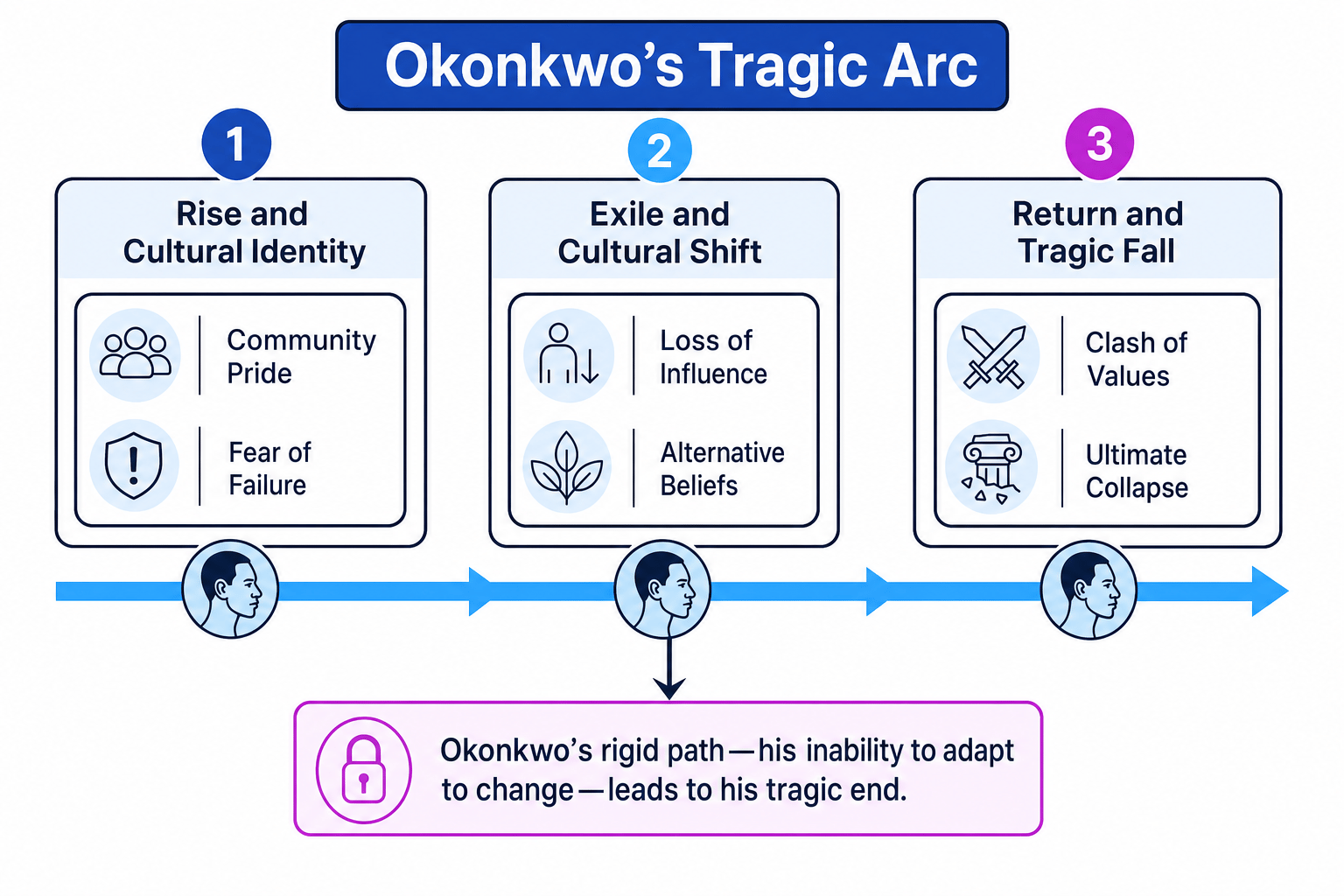
To help you organize these quotes, think of the novel as a three-part journey. The diagram below illustrates how Okonkwo's personal psychology intersects with the wider structural shift of Umuofia.
2. Key Quotes: Okonkwo's Psychology and Masculinity
At the heart of the novel is Okonkwo’s psychological struggle. His identity is defined entirely in opposition to his father, Unoka, whom he views as effeminate and lazy.
Quote 1: The Fear of Failure
"He had no patience with unsuccessful men. He had had no patience with his father." (Chapter 1)
- Thematic Focus: Generational conflict, masculinity, fear.
- Method Analysis: The parallel syntax and repetition of the noun phrase "no patience" establishes Okonkwo’s uncompromising, rigid nature early in the novel. The transition from the general "unsuccessful men" to the highly personal "his father" reveals that his public cruelty is born out of a private, deep-seated family trauma.
- AO4 Link: In Umuofian society, achievement is not inherited; it is earned through personal physical prowess and agricultural success (growing yams). Okonkwo's rejection of his father is a rejection of a man who held no titles, making Okonkwo a self-made man but also leaving him emotionally hollow.
Mischaracterizing Okonkwo's Anger
Do not simplify Okonkwo as merely a "violent, angry man." Achebe is careful to present Okonkwo’s violence as a defense mechanism masking an intense, agonizing vulnerability. When analyzing his anger, always trace it back to his foundational fear of looking like Unoka.
Quote 2: The Tragic Flaw (Hamartia)
"He was afraid of being thought weak." (Chapter 7)
- Thematic Focus: Pride, reputation, hamartia (tragic flaw).
- Method Analysis: The use of the passive voice ("being thought weak") is crucial. Okonkwo is not necessarily afraid of actually being weak; he is terrified of the perception of weakness by others. This psychological fragility leads directly to his participation in the execution of Ikemefuna, a boy who called him "father."
- AO4 Link: The tragedy of Okonkwo reflects the tragedy of his culture. While Umuofia values strength, it also values balance, mercy, and community cohesion. Okonkwo overcompensates by taking the clan’s masculine ideals to an unnatural, destructive extreme.
3. Key Quotes: Igbo Sophistication and Culture
Before the arrival of the European missionaries, Achebe presents Umuofia as a complex, orderly, and highly civilized society. This was a radical political act in 1958, designed to dismantle Western colonial myths that depicted Africa as a "primitive" continent.
Quote 3: The Art of Conversation
"Among the Ibo the art of conversation is regarded very highly, and proverbs are the palm-oil with which words are eaten." (Chapter 1)
- Thematic Focus: Language, culture, community, wisdom.
- Method Analysis: Achebe uses a striking metaphor, comparing proverbs to "palm-oil." Palm-oil is a vital ingredient in Igbo cooking used to smooth over food and make it digestible. Similarly, proverbs are the cultural lubricant that allows difficult, tense, or complex ideas to be discussed politely and smoothly within the community.
- AO4 Link: By emphasizing the "art of conversation," Achebe directly counters the colonialist literature of his time (such as Joseph Conrad’s Heart of Darkness), which portrayed Africans as grunting or incapable of complex language.
The Palm-Oil of Language
Think of proverbs in Umuofia as social shock-absorbers. Just as oil reduces friction in an engine, proverbs allow the elders to deliver hard truths, negotiate peace, or demand justice without causing direct insult or sparking sudden violence.
4. Key Quotes: Fracture and Colonial Impact
The final third of the novel depicts the rapid disintegration of Igbo society under the dual pressures of white Christian missionaries and British colonial government.
Quote 4: The Severing of Ties
"He has put a knife on the things that held us together and we have fallen apart." (Chapter 20 - spoken by Obierika)
- Thematic Focus: Colonialism, division, social collapse.
- Method Analysis: Obierika’s dialogue uses the stark, violent image of a "knife" to describe the colonial apparatus. The "things that held us together" refers to the intricate web of kinship, religious belief, and ancestral law. The clause "we have fallen apart" directly echoes the novel's title and the Yeats epigraph.
- AO4 Link: Achebe demonstrates that the British did not conquer Umuofia solely through military force, but by introducing a new religion and legal system that divided families. Once father was turned against son (as seen with Nwoye and Okonkwo), the internal structural integrity of the clan collapsed.
The Title Connection
Achebe took his title from W.B. Yeats’s poem The Second Coming: "Things fall apart; the centre cannot hold." By placing this Western literary reference at the heart of an African story, Achebe asserts that the tragedy of cultural collapse is a universal human experience, not just an African one.
5. How to Analyze a Quotation in the Exam
In your exam, you must construct a cohesive, academic argument. You should aim for a structured paragraph layout that seamlessly blends textual evidence with analytical methods and contextual insights.
Let's look at a worked example of how to build an analytical paragraph using micro-quotations.
Analyzing Okonkwo's tragic flaw using micro-quotations
-
Formulate a precise, thesis-driven topic sentence (AO1):
Okonkwo’s tragic downfall is not caused by external forces alone, but by his internal, obsessive dread of perceived vulnerability.
-
Embed a micro-quotation seamlessly within your sentence syntax (AO1/AO2):
This internal vulnerability is laid bare during the execution of Ikemefuna, where Okonkwo strikes the fatal blow because he is "afraid of being thought weak" by his fellow clan members.
-
Identify and analyze the grammatical and psychological methods used by Achebe (AO2):
Achebe’s use of the passive voice in the phrase "being thought" emphasizes that Okonkwo’s actions are governed by an external mirror; he is a prisoner to the opinions of his peers. His subsequent action of drawing his machete to cut down his adoptive son is a visceral, physical overcompensation designed to violently erase any trace of his father Unoka's gentle legacy.
-
Anchor the literary analysis in the socio-cultural context of Umuofia (AO4):
This action highlights the rigid, unbalanced nature of Okonkwo’s masculinity. While Umuofian society respects martial strength, it also respects the warnings of the oracle and the sacred bonds of hospitality. By violating these values to preserve his personal pride, Okonkwo isolates himself from the spiritual protection of his ancestors, foreshadowing his ultimate, lonely destruction.
In the exam
- Select short quotes: Memorize quotes that are under five words. They are easier to remember under exam stress and much easier to integrate into your sentences.
- Weave quotes into your grammar: Never start a sentence with a quotation. Always lead with your own analytical point and let the quote act as the grammatical continuation of your sentence.
- Link language directly to context: Every time you analyze a quote (AO2), ask yourself: How does this reflect the conflict between traditional Igbo life and British colonialism (AO4)?
- Contrast characters: Use quotes structurally. Pair a quote from Okonkwo with a quote from his foil, Obierika, to show how different characters navigate the arrival of the white men.
Check yourself
- Why does Chinua Achebe describe proverbs as the "palm-oil" of conversation? What does this reveal about Igbo culture?
- Explain the significance of the passive construction in the quote: "He was afraid of being thought weak."
- How does Obierika’s metaphor of the "knife" in Chapter 20 explain the success of British colonial division in Umuofia?