Welcome to your study guide on the structural anchors of Chinua Achebe’s masterpiece, Things Fall Apart.
To excel in your Pearson Edexcel International GCSE English Literature exam (which, for Section C Modern Prose, is a closed-book exam), you cannot simply memorize quotes at random. You must understand how the novel is put together. This guide focuses on the most structurally, thematically, and contextually significant chapters in the book. By masterfully unpacking these chapters, you will build a sophisticated understanding of how Achebe uses structural shifts to convey the destruction of Umuofia.
Structure is Meaning
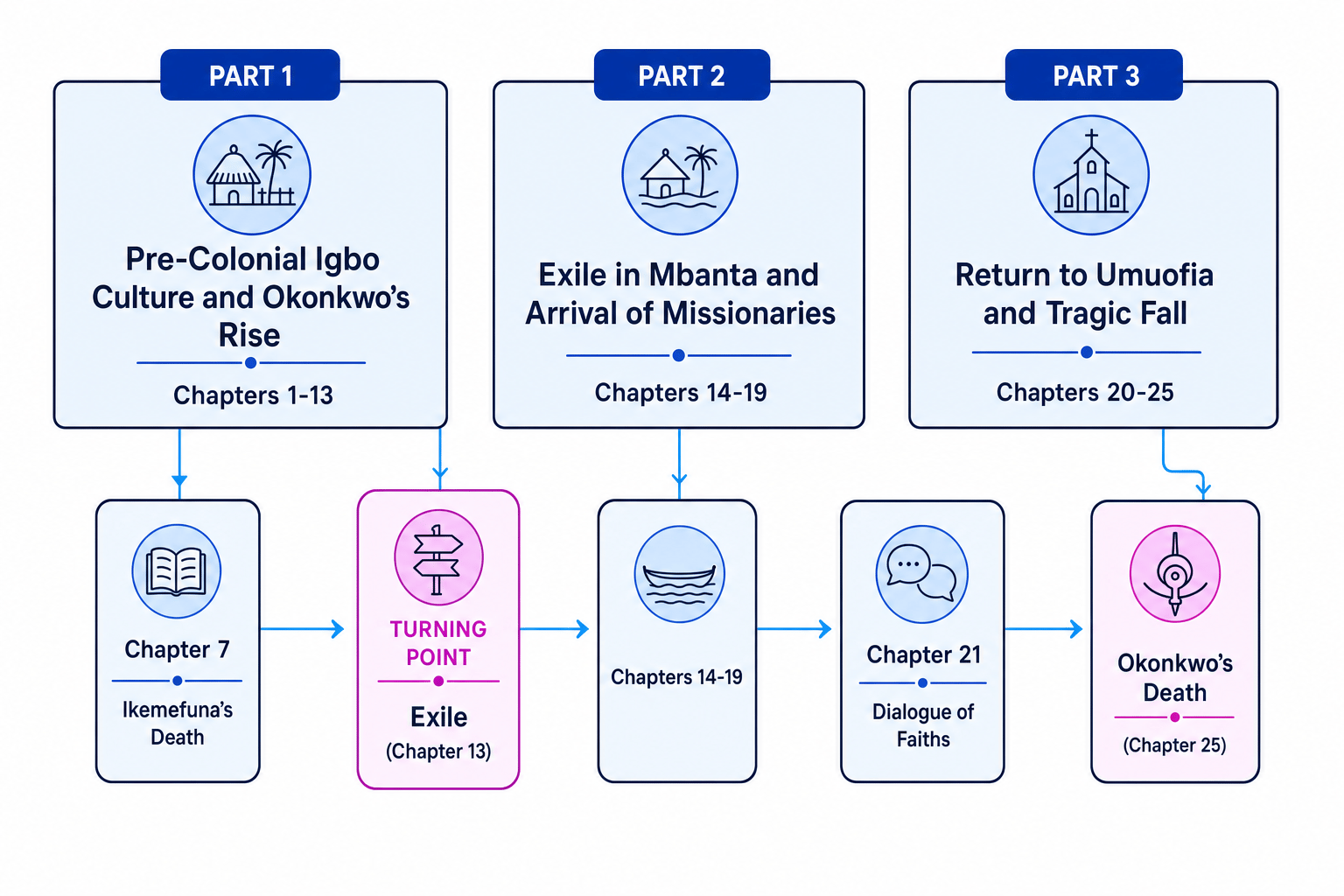
In Things Fall Apart, structure is directly tied to the novel's tragedy. The division of the novel into three distinct parts mirrors the gradual destabilization, invasion, and collapse of traditional Igbo society.
The Macro-Structure of the Novel
Achebe deliberately divides his novel into three distinct parts. This structural choice is a literary method in itself (AO2) and acts as a direct response to the colonial-era literature that frequently painted Africa as a "formless" or "primitive" place without history.
- Part One (Chapters 1–13): Establishes the complexity, richness, and self-sufficiency of Umuofia's social, judicial, and religious systems.
- Part Two (Chapters 14–19): Documents Okonkwo's exile to his motherland, Mbanta. This physical displacement coincides with the subtle, ideological invasion of Christian missionaries.
- Part Three (Chapters 20–25): Tracks Okonkwo's return to a fractured Umuofia, culminating in his suicide and the silencing of the native voice by British colonial authorities.
Chapter 7: The Sacrifice of Ikemefuna
Chapter 7 is the emotional and thematic climax of Part One. Up to this point, Ikemefuna has lived with Okonkwo's family for three years, integrating peacefully and acting as a positive, masculine influence on Okonkwo's sensitive son, Nwoye.
Key Narrative Events
The Oracle of the Hills and the Caves decrees that Ikemefuna must be killed. The elder Ogbuefi Ezeudu warns Okonkwo: "That boy calls you father. Do not bear a hand in his death." Despite this, when the elders lead Ikemefuna into the forest to execute him, Okonkwo participates. When Ikemefuna runs to Okonkwo crying, "My father, they have killed me!", Okonkwo draws his machete and cuts him down.
Hamartia
Hamartia is a Greek literary term referring to a protagonist’s tragic flaw or error in judgment, which ultimately leads to their downfall.
Analysis of Methods and Context
Achebe uses this chapter to expose Okonkwo's fatal flaw (his hamartia): his absolute, pathological fear of weakness and failure.
- Internal Monologue and Motives: Achebe notes that Okonkwo acts "because he was afraid of being thought weak." This highlights the tragic irony of Okonkwo's character—his desperation to appear strong causes him to commit a deeply unnatural act of violence against a boy who loved him.
- Foreshadowing and Structural Fracture: This chapter marks the emotional alienation of Nwoye. When Nwoye senses that Ikemefuna has been killed, Achebe writes that "something seemed to give way inside him, like the snapping of a tightened bow." This vivid simile foreshadows Nwoye's eventual conversion to Christianity in Part Two; the cultural fabric of the family (and by extension, the clan) begins to split from within before the white man ever arrives (AO4).
Chapter 13: The Turning Point
Chapter 13 marks the end of Part One and acts as the structural pivot of the entire novel.
Key Narrative Events
During the massive, ritualistic funeral ceremony for Ogbuefi Ezeudu—the very elder who had warned Okonkwo not to kill Ikemefuna—Okonkwo’s gun accidentally explodes. A stray piece of iron pierces the heart of Ezeudu’s sixteen-year-old son, killing him instantly. Because killing a clansman is a crime against Ani (the Earth Goddess), Okonkwo and his family are cast out of Umuofia.
Confusing the Types of Crime
Make sure you do not confuse "male" and "female" crimes in your exam. Okonkwo's crime is a female ochu (manslaughter) because it was accidental. Had it been intentional, it would have been a male crime. This distinction showcases the complex, highly organized nature of traditional Igbo justice (AO4).
Analysis of Methods and Context
- Cosmic Irony: It is highly symbolic that the victim is the son of Ezeudu, the man whose moral advice Okonkwo ignored in Chapter 7. This is an example of cosmic irony; the universe seems to punish Okonkwo for his spiritual arrogance.
- Structural Exile: Okonkwo’s forced exile to Mbanta physically removes Umuofia’s primary defender just as the Christian missionaries arrive. When Okonkwo is absent, Umuofia loses its warrior energy, allowing the new faith to take root.
Chapter 21: The Dialogue of Faiths
Often overlooked by students looking only for action, Chapter 21 is a crucial intellectual center of the novel. It details the peaceful period of colonization overseen by Mr. Brown, the moderate white missionary.
Key Narrative Events
Rather than using physical force, Mr. Brown seeks to understand the Igbo religion. He spends hours discussing theology with Akunna, a respected elder in Umuofia.
Analysis of Methods and Context
This chapter is a masterclass in Achebe's balanced narrative voice. Instead of painting a simplistic picture of evil colonizers and innocent victims, Achebe presents a complex dialogue of equals.
- Dialogue and Parallelism: Through Akunna and Mr. Brown, Achebe compares the Christian God with Chukwu, the supreme deity of the Igbo pantheon. Akunna explains that Chukwu made all the world and the other, minor gods: "We make sacrifices to the little gods, but when they fail, we go to Chukwu." Mr. Brown responds by comparing the minor gods to Christian angels, but Akunna rejects this, pointing out that angels are merely servants, whereas Igbo minor gods are intermediaries.
- The Power of Moderate Imperialism: This chapter highlights the danger of Mr. Brown’s gentle approach. He realizes that an open, violent assault on Igbo religion will fail, so he builds a school and a hospital instead. Achebe uses this to show that intellectual and cultural assimilation is far more effective at dismantling a society than physical warfare (AO4).
Quotation Integration
When discussing colonization, use the famous metaphor from Chapter 21: Mr. Brown’s school and hospital became "a frontal attack" on the clan, but it was successful because it was wrapped in the promise of education and medicine.
Chapter 25: The Erasure of Voice
Chapter 25 is the final chapter of the novel. It contains one of the most famous and devastating narrative shifts in modern literature.
Key Narrative Events
Following the destruction of the local church and Okonkwo's desperate decapitation of a court messenger, the British District Commissioner arrives at Okonkwo's compound. He finds that Okonkwo has hanged himself. Because suicide is an abomination in Igbo culture, Okonkwo’s fellow clansmen cannot touch his body. They ask the Commissioner's men to cut him down. The novel ends with the Commissioner's internal monologue about the book he is planning to write.
Analysis of Methods and Context
- Structural and Narrative Shift: For twenty-four chapters, the story has been told from an intimate, third-person omniscient perspective that deeply understands and respects the Igbo worldview. In the final paragraph of Chapter 25, the perspective abruptly shifts to the cold, clinical, and highly ethnocentric perspective of the District Commissioner.
- Deep Irony: The Commissioner contemplates the title of his future book: "The Pacification of the Primitive Tribes of the Lower Niger." This title is dripping with colonial irony (AO2/AO4). The word "pacification" is ironic because the British brought violence, not peace. The word "primitive" is ironic because, as the reader has seen over twenty-four chapters, Umuofia possessed a highly complex social, judicial, and religious structure.
- The Reduction of Okonkwo: The Commissioner decides that Okonkwo's life—the epic, tragic struggle we have just read—is barely worth a passage in his book: "One could almost write a whole chapter on him. Perhaps not a whole chapter but a decent paragraph, at any rate." This final reduction of a great warrior to a mere "decent paragraph" represents the ultimate tragedy of colonization: the systematic erasure of African history and voice by European empires.
Analyzing Perspective Shift in Chapter 25
When writing about the end of the novel, you must be able to write a structured analytical paragraph showing how Achebe’s methods convey his message about colonization. Here is a step-by-step guide to analyzing the shifting perspective of Chapter 25.
Analyzing perspective shift in Chapter 25
Analyze how Achebe uses narrative voice in the final chapter of Things Fall Apart to present the impact of colonialism.
-
Identify the shifting narrative perspective and state its direct effect:
- Step: Explain that Achebe abruptly shifts the narrative voice from a sympathetic, insider perspective of Igbo culture to the detached, administrative voice of the District Commissioner.
- Drafting: "In the final paragraph of Chapter 25, Achebe employs a dramatic narrative shift, transferring the point of view from the communal, empathetic voice of Umuofia to the clinical, imperialistic lens of the District Commissioner."
-
Integrate textual evidence (a specific quote) and analyze its linguistic methods:
- Step: Quote the title of the Commissioner's book and analyze the word choice ("primitive," "pacification") to reveal his deep-seated prejudices.
- Drafting: "This shift is crystallized in the title of the Commissioner's proposed book: 'The Pacification of the Primitive Tribes of the Lower Niger'. The noun 'pacification' is heavily ironic, as it euphemistically masks the brutal, disruptive violence of colonial conquest as a peaceful mission. Furthermore, the adjective 'primitive' exposes the ethnocentric ignorance of the colonial authorities, who are completely blind to the sophisticated judicial and social systems documented in the first two parts of the novel."
-
Link this linguistic analysis directly to the broader historical and cultural context (AO4):
- Step: Connect the Commissioner's desire to write a book about the Igbo people to the historical context of European writers writing for Africa, silencing indigenous voices. Explain Achebe's purpose in writing the novel.
- Drafting: "This linguistic erasure mirrors the historical reality of late nineteenth-century British imperialism, where colonial administrators wrote biased histories that stripped colonial subjects of their agency. By showing the Commissioner reducing Okonkwo’s rich, tragic life to a mere 'decent paragraph', Achebe illustrates how colonial literature sought to silence African voices. Ultimately, Achebe’s novel acts as a direct, postcolonial counter-narrative, reclaiming the very 'whole chapter' that the Commissioner deemed Okonkwo unworthy of receiving."
In the exam
When writing about the key chapters of Things Fall Apart under closed-book conditions:
- Structure chronologically if appropriate: If a question asks how a character or theme develops, structure your essay around the three parts of the novel. Contrast Okonkwo’s rise in Part One with his stagnation in Part Two, and his ultimate erasure in Part Three.
- Anchor your analysis in structural turning points: Don't just analyze what characters say; analyze where they say it. For example, point out that Nwoye's psychological break in Chapter 7 (with the death of Ikemefuna) directly causes his conversion to Christianity in Part Two. This shows the examiner you understand structural cause-and-effect (AO2).
- Always pair structural features with context (AO4): If you are discussing the trial scene in Chapter 10 or the funeral in Chapter 13, explain that Achebe structured Part One this way to prove to his Western audience that pre-colonial Africa was orderly, civilized, and possessed complex legal frameworks.
Check yourself
- What major thematic and narrative event takes place in Chapter 7, and how does it act as a catalyst for Nwoye’s character arc?
- Why is Okonkwo’s crime in Chapter 13 defined as a "female" crime, and what are the structural consequences of his exile?
- How does the change in narrative voice in the final paragraph of Chapter 25 reinforce Achebe's wider message about the impact of British colonial rule?