What you'll learn
- How to turn a theme into a clear interpretation, not just a topic word.
- The main themes in The Whale Rider: tradition, gender, leadership, nature, love and community.
- How Ihimaera uses structure, symbolism and context to develop these themes.
- How to write about themes in the Edexcel IGCSE closed-book prose exam.
Starting point: what is a theme?
Theme
A theme is a big idea that a writer develops across a whole text. In The Whale Rider, themes are not separate from the story: they grow through Kahu’s exclusion, Koro Apirana’s beliefs, the Paikea legend, and the crisis of the stranded whales.
A theme is more than a one-word label. “Gender” is a topic; a stronger thematic idea would be: Ihimaera shows that true leadership may come from the person a community has been taught to overlook.
Theme as argument
For exam paragraphs, write about what Ihimaera is saying about a theme, not just where the theme appears.
A quick map of the major themes
The themes overlap. For example, Kahu’s gender links to leadership; leadership links to tradition; tradition links to whakapapa; whakapapa links to the whales and the natural world.
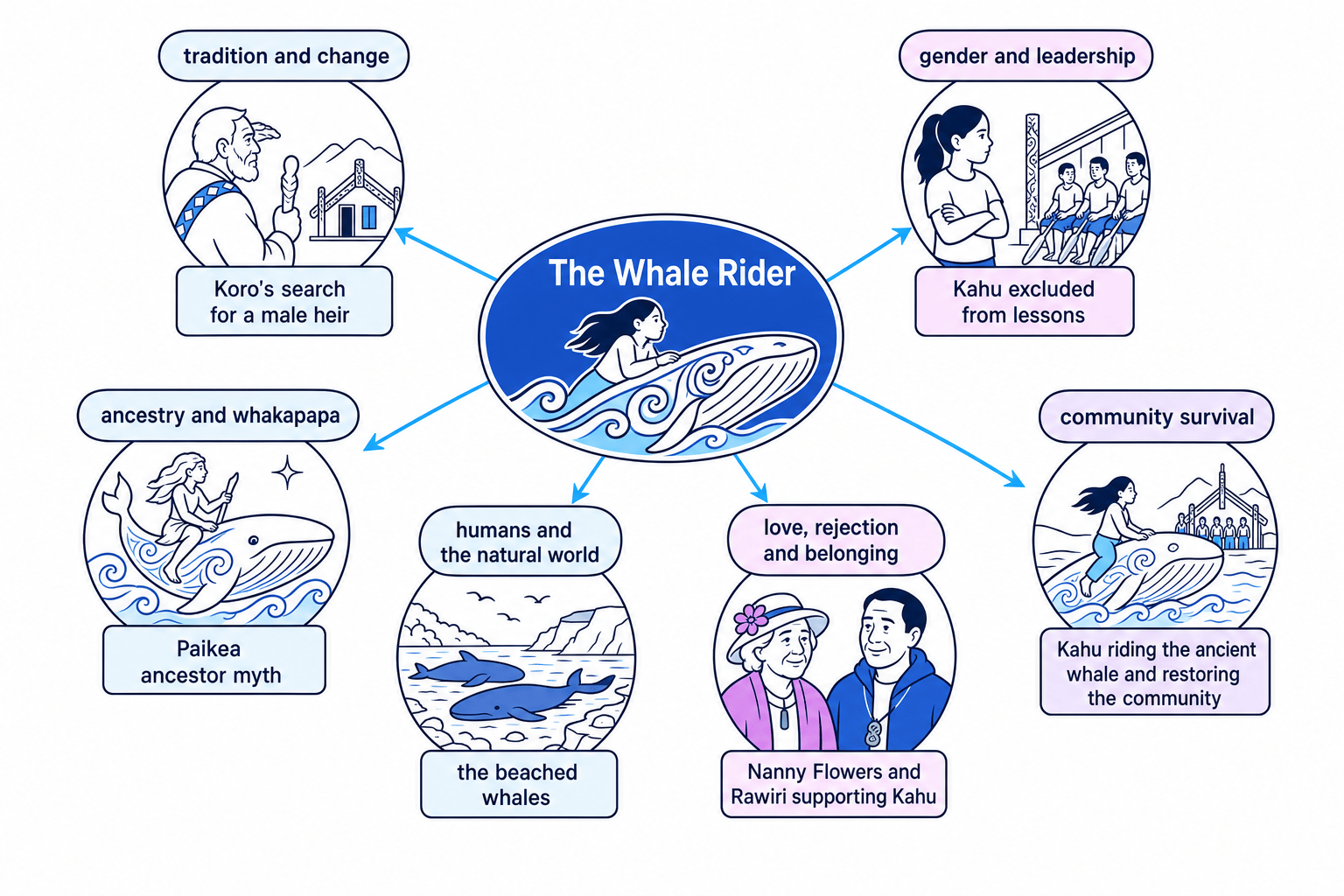
Turning a theme into an interpretation
- Start with the broad topic: gender and leadership.
- Connect it to a repeated pattern in the novel: Koro searches for a male successor, while Kahu repeatedly shows spiritual insight, courage and commitment.
- Choose a precise textual anchor: Kahu’s naming is described as “an outrage” because she is given the ancestral name “Kahutia Te Rangi”.
- Interpret the effect: the loaded noun “outrage” shows how Koro’s understanding of tradition is narrowed by gender expectations.
- Form a thematic argument: Ihimaera suggests that tradition survives not by excluding Kahu, but by recognising that she has inherited its deepest values.
Tradition, ancestry and whakapapa
Whakapapa
Whakapapa means genealogy or ancestral connection. In Māori culture, it links people to family, land, sea, ancestors and identity.
Tradition is central to the novel. Koro Apirana wants to protect the mana — the spiritual authority and prestige — of his people. His fear is that the old knowledge and leadership line will be lost.
However, Ihimaera does not present tradition as simple or fixed. Kahu is named after the ancestor “Kahutia Te Rangi”, also known as Paikea. This should connect her powerfully to whakapapa, but Koro sees the naming as “an outrage” because he expects the inheritor to be male.
This creates one of the novel’s key tensions: Kahu is both a challenge to Koro’s version of tradition and the fulfilment of a deeper tradition.
Method: myth and modern life
Ihimaera structures the novel by weaving together contemporary family life with the ancient Paikea legend. Structure means the way a text is organised. The movement between mythic whale sections and Rawiri’s family narrative shows that the past is not dead; it is still active in the present.
A motif is a repeated image or idea. The whale motif links Kahu to Paikea, to the sea, and to the survival of her community.
Writing about context
For AO4, do not bolt on a sentence like “Māori culture is important.” Instead, link context to meaning: whakapapa matters because Kahu’s identity and leadership come from ancestral connection, not from individual ambition.
Gender and leadership
Patriarchy
Patriarchy is a social system in which men hold most authority and power, often limiting women’s roles.
Koro’s tragedy is that he loves his people deeply but cannot see Kahu clearly. He believes leadership must pass through a male line, so Kahu’s gifts are dismissed before they are even understood.
Kahu is excluded from the formal spaces where boys are trained for leadership. Yet Ihimaera shows that leadership is not just public status or physical strength. Kahu’s leadership is based on love, courage, listening, sacrifice and spiritual connection.
This matters because Kahu does not reject her culture. She wants to belong to it. The novel therefore criticises gender exclusion, not Māori tradition itself.
Making Koro a simple villain
Do not write as if Koro is only cruel. A stronger answer sees him as conflicted: he is trying to protect his community, but his rigid expectations stop him recognising Kahu’s mana.
Change and cultural survival
The novel asks how a community can survive when the world is changing. Koro worries that the younger generation is losing touch with language, ritual, discipline and collective responsibility.
But Ihimaera suggests that survival requires adaptation. Kahu represents change, yet she is also the descendant who most deeply answers the call of the ancestors. This makes the ending feel restorative rather than rebellious: the community is renewed when it finally recognises her.
Māori Renaissance
The Māori Renaissance refers to the revival and strengthening of Māori language, arts, identity and political awareness in the late twentieth century. Ihimaera’s work belongs to this wider cultural movement.
In an exam, this context helps you explain why the novel values storytelling, genealogy and cultural memory. The Whale Rider is not just about one family; it is about a people trying to preserve identity while moving into the future.
Humans, whales and the natural world
The whales are not just animals in the plot. They are symbolic. Symbolism is when a person, object, place or creature represents a larger idea. The whales symbolise ancestry, spiritual knowledge, nature’s power and the bond between humans and the non-human world.
Rawiri reflects that “Man might carve his mark on the earth” but “Nature will take it all back”. The metaphor “carve his mark” suggests human pride and control, while the personification of “Nature” gives the natural world power and agency.
The beaching of the whales becomes a crisis for the whole community. It suggests that when humans lose spiritual balance, the natural world also suffers. Kahu’s ability to communicate with the whale shows that she understands a relationship others have forgotten.
Analysing nature as a theme
- Select the key contrast in the quotation: “Man” tries to “carve his mark”, but “Nature” can “take it all back”.
- Identify the method: “carve” is a metaphor for human control, while “Nature” is personified as an active force.
- Link method to meaning: Ihimaera presents nature as more powerful than human pride or social systems.
- Connect to the wider novel: the stranded whales turn this idea into action, forcing the community to confront its broken relationship with the natural and spiritual world.
- Link to theme: Kahu restores balance because she respects the whale as kin, not as an object.
Love, rejection and belonging
Kahu’s love for Koro is one of the emotional centres of the novel. Her affectionate name for him, “Paka”, shows intimacy and longing. She wants his approval, but she is repeatedly pushed away.
This creates pathos, which means a quality that makes the reader feel pity or tenderness. The pathos is powerful because Kahu is not trying to defeat Koro; she is trying to be seen by him.
Nanny Flowers and Rawiri help to balance Koro’s rejection. Through them, Ihimaera shows that belonging is sustained by everyday love, humour, patience and protection. Kahu’s final act is not motivated by ego. She risks herself for the whales and for the community that has not fully valued her.
Community, responsibility and renewal
The final whale-riding episode brings the themes together. The title, The Whale Rider, points backwards to Paikea and forwards to Kahu. By becoming the whale rider, Kahu proves that ancestral power can appear in an unexpected form.
The community’s survival depends on recognising her. This is why the ending is about more than Koro changing his mind. It is about a community learning to widen its understanding of leadership.
A strong thematic reading might say: Ihimaera presents renewal as a return to the deepest values of tradition — whakapapa, service, humility and connection — rather than a rejection of tradition.
Useful theme links for essays
| Theme | Textual anchor | What to say about it |
|---|---|---|
| Tradition and whakapapa | Kahu is named “Kahutia Te Rangi” | Her identity connects her to Paikea and ancestral authority. |
| Gender and leadership | The naming is “an outrage” to Koro | Koro’s patriarchal assumptions blind him to Kahu’s mana. |
| Nature and spirituality | “Nature will take it all back” | The natural world is powerful, sacred and morally significant. |
| Love and rejection | Kahu calls Koro “Paka” | Her love makes his rejection more painful and her courage more moving. |
| Renewal | The title The Whale Rider | Kahu fulfils the old story in a new form. |
In the exam
- Because Component 1 Modern Prose is closed book, memorise a small set of flexible quotations such as “the naming was an outrage”, “Kahutia Te Rangi” and “Nature will take it all back”.
- For a theme question, plan three stages: how the theme is introduced, how it develops through conflict, and how it is resolved or complicated at the end.
- Keep AO4 precise: link Māori concepts such as whakapapa, mana and cultural renewal directly to Ihimaera’s characters and choices.
Check yourself
- How does Kahu both challenge and continue tradition?
- Why is Koro’s attitude more complex than simple cruelty?
- How do the whales connect the themes of nature, ancestry and community survival?
