What you'll learn
- How Kahu, Koro Apirana, Nanny Flowers and Rawiri shape the novel’s central conflict.
- How Ihimaera presents character through names, family roles, actions, silence and symbolism.
- How to connect character analysis to Māori cultural context for Edexcel IGCSE modern prose.
- How to build closed-book character paragraphs using short, accurate textual references.
Starting point: characters in The Whale Rider
In The Whale Rider, characters are not just individuals with private feelings. They belong to whānau — extended family — and to an iwi — a Māori people or tribe. That means identity is strongly connected to ancestry, land, community and responsibility.
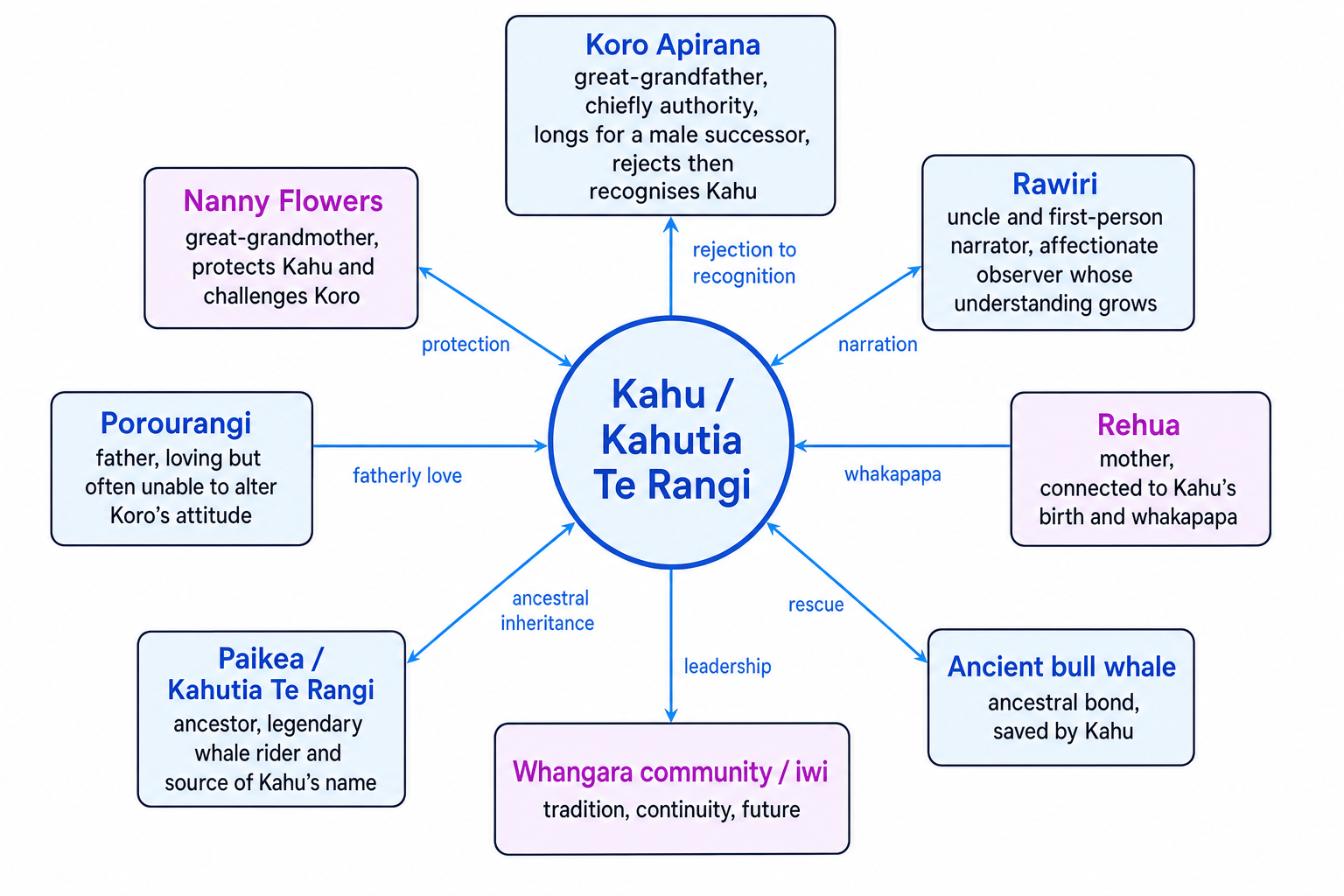
The main character conflict is simple to understand but rich to analyse: Kahu is the rightful future leader, but Koro Apirana cannot recognise her because she is a girl.
Characterisation
Characterisation means the methods a writer uses to create a character. This can include what the character says, what they do, how others describe them, what they symbolise, and how they change across the story.
The big character idea
Ihimaera presents leadership as something deeper than gender: true leadership comes from whakapapa, courage, love for the community and spiritual connection.
Kahu / Kahutia Te Rangi: the hidden leader
Kahu is the protagonist, meaning the central character whose story carries the main meaning of the novel. She is also the character who proves that tradition can survive by adapting.
Her full name, “Kahutia Te Rangi”, directly links her to the ancestral whale rider. This matters because names in the novel are not decorative: they carry history. Kahu is born into the line Koro values, but because she is a girl, he fails to see what her name already announces.
Whakapapa
Whakapapa means genealogy or ancestry. In the novel, whakapapa gives characters identity, responsibility and connection to the past.
Kahu is presented through a powerful contrast. On one level, she is an affectionate child who longs for Koro’s love and calls him “Paka”. On another level, she has a mysterious bond with whales and with the ancient story of Paikea. This makes her both ordinary and extraordinary.
Kahu’s key qualities
- Loving: she keeps reaching out to Koro even when he rejects her.
- Resilient: she is hurt by rejection but does not become bitter.
- Spiritually connected: her relationship with the whales suggests ancestral recognition.
- A natural leader: she acts when the community cannot save itself.
Analysing Kahu through her name
- Start with the evidence: Kahu’s full name is “Kahutia Te Rangi”, the name connected with the legendary whale rider.
- Identify the method: Ihimaera uses naming as symbolism. A symbol is something concrete that carries a deeper meaning.
- Explain the effect: the name suggests Kahu has inherited ancestral authority before Koro is ready to accept it.
- Link to context: because whakapapa is central to Māori identity, Kahu’s ancestry should make her significant despite Koro’s gender expectations.
- Link to the question: if asked about leadership, this shows that Ihimaera presents Kahu as the true heir from the beginning.
Calling Kahu just a victim
Kahu is hurt by Koro’s rejection, but she is not powerless. She is the character who ultimately acts, saves the whales and restores hope to Whangara.
Koro Apirana: tradition, authority and blindness
Koro Apirana is Kahu’s great-grandfather and the community’s elderly leader. He represents chiefly authority, cultural knowledge and commitment to tradition. However, he also represents the danger of interpreting tradition too narrowly.
Koro wants a male successor. His disappointment that Kahu is “a girl” shows how quickly he reduces her identity to gender. He values whakapapa, but he cannot see that Kahu’s whakapapa is meaningful because his idea of leadership is tied to the “male line”.
Character arc
A character arc is the pattern of change a character goes through across a text. Koro’s arc moves from rejection and blindness towards recognition and emotional humility.
Koro is not a simple villain. Ihimaera makes him more interesting than that. He loves his people and fears cultural loss. His mistake is that his fear makes him rigid. He searches for a future leader among the boys while ignoring the girl who already shows the qualities he wants.
Koro’s key qualities
- Traditional: he protects Māori knowledge, language and leadership structures.
- Patriarchal: he assumes leadership must be male.
- Proud: he struggles to admit he may be wrong.
- Loving but emotionally blocked: he cares deeply, yet cannot show Kahu acceptance until late in the novel.
Tracking Koro’s change
- At the start, Koro interprets Kahu’s birth as a disappointment because she is not male.
- In the middle, he trains boys and tests them, which shows his belief that leadership must come through the male line.
- Kahu quietly passes the deeper tests of leadership: love, courage, sacrifice and connection with the whales.
- By the end, Koro’s recognition of Kahu forces him to revise his understanding of tradition.
- Therefore, his character arc helps Ihimaera argue that culture survives not by excluding people, but by recognising where mana truly appears.
Mana
Mana means spiritual authority, prestige or power. In the novel, Kahu’s mana is shown through action and ancestral connection, not through age or gender.
Nanny Flowers: protection, humour and resistance
Nanny Flowers is Kahu’s great-grandmother and Koro’s wife. She is one of the novel’s most important balancing characters because she challenges Koro from inside the family.
She often brings humour into serious scenes, especially through her arguments with Koro. But her humour should not make you underestimate her. She protects Kahu, speaks back to male authority and reminds the reader that women also carry strength, knowledge and whakapapa.
Foil
A foil is a character whose contrast with another character makes both of them clearer. Nanny Flowers is a foil to Koro because her flexibility exposes his stubbornness.
Nanny’s role is especially useful in essays about gender. Koro sees Kahu’s femaleness as a problem; Nanny sees Kahu as family, as loved, and as capable. Through Nanny, Ihimaera shows that tradition itself contains female strength, even when some characters ignore it.
Writing about Nanny
Do not describe Nanny Flowers as only “comic relief”. Her humour is part of her power: she can challenge Koro without destroying the family bond.
Rawiri: narrator, uncle and witness
Rawiri is Kahu’s uncle and the novel’s first-person narrator for much of the story. A first-person narrator tells the story using “I”, so we experience events through that character’s perspective.
Rawiri matters because he is close enough to the family to understand its emotions, but not so central that he controls the conflict. He watches Kahu, Koro and Nanny, and his affection guides the reader’s response.
Rawiri also connects local Whangara life with a wider world. His travels and experiences help the novel explore Māori identity beyond one village. When he returns, he has a deeper understanding of home, belonging and cultural survival.
Explaining why Rawiri narrates Kahu’s story
- If Kahu narrated everything herself, the novel might feel like a simple personal story about rejection.
- By using Rawiri, Ihimaera gives us an observer who can describe Kahu’s innocence, Koro’s stubbornness and Nanny’s resistance from the outside.
- Rawiri’s perspective also creates warmth: he loves Kahu, so the reader is encouraged to value her before Koro does.
- This makes Koro’s blindness more frustrating, because the reader can see what he cannot.
- Therefore, Rawiri’s narration helps structure the novel around delayed recognition.
Porourangi and Rehua: family, absence and inheritance
Porourangi is Kahu’s father. He loves Kahu, but he cannot force Koro to accept her as the successor. This makes him important but not dominant: he shows that love exists around Kahu, even when the main authority figure rejects her.
Rehua, Kahu’s mother, is linked to Kahu’s birth and whakapapa. Even when she is less central in the action, her role reminds us that identity in the novel is inherited through family lines and relationships, not just through public leadership.
These characters help you avoid writing as if Kahu stands alone. She is part of a family system, and Ihimaera’s characterisation depends on that network.
Paikea, the whale and the community
The ancestor Paikea, also associated with Kahutia Te Rangi, is not a normal present-day character, but he is essential to how character works in the novel. His story gives Kahu’s life mythic significance.
The ancient bull whale also functions almost like a character. It remembers the ancestral bond between humans and whales, and its crisis becomes the community’s crisis. When Kahu saves the whale, she proves that she understands leadership as service and sacrifice.
Mythic parallel
A mythic parallel is when a modern character or event echoes an ancient story. Kahu parallels Paikea because her actions repeat and renew the whale-rider story.
The Whangara community is also a kind of collective character. Koro is not just worried about his own family pride; he fears for the survival of the people’s traditions. That is why the ending matters so much: Kahu’s recognition offers a future for the whole community.
How to write about characters in the exam
For Edexcel IGCSE, The Whale Rider is modern prose in Component 1, which is closed book. You need secure AO1 knowledge — clear understanding, relevant references and a personal response — and AO4 context, meaning the relationship between the text and Māori cultural ideas such as whakapapa, iwi, whānau, mana and leadership.
A strong paragraph does not just say what a character is like. It explains how Ihimaera presents them and why that presentation matters.
A useful paragraph pattern
Point → evidence → method → effect → context → link.
For example:
Ihimaera presents Kahu as the rightful future leader long before Koro accepts her. Her name, “Kahutia Te Rangi”, connects her to the ancestral whale rider, so naming becomes a form of symbolism. This creates dramatic irony because the reader can recognise Kahu’s importance while Koro continues searching elsewhere for a male heir. In the context of whakapapa, Kahu’s ancestry gives her authority, suggesting that Koro’s problem is not tradition itself but his limited interpretation of it. Through Kahu, Ihimaera shows that the future of Whangara depends on recognising mana wherever it appears.
In the exam
- Memorise a small set of flexible references: “Kahutia Te Rangi”, “Paka”, “a girl”, “male line”, plus one moment such as the stone test or the whale rescue.
- Avoid character summaries. For every point, explain how Ihimaera shapes your response through contrast, naming, narration, symbolism or character arc.
- Link context precisely: write about whakapapa, mana, whānau and leadership rather than vague comments like “Māori culture is traditional”.
Check yourself
- How does Kahu prove she is a leader before Koro recognises her?
- Why is Koro Apirana more complex than a simple antagonist?
- How does Rawiri’s narration influence the way you respond to Kahu?
