To truly understand The Whale Rider, you must look beyond the surface of its plot. Witi Ihimaera’s 1987 novel is deeply rooted in the cultural landscape of New Zealand (Aotearoa) and the struggles of the indigenous Māori people.
In your Edexcel IGCSE English Literature exam, The Whale Rider is assessed under Section C (Modern Prose). Here, you are marked on two Assessment Objectives: AO1 (your close knowledge, critical style, and personal response) and AO4 (your understanding of the relationship between the text and its context).
No AO2 in Section C!
Unlike other sections of the exam, Section C does not assess AO2 (language and structure analysis). You do not need to spend time analyzing metaphors or sentence structures. Instead, your focus must be on linking your thematic analysis (AO1) directly to the social, cultural, and historical context of the novel (AO4).
What you'll learn
- How the Māori Renaissance of the late twentieth century shaped Ihimaera's writing.
- The core Māori spiritual and social concepts (Whakapapa, Kaitiakitanga, Mana) that drive the novel's conflict.
- How the tension between traditional patriarchy and modern cultural survival is explored through Kahu and Koro Apirana.
- How to seamlessly weave this context into your essay responses to secure high marks.
The Māori Renaissance and Post-Colonial New Zealand
To understand why Ihimaera wrote The Whale Rider, we must look at the historical context of New Zealand in the mid-to-late twentieth century.
Māori Renaissance
The Māori Renaissance was a cultural revival movement that began in New Zealand in the 1970s. It sought to celebrate Māori identity, reclaim traditional land rights, protect the Māori language (Te Reo), and challenge the cultural dominance of European (Pākehā) colonizers.
Following British colonization in the nineteenth century, the Māori population faced systemic marginalization. Traditional lands were confiscated, and colonial policies actively suppressed Māori language and customs. By the mid-twentieth century, many Māori had migrated to cities, leading to a disconnection from their tribal roots (iwi), ancestral lands, and traditional ways of life.
Witi Ihimaera made history in 1973 as the first Māori writer to publish a novel in English (Tangi). He wrote The Whale Rider in 1987 while living in New York, prompted by a desire to write a story for his daughters that featured a strong female Māori protagonist. The novel is a direct product of the Māori Renaissance: it is a work of post-colonial literature designed to breathe new life into ancient mythologies while showing how indigenous cultures can adapt to survive in the modern world.
Core Māori Cultural Concepts
To write analytically about the novel, you must use accurate vocabulary to describe the spiritual and social systems of the Whāngārā community. The diagram below maps out how these concepts connect to the characters and thematic conflicts in the text.
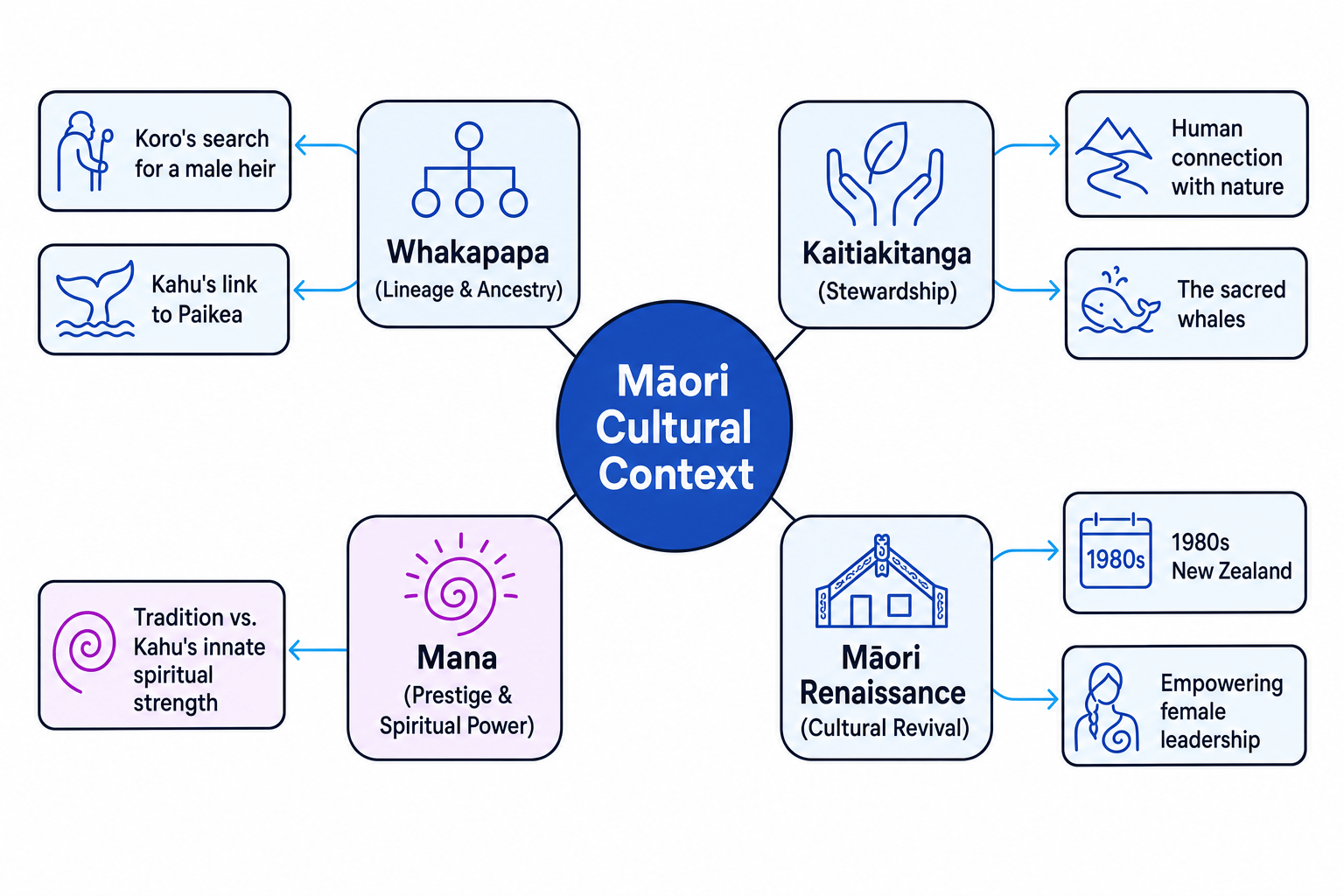
Whakapapa (Lineage and Genealogy)
Whakapapa is more than just a family tree; it is a sacred, living chain that links every individual back to the ancestors, the gods, and the earth itself. In the novel, the community’s identity is anchored to their founding ancestor, Paikea (the original Whale Rider).
Koro Apirana’s obsession with finding a male heir is driven by his fear that the whakapapa of leadership will be broken. He believes that only a first-born male can inherit this sacred lineage. Ironically, he overlooks Kahu, whose very name (Kahutia Te Rangi) directly links her to their legendary ancestor.
Kaitiakitanga (Guardianship)
Kaitiakitanga is the traditional Māori system of environmental guardianship. It reflects a belief that humans do not own the earth, but are caretakers of it, sharing a mutual kinship with all living things.
This is represented by the sacred relationship between the community and the ocean, particularly the ancient bull whale. When the whales beach themselves, it symbolizes a breakdown in this vital connection. Kahu’s ability to communicate with the whales and lead them back to the deep water demonstrates her role as a true kaitiaki (guardian).
Mana (Prestige, Authority, and Spiritual Power)
Mana is a supernatural force that gives a person authority, influence, and prestige. It can be inherited through birth (whakapapa) or earned through deeds, wisdom, and leadership.
Koro Apirana possesses immense mana as the chief, but his rigid adherence to tradition threatens to diminish it. In contrast, Kahu possesses an innate, spiritual mana that manifests through her extraordinary affinity with the natural world—such as retrieving Koro’s stone from the ocean floor.
Patriarchy vs. Cultural Adaptation
The central conflict of the novel lies in the clash between traditional Māori patriarchy and the modern need for cultural survival.
Traditionally, leadership (ariqi) within the tribe was passed down through male-only succession (primogeniture). Koro Apirana defends this rule fiercely because he believes that preserving the ancient customs exactly as they were is the only way to save his people from losing their identity. He views Kahu’s birth as a personal and cultural failure:
"I will have nothing to do with her... She is of no use to me."
However, Ihimaera uses the narrative to argue that culture must adapt to survive. By refusing to recognize Kahu's natural leadership qualities simply because she is female, Koro nearly dooms his community. Kahu represents the modern Māori Renaissance: she is deeply respectful of her heritage, yet her gender proves that the traditional patriarchal structures must evolve if the culture is to remain vital in a changing world.
The 'Anti-Tradition' Misinterpretation
Do not write that the novel is a total rejection of traditional Māori culture. Ihimaera does not want to destroy tradition; he wants to save it. Kahu’s ultimate victory is not that she defeats Koro's beliefs, but that she proves she is the perfect keeper of them. She is the bridge between the ancient past and the modern future.
Environmentalism and the Sacred Bond with Nature
Published in 1987, The Whale Rider was written during a decade of heightened environmental awareness and political tension in the Pacific.
During this era, the Pacific Ocean was being disrupted by nuclear testing (particularly by France at Mururoa Atoll) and industrial whaling. Ihimaera directly addresses this global context in the chapters written from the perspective of the ancient bull whale. The whale’s memories of "the sacred islands" are contrasted with the modern ocean of "underwater explosions" and toxic waste.
The beaching of the whales is not just a biological disaster; it is a spiritual warning. For the Māori, the degradation of the natural environment is directly linked to the degradation of human society. By saving the whales, Kahu heals both the ecological rift and the social rift within her own family.
Mastering the AO1 and AO4 Connection
In your essay, you must never write about context as a separate, detached history lesson. Every piece of context must be tied directly to a character's actions, a theme, or a specific moment in the text (AO1).
The Context Sandwich
When planning your paragraphs, try the "Context Sandwich":
- Make your thematic point (AO1).
- Support it with a precise quotation (AO1).
- Explain how the historical or cultural context explains the character's behavior or the writer's underlying message (AO4).
Here is how you can put this into practice.
Linking Māori patriarchy to Koro Apirana's conflict
Question: How does Witi Ihimaera present the character of Koro Apirana in The Whale Rider?
Step-by-step analysis:
- State your point clearly (AO1): Ihimaera presents Koro Apirana not as a cruel villain, but as a leader burdened by the immense responsibility of preserving his cultural heritage.
- Provide direct textual evidence (AO1): This pressure is seen in his desperate search for a male heir, which leads him to reject his great-granddaughter, stating that she is "of no use" because "disaster" will strike if a female takes leadership.
- Integrate the cultural context (AO4): This reaction is rooted in the traditional Māori custom of male-only leadership succession. In the late twentieth century, as Māori communities faced cultural erosion and assimilation into Pākehā society, chiefs like Koro felt a desperate urgency to preserve ancient protocols exactly as they were, fearing that any deviation would dilute their tribe's mana and lead to cultural extinction.
- Link back to the writer's wider message (AO1/AO4): Consequently, Koro's harshness toward Kahu is shown to be born of cultural fear rather than lack of love, illustrating the tragic tension of the Māori Renaissance: the struggle to balance a preservation of the past with the practical necessities of the modern world.
In the exam
- Never analyze language devices: Do not waste valuable time searching for similes, alliteration, or sentence structures. Focus your energy on exploring character motivations, thematic developments, and context.
- Memorize Māori terminology: Use terms like whakapapa, kaitiakitanga, and mana naturally in your writing. Correctly identifying these concepts shows examiners a sophisticated, culturally literate understanding of the text.
- Avoid context dumping: Do not write paragraphs of historical facts about New Zealand or the Māori without linking them back to a specific quote or character dynamic. Every contextual point must help explain the novel itself.
Check yourself
- How does the context of the Māori Renaissance explain why Witi Ihimaera chose a young girl (Kahu) as the heroic savior of her tribe?
- What is the difference between whakapapa and kaitiakitanga, and which characters represent these concepts most strongly?
- Why does the 1980s environmental context of the Pacific Ocean play such a crucial role in the sections of the novel told from the whale's perspective?
