What you'll learn
- The main events of The Whale Rider in a clear order.
- How the ancient story of Paikea connects to Kahu’s modern story.
- Why the plot is built around rejection, testing, crisis, and recognition.
- How to use plot knowledge in an Edexcel IGCSE closed-book essay without simply retelling the story.
Plot: more than “what happens”
Plot
Plot means the organised sequence of events in a story. It is not just “what happens”; it is how the writer arranges events to create conflict, tension, meaning, and change.
In The Whale Rider, Witi Ihimaera’s plot follows Kahu’s movement from being rejected as “a girl” to being recognised as the true heir to the tradition of “Kahutia Te Rangi”, the whale rider ancestor.
The novel is especially important for Edexcel IGCSE because The Whale Rider is a modern prose text in Component 1, which is closed book. That means you need a secure memory of the plot, but you should use it for analysis, not just summary.
The big plot pattern
The plot turns on a painful irony: Koro Apirana searches for a male leader, while the real future leader is already in front of him — Kahu.
The story at a glance
The modern plot is mostly chronological, meaning events generally move forward in time. However, Ihimaera also weaves in an ancient strand about Paikea and the whales.
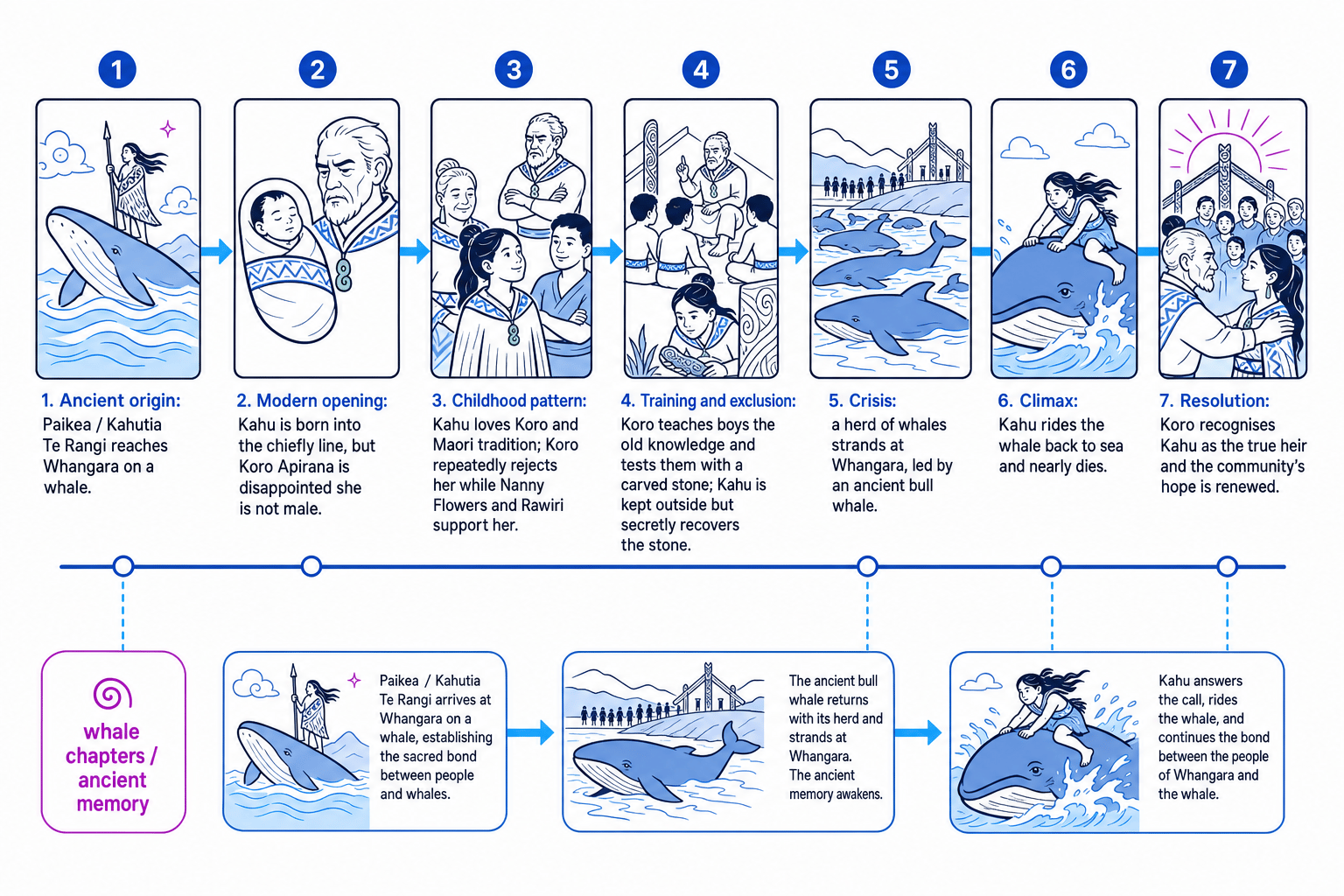
The ancestral beginning: Paikea and the whale
The novel begins by establishing the sacred history of Whangara. The ancestor Paikea, also known as “Kahutia Te Rangi”, comes to Aotearoa/New Zealand on the back of a whale.
This matters because Kahu is not just a clever child who happens to love whales. Her name, “Kahutia Te Rangi”, links her directly to the founding ancestor. The plot therefore asks whether the old tradition will be understood narrowly — through male inheritance — or more deeply, through spiritual connection and responsibility.
Whakapapa
Whakapapa is Māori genealogy: the line of descent connecting people to ancestors, land, tribe, and identity. In the novel, whakapapa makes leadership a cultural and spiritual responsibility, not just a family title.
Kahu’s birth: the central conflict begins
Kahu is born into the chiefly line of Whangara. Her father is Porourangi, and her mother is Rehua. Koro Apirana, the elderly tribal leader, hopes for a male heir who will continue the “male line”.
But Kahu is born female. This creates the main conflict of the novel.
Koro’s disappointment is not simply personal cruelty. It comes from his belief that tradition requires a boy. However, Ihimaera makes that belief look increasingly limited as Kahu grows and repeatedly shows the qualities Koro is searching for.
Conflict
Conflict is the central struggle in a text. It may be between characters, within a character, or between a character and society’s expectations.
In The Whale Rider, the main conflict is between Kahu’s natural spiritual authority and Koro’s refusal to accept female leadership.
Kahu’s childhood: love, rejection, and persistence
As Kahu grows up, she loves Koro deeply. She wants his approval and is drawn towards Māori language, ceremony, and ancestry.
Koro, however, repeatedly pushes her away. He does not fully see what the reader is invited to see: Kahu is the one with the strongest connection to the old world of Paikea and the whales.
Nanny Flowers and Rawiri are important here. Rawiri, Kahu’s uncle and the narrator, helps us see Kahu with warmth and sympathy. Nanny Flowers challenges Koro’s stubbornness and supports Kahu, often bringing humour and common sense into painful moments.
The emotional pattern is simple but powerful:
- Kahu reaches towards Koro.
- Koro rejects or ignores her.
- Kahu continues to love him.
- The reader becomes more aware that Koro is misreading the situation.
Koro’s school for boys: tradition becomes exclusion
Koro tries to train the next leader by teaching selected boys the old knowledge. This includes language, custom, discipline, and respect for whakapapa.
Kahu wants to learn too, but she is excluded because she is female. This is one of the clearest ways the plot turns tradition into a test: is tradition about protecting wisdom, or about keeping people out?
Kahu’s exclusion also builds tension. The reader knows she may be the most worthy learner, but Koro refuses to let her inside the circle.
Seeing Koro as only a villain
Do not write as if Koro is simply “bad”. He is loving, afraid, proud, and trapped by a narrow idea of inheritance. A stronger answer explains how his rejection of Kahu comes from his anxiety about cultural survival.
The carved stone test: Kahu proves herself quietly
Koro throws a carved stone into the sea as a test for the boys. The object represents the tribe’s mauri, or life force. The boys fail to retrieve it.
Kahu later succeeds. This is a major turning point, although Koro does not immediately understand its importance.
Symbolism
Symbolism is when an object, action, place, or character represents a larger idea. The carved stone symbolises the spiritual life and future of the community.
Reading the stone test
-
Identify the surface event: Koro creates a test for boys by throwing the carved stone into the sea, but the boys cannot recover it.
-
Connect the event to conflict: Koro thinks leadership must come through male inheritance, yet the plot shows that the boys he chooses do not have the necessary spiritual connection.
-
Analyse the symbol: because the stone represents the tribe’s mauri, Kahu’s recovery of it suggests she can restore or protect the community’s life force.
-
Link to the whole plot: this event foreshadows the climax, where Kahu again enters the sea and succeeds where others cannot.
The whale chapters: a second plotline
Alongside the human story, Ihimaera includes sections focused on the whales, especially an ancient bull whale connected to Paikea.
This creates a parallel narrative.
Parallel narrative
A parallel narrative is a second storyline that runs alongside the main plot. The two strands may seem separate at first, but they eventually connect.
The whale plotline gives the novel a larger, mythic scale. Kahu’s story is not just about one family. It becomes part of a sacred relationship between people, ancestors, land, sea, and whales.
The whale chapters also create foreshadowing.
Foreshadowing
Foreshadowing is when a writer plants hints about future events, making the ending feel meaningful rather than random.
Because the novel keeps returning to whales before the final crisis, Kahu’s ride does not feel like a sudden miracle. It feels prepared by the whole structure.
The crisis: the whales strand at Whangara
The plot reaches crisis when a herd of whales strands near Whangara. The community tries to save them. The event is both practical and spiritual: physically, the whales may die; symbolically, the tribe’s connection to its origins seems endangered.
Koro understands the crisis as a sign that something is wrong. Yet he still has not fully recognised Kahu.
This is where the novel’s two plotlines finally meet:
- the ancestral story of Paikea and the whale,
- the modern story of Kahu and Koro,
- the community’s fear for its future.
The climax: Kahu rides the whale
The climax is the most intense turning point of the plot. In The Whale Rider, this is Kahu’s ride on the whale.
Kahu climbs onto the ancient whale and rides it back out to sea. The action directly echoes Paikea’s original arrival. This is why the title phrase, “the whale rider”, comes to belong to Kahu as well as to the ancestor.
Her act saves the whales, but it nearly kills her. The plot makes leadership sacrificial: Kahu does not claim power for herself; she risks herself for her people and for the whales.
Climax
The climax is the moment of highest tension in a plot, when the central conflict reaches a decisive turning point.
Placing the whale ride in the structure
-
Compare the beginning and the climax: the novel opens with Paikea’s legendary whale ride, then later gives Kahu a matching action in the modern world.
-
Identify what changes: before the climax, Koro sees Kahu mainly as the wrong gender for leadership; after it, he must face evidence that she carries the ancestral connection.
-
Explain the effect: the structure makes Kahu’s authority feel both personal and inherited, joining modern courage to ancient tradition.
The resolution: Koro recognises Kahu
The resolution is the part of the plot after the climax, where the main conflict is given an outcome.
Kahu survives, though she has been badly endangered. Koro finally recognises that he was wrong to reject her. The future of the community is no longer imagined only through a male heir.
This does not mean the novel ends with every problem magically solved. Instead, it offers a hopeful correction: tradition can survive by becoming more open, not by becoming more rigid.
Resolution
The resolution is the closing stage of a plot, where the consequences of the climax are shown and the main conflict is settled or redirected.
How to remember the plot for essays
A helpful memory chain is:
Ancestor → birth → rejection → learning → test → whales → ride → recognition
This gives you enough structure to answer most plot-based questions without retelling every chapter.
Closed-book memory chain
For Component 1, memorise a few short anchors: “Kahutia Te Rangi”, the “male line”, the carved stone/mauri test, the whale stranding, and Kahu as “the whale rider”. These help you prove close knowledge without needing long quotations.
Turning plot into analysis
In an essay, plot knowledge supports AO1, which means close knowledge, understanding, and a clear personal response. But the best answers do not just narrate events.
You should connect plot moments to Ihimaera’s methods: structure, symbolism, foreshadowing, contrast, and narrative perspective.
For example, instead of writing:
Kahu is rejected, then she rides the whale, and Koro accepts her.
Write more analytically:
Ihimaera structures Kahu’s story as a movement from exclusion to recognition. Koro’s obsession with the “male line” blinds him to Kahu’s inherited connection to “Kahutia Te Rangi”, so the final whale ride becomes both a rescue and a revelation.
That second version still uses plot, but it explains meaning and writer’s craft.
In the exam
-
Use plot events as evidence, but always explain what they reveal about character, tradition, gender, or community.
-
Avoid retelling the whole novel. Choose two or three key moments and analyse how Ihimaera positions them in the structure.
-
Remember that The Whale Rider is closed book in Component 1, so learn short, accurate anchors rather than trying to memorise long passages.
Check yourself
- Why is Kahu’s name, “Kahutia Te Rangi”, important to the plot?
- How does the carved stone test prepare us for the final whale ride?
- In what way does Koro change by the resolution?
