What you'll learn
- The basic plot and setting of Witi Ihimaera’s The Whale Rider.
- How the novel combines myth, family drama and Māori cultural identity.
- The main conflicts you should keep in mind for Edexcel IGCSE essays.
- How to turn an overview into analytical points about method, meaning and context.
First: what kind of text is The Whale Rider?
The Whale Rider is a short modern prose text by Witi Ihimaera, a Māori writer from Aotearoa New Zealand. It is set mainly in Whangara, a coastal Māori community, and follows Kahu, a young girl descended from the legendary ancestor Paikea, also known as “Kahutia Te Rangi”.
At its simplest, the story asks: who is allowed to inherit tradition, and what happens when the future arrives in an unexpected form?
Novella
A novella is a prose fiction text shorter than most novels but longer and more developed than a short story. Because it is compact, every major event, symbol and relationship in The Whale Rider is carefully chosen.
This diagram gives you the “big picture” before we slow everything down.
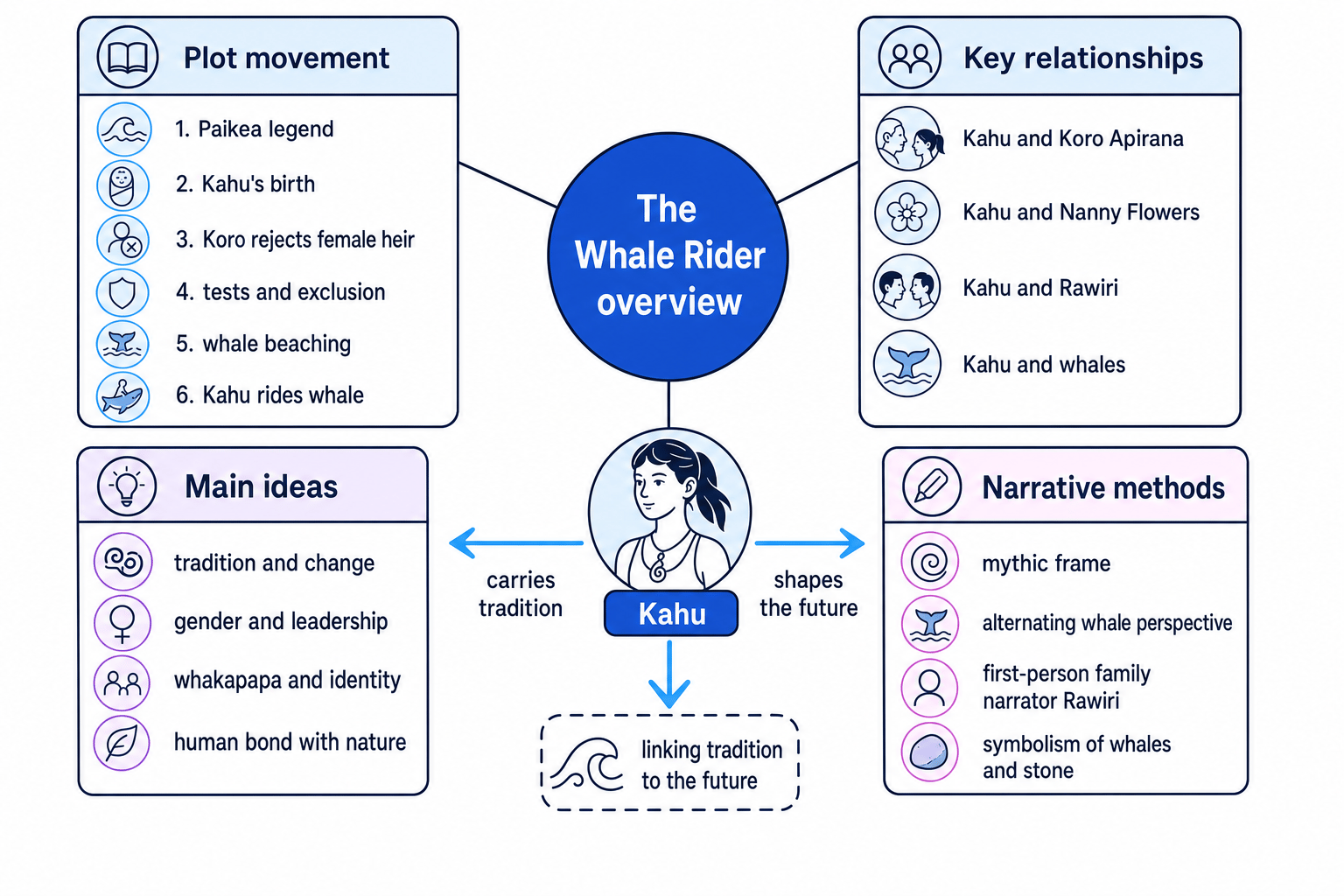
The core story in one paragraph
Kahu is born into a chiefly line connected to Paikea, the ancestral whale rider. Her great-grandfather, Koro Apirana, wants a male successor to lead the people and preserve their traditions. Because Kahu is a girl, he cannot recognise her importance, even though she loves him deeply and shows a powerful spiritual connection with whales. When a group of whales beach themselves, Kahu’s act of riding the ancient whale back to sea proves that she is the true inheritor of the tradition Koro has been trying to protect.
The central idea
The novella does not reject tradition. Instead, it suggests that tradition survives when people are brave enough to recognise it in new forms.
The Māori world of the text
The novel is rooted in Māori culture. Māori are the Indigenous people of Aotearoa New Zealand. Ihimaera’s setting is not just a background; it shapes the characters’ sense of duty, ancestry, language and belonging.
Whakapapa
Whakapapa means genealogy or ancestry: the network of family connections linking people to ancestors, land, community and identity. In The Whale Rider, Kahu matters because she is part of this ancestral line.
The name “Kahutia Te Rangi” is important because it connects Kahu to Paikea, the original whale rider. Her identity is not only personal; it is historical and spiritual. This is why Koro’s rejection of her is so painful: he is trying to preserve the past, but he fails to see that the past is already alive in Kahu.
Myth
A myth is a traditional story that explains origins, values or sacred relationships. In literature, “myth” does not mean “untrue”; it means a story that carries cultural meaning.
Why context matters
For Edexcel IGCSE, The Whale Rider is studied as modern prose in Component 1, Section C. This section is closed book, so you need secure knowledge of plot, characters and short quotations.
Context is assessed through AO4, which means you should connect the text to relevant ideas about society and culture. For this novella, useful context includes:
- Māori ancestry, leadership and cultural survival.
- The impact of modern change on traditional communities.
- Gender expectations within leadership.
- The relationship between humans, nature and the spiritual world.
Do not bolt context on at the end of a paragraph. Link it directly to Ihimaera’s choices.
Connecting myth to meaning
-
Start with the detail that Kahu is named “Kahutia Te Rangi”, linking her to the ancestral figure Paikea.
-
Connect that name to the wider idea of whakapapa: Kahu’s identity is shaped by ancestry, not just by her age or gender.
-
Compare this with Koro’s belief that leadership should pass through a male line; this creates tension because he values ancestry but misreads who truly carries it.
-
Link to meaning: Ihimaera uses myth to show that tradition is living and flexible, not a fixed rulebook.
Plot shape: from exclusion to recognition
A strong overview of plot helps you avoid vague essays. Think of the novella’s structure as a movement from misrecognition to recognition.
Structure
Structure means how a writer organises a text: the order of events, shifts in perspective, repeated patterns, contrasts and turning points.
1. Exposition: the world and the problem
The opening establishes the legendary world of Paikea and the present-day community of Whangara. Kahu’s birth creates the central problem: she belongs to the leadership line, but Koro wants a boy.
2. Rising action: Kahu is excluded
Koro teaches boys about Māori traditions and leadership, but he refuses to include Kahu fully. This exclusion builds tension because the reader increasingly understands that Kahu has the qualities Koro is searching for.
3. Crisis: the whales beach themselves
The whale beaching is both a practical emergency and a symbolic crisis. The community’s ancestral connection to the whales seems broken or endangered.
4. Climax: Kahu rides the whale
Kahu’s ride is the moment when myth and modern life meet. The child Koro underestimated becomes the figure who restores balance.
5. Resolution: Koro finally understands
Koro’s recognition of Kahu does not simply “solve” everything, but it marks a major change. The future of the community can now include both tradition and adaptation.
Climax
The climax is the most intense turning point in a story, where the central conflict reaches its peak and something decisive happens.
Plot is not enough
In an essay, do not retell the plot for its own sake. Use plot moments to explain Ihimaera’s ideas about ancestry, gender, leadership and change.
Narrative voice and viewpoint
The story is mainly narrated by Rawiri, Kahu’s uncle. A narrator is the voice that tells the story. Because Rawiri is part of the family, the narration feels personal, affectionate and sometimes humorous.
But the novella also includes more mythic passages connected to the whales and the ancestral past. This gives the text two important layers:
- a realistic family story about Kahu, Koro, Nanny Flowers and Rawiri;
- a spiritual and legendary story about Paikea, whales and ancestry.
Narrative perspective
Narrative perspective means the position from which a story is told. It affects what the reader knows, how close we feel to characters, and how we judge events.
This mixed perspective helps make Kahu seem both ordinary and extraordinary. She is a child in a family, but she is also linked to the sacred role of the “whale rider”.
Dramatic irony: the reader sees what Koro cannot
Dramatic irony
Dramatic irony happens when the reader or audience understands something important that a character does not.
Koro searches for a male leader, but the title, the mythic frame and Kahu’s name all point towards her importance. This makes his blindness frustrating but also tragic: he is not stupid or cruel in a simple way; he is limited by the expectations he has inherited.
Making Koro a simple villain
Do not write that Koro “hates” Kahu. A stronger interpretation is that he loves his culture so intensely that fear makes him unable to recognise Kahu’s value until the end.
Main conflict: tradition and change
The central conflict is not “old culture versus modern life” in a simple way. Koro is right to care about preserving Māori identity, language and leadership. The problem is that his idea of preservation is too narrow.
Patriarchy
Patriarchy is a social system in which men hold most authority and leadership is usually associated with masculinity.
Koro’s patriarchal thinking means he assumes the future leader must be male. Kahu challenges this, not by rejecting tradition, but by fulfilling it more deeply than anyone expects.
Kahu’s role
Kahu represents renewal. She shows that cultural inheritance is not weakened by change; it can be strengthened when a community expands who it is willing to recognise.
Symbols to know from the overview
Symbol
A symbol is a person, object, creature, place or action that has a deeper meaning beyond its literal role in the story.
The whales
The whales symbolise ancestry, spiritual connection and the health of the community. When the whales are in danger, the community’s bond with its origins is also under pressure.
The whale ride
Kahu’s ride symbolises the return of the Paikea story in a new generation. It is the clearest moment when myth becomes present reality.
The sea
The sea is a boundary between the human world and the spiritual or ancestral world. It can seem dangerous, but it is also a source of identity and renewal.
The stone Koro throws into the sea
Koro’s test is meant for boys, but Kahu’s involvement shows that she can recover what others cannot. Symbolically, she retrieves the tradition from the place where Koro has hidden it from her.
Turning a symbol into analysis
-
Choose the symbol: the whales are not just animals; they are linked to Paikea and the community’s ancestral identity.
-
Connect the plot moment to theme: when the whales beach, the crisis suggests a damaged relationship between people, nature and tradition.
-
Add method: Ihimaera uses symbolism and structure by placing the whale crisis near the climax, so the community’s problem becomes urgent and visible.
-
Link to Kahu: her ride restores the connection, showing that the future of tradition depends on recognising her spiritual authority.
How to write about the overview in an essay
For The Whale Rider, your best paragraphs will usually combine:
- a clear argument about Ihimaera’s message;
- brief textual reference, such as “Kahutia Te Rangi” or “whale rider”;
- method, such as symbolism, structure, narrative perspective or mythic framing;
- context, especially Māori whakapapa, leadership and cultural survival.
A useful analytical sentence might look like this:
Ihimaera presents Kahu as the unexpected inheritor of tradition through her name, “Kahutia Te Rangi”, which links her directly to Paikea; this mythic reference creates dramatic irony because Koro searches for a male successor while the true “whale rider” is already within his own family.
Notice how that sentence does more than retell the story. It links evidence, method, effect and meaning.
In the exam
-
Begin with a clear argument about the whole novella, such as: Ihimaera shows that tradition survives by adapting.
-
Use short, accurate references because Component 1 modern prose is closed book; learn key names, symbols and a few precise phrases.
-
Keep linking method to meaning: if you mention myth, symbolism or narrative perspective, explain how it shapes the reader’s understanding of Kahu, Koro and Māori identity.
Check yourself
-
Why is Kahu’s name “Kahutia Te Rangi” so important to the overview of the novella?
-
How does Koro’s desire to protect tradition become part of the problem?
-
What do the whales symbolise beyond their literal role in the plot?
