Writing a high-scoring essay on John Steinbeck’s Of Mice and Men for your Pearson Edexcel IGCSE English Literature exam requires more than just knowing what happens in the story. Because this is a closed-book exam (Component 1, Section C), you must show deep textual knowledge, construct a persuasive argument, and seamlessly weave in historical context.
This guide will show you how to move from a basic summary to a sophisticated, exam-ready model essay.
What you'll learn
- How the Pearson Edexcel assessment objectives (AO1 and AO4) apply to your essay.
- The PEACL paragraph structure designed specifically for Section C.
- How to transform isolated historical facts into integrated contextual analysis.
- How to draft a high-scoring analytical paragraph under timed conditions.
Understanding the Rules of the Game
To secure a Level 5 (the highest mark band), you must understand exactly how your essay is evaluated. In Component 1, Section C, you are assessed on two specific Assessment Objectives (AOs):
Assessment Objectives (AO1 & AO4)
- AO1: Demonstrate a close knowledge and understanding of the prose text, maintaining a critical style and presenting an informed personal response. This must be backed up by precise textual references (quotations).
- AO4: Explore the relationship between the text and the context in which it was written (historical, social, and cultural settings).
These two elements are not graded separately; they must work together. Your historical context must explain why a character behaves a certain way or why Steinbeck uses a particular literary method.
The Golden Ratio
In your Of Mice and Men essay, AO1 holds 60% of the marks and AO4 holds 40%. This means you must never write a pure history essay or a pure character analysis. Every historical fact must explain a character's choice, and every character analysis must be anchored in the realities of 1930s America.
Structural Architecture: The PEACL Paragraph
Many students struggle to organise their thoughts under timed conditions. To ensure you hit both AO1 and AO4 in every single body paragraph, use the PEACL structural model.
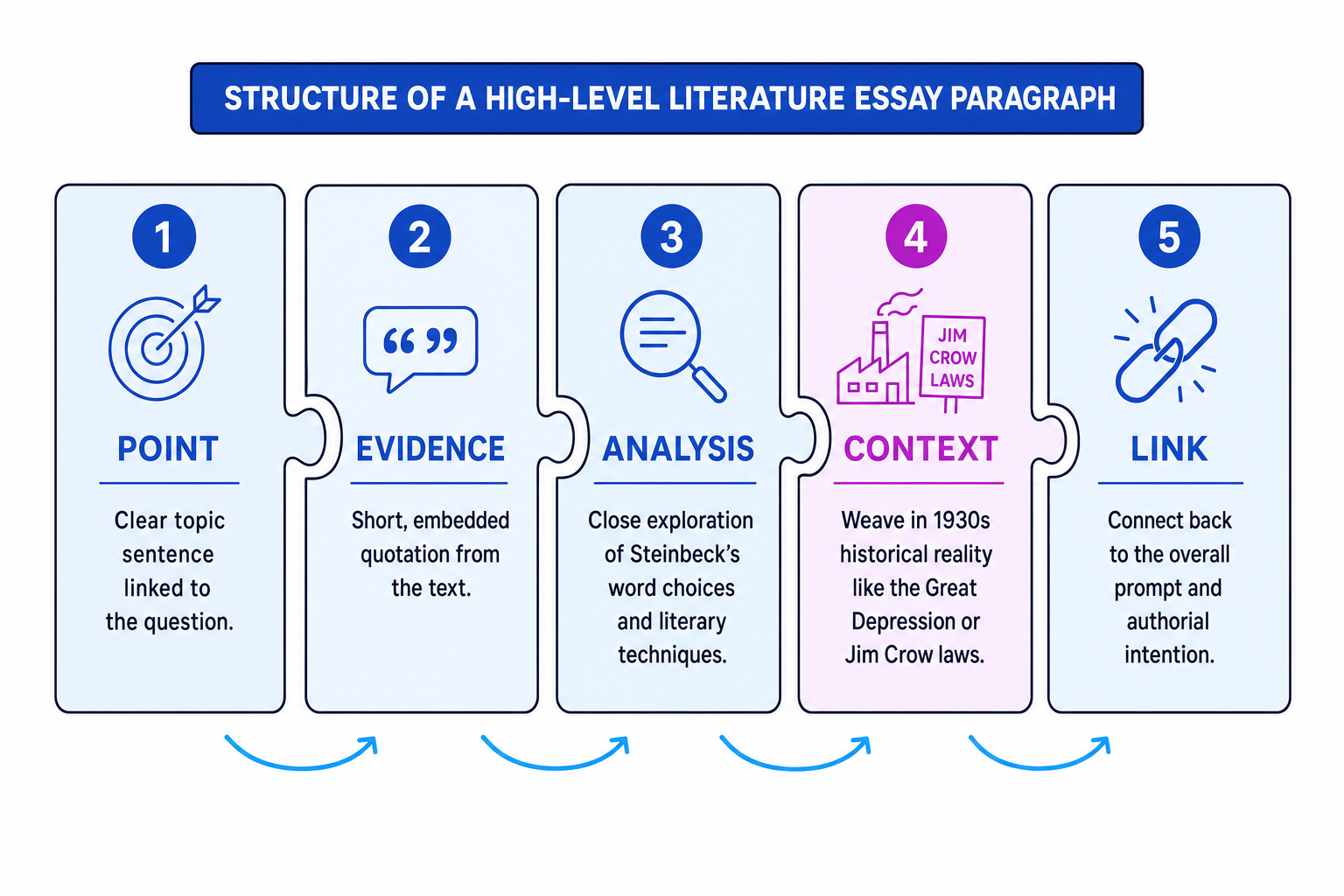
1. Point (AO1)
Begin with a clear, argumentative topic sentence. This sentence must directly answer the exam prompt and focus on an idea or theme rather than just a plot point.
2. Evidence (AO1)
Introduce a short, precise quotation. Since this is a closed-book exam, you must memorise these in advance. Keep them under six words and embed them directly into your own sentence flow.
3. Analysis (AO1)
Deconstruct Steinbeck’s craft. Look at specific word choices, literary techniques (such as foreshadowing, animal imagery, or symbolism), and the effect they have on the reader.
4. Context (AO4)
Connect your analysis directly to the historical, social, or cultural realities of the 1930s. Explain how the Great Depression, the Dust Bowl, Jim Crow laws, or the marginalisation of vulnerable groups shaped Steinbeck’s characters.
5. Link (AO1)
Conclude the paragraph by linking your point back to the overall essay question and Steinbeck’s overarching moral purpose. Ask yourself: What is Steinbeck trying to teach his contemporary reader through this?
Embedding Quotations
Never write "A quote that shows this is..." Instead, weave the quote into your natural sentence structure.
- Poor: Crooks is lonely. "A guy goes nuts if he ain't got nobody."
- Excellent: Crooks highlights the psychological toll of forced isolation, warning that "a guy goes nuts" without human companionship.
Draft Workshop: Building an Analytical Paragraph
Let us walk through how to build a high-level paragraph using this method.
We will use the following practice prompt: Explore how Steinbeck presents the theme of loneliness through the character of Curley's wife.
Developing a Level 5 PEACL paragraph
- Formulate a thesis-driven point (AO1): Draft a topic sentence that addresses how her isolation is a direct consequence of her gender and societal role.
- Drafting: Steinbeck presents Curley’s wife as a deeply isolated figure whose loneliness is reinforced by the hostile, patriarchal environment of the ranch.
- Integrate precise textual evidence (AO1): Select a short, powerful quotation that captures her search for connection.
- Drafting: She confesses her desperation to Lennie, asking, "think I don't like to talk to somebody once in a while?"
- Analyse Steinbeck's language and methods (AO1): Examine the tone, punctuation, and structural placement of this quote.
- Drafting: The rhetorical question and the defensive, colloquial phrasing "think I don't" highlight her desperation and lack of regular human contact. Her confession to Lennie—a man she knows is intellectually disabled—reveals that she is so starved of interaction she will confide in anyone who will listen, highlighting her profound emotional neglect.
- Weave in relevant historical context (AO4): Explain how this reflects the lives of women in 1930s America.
- Drafting: This isolation reflects the strictly patriarchal structure of 1930s depression-era America. Women on agricultural ranches were often treated as domestic property rather than individuals, a status reinforced by her lack of a personal name in the novella. She is defined solely by her marital connection to Curley, rendering her socially invisible and confined to her home.
- Link back to the essay prompt and Steinbeck's message (AO1/AO4): Summarise how this point answers the question and reveals the author's purpose.
- Drafting: Ultimately, through her tragic isolation, Steinbeck criticises a capitalistic, male-dominated society that strips vulnerable individuals of their identity and denies them basic human companionship.
Putting It Together: The Full Model Excerpt
If we join these five steps together, we get a cohesive, high-scoring essay paragraph:
Steinbeck presents Curley’s wife as a deeply isolated figure whose loneliness is reinforced by the hostile, patriarchal environment of the ranch. She confesses her desperation to Lennie, asking, "think I don't like to talk to somebody once in a while?" The defensive rhetorical question and colloquial phrasing highlight her deep-seated neglect and emotional starvation. Her choice to confide in Lennie—someone she knows cannot fully process her words—demonstrates that she is so desperate for human contact that she will accept any listener, regardless of their capability to understand. This profound isolation reflects the patriarchal structure of 1930s depression-era America, where women were frequently isolated on rural agricultural ranches and viewed as domestic property. This societal marginalisation is structurally reinforced by Steinbeck’s decision to leave her nameless throughout the novella; she is defined only as a possession of her husband. Through her tragic isolation, Steinbeck exposes the cruelty of a highly individualistic society that strips vulnerable people of their identity and denies them the fundamental human need for companionship.
Avoiding Common Pitfalls
When writing under timed conditions, it is easy to make mistakes that limit your grade. Watch out for these common errors:
Context Dumping
Many students memorise historical facts (such as the Wall Street Crash of 1929 or the migration from the Dust Bowl) and write a whole paragraph on history without linking it back to the text. This is called "context dumping" and will limit your mark. Context (AO4) must always serve to explain the text (AO1).
Context is the Lens, Not the Picture
Think of historical context as a pair of glasses. You don't write an essay describing the glasses themselves; you use the glasses to look at the picture (the novel) more clearly.
The Trap of the Named Character
In an essay about loneliness, do not write a separate paragraph for every lonely character. This makes your essay feel like a list. Instead, group your paragraphs by thematic ideas. For example, write one paragraph on "spatial loneliness" (isolation caused by physical segregation, like Crooks), and another on "relational loneliness" (isolation within a group, like Curley's wife or Candy).
In the exam
- Spend 5 minutes planning: Write down a quick thesis statement and select 3 main points. Beside each point, write down the 2-3 short quotes you will use.
- Unpack the question: Circle the key terms in the prompt. If the question asks about "dreams," make sure every single paragraph mentions the word "dream" or "hope" to keep your argument focused.
- Vary your context: Do not just talk about the Great Depression in every paragraph. Show the examiner your range by discussing migrant labor patterns, the economic displacement of elderly workers (Candy), racism under Jim Crow (Crooks), and the domestic isolation of women.
- End with authorial intent: In your conclusion, always address why Steinbeck wrote this book. He wanted to show the world the structural failures of American society during the Great Depression. Ensure this message comes through clearly.
Check yourself
- Can you explain why John Steinbeck chose to leave Curley's wife nameless, linking this choice to both AO1 (literary method) and AO4 (1930s context)?
- Are your memorised quotations short enough (under 6 words) to be naturally integrated into any sentence?
- Does your topic sentence state an analytical argument, or does it simply state a plot fact?
