What you'll learn
- How to turn a question on The Whale Rider into a clear argument.
- How to build paragraphs using point → evidence → method → effect → link.
- How to weave Māori cultural context into your analysis without bolting it on.
- How to use model essays as patterns, not scripts to memorise.
The job of a model essay
A model essay is not something you copy. It is a guide to the moves a strong answer makes: focusing on the question, choosing precise evidence, explaining meaning, and linking context to interpretation.
Model essay
A model essay is an example response that shows you how to structure, develop and support an argument. For The Whale Rider, it should show strong AO1 skills — knowledge, understanding, textual references and a critical style — and strong AO4 skills — explaining how context shapes meaning.
The Whale Rider is studied in Component 1, Section C: Modern Prose. This section is closed book, meaning you will not have a copy of the novel in the exam. Your quotations must be short, secure and accurate.
Your target
A high-quality essay on The Whale Rider argues about Ihimaera’s ideas — tradition, leadership, gender, ancestry and community — rather than simply retelling what happens.
A strong essay keeps every paragraph pulled back to the question focus.
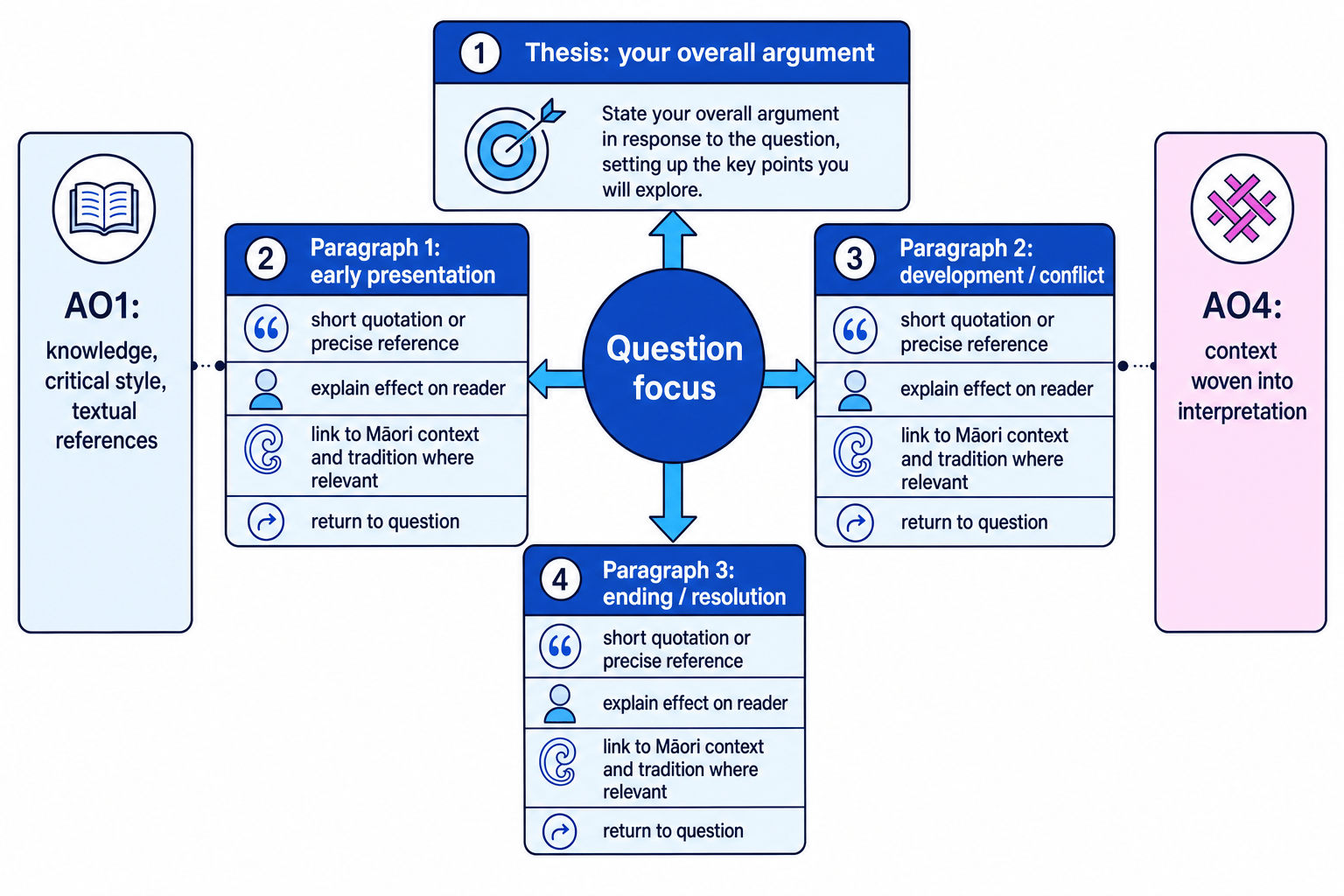
Step 1: Turn the prompt into a thesis
A thesis is your overall answer to the question. It should be arguable, not obvious. A line of argument is the way your paragraphs develop that thesis from beginning to end.
Thesis, line of argument and textual reference
- A thesis is your main interpretation in one or two sentences.
- A line of argument is the logical journey of your essay.
- A textual reference is either a short quotation or a precise reference to a moment in the novel.
For The Whale Rider, a weak thesis might say: “Kahu is important in the novel.” That is true, but too general. A stronger thesis explains how and why she matters.
Planning an essay on Kahu and Koro
Use the prompt: Explore how Ihimaera presents the relationship between Kahu and Koro.
-
Decide the central tension: the relationship is loving but painful, because Kahu adores Koro while Koro’s belief in male inheritance prevents him from recognising her value.
-
Choose the essay’s journey: begin with Koro’s rejection of Kahu at birth, move to Kahu’s repeated attempts to win his love, and end with Koro’s recognition after the whale crisis.
-
Connect context to the conflict: Koro’s anxiety comes from ideas about whakapapa — genealogy or descent — and inherited leadership, but Ihimaera challenges a narrow, patriarchal version of that tradition.
-
Draft the thesis: Ihimaera presents Kahu and Koro’s relationship as emotionally painful but ultimately healing, showing that tradition can survive only when it recognises love, spiritual insight and female leadership.
Step 2: Choose closed-book evidence carefully
Because the exam is closed book, you do not need long quotations. You need brief fragments that you can embed accurately.
Good evidence clusters for model essays include:
- Koro’s rejection of Kahu: “I will have nothing to do with her” and the phrase “male line of descent”.
- Kahu’s devotion: her repeated “I love you, Paka”.
- Kahu’s hidden authority: retrieving the stone Koro throws into the sea.
- The final whale crisis: Kahu’s connection with the ancient whale and with the ancestor Kahutia Te Rangi.
- The title, The Whale Rider, which links Kahu to Paikea and to renewal of the tribe.
Do not try to memorise whole paragraphs from the novel. Short quotations are easier to remember and easier to analyse.
Short quotations are powerful
A fragment like “male line of descent” can support a whole paragraph if you explain how it reveals Koro’s beliefs about gender, ancestry and leadership.
Step 3: Weave in context
Context means the circumstances, beliefs and cultural ideas that help shape the text. For this novel, the most useful context is not random biography; it is the Māori cultural framework Ihimaera places at the centre of the story.
Important contextual terms:
- Whakapapa means genealogy, ancestry or lines of descent.
- Mana means authority, prestige, spiritual power or honour.
- Patriarchy means a social structure where men hold most power.
- Māori oral tradition includes ancestral stories passed through storytelling, song and communal memory.
The best essays use context to deepen interpretation. Do not write a separate paragraph saying “Māori culture is important.” Instead, attach context to a specific moment, character or theme.
Weaving context into analysis
-
Start with the textual detail: Koro objects to Kahu because she disrupts the “male line of descent”.
-
Add the relevant context: leadership in the novel is linked to whakapapa, so Koro sees inheritance as a sacred duty, not just a family preference.
-
Interpret Ihimaera’s purpose: the novel respects Māori tradition, but challenges Koro’s assumption that leadership must be male.
-
Shape the analytical sentence: Koro’s focus on the “male line of descent” shows how his reverence for whakapapa has become limited by patriarchy, so Kahu’s eventual recognition feels like a renewal of tradition rather than a rejection of it.
Step 4: Build analytical paragraphs
A topic sentence is the first sentence of a paragraph, stating the paragraph’s main point. A method is a writer’s choice, such as symbolism, contrast, narrative structure or motif. A motif is a repeated image or idea; in this novel, whales form a central motif linking past and present.
Use this paragraph shape:
- Point — answer the question directly.
- Evidence — embed a short quotation or precise reference.
- Method / meaning — explain Ihimaera’s choice.
- Effect / context — connect to reader response and Māori context.
- Link — return to the question.
Model paragraph
Ihimaera first presents Kahu’s importance through Koro’s refusal to see it. At her birth, his rejection — “I will have nothing to do with her” — is linked to his fear that she has interrupted the “male line of descent”. This makes the conflict larger than one family argument: Koro believes he is protecting the tribe’s whakapapa and future leadership. However, the harshness of the rejection makes the reader question whether his loyalty to tradition has become too narrow. Ihimaera therefore presents Kahu as important from the beginning because she exposes the limits of a patriarchal understanding of mana, before proving that spiritual authority can exist in a girl.
Notice that this paragraph does not just say Koro is mean. It gives a more mature interpretation: Koro is wrong, but his wrongness grows out of fear for his people and their future.
Making Koro a simple villain
Avoid writing as if Koro is only cruel. A stronger essay recognises that he loves his people and feels responsible for their survival, but his belief in male leadership blinds him to Kahu’s mana.
A model essay plan: Kahu’s importance
Use this as a flexible pattern for questions about Kahu, leadership, gender or tradition.
Possible thesis
Ihimaera presents Kahu as the child who restores the tribe’s connection to its ancestral past while also moving it towards a more inclusive future. Through Koro’s rejection of her, Kahu’s persistent love, and her final connection with the whale, the novel shows that true leadership depends on mana and service, not simply gender.
Paragraph 1: Kahu is rejected because she is female
Start with Koro’s response to her birth. Use “I will have nothing to do with her” and “male line of descent”. Explain that Kahu is important because she immediately challenges Koro’s assumptions about inheritance and authority.
Paragraph 2: Kahu’s love reveals her strength
Use “I love you, Paka” to show her emotional loyalty. Refer to her school performance or her desire for Koro’s approval. Explain that Ihimaera presents love as a form of strength, not weakness.
Paragraph 3: Kahu fulfils the ancestral pattern
Refer to her retrieving the stone and riding the whale. Link her to Kahutia Te Rangi and Paikea. Explain that the title The Whale Rider becomes symbolic: Kahu is not outside tradition, but the person who renews it.
Conclusion
Return to the question. State that Kahu’s importance lies in uniting old and new: she honours ancestral tradition while forcing the community to recognise female spiritual authority.
Adapting model essays to different questions
You can reuse the same knowledge, but you must change the angle.
If the question is about Koro, centre his fear, responsibility and eventual change.
If the question is about tradition, focus on whakapapa, Paikea, the whales and the way the novel balances respect with challenge.
If the question is about women, focus on Kahu and Nanny Flowers. Nanny’s humour and defiance help prevent the novel from becoming only a story of male authority.
If the question is about community, include Rawiri’s narration, the tribe’s concern for its future, and the collective response to the stranded whales.
Writing about the film instead of the novel
The exam is on Ihimaera’s novel. Do not rely on scenes, names or dialogue from the film adaptation unless they are also in the book.
Final reminders for model essays
A top answer sounds confident but not overcomplicated. You do not need to force in every theme. It is better to develop three strong ideas clearly than to mention ten ideas briefly.
Use the writer’s name often: Ihimaera presents, Ihimaera suggests, Ihimaera challenges, Ihimaera links. This keeps you in analytical mode.
In the exam
-
Spend a few minutes planning a thesis and three main paragraphs before you start writing.
-
Use short, accurate quotations such as “male line of descent” and “I love you, Paka”, then explain their significance fully.
-
Weave context into analysis: connect whakapapa, mana or Māori tradition to a specific character, moment or idea.
-
Keep returning to the exact wording of the question so your essay stays focused rather than becoming plot summary.
Check yourself
- Can you write a one-sentence thesis about Kahu’s importance without retelling the plot?
- Can you explain how “male line of descent” links to Koro’s beliefs and the novel’s context?
- Can you turn one key moment — Kahu’s birth, the stone, or the whale ride — into a full analytical paragraph?
