What you'll learn
- How The Joy Luck Club is built as a linked set of stories rather than one simple plot.
- Why Suyuan Woo’s death and Jing-mei’s journey frame the whole novel.
- How to connect the novel’s structure, voices and context to Edexcel IGCSE essay writing.
- Which overview ideas are most useful for Component 1, Section C: Modern Prose.
The novel at a glance
Amy Tan’s The Joy Luck Club was published in 1989. For Edexcel International GCSE English Literature, it is studied as modern prose: a twentieth- or twenty-first-century fiction text. It appears in Component 1, which is closed book, so you need to remember carefully chosen short quotations.
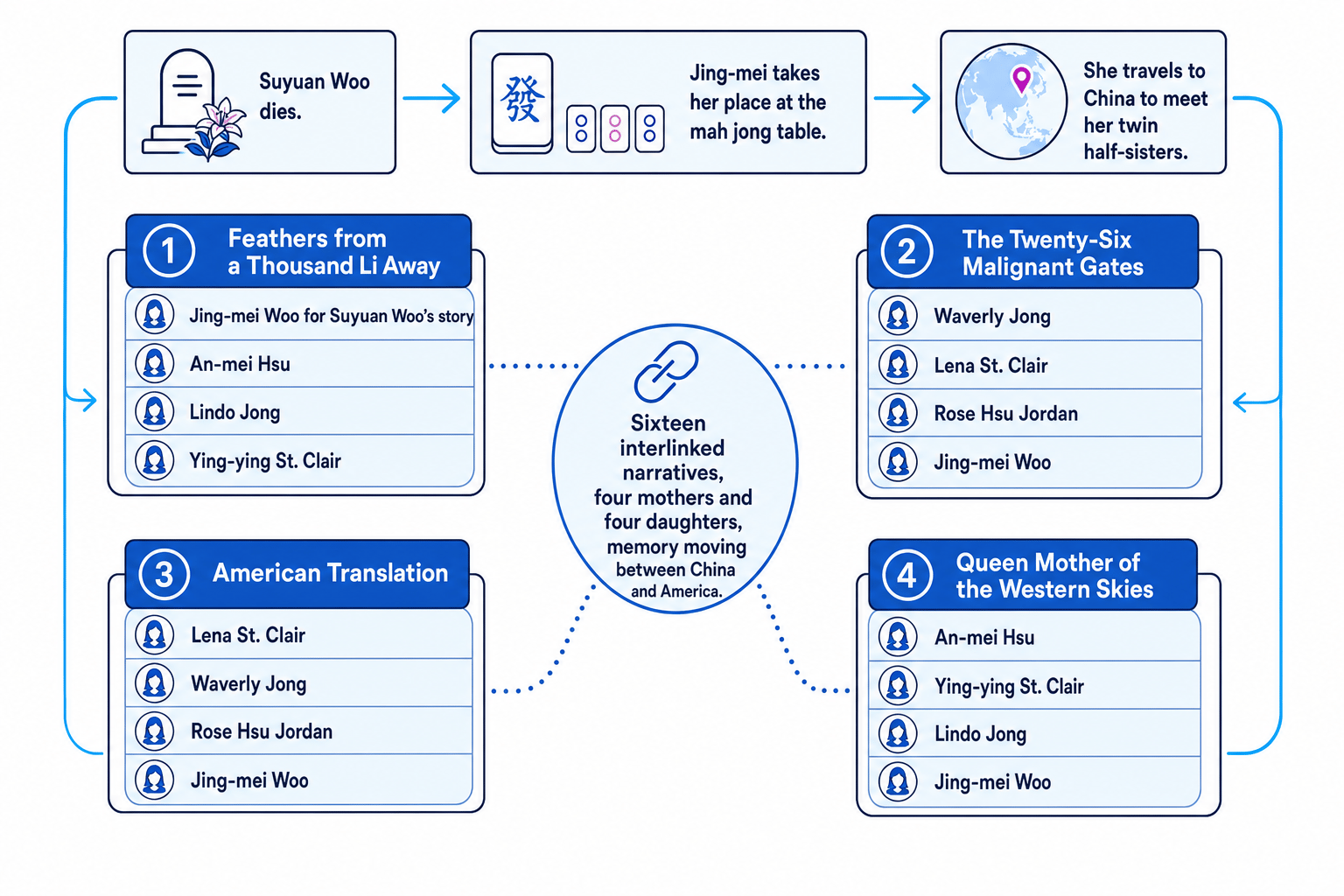
The novel focuses on four Chinese immigrant mothers and their four American-born daughters, mostly living in San Francisco. It also moves back into memories of China: childhood, arranged marriage, war, loss, family shame and survival. The present-day story begins after Suyuan Woo has died. Her daughter, Jing-mei “June” Woo, is asked to take her mother’s place at the Joy Luck Club’s mah jong table and later travels to China to meet Suyuan’s twin daughters.
Linked-story novel
A linked-story novel is a novel made from separate stories or chapters that can partly stand alone, but which join together through shared characters, themes and patterns. The Joy Luck Club has sixteen linked narratives, so you should read it as a mosaic: each piece matters, but the whole design matters too.
The big overview point
Tan presents family identity as something built through stories. The daughters often misunderstand their mothers, but the novel’s structure gradually reveals the pain, love and hope behind what the mothers say.
Structure: four parts, sixteen voices
The novel is divided into four main sections. Each section opens with a short parable, which is a brief symbolic story that suggests a moral or idea. These parables prepare you to read the family stories symbolically, not just literally.
Tan also uses a frame narrative. A frame narrative is an outer story that surrounds and gives meaning to the inner stories. Here, the outer frame is Jing-mei’s movement from not fully understanding Suyuan to travelling to China and recognising her mother’s legacy. Within that frame, the novel uses flashbacks: moments when the narrative moves back to earlier events.
The pattern below shows how the novel’s four sections connect the mothers, daughters and Suyuan’s absent-but-powerful story.
Why the structure matters
The novel is not arranged as a neat chronological biography. Instead, Tan places stories beside each other so that you notice echoes: a mother’s past may explain a daughter’s present; a daughter’s conflict may reveal a mother’s hidden fear.
Analysing the novel's circular structure
-
Begin with the opening problem: Suyuan is dead, so Jing-mei has to sit in her mother’s place and try to understand a story that was never fully explained to her. This creates a gap at the centre of the novel.
-
Compare the ending: in “A Pair of Tickets”, Jing-mei meets her half-sisters in China and realises, “Together we look like our mother.” The final image brings Suyuan back through her daughters’ shared resemblance.
-
Explain the effect: the structure moves from absence to recognition. Tan suggests that stories, memories and family likeness can survive even after death, but only when the next generation learns to listen.
The plot spine: what you must not lose sight of
Because there are sixteen chapters, it is easy to feel as if the novel is “about everything”. For overview revision, keep a clear plot spine in your head.
Suyuan founded the first Joy Luck Club in wartime Kweilin as an act of hope during terror and displacement. Later, in America, the club becomes a social and emotional space for the immigrant mothers. After Suyuan dies, the aunties ask Jing-mei to complete her mother’s unfinished emotional journey by meeting the twin daughters Suyuan had to leave behind in China.
Around this frame, the other stories show different versions of the same broad struggle: mothers try to pass on strength, warning and memory; daughters often hear criticism, pressure or superstition instead. Jing-mei’s piano conflict in “Two Kinds”, Waverly’s chess success in “Rules of the Game”, Rose’s uncertainty in marriage, and Lena’s unhappy household all show daughters trying to define themselves.
Retelling all sixteen chapters
In an essay, do not try to summarise every family story. Select two or three moments that directly answer the question, then explain how they connect to Tan’s bigger ideas about memory, identity, conflict or inheritance.
Narrative voice: why there are so many “I”s
A narrator is the voice that tells a story. A first-person narrator uses “I” and presents events through their own memory and understanding. In The Joy Luck Club, the first-person voice keeps changing, so the reader has to assemble truth from several partial perspectives.
This matters because many conflicts come from limited understanding. The daughters often know what their mothers said, but not what their mothers survived. The mothers often know what they meant, but not how their daughters heard it. Suyuan’s demand in “Two Kinds” — “Only two kinds of daughters” and “Obedient daughter!” — sounds harsh to Jing-mei, but it also comes from a mother whose hopes have been shaped by loss, migration and fear.
Tracking Jing-mei's changing voice
-
Read the earlier voice: in “Two Kinds”, Jing-mei resists Suyuan’s dream of an American prodigy child: “I won’t let her change me.” The first-person voice is defensive and determined.
-
Read the later voice: in “A Pair of Tickets”, Jing-mei thinks, “My mother was right. I am becoming Chinese.” The present-tense phrase “am becoming” suggests a process, not a sudden magical transformation.
-
Link the change to the whole novel: Tan does not simply make Jing-mei “give in” to her mother. Instead, Jing-mei grows into a more complex identity by understanding the story behind Suyuan’s hopes.
Context: how to use AO4 well
For this set text, Edexcel rewards your knowledge and interpretation of the novel through AO1, and your understanding of the relationship between the text and its context through AO4. Context means the historical, social and cultural circumstances that shape the text’s meanings.
Useful context includes Chinese immigration to America, the trauma of war in China, expectations of family duty, and patriarchy, a social system in which men hold most power. Some mothers experienced arranged marriage, concubinage, poverty or social shame. Their daughters grow up in America, where they are encouraged to value individual choice and self-expression. Tan explores what happens when these value systems meet inside one family.
Do not flatten context
Avoid writing as if “Chinese culture” is one simple thing. Tan presents individual women with different histories. Strong AO4 links explain how context shapes a character’s choices, not as a stereotype but as part of the novel’s emotional world.
Linking context to Lindo's conflict
-
Choose a precise quotation: in “Double Face”, Lindo says she wanted “American circumstances and Chinese character” for her children, then asks, “How could I know these two things do not mix?”
-
Connect the context: Lindo values American opportunity because immigration promises freedom and security, but she also values Chinese ideas of family loyalty, endurance and self-control.
-
Develop the interpretation: the contrast between “American” and “Chinese” shows the pressure of hybrid identity: the daughters inherit more than one cultural world, and the mothers cannot fully control how those worlds combine.
Methods to notice in an overview essay
Even though this exam section focuses especially on AO1 and AO4, you still need to write about Tan as a writer. Do not list techniques for their own sake; connect methods to meaning.
Tan often uses symbolism, where an object, action or image represents a bigger idea. The swan feather in the opening parable is a clear example: “This feather may look worthless, but it comes from afar and carries with it all my good intentions.” The feather symbolises inheritance that may look small or misunderstood, but carries a mother’s hopes across distance and generations.
She also uses motifs, which are repeated images or ideas. Games, food, mirrors, music, houses, silence and speech all return across different chapters. For example, mah jong and chess are not just games: they become ways of thinking about strategy, power, competition and hidden rules.
Closed-book quotation strategy
Learn short, flexible quotations rather than long speeches. Phrases like “all my good intentions”, “American circumstances and Chinese character”, “I am becoming Chinese” and “Together we look like our mother” can support many different questions.
Turning the overview into an essay argument
A strong paragraph should move from point → evidence → method → effect → link to question and context. That means you make an argument, use a short quotation, explain how Tan has shaped it, and connect it to the wider meaning of the novel.
A concise overview-style paragraph might look like this:
Tan presents identity as something Jing-mei learns through relationship rather than blood alone. At the end of “A Pair of Tickets”, the final image — “Together we look like our mother” — uses visual imagery, meaning language that helps the reader picture a scene, to turn Suyuan’s absence into a shared presence. The first-person plural “we” and “our” makes Jing-mei part of a family story larger than herself. In context, Tan is writing about a Chinese-American family shaped by migration, so the scene is not a simple “return” to China; it is a recognition that Jing-mei’s identity has always been partly inherited through Suyuan’s stories.
In the exam
-
Start with the question focus, then choose the mother-daughter pair or structural moment that best proves your point.
-
Use brief, accurate quotations and analyse what they reveal about character, memory, conflict or identity.
-
Link context to meaning, especially migration, family duty, gender expectations and generational difference, but avoid broad stereotypes.
Check yourself
- Why is Suyuan’s absence still a powerful presence in the novel?
- How does the four-part structure help Tan connect mothers’ pasts with daughters’ present lives?
- Which one context point could you use to explain a mother-daughter misunderstanding without stereotyping either side?
