What you'll learn
- How to turn a The Whale Rider question into a clear line of argument.
- How to choose the best moments from across the novella for your plan.
- How to include short quotations, narrative details, and context effectively.
- How to avoid common planning mistakes in the closed-book Edexcel IGCSE exam.
Why essay planning matters for The Whale Rider
In Edexcel IGCSE English Literature, The Whale Rider appears in Component 1: Poetry and Modern Prose, which is closed book. That means you cannot take the text into the exam, so your plan has to rely on remembered moments, short quotations, and secure understanding of the whole novella.
For this section, the key assessment objectives are AO1 and AO4. In simple terms, you need to show you know the text well, write a clear personal argument, and connect the novella to its context.
Essay plan
An essay plan is a brief, ordered route through your answer. It is not a full essay: it is a map of your argument, usually with a thesis, three or four paragraph ideas, key evidence, and contextual links.
A strong plan stops you from simply retelling the plot. Instead of writing “then this happens, then this happens”, you write a developing argument about how Ihimaera presents an idea.
Use this flowchart as a mental model when you plan a response.
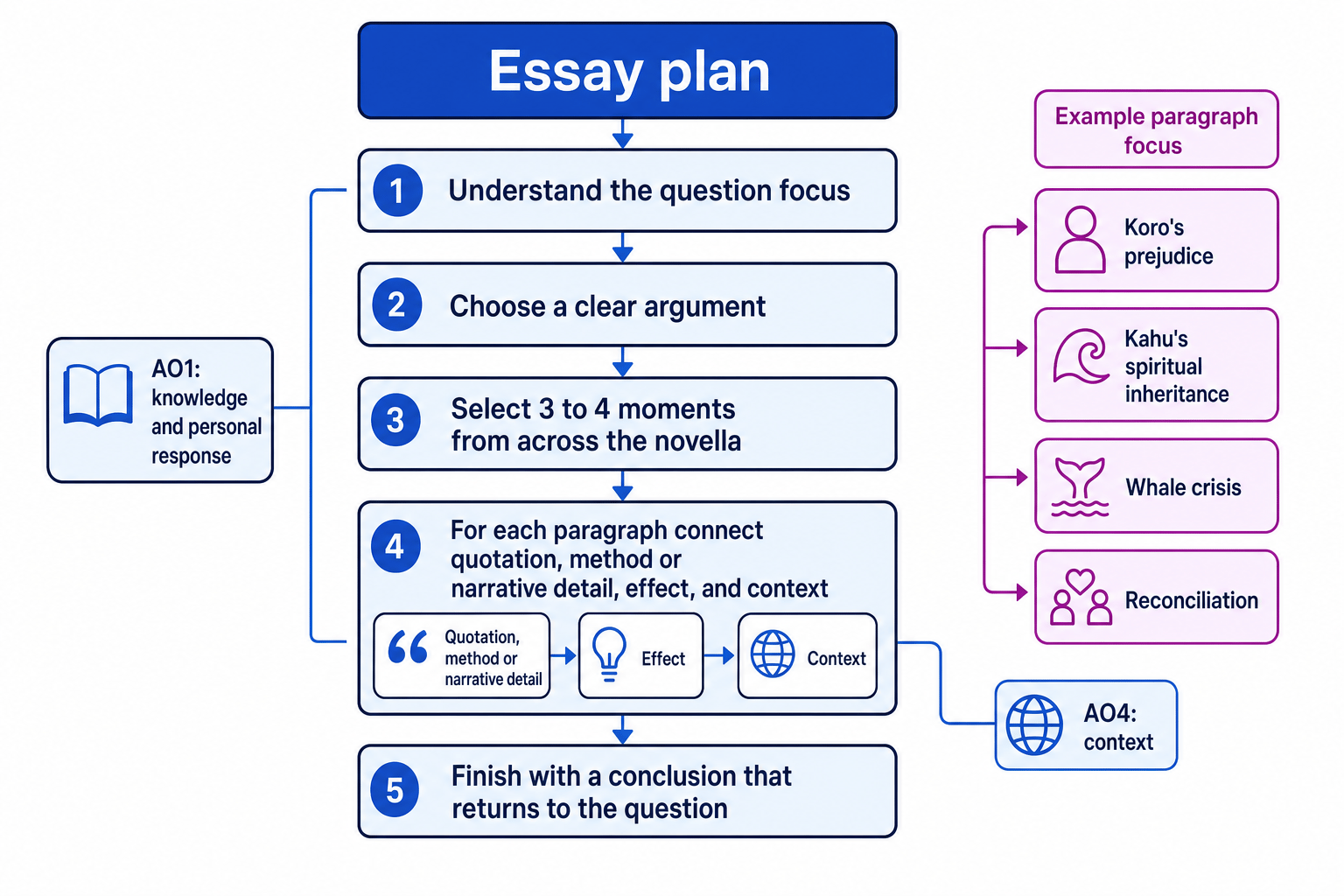
Start with the question focus
Most questions on prose ask you to explore the importance or presentation of something: a character, relationship, theme, setting, or idea.
For The Whale Rider, common question areas include:
- Kahu’s importance
- Koro Apirana’s attitudes
- the role of women
- tradition and change
- leadership
- whales and the natural world
- family and community
- Māori culture and ancestry
Question focus
The question focus is the specific person, theme, relationship, or idea the question wants you to write about. Everything in your plan must connect back to it.
If the question asks about tradition, do not write a general essay on Kahu. If it asks about Koro, do not turn it into a full theme essay on Māori culture. You can mention those things, but they must serve the question.
Planning the text, not the question
A weak plan often lists important scenes from the novella without shaping them around the question. Always ask: “What does this moment prove about the exact focus I have been given?”
Build a thesis before choosing paragraphs
Thesis
A thesis is your main argument in one or two sentences. It should answer the question directly and suggest how your ideas will develop.
A good thesis for The Whale Rider often contains a tension. A tension is a conflict between two ideas. Ihimaera’s novella is full of these: tradition versus change, male authority versus female leadership, human society versus the natural world, and old stories versus modern life.
For example, if the question is about Koro, a simple thesis might be:
Ihimaera presents Koro Apirana as a devoted guardian of Māori tradition, but also as a flawed leader whose gender expectations prevent him from recognising Kahu’s spiritual authority until the crisis with the whales.
That thesis is useful because it is not one-sided. Koro is not simply “bad”. He loves his people and wants continuity, but his understanding of leadership is too narrow.
Your argument should develop
The best plans move from problem to complication to resolution. In The Whale Rider, this often means moving from Kahu’s rejection, to her hidden signs of leadership, to her final recognition.
Choose moments from across the whole novella
A plan should cover the whole text, not just one memorable episode. For The Whale Rider, it is often useful to select moments from the beginning, middle, and ending.
A balanced plan might use:
- Beginning — Kahu’s birth and Koro’s disappointment that she is not male.
- Middle — Kahu’s love for Koro, her exclusion from his lessons, and her connection to the whales.
- Crisis — the whale stranding, where human leadership fails.
- Ending — Kahu’s rescue of the ancient whale and Koro’s eventual recognition of her.
This structure helps you show development. It also proves AO1 because you demonstrate knowledge of the novella as a whole.
Use short, secure quotations
Because the exam is closed book, learn short quotations you can use flexibly. For example, the blunt narrative phrase “Kahu was a girl” is useful for questions about gender, Koro, leadership, and tradition.
Worked plan: tradition and change
Here is how you might plan an answer to this question:
How does Ihimaera present tradition and change in The Whale Rider?
Planning a question about tradition
-
Define the argument. The question is not asking whether tradition is good or bad. A stronger argument is that Ihimaera respects Māori tradition but shows that it must be open enough to recognise Kahu.
-
Choose a beginning moment. Use Kahu’s birth and Koro’s disappointment. The phrase “Kahu was a girl” becomes central because Koro sees her gender as a problem for the line of male leadership.
-
Add a cultural idea. Link Koro’s anxiety to whakapapa, meaning genealogy or ancestral descent. In the novella, ancestry is not just family history; it gives people identity, responsibility, and connection to Paikea.
-
Choose a middle moment. Use Koro’s search for a male successor and his lessons for the boys. This shows his commitment to preserving tradition, but also his inability to see that Kahu already carries the qualities he seeks.
-
Choose an ending moment. Use the whale crisis. Kahu’s bond with the ancient whale proves that spiritual inheritance is not limited by gender. The ending changes the community’s understanding of leadership rather than destroying tradition.
-
Shape the thesis. A final thesis could be: Ihimaera presents tradition as precious and life-giving, but he also shows that tradition survives only when the community learns to recognise new forms of leadership.
Notice that this plan does not try to include everything. It selects the best evidence for the question.
Planning paragraph by paragraph
Each paragraph in your plan should have a clear job.
Topic sentence
A topic sentence is the first sentence of a paragraph. It states the paragraph’s main point and links directly to the question.
For The Whale Rider, a useful paragraph structure is:
- Point — answer the question.
- Evidence — include a short quotation or precise moment.
- Method or narrative choice — identify how Ihimaera presents the idea.
- Effect — explain what the reader understands or feels.
- Context — connect to Māori culture, gender roles, storytelling, or setting.
- Link — return to the question.
Even though Component 1 modern prose is focused on AO1 and AO4, you can still mention methods such as symbolism, structure, narrative voice, and mythic parallel when they help your argument.
Context
Context means the social, cultural, historical, or biographical background that helps explain a text. For The Whale Rider, relevant context includes Māori ancestry, oral storytelling, whakapapa, gender expectations, and the relationship between people, land, and sea in Aotearoa New Zealand.
Do not bolt context onto the end of a paragraph. Instead, make it part of your interpretation.
For example, do not write:
This links to Māori culture.
That is too vague. Instead, write something like:
Koro’s fear matters because whakapapa gives the community a sacred connection to Paikea; however, Ihimaera shows that Kahu belongs to this inheritance even though Koro’s patriarchal expectations blind him to it.
Context dumping
Do not write a mini history essay about Māori culture. AO4 rewards context only when it explains Ihimaera’s choices and deepens your answer to the question.
Plan bank for common question types
Use these as planning models, not scripts. In the exam, adapt them to the exact wording of the question.
If the question is about Kahu
Possible thesis: Ihimaera presents Kahu as the rightful spiritual heir to Paikea, using her rejection and final triumph to challenge narrow ideas about gender and leadership.
Possible paragraph route:
- Kahu’s birth immediately creates conflict because “Kahu was a girl”.
- Her repeated love for Koro, especially “Paka, I love you”, shows emotional strength rather than weakness.
- Her connection with the whales links her to the mythic world of Paikea.
- Her final act proves that leadership is spiritual, courageous, and self-sacrificing.
If the question is about Koro Apirana
Possible thesis: Ihimaera presents Koro as both admirable and limited: he protects tradition, but his patriarchal thinking prevents him from recognising Kahu until almost too late.
Possible paragraph route:
- Koro’s concern for the tribe shows his sense of duty.
- His rejection of Kahu reveals the damage caused by rigid gender expectations.
- His training of the boys shows his desperate search for continuity.
- His eventual grief and recognition create a movement towards healing.
Avoid a simple villain reading
Koro is frustrating, but he is not written as a cartoon villain. A mature essay sees that his prejudice comes from fear for the community’s future as well as from patriarchal tradition.
If the question is about tradition and change
Possible thesis: Ihimaera suggests that tradition should not be abandoned; instead, it must be reinterpreted so that the community can survive.
Possible paragraph route:
- The Paikea legend establishes tradition as sacred and powerful.
- Koro’s male-only view of leadership shows tradition becoming restrictive.
- Nanny Flowers challenges Koro’s assumptions and provides comic resistance.
- Kahu’s bond with the whale renews tradition by revealing its deeper truth.
If the question is about whales or the natural world
Possible thesis: Ihimaera uses the whales as symbols of ancestry, spiritual connection, and ecological crisis, showing that the human community has become separated from older forms of wisdom.
Possible paragraph route:
- The whale rider legend connects humans and whales from the start.
- The ancient whale’s journey mirrors the community’s crisis.
- The whale stranding exposes the limits of ordinary human authority.
- Kahu’s rescue of the whale restores connection between people, nature, and ancestry.
Symbolism
Symbolism is when a person, object, animal, or place represents a larger idea. In The Whale Rider, the whales symbolise ancestral memory, spiritual power, and the bond between the Māori community and the natural world.
Turning a plan into a paragraph
Here is a short model of how one planned point could become analytical writing:
Ihimaera presents Koro as a guardian of tradition whose judgement is limited by gender expectations. Kahu’s identity is reduced, in Koro’s eyes, to the blunt fact that “Kahu was a girl”, and the simplicity of the phrase shows how quickly her worth is dismissed. Yet the reader understands that Koro’s fear is connected to whakapapa: he believes the tribe needs a male successor to continue the line from Paikea. This makes his attitude more complex, because his prejudice is tied to his sense of duty. However, by making Kahu the character who ultimately answers the whales’ call, Ihimaera shows that true inheritance depends on courage, love, and spiritual connection, not simply on being male.
That paragraph follows a clear chain: point → evidence → method → effect → context → link.
Planning your conclusion
A conclusion should not introduce a new scene. It should return to your thesis and show what Ihimaera ultimately suggests.
For The Whale Rider, many strong conclusions focus on renewal. The novella does not reject Māori tradition. Instead, it shows that tradition remains alive when the community recognises Kahu’s place within it.
A useful concluding sentence might be:
Ultimately, Ihimaera presents Kahu’s recognition as a renewal of tradition, suggesting that the future of the community depends on honouring the past while allowing leadership to take unexpected forms.
In the exam
- Spend a few minutes making a plan with a thesis and three or four paragraph focuses before you start writing.
- Choose evidence from across the novella: early rejection, middle conflict, whale crisis, and final recognition are often useful anchor points.
- Link context directly to interpretation: use ideas such as whakapapa, Māori oral tradition, patriarchy, and community only when they help answer the exact question.
Check yourself
- Can you write a one-sentence thesis for a question about Kahu without retelling the plot?
- Can you name three moments from different parts of the novella that would support an essay on tradition?
- Can you explain how a contextual idea such as whakapapa changes your interpretation of Koro or Kahu?
