What you'll learn
- How to recognise the key chapters of The Whale Rider without just retelling the plot.
- How Ihimaera links the family story with the ancient whale/Paikea story.
- Which episodes are most useful for questions on leadership, gender, tradition and change.
- How to turn a chapter moment into a strong Edexcel IGCSE paragraph for Component 1 Section C.
First: what makes a chapter “key”?
In a Literature essay, a chapter is “key” because it does more than contain events. It may introduce a conflict, develop a theme, reveal a character, echo an earlier moment, or prepare the ending.
Key chapter
A key chapter is a chapter or episode that changes the direction of the plot, deepens a central theme, or shows an important shift in a character or relationship.
For The Whale Rider, it is safest to revise by episode rather than page number, because different editions can vary. In the exam, you can write “in the birth episode”, “during Koro’s school for boys”, or “at the whale stranding” and still be precise.
Chapter choice
The best chapters to revise are the ones where the human family story and the ancient whale story start to overlap.
The novel’s two-track structure
Structure
Structure means the way a text is organised: the order of events, shifts in narrator, repeated patterns, beginnings, endings and turning points.
Ihimaera does not tell the novel as a simple family story only. He uses a parallel narrative, meaning two connected storylines run alongside each other. One storyline follows Kahu, Koro Apirana, Nanny Flowers and Rawiri in Whangara. The other follows the ancient whale world and the memory of Paikea, the ancestor who came to Aotearoa on a whale.
This matters because the ending feels earned: Kahu’s ride is not random. The opening myth, the whale sections, Koro’s search for a male leader, and Kahu’s hidden gifts all prepare us for the climax.
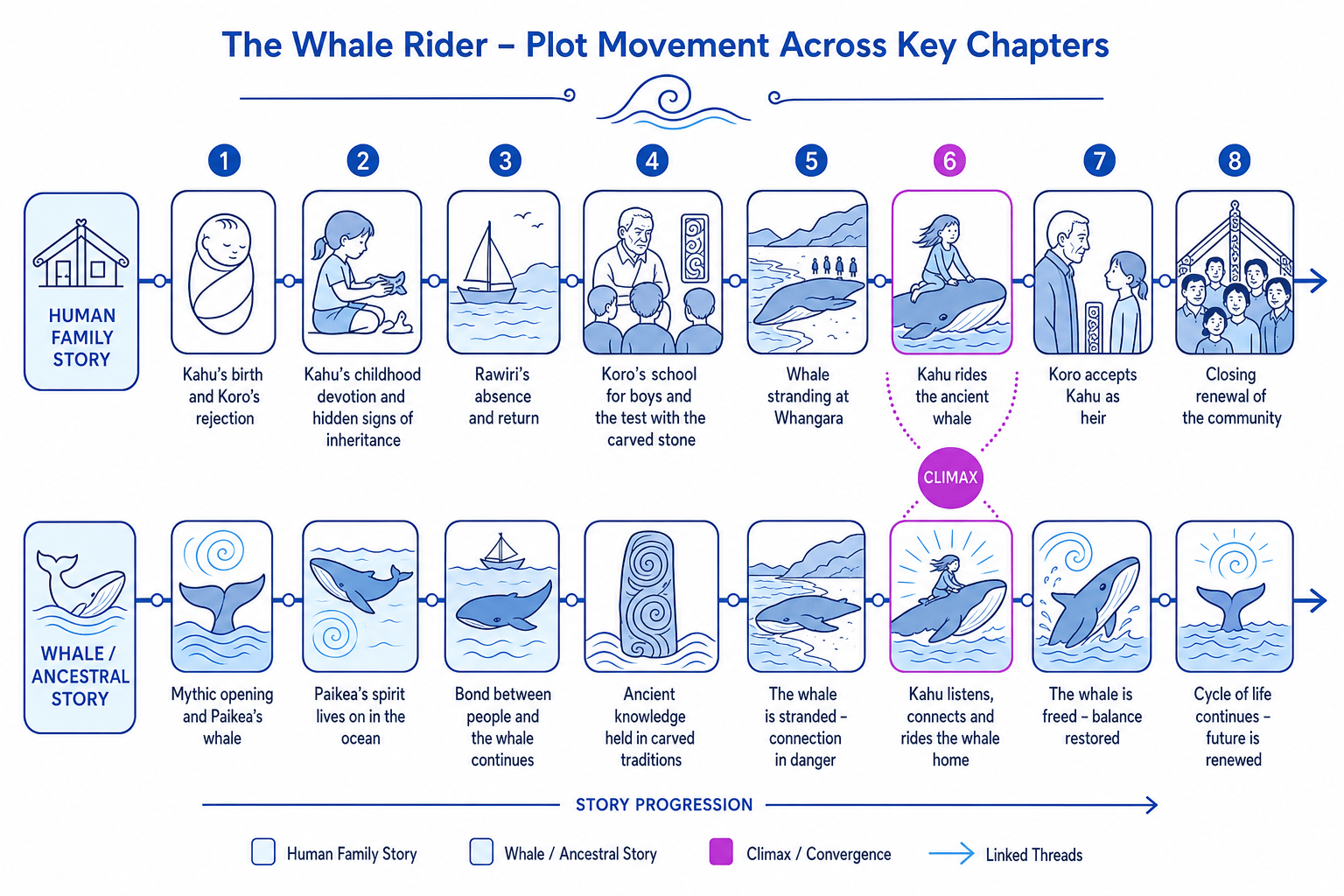
Parallel narrative
A parallel narrative is a structure where two storylines develop side by side and gain meaning from their connection.
Key chapters at a glance
| Episode | Why it is key | Useful essay focus |
|---|---|---|
| Mythic opening / Paikea story | Establishes ancestry, the sea, whales and Māori tradition before Kahu appears. | Whakapapa, legend, spiritual connection with nature. |
| Kahu’s birth | Koro rejects her because she is female: “A girl” and “broken the male line of descent”. | Gender, leadership, tradition, Koro’s blindness. |
| Kahu’s childhood devotion | Kahu loves Koro despite his rejection; her repeated “I love you, Paka” makes his coldness painful. | Family love, dramatic irony, sympathy for Kahu. |
| Rawiri’s departure and return | Rawiri’s wider experiences help the reader see Māori identity in a modern, changing world. | Context, cultural survival, narration. |
| Koro’s school for boys | Koro looks for a male successor and excludes Kahu. | Patriarchy, leadership, narrow interpretation of tradition. |
| The carved stone test | Kahu succeeds where the boys fail, though Koro does not properly recognise it. | Symbolism, foreshadowing, hidden worth. |
| Whale stranding | The community crisis mirrors the crisis in leadership and tradition. | Nature, ancestry, collective responsibility. |
| Kahu rides the whale | Human and mythic stories converge; Kahu fulfils the role Koro has been searching for. | Climax, renewal, reinterpretation of tradition. |
| Final recognition | Koro’s attitude changes as he recognises Kahu’s status as leader. | Resolution, humility, hope for the future. |
Chapter focus 1: the mythic opening
The opening takes us back to the world of Paikea before the modern family plot begins. This gives the novel a mythic quality: it feels connected to legend, ancestry and sacred history.
Whakapapa
Whakapapa is Māori genealogy: a line of descent connecting people to ancestors, land, community and identity.
This opening is important for AO4 because the novel is rooted in Māori cultural ideas of ancestry, community and the relationship between humans and the natural world. The whales are not just animals in the background. They are linked to memory, identity and spiritual inheritance.
The opening also prepares the reader for Kahu. Koro thinks leadership must come through a male line, but the structure quietly suggests that true inheritance is deeper than gender.
Chapter focus 2: Kahu’s birth and Koro’s rejection
This is one of the most important early chapters because it sets up the central conflict. Koro wants a male heir to continue the line of chiefs. When Kahu is born a girl, he sees her as a disappointment rather than a blessing.
Patriarchy
Patriarchy is a social system where men hold most authority and power. In the novel, Koro’s patriarchal thinking makes him assume that leadership must be male.
Ihimaera makes Koro’s reaction shocking through blunt direct speech: “A girl” and “I will have nothing to do with her”. The phrase “broken the male line of descent” shows that Koro thinks of Kahu almost as a break in history, not as a child with her own value.
Analysing Koro’s rejection
-
Start with the chapter’s function: this episode introduces the main conflict between Koro’s expectations and Kahu’s true potential.
-
Select precise evidence: Koro’s phrase “A girl” is abrupt, while “broken the male line of descent” shows his obsession with male inheritance.
-
Analyse the method: the short sentence “A girl” sounds dismissive, and the verb “broken” suggests damage, as if Kahu’s birth has harmed the tribe.
-
Explain the reader’s response: we feel sympathy for Kahu and see Koro’s view as limited, even though he believes he is protecting tradition.
-
Link to the whole novel: the later whale-riding episode overturns this judgement, proving that Kahu is not a break in the line but its renewal.
Reducing Koro to a villain
Do not write as if Koro is simply evil. He loves his people and fears cultural loss, but his tragedy is that he misunderstands where the next leader will come from.
Chapter focus 3: Kahu’s childhood and hidden signs
Kahu’s childhood chapters are emotionally important because she keeps reaching out to Koro. Her “I love you, Paka” shows innocence, loyalty and unconditional affection. The pain comes from the gap between what Kahu offers and what Koro refuses to see.
Dramatic irony
Dramatic irony happens when the reader or audience understands something that a character does not.
There is strong dramatic irony in these chapters. You can see Kahu’s courage, sensitivity and special connection to the old world, but Koro remains blind because he is focused on finding a boy.
Foreshadowing
Foreshadowing is when a writer plants hints that prepare the reader for later events.
Kahu’s unusual connection with the sea and whales foreshadows the climax. Ihimaera slowly teaches you to expect that Kahu belongs to the Paikea story, even before Koro accepts it.
Chapter focus 4: Koro’s school for boys and the carved stone test
Koro’s school for boys is a crucial middle episode because it shows his narrow definition of leadership. He teaches the boys because he believes one of them must become the future chief. Kahu is excluded, even though she is the character most spiritually connected to the ancestral tradition.
Symbolism
Symbolism is when a person, object, place or action represents a bigger idea.
The carved stone test is symbolic because the stone represents inheritance, authority and connection to the past. The boys’ failure and Kahu’s success reveal the gap between Koro’s assumptions and the truth.
Using the carved stone test
-
Identify Koro’s assumption: he believes the future leader must be one of the boys he trains.
-
Explain the object’s meaning: the carved stone symbolises the old knowledge and authority Koro wants to pass on.
-
Compare the outcomes: the boys cannot fulfil the test, but Kahu, although excluded, is connected enough to succeed.
-
Draw out the theme: Ihimaera suggests that true leadership depends on courage, spiritual connection and responsibility, not simply gender.
-
Link to context: the episode does not reject Māori tradition; it challenges a rigid interpretation of tradition that cannot recognise female leadership.
Closed-book revision shortcut
For Edexcel Component 1, The Whale Rider is examined closed book, so memorise short quote fragments attached to episodes: “A girl”, “broken the male line”, “I love you, Paka”, “wise leader”.
Chapter focus 5: Rawiri’s departure and return
Rawiri’s chapters may feel less dramatic than the whale climax, but they are still important. As narrator, Rawiri gives the reader a bridge between the intimate family story and the wider modern world.
His travels show that Māori identity is not frozen in the past. People move, work, change and encounter other cultures, but the pull of home and ancestry remains powerful. This helps you avoid a simplistic essay where “tradition” and “modern life” are treated as opposites. Ihimaera is more subtle: the novel asks how tradition can live in the modern world.
Chapter focus 6: the whale stranding
Climax
The climax is the point of greatest tension in a narrative, where the central conflict reaches its most decisive moment.
The whale stranding is the beginning of the climax. The community faces a crisis that is practical, emotional and spiritual. The stranded whale is linked to the ancient whale of the Paikea story, so saving it is not just an environmental act; it becomes a test of whether the people can restore balance.
The scene also exposes Koro’s despair. He has tried to prepare a male successor, but the crisis cannot be solved by the system he has created. This prepares the reader for Kahu’s action.
Chapter focus 7: Kahu rides the whale
This is the central chapter for understanding the whole novel. Kahu’s ride brings together the title, the mythic opening, the whale sections and the family conflict. She becomes the figure Koro has been searching for all along.
Linking the climax to the opening
-
Begin with the opening pattern: Paikea’s identity is connected to a whale and to ancestral arrival.
-
Connect Kahu to that pattern: when Kahu rides the whale, she repeats the ancestral action in a new generation.
-
Explain the twist: Koro expected the pattern to continue through a male heir, but Ihimaera reveals that Kahu is the true inheritor.
-
State the wider meaning: the novel presents tradition as living and adaptable, not dead or fixed.
This chapter is powerful because it does not make Kahu a leader through speeches or status. She proves herself through sacrifice. Her near-death gives the scene emotional weight and makes Koro’s later recognition feel necessary rather than easy.
Chapter focus 8: the ending and Koro’s recognition
The final chapters provide the resolution, meaning the part of the narrative where the central conflict is settled. Koro’s recognition of Kahu matters because it shows a change in his understanding. His language of “wise leader” and being a “fledgling” reverses the earlier power dynamic: the old chief must learn from the child he dismissed.
Resolution
The resolution is the ending phase of a story, where the main tensions are answered or settled.
The ending is hopeful, but it is not shallow. Ihimaera does not say that the past should be thrown away. Instead, the ending suggests that the community survives when it recognises the right person to carry tradition forward.
Turning chapters into exam points
A strong paragraph should not simply say what happens. Move from episode to meaning:
- Point: Kahu’s birth chapter shows Koro’s limited view of inheritance.
- Evidence: He responds to her as “A girl” and says she has “broken the male line of descent”.
- Method: Ihimaera uses blunt direct speech and the harsh verb “broken”.
- Effect: The reader sees how Koro’s fear for tradition becomes unfairness towards Kahu.
- Link: This prepares the later reversal when Kahu proves herself as the true whale rider.
In the exam
-
Anchor each paragraph in a specific episode: birth, childhood rejection, school for boys, stone test, whale stranding, whale ride, final recognition.
-
Use short quotations accurately, then explain how the chapter develops the whole novel rather than retelling the scene.
-
Keep linking AO1 knowledge to AO4 context: Māori ancestry, whakapapa, community leadership, gender expectations and cultural survival.
Check yourself
-
Which early chapter first shows Koro’s belief that leadership must follow the “male line”?
-
How does the carved stone test foreshadow Kahu’s role in the climax?
-
Why is the whale-riding chapter both a personal victory for Kahu and a renewal of the community?
