What you'll learn
- How to tell the difference between language, form and structure.
- How Ihimaera blends Māori myth, family realism and spiritual storytelling.
- How the novel’s dual narrative makes Kahu’s role feel destined.
- How to write about methods without just listing techniques.
Start with the basics: language, form and structure
Language, form and structure
Language means the writer’s word choices: imagery, dialogue, symbolism, sentence style and tone. Form means the kind of text it is and the storytelling mode it uses. Structure means how the text is arranged: order, contrasts, patterns, openings, endings and shifts in viewpoint.
In an essay, you should not write, “Ihimaera uses symbolism” and stop there. You need to explain what the method suggests and how it shapes the reader’s understanding of Kahu, Koro Apirana, the whales, and the community at Whangara.
Method must link to meaning
A strong Literature point moves from method to effect: “Ihimaera uses this word / voice / structural pattern to make us understand…” This is what makes your response analytical rather than descriptive.
Language: how words reveal values
Māori vocabulary and naming
Ihimaera places Māori language and culture at the centre of the novel. Words such as “Koro”, “marae” and “hui” are not decorative extras; they make the reader enter a world shaped by Māori relationships, customs and communal identity.
Whakapapa
Whakapapa means genealogy or descent, but it is more than a family tree: it connects people to ancestors, land, community and responsibility.
Kahu’s full name, Kahutia Te Rangi, links her to the ancestral story of Paikea. This matters because Koro Apirana judges leadership through male descent, while the novel’s language of naming suggests that Kahu already belongs inside the line of inheritance.
Patriarchal language
Koro’s language often shows his narrow understanding of tradition. When he believes Kahu has “broken the male line of descent”, the verb “broken” is harsh and judgemental. It makes a baby sound like damage or failure, rather than a living child.
Analysing patriarchal language
-
The verb “broken” usually describes something damaged, so applying it to Kahu shows how Koro sees her birth as a problem rather than a blessing.
-
The phrase “male line of descent” creates a semantic field of inheritance, gender and authority. Koro is not just disappointed personally; he thinks the tribe’s future depends on a boy.
-
The reader later sees that Kahu is spiritually connected to the whales and to Paikea, so Koro’s language becomes ironic. He thinks she has broken the line, but structurally she is the one who will renew it.
-
The effect is to make us question Koro’s interpretation of tradition, not Māori tradition itself. Ihimaera presents the problem as Koro’s limited vision.
Semantic field
A semantic field is a group of words connected by meaning. For example, words linked to descent, inheritance and leadership create a semantic field of authority.
Affectionate, simple dialogue
Kahu’s repeated love for Koro is expressed through simple, direct language, especially in the childlike phrase “I love you, Paka.” The simplicity is important. Ihimaera does not make Kahu sound politically ambitious; she sounds loving, loyal and emotionally open.
That makes Koro’s rejection more painful for the reader. We see the gap between Kahu’s innocent affection and Koro’s inability to recognise her value.
Register: family comedy and mythic seriousness
Register
Register means the level or style of language: for example, formal, colloquial, comic, sacred, mythic or conversational.
The novel moves between different registers. Scenes involving Rawiri, Nanny Flowers and Koro can feel lively, comic and domestic. Nanny Flowers’ arguments with Koro bring warmth and humour into the family world.
By contrast, the whale sections use a more legendary and solemn register. The old whale is connected to memory, ancestry and the ancient past. This shift in register helps the novel hold two worlds together: ordinary family life and sacred myth.
Do not device-spot
Avoid writing a list like “Ihimaera uses dialogue, symbolism and foreshadowing.” Instead, choose one method and explain how it changes the reader’s view of Kahu, Koro or tradition.
Form: the kind of story Ihimaera creates
A modern myth
The Whale Rider is a modern prose text, but it borrows features from myth and oral storytelling. A myth is a traditional story that explains origins, values or spiritual truths. Ihimaera does not present the Paikea story as a dead legend; he makes it active in the present.
The mythic opening gestures towards oral tradition with phrases like “In the old days”. This makes the story feel as if it is being passed down across generations.
Mythic realism
Mythic realism
Mythic realism is a form where realistic events and mythic or spiritual events exist together in the same narrative world.
Kahu lives in a recognisable family and community: she is born, grows up, seeks love and faces rejection. At the same time, whales communicate, ancestral memory matters, and Kahu’s destiny connects to Paikea. Ihimaera’s form shows that the spiritual world is not separate from everyday life.
Rawiri’s first-person narration
Most of the human story is told by Rawiri, Kahu’s uncle. His narration is first-person, meaning he tells the story using “I”. It is also retrospective, meaning he tells events after they have happened, with hindsight.
This is important because Kahu does not usually explain herself directly. We often understand her through other people’s reactions to her. That gives her a mysterious quality: the reader gradually realises her significance before Koro fully does.
The whale narrative
Alongside Rawiri’s family narrative, Ihimaera includes sections focused on the ancient whale. These sections are not limited to one human character’s viewpoint. They widen the scale of the novel from one family to the whole history of a people.
Comparing narrative voices
-
Rawiri’s first-person narration makes the family conflict feel personal and emotionally close. We see Kahu through the eyes of someone who loves her.
-
The whale sections move beyond ordinary human knowledge. They create a larger spiritual and ancestral perspective.
-
When these two voices come together at the whale stranding, the reader understands that Kahu’s family story and the ancient Paikea story have always been connected.
Structure: how the pattern creates meaning
The structure of The Whale Rider is built around parallel narratives that gradually converge. One strand follows Kahu and her family; the other follows the whales and the memory of Paikea.
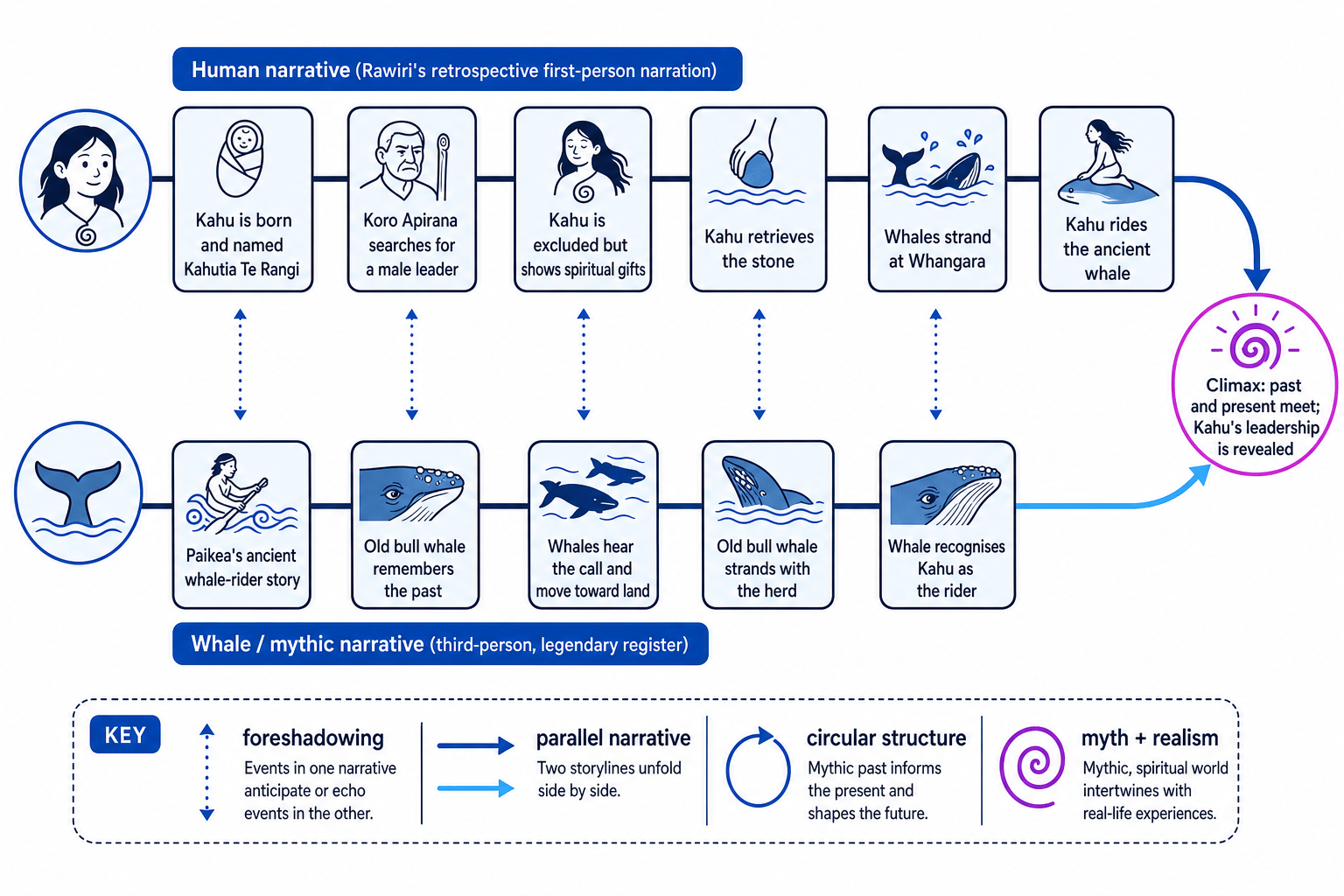
Parallel narrative
A parallel narrative is when two storylines develop side by side. They may seem separate at first, but they echo, contrast with or eventually connect to each other.
Foreshadowing and delayed recognition
Foreshadowing
Foreshadowing is when a writer plants hints early in a text that prepare the reader for later events.
Kahu’s name, her bond with the sea, and her recovery of Koro’s stone all prepare us for the climax. The reader is encouraged to recognise her importance before Koro does.
This creates a kind of dramatic irony: the audience understands something that a character does not. Koro searches for a male successor, while the structure keeps showing that the true heir is already in front of him.
Tracking foreshadowing
-
Kahu’s name links her to Kahutia Te Rangi and Paikea, so her identity is structurally tied to the ancestral whale-rider story from the beginning.
-
Her ability to retrieve the stone shows that she has the spiritual strength Koro is trying to find in the boys.
-
The whale stranding then turns earlier hints into proof. Kahu’s connection to the sea becomes the central action of the plot.
-
The effect is that her leadership feels earned and inevitable, not sudden or random.
Cyclical structure and renewal
Cyclical structure
A cyclical structure is when a text returns to images, ideas or patterns from the beginning, making the ending feel like a return or renewal.
The novel begins with the ancient Paikea story and ends by showing Kahu as a new version of the whale rider. This creates a circular movement: the past returns, but in a changed form.
The seasonal movement of the novel also suggests cycles of loss and renewal. Koro’s world seems to be declining, but Kahu offers a future that is still connected to ancestry.
A useful structure sentence
Try: “Structurally, Ihimaera delays Koro’s recognition of Kahu so that the reader sees the limits of his thinking before he does.”
Putting language, form and structure together
Here is what a strong analytical paragraph might sound like:
Ihimaera uses Koro’s patriarchal language to show the danger of interpreting tradition too narrowly. When Koro sees Kahu as having “broken the male line of descent”, the verb “broken” presents her as a failure before she has even had a chance to act. However, the structure of the novel undermines Koro’s judgement: Kahu’s name, her bond with the sea and her recovery of the stone all foreshadow her role as the true inheritor of Paikea’s legacy. Through this contrast between Koro’s language and the novel’s structure, Ihimaera suggests that tradition can survive only if the community learns to recognise spiritual authority in unexpected forms.
Notice how the paragraph does not just name methods. It connects word choice, structure and meaning.
In the exam
-
For Component 1 Modern Prose, remember this is closed book, so memorise a small bank of short, accurate quotations such as “broken the male line of descent” and “I love you, Paka.”
-
Even though the Modern Prose question mainly rewards knowledge, argument and context, method analysis helps you write in a critical style: always link language, form or structure to Ihimaera’s ideas about tradition, gender and ancestry.
-
Avoid retelling the plot. Use plot moments as evidence for a point about how the novel is built: dual narrative, foreshadowing, mythic realism or cyclical renewal.
Check yourself
- How does Rawiri’s narration affect the way we see Kahu?
- What does Koro’s phrase “broken the male line of descent” reveal about his values?
- How do the human narrative and whale narrative come together at the climax?
