What you'll learn
- How to recognise a theme in The Scarlet Letter without just retelling the plot.
- How Hawthorne develops themes through symbols, repeated settings, contrasts and narrative comments.
- The main themes you can use in essays: sin, guilt, judgement, identity, nature, revenge and gender.
- How to connect themes to Edexcel AO1, AO2 and AO4 in a clear, analytical way.
Start here: what is a theme?
A theme is not just “what happens”. It is the bigger idea the writer explores through characters, events, settings and language.
Theme
A theme is a central idea or concern in a text, such as guilt, hypocrisy, identity or social judgement. In an essay, you should explain how the writer presents that idea and why it matters.
For Edexcel IGCSE, The Scarlet Letter is assessed in Component 2, Section B: Literary Heritage, which is open book: you may use a clean copy of the novel. Strong answers still need precise references. You are not rewarded for copying long passages; you are rewarded for knowing where important moments are and analysing them closely.
You should blend:
- AO1: a clear argument and accurate references.
- AO2: analysis of language, form and structure. Structure means the order and pattern of events.
- AO4: links to context. Context means the historical, social and cultural conditions surrounding the text.
How Hawthorne builds themes
Hawthorne does not simply announce his themes. He builds them through repeated images, symbolic objects and contrasts between characters.
Symbol and motif
- A symbol is an object, place or character that represents a bigger idea. The scarlet letter “A” is the central symbol of the novel.
- A motif is a repeated detail or pattern that helps develop a theme. The scaffold, light and darkness, and the forest all work as motifs.
The quickest way to think about the novel’s themes is to link each one to a key symbol, character and quotation.
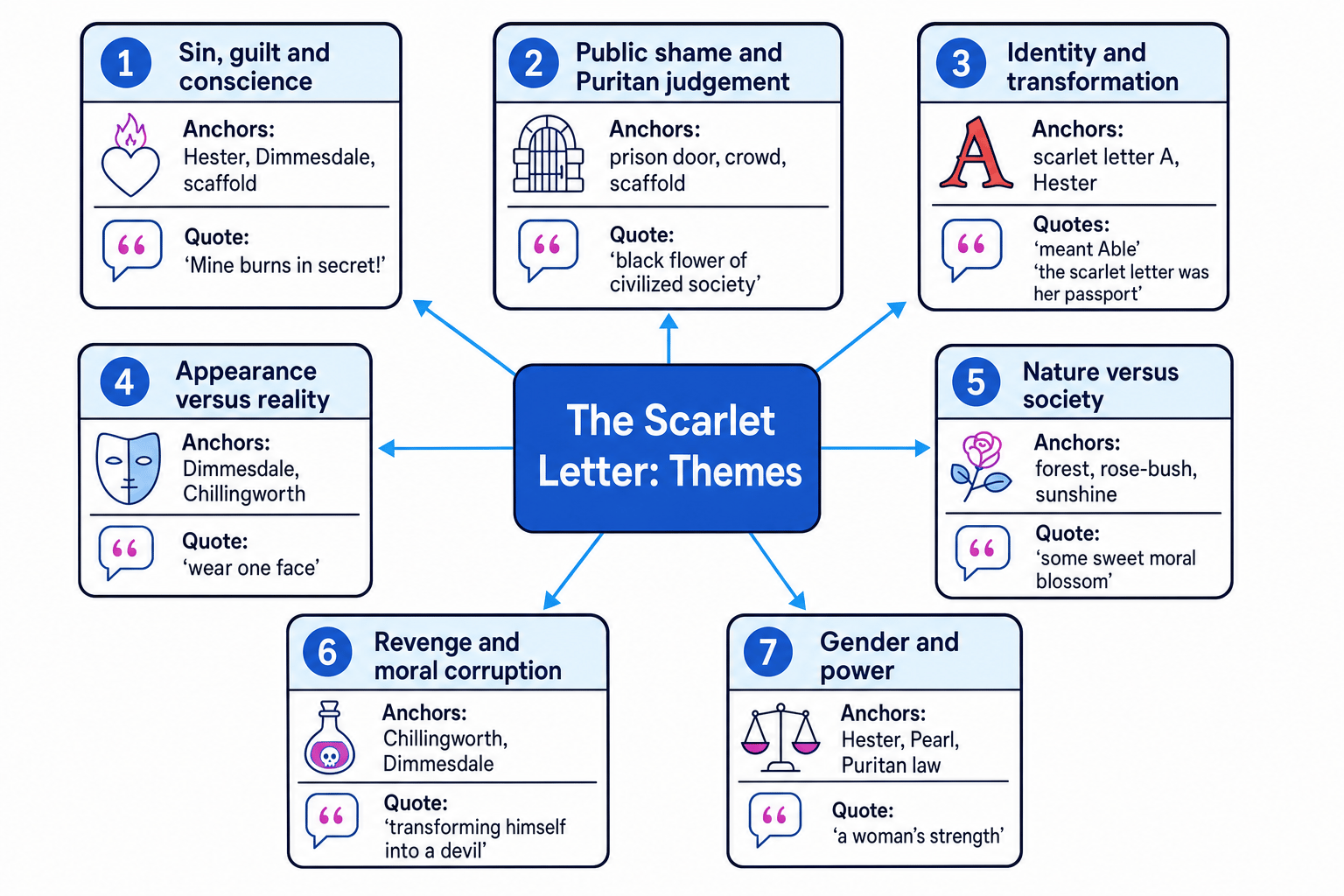
Themes are built through change
The best theme paragraphs show development. For example, the scarlet letter begins as a punishment imposed on Hester, but its meaning changes as she changes and as society’s view of her changes.
Tracing the scarlet letter as a symbol
-
Begin with the letter’s early meaning. In Chapter 2, the badge has “the effect of a spell”, separating Hester from ordinary human sympathy. Hawthorne presents shame as something society forces onto her body.
-
Move to the middle of the novel. In Chapter 13, people say the “A” “meant Able”. The symbol’s meaning shifts because Hester’s actions — charity, endurance and strength — challenge the original label of “Adulteress”.
-
Add a later development. Hawthorne writes that “the scarlet letter was her passport into regions where other women dared not tread”. The punishment becomes a source of insight, giving Hester a painful but powerful understanding of society.
-
Link the pattern to the theme. Hawthorne suggests that identity is not fixed by public judgement: meanings can be remade, but only through suffering, isolation and moral courage.
Sin, guilt and conscience
Conscience means your inner sense of right and wrong. In The Scarlet Letter, Hawthorne is interested not only in sin itself, but in what guilt does to the human soul.
Hester’s sin is public. She must wear the scarlet letter and stand on the scaffold before the community. Dimmesdale’s sin is private. He keeps his guilt hidden while continuing to appear holy. This contrast lets Hawthorne explore whether public punishment or secret guilt is more destructive.
Dimmesdale tells Hester, “Happy are you, Hester, that wear the scarlet letter openly upon your bosom! Mine burns in secret!” The verb “burns” turns guilt into physical pain. His hidden guilt becomes an inward scarlet letter.
Comparing public and private guilt
-
Choose the contrast: Hester’s guilt is visible, while Dimmesdale’s guilt is concealed. This gives you a clear theme-based argument rather than a plot summary.
-
Use evidence for both sides. Hester is isolated by the badge, which encloses her “in a sphere by herself”. Dimmesdale says, “Mine burns in secret!”
-
Analyse the method. Hawthorne uses symbolism in the letter and a metaphor — a direct comparison — in “burns” to show that guilt can punish internally as painfully as society punishes externally.
-
Explain the effect. The reader sees that hidden sin corrodes Dimmesdale’s mind and body, while Hester’s public suffering gradually becomes a form of strength.
Public judgement and Puritan society
The novel is set in seventeenth-century Puritan Boston. Puritans were English Protestants who believed in strict religious discipline and moral seriousness. Hawthorne, writing in 1850, looks back at this society critically.
From the opening chapter, the prison is described as the “black flower of civilized society”. This is a powerful metaphor because the prison is imagined as a flower growing from civilisation itself. Hawthorne suggests that even a community founded on religious ideals quickly creates systems of punishment and exclusion.
The scaffold is the public stage of judgement. Hester stands on it in shame; Dimmesdale secretly stands there at night; finally, he confesses there. Structurally, these scaffold scenes show the movement from public punishment, to private torment, to revelation.
Making the Puritans cartoon villains
Do not write that Hawthorne simply “hates religion”. The novel uses Christian ideas such as sin, mercy, confession and redemption seriously. Hawthorne criticises harsh public judgement, hypocrisy and the misuse of moral authority.
Hypocrisy and appearance versus reality
Hypocrisy means pretending to have moral standards that you do not truly live by. Dimmesdale is loved as a saintly minister, but he is secretly guilty. Chillingworth appears to be a helpful physician, but he becomes a tormentor.
Hawthorne writes, “No man, for any considerable period, can wear one face to himself, and another to the multitude, without finally getting bewildered as to which may be the true.” The image of “one face” and “another” suggests a split identity. Dimmesdale’s public role and private self cannot remain separate forever.
There is also dramatic irony, which means the reader knows something that some characters do not. We know Dimmesdale’s spiritual torment while his congregation continues to admire him. This makes his praise feel painfully ironic: the more holy he seems, the more divided he becomes.
Identity and transformation
The novel repeatedly asks: are people defined by their worst action, or can they become something else?
Hester’s identity is first reduced to one letter. The community tries to turn her into a warning sign, a “general symbol” of “woman’s frailty and sinful passion”. Yet she refuses to become only what others say she is.
By Chapter 13, the “A” is interpreted as “Able”, “so strong was Hester Prynne, with a woman’s strength.” Hawthorne shows that identity is partly social — other people label us — but also moral and active: Hester changes the meaning of the sign through how she lives.
Pearl also develops this theme. She is described as “the scarlet letter in another form; the scarlet letter endowed with life!” Pearl embodies the consequences of Hester and Dimmesdale’s relationship, but she is not merely a punishment. She is wild, truthful and full of energy.
Writing about changing symbols
For a strong paragraph, use at least two moments from different parts of the novel. “At first…” and “later…” are useful because they help you discuss development rather than just one isolated quotation.
Nature, society and moral ambiguity
Moral ambiguity means a situation is not presented as simply right or wrong. Hawthorne often uses nature to create this uncertainty.
The town is associated with law, punishment and surveillance. The forest is outside that control. In the forest, Hester and Dimmesdale can speak honestly, and Hester briefly removes the scarlet letter. Hawthorne writes that “forth burst the sunshine” after she does so, linking nature with release and emotional truth.
However, the forest is not simply “good”. It is also associated with the “Black Man”, temptation and fear in Puritan imagination. Hawthorne keeps the setting ambiguous: nature can suggest freedom, but also danger.
The rose-bush beside the prison door is one of the novel’s most important images. It may offer “some sweet moral blossom” in a world of punishment. This suggests that beauty, sympathy and mercy can survive even beside cruelty and shame.
The forest is not simply freedom
Avoid writing “town bad, forest good”. Hawthorne uses the forest to challenge Puritan rules, but he also makes it a place of moral risk and uncertainty.
Revenge and moral corruption
Chillingworth develops the theme of revenge. At first, he has been wronged; but his response to that wrong becomes spiritually destructive. His revenge is secret, patient and intimate.
Hawthorne says Chillingworth shows “man’s faculty of transforming himself into a devil”. The religious image is severe: Chillingworth does not just commit a bad act; he reshapes his own soul around vengeance.
Dimmesdale recognises this when he says, “That old man’s revenge has been blacker than my sin.” The comparative “blacker” suggests that deliberate cruelty may be morally worse than passionate sin, because revenge is sustained and chosen.
Building a theme paragraph about revenge
-
Make a precise point: Hawthorne presents revenge as a form of moral self-destruction, not justice.
-
Select evidence: use “transforming himself into a devil” and Dimmesdale’s judgement that Chillingworth’s revenge is “blacker than my sin”.
-
Analyse the methods: the religious image of “devil” shows spiritual corruption, while “blacker” uses colour symbolism to intensify moral darkness.
-
Link to meaning and context: in a Puritan world obsessed with sin, Hawthorne suggests that cold, secret vengeance may be more spiritually dangerous than openly acknowledged wrongdoing.
Gender and power
Hester’s punishment is also gendered. The community controls her body, clothing, motherhood and reputation. She is made visible in a way Dimmesdale is not.
Hawthorne shows how society turns Hester into a lesson about “woman’s frailty and sinful passion”. The phrase reveals the patriarchal assumptions of the community: Hester is treated as an example of female weakness, even though she becomes one of the strongest figures in the novel.
Hester’s suffering also leads her into radical thought. Hawthorne writes that “the whole system of society is to be torn down, and built up anew” before women can occupy a fair position. This is a striking moment because Hester’s experience of shame gives her insight into social injustice.
At the same time, Hawthorne is not entirely straightforwardly modern. He presents Hester’s thinking as powerful, but also lonely and troubling. A nuanced essay should recognise both her strength and the novel’s anxieties about rebellion.
Pulling the themes together
The themes overlap. Sin links to guilt; guilt links to secrecy; secrecy links to hypocrisy; hypocrisy links to public judgement. The scarlet letter connects nearly all of them.
A strong essay usually does not need every theme. It needs a focused argument about one or two themes, supported by carefully chosen moments.
In the exam
-
Use the open book wisely: find short, precise quotations and key scenes, but do not waste time copying long extracts.
-
Build each paragraph around a theme-based argument: point → evidence → method → effect → link to Hawthorne’s wider message.
-
Track development across the novel, especially the changing meaning of the scarlet letter and the three scaffold scenes.
-
Embed context briefly: connect Puritan beliefs, public punishment and gender expectations to Hawthorne’s presentation of character and theme.
Check yourself
- How does the meaning of the scarlet letter change from the start to the end of the novel?
- Why is Dimmesdale’s secret guilt presented as so destructive?
- What does Chillingworth teach the reader about revenge and moral corruption?