When studying Nathaniel Hawthorne’s The Scarlet Letter for your Edexcel IGCSE English Literature exam, it is easy to treat the characters simply as real people in a tragic story. However, Hawthorne was a master of romance—a 19th-century literary genre that blends realistic human psychology with deep, symbolic truths. To score highly, you need to explore how these characters operate both as complex psychological portraits (AO1) and as symbolic figures representing competing moral forces in Puritan New England (AO2 and AO4).
What you'll learn
- How to analyse the symbolic and psychological dimensions of the four central characters.
- How Hawthorne uses physical traits and relationships to reflect internal moral states.
- How to link character dynamics to 17th-century Puritan context and Hawthorne’s 19th-century criticisms.
Understanding Hawthorne's Characterisation Methods
Before we look at individual characters, we must understand how Hawthorne constructs them. He does not write purely realistic fiction. Instead, he uses two key techniques that you should use in your essays: allegory and physiognomy.
Allegory
An allegory is a literary device where characters, settings, or events represent broader, abstract ideas, moral principles, or historical events. In The Scarlet Letter, characters often stand for abstract concepts like Guilt, Pride, Law, or Nature.
Physiognomy
Popular in the 19th century, physiognomy is the practice of assessing a person's character, moral standing, or personality from their outer appearance, especially the face and body. Hawthorne constantly uses physical deformity or beauty to signal a character's internal spiritual state.
The four main characters—Hester Prynne, Arthur Dimmesdale, Roger Chillingworth, and Pearl—form a tight, interconnected web of relationships. Their interactions drive both the plot and the moral arguments of the novel.
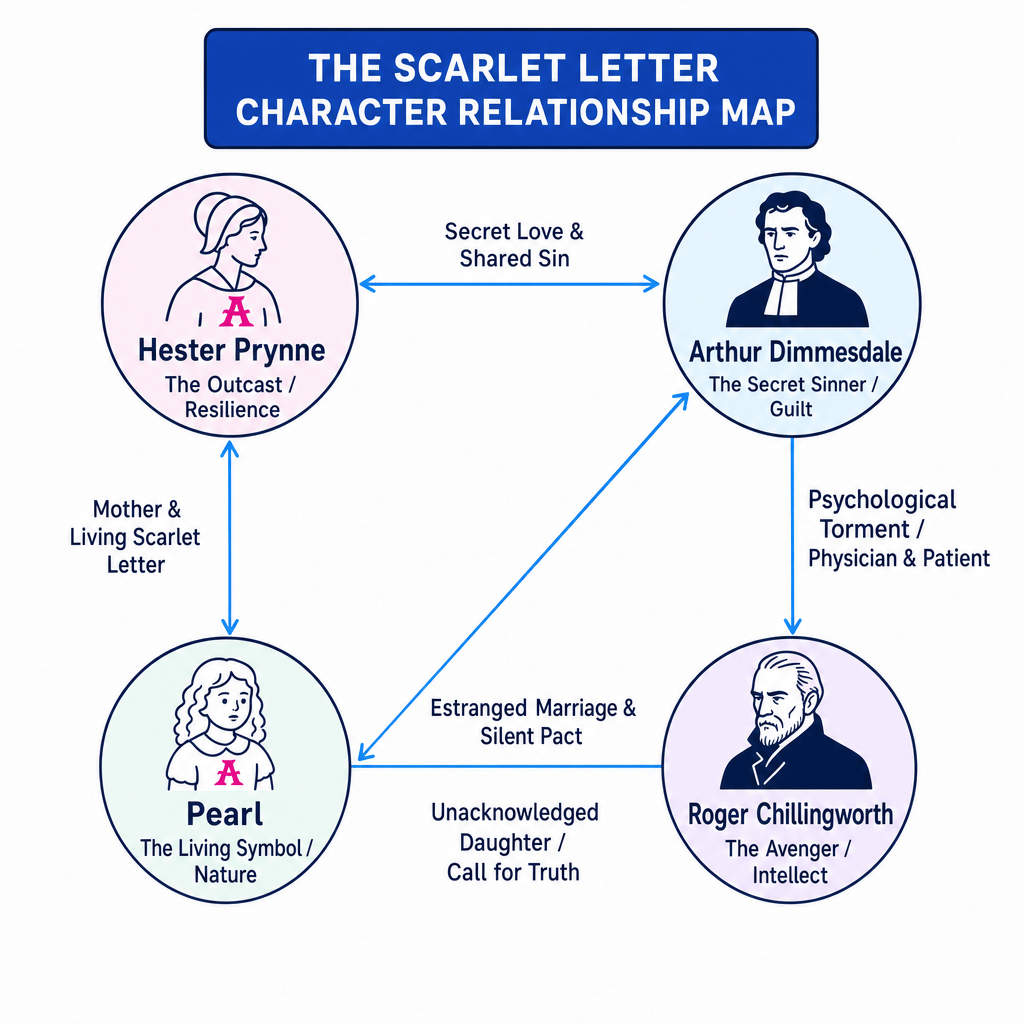
Hester Prynne: The Resilient Outcast
Hester is the emotional and moral heart of the novel. Sentenced to wear the scarlet letter "A" for committing adultery, she is physically and socially marginalised by the Puritan community.
The Symbolic Shifting of the Letter "A"
Initially, the Puritan magistrates intend for Hester’s scarlet letter to be a symbol of ignominy (shame) and sin. However, Hester’s resilience transforms its meaning over time:
- "Adultery" (Chapters 1–8): Hester is viewed as a living sermon against sin.
- "Able" (Chapters 13–18): Through her quiet charity, sewing, and strength, the townspeople begin to say the "A" stands for "Able," noting that it has "the effect of the cross on a nun's bosom."
- "Angel" / Prophetess (Chapter 24): By the end of the novel, the letter becomes a badge of wisdom. Women seek Hester out for counsel, transforming her into a symbol of empathy and proto-feminist hope.
Hester's Internal Rebellion
While Hester appears outwardly submissive to the town's laws, her mind remains completely free. Hawthorne notes that "the world's law was no law for her mind." Living on the outskirts of Boston, she develops a free-thinking, critical perspective on the patriarchal and religious institutions of her time, making her a highly modern protagonist.
Arthur Dimmesdale: The Tormented Minister
The Reverend Arthur Dimmesdale is Hester’s secret co-sinner and Pearl's father. While Hester's sin is public, Dimmesdale’s sin is private, leading to a devastating psychological decay.
The Hypocrisy of the Public Self
Dimmesdale represents the spiritual crisis of the Puritan community. He is revered by his congregation as a saintly, almost angelic figure, yet he knows he is a "hypocrite." The contrast between his holy public persona and his corrupt private reality causes him agonizing guilt.
The Self-Inflicted Penance
Unlike Hester, who grows stronger through public shame, Dimmesdale is consumed by his secret. He attempts to purge his guilt through hidden corporal punishment:
- Vigils: Staying awake all night, staring at his own face in a mirror.
- Fasting: Starving himself until his knees tremble.
- Scourging: Whipping himself in his secret closet.
His inability to confess publically acts as a spiritual cancer, showing Hawthorne’s critique of a Puritan system that values outward conformity over genuine inward truth.
The Paradox of Guilt
Hester’s public punishment isolates her but ultimately liberates her soul. Dimmesdale’s private guilt integrates him socially but completely destroys his physical and spiritual life.
Roger Chillingworth: The Cold Avenger
Roger Chillingworth is Hester’s long-lost husband who arrives in Boston under an assumed identity. Rather than demanding public justice, he chooses a path of secret, psychological vengeance against Dimmesdale.
The Corrupting Nature of Revenge
Chillingworth represents intellect divorced from human sympathy. He begins his investigation like a objective scientist or physician (often called a "leech" in the novel, a double entendre referring to both his medical profession and his parasitic drain on Dimmesdale's life). However, his obsession with revenge corrupts him completely.
The Physical Manifestation of Evil
Using the principle of physiognomy, Hawthorne physically transforms Chillingworth as his soul decays:
- Upon his arrival, he is described as having a slight physical deformity (one shoulder higher than the other).
- As his psychological torture of Dimmesdale intensifies, his face grows "darker," his eyes glow with a "blue flame," and his physical frame becomes more misshapen and stooped. He becomes a physical embodiment of the Devil (the "Black Man" of the forest).
Pearl: The Living Scarlet Letter
Pearl is the illegitimate daughter of Hester and Dimmesdale. Rather than being just a realistic child, Pearl is a highly complex allegorical force.
The Living Symbol
Pearl is the scarlet letter brought to life. Hester even dresses her in elaborate crimson tunics embroidered with gold thread, mirroring the design of the letter on her breast. Pearl is a constant, unavoidable reminder of the parents' sin, preventing either Hester or Dimmesdale from ever forgetting what they did.
Connection to Nature and Truth
Unlike the townspeople, who are governed by rigid social laws, Pearl is allied with the wild, untamed forest. She refuses to lie or fit into Puritan social structures.
- She acts as a catalyst for truth: she constantly asks Dimmesdale when he will hold her hand in the daylight on the scaffold, refusing to accept his affection in the dark forest where it is hidden.
- She only becomes a fully integrated "human" being when Dimmesdale finally confesses his sin on the scaffold at the end of the novel, kissing her in the light of day.
Treating Pearl as a regular child
Do not write about Pearl as if she is just a naughty or badly behaved child. Hawthorne uses her as an allegorical mirror. Her wild behaviour, her affinity for nature, and her unsettling questions are literary devices designed to expose the repressed guilt and hypocrisy of her parents and the Puritan state.
Analysing Characterisation in Your Essay
In the open-book exam (Component 2, Section B), you need to analyse how Hawthorne's linguistic and structural choices develop these characters (AO2) and reflect their context (AO4). Let's walk through a structural analysis of a character passage.
Analysing Chillingworth's Moral Decay
Read the following quotation from Chapter 14, where Hester confronts Chillingworth about his torment of Dimmesdale:
"there came a glare of red light out of his eyes; as if the old man’s soul were on fire, and kept on smoldering duskily within his breast, so that the reflection came through as in a passage of a chamber."
How does Hawthorne use language and imagery to characterise Chillingworth in this passage?
-
Formulate your main analytical point (AO1 / AO4): State clearly what the quotation reveals about Chillingworth’s character.
Example: "Hawthorne uses demonic visual imagery to illustrate Chillingworth’s total loss of humanity, showing how his obsessive quest for revenge has corrupted his soul, aligning him with the Puritan conception of the devil."
-
Identify the language methods (AO2): Locate specific literary devices and word choices within the quote.
Example: Look at the metaphor of his soul being "on fire" and "smoldering duskily," alongside the sensory noun "glare" and the colour adjective "red."
-
Analyse the effects of the language (AO2): Explain how these words construct his character and affect the reader.
Example: "The noun 'glare' suggests an unnatural, hostile light, while the 'red light' and 'soul on fire' evoke the flames of Hell. The verb 'smoldering' implies a slow, self-consuming destruction. Hawthorne’s use of the simile 'as in a passage of a chamber' suggests that Chillingworth’s body has become a mere vessel or cage for this internal, hellish rage, showing how revenge has hollowed out his original identity."
-
Integrate context and authorial purpose (AO4): Link this characterisation back to the wider themes and historical context of the novel.
Example: "For a 17th-century Puritan reader, this demonic imagery would immediately associate Chillingworth with the 'Black Man' of the forest, the literal devil. By physically manifesting Chillingworth's moral corruption, Hawthorne warns his 19th-century readers that intellectual brilliance, when stripped of Christian charity and empathy, inevitably leads to spiritual damnation."
In the exam
- Focus on character relationships: Do not write about characters in isolation. The Edexcel mark scheme rewards your ability to trace how characters act as foils to one another (e.g., Hester’s public strength vs. Dimmesdale’s private weakness).
- Utilise the open-book format: Since you have a clean copy of the text, do not waste time memorising giant passages. Instead, locate short, high-impact phrases (like "the world's law was no law for her mind") that you can unpack with precise linguistic terms (AO2).
- Always link to Context (AO4): Remember that Hawthorne wrote this in 1850 about a society in the 1640s. Explain why he presents characters this way—for instance, using Hester’s independence to critique both the historic Puritan rigidity and the mid-19th-century limitations placed on women.
Check yourself
- Why does Hester dress Pearl in ornate, crimson outfits, and how does this serve Hawthorne's allegorical purpose?
- Contrast the physical changes experienced by Dimmesdale and Chillingworth over the course of the novel. What do these changes tell us about their respective sins?
- How does the meaning of the scarlet letter "A" evolve through Hester's interactions with the Puritan community?