What you'll learn
- What “context” means for The Scarlet Letter and why it matters for AO4.
- How Puritan Boston shapes the novel’s treatment of sin, shame, punishment and secrecy.
- How Hawthorne’s own nineteenth-century viewpoint changes the way we read the seventeenth-century setting.
- How to use context in essays without turning your answer into a history lesson.
What is context?
Context
Context means the circumstances surrounding a text: the historical period, social attitudes, religious beliefs, political structures, literary traditions and the writer’s own background that help shape its meanings.
For Edexcel IGCSE English Literature, The Scarlet Letter appears in Component 2, Section B: Literary Heritage, which is open book. You may use a clean copy of the text, but you still need to know where key moments are and how to link them to Hawthorne’s methods.
Context is assessed through AO4, which means exploring the relationship between the text and its context. The key word is relationship: do not just bolt on facts. Show how context helps explain Hawthorne’s choices, characters, symbols and moral questions.
Context is not a fact dump
A strong context point explains how Hawthorne uses the world of Puritan Boston to create meaning — especially around sin, judgement, gender, secrecy and personal conscience.
The two time periods you must keep separate
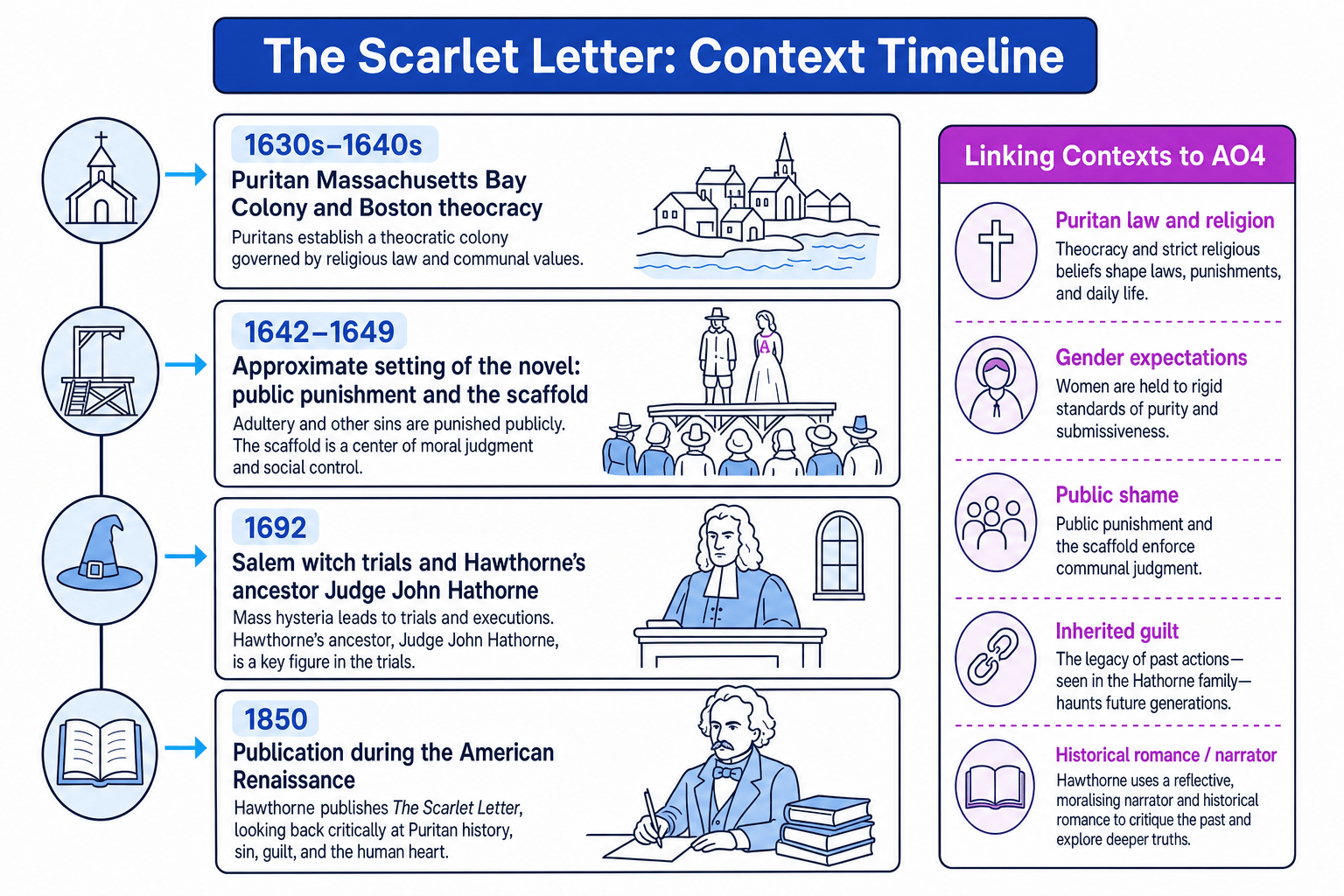
The Scarlet Letter was published in 1850, but it is set in seventeenth-century Puritan Boston, mainly around the 1640s. This matters because Hawthorne is not writing from inside Puritan society. He is looking back at it, judging it, questioning it and sometimes admiring its seriousness.
Mixing up Hawthorne and the Puritans
Do not write as if Hawthorne himself is a Puritan writer. He is a nineteenth-century American author using a Puritan setting to explore guilt, punishment, hypocrisy and the human heart.
Puritan Boston: religion, law and community
Puritanism
Puritanism was a Protestant Christian movement that aimed to “purify” the Church and daily life. In Hawthorne’s Boston, Puritan values are linked to strict moral discipline, fear of sin, public worship and close community surveillance.
Theocracy
A theocracy is a society where religious authority strongly shapes law and government. In the novel, Puritan Boston treats moral and religious wrongdoing as public legal wrongdoing.
Hawthorne presents Boston as a society where religion and law are almost fused. In Chapter 2, he describes the Puritans as “a people amongst whom religion and law were almost identical”. This explains why Hester’s adultery is not treated as a private matter. It becomes a public spectacle.
The opening of the novel makes this clear. Hawthorne says the founders of a new colony must quickly set aside land for “a cemetery” and “the site of a prison”. This is a bleak structural choice: before we meet Hester, we meet institutions of death and punishment.
Linking Puritan context to the prison-door
- Start with the contextual idea: Puritan Boston treats sin as a public danger, not just a private failing.
- Connect it to Hawthorne’s structural choice: he opens the novel with the prison, suggesting punishment is built into the foundations of the colony.
- Add precise evidence: the colony needs both “a cemetery” and “the site of a prison”, which makes death and discipline seem unavoidable.
- Analyse the effect: Hawthorne’s pairing of these places creates a grim tone and encourages the reader to question a society that begins with punishment rather than mercy.
- Link back to context: the Puritan setting helps Hawthorne explore how a religious community can become morally severe when it turns belief into public control.
Public shame and the scaffold
A major part of Puritan punishment in the novel is public shame. Hester is displayed on the scaffold wearing the scarlet letter “A”, which marks her as an adulteress.
Symbol
A symbol is an object, image or action that represents a larger idea. The scarlet letter is a symbol because it is a physical letter, but it also represents sin, shame, identity, punishment and later strength.
The scaffold is not just a setting. It is a public stage where the community performs judgement. Hawthorne’s repeated use of scaffold scenes gives the novel a clear structure: Hester is exposed at the start, Dimmesdale struggles with hidden guilt in the middle, and confession becomes unavoidable by the end.
This context helps you understand why Dimmesdale suffers so intensely. In a society where reputation and godliness are everything, his secret sin separates his public role from his private conscience.
A useful scaffold sentence
You can write: Hawthorne uses the Puritan practice of public punishment to contrast visible shame with hidden guilt, making Hester’s punishment external while Dimmesdale’s becomes psychological.
Gender expectations and Hester’s punishment
Seventeenth-century Puritan society was patriarchal, meaning men held most official authority in church, government and family life. Women were expected to be sexually pure, obedient and modest. Hester’s adultery therefore threatens more than a moral rule: it challenges male control over female behaviour.
Hawthorne makes Hester’s punishment visual. In Chapter 2, the letter is described as “fine red cloth” with “elaborate embroidery” and “fantastic flourishes of gold-thread”. This is important because Hester transforms a sign of shame into an artwork. Her needlework does not remove her punishment, but it shows her creativity and dignity.
Patriarchy
Patriarchy is a social system in which men hold most power and authority, especially in law, religion, family and public life.
Hester is not simply a victim. Over time, isolation makes her intellectually independent. Hawthorne writes in Chapter 13 that “The world’s law was no law for her mind.” This suggests that exclusion from society allows her to question society’s rules.
Using gender context to analyse Hester
- Identify the contextual pressure: Puritan patriarchy expects women to be sexually controlled and publicly modest.
- Link it to the text: Hester is forced to wear the scarlet letter so that her sexual sin is permanently visible.
- Analyse Hawthorne’s method: the detailed visual imagery of “elaborate embroidery” and “gold-thread” makes the letter beautiful as well as punitive.
- Explain the effect: Hester partly reclaims the symbol, so the reader sees her as artistically powerful rather than merely disgraced.
- Link to meaning: Hawthorne uses gender context to criticise a society that tries to reduce a woman to one sin, while showing Hester’s identity becoming more complex.
Making Hester too modern
It is fine to discuss gender, but avoid calling Hester a straightforward modern feminist heroine. Hawthorne presents radical ideas through her, but he also shows her as shaped by suffering, sin, motherhood and isolation.
Hawthorne’s family guilt and the Salem legacy
Hawthorne had personal reasons for being interested in Puritan judgement. One of his ancestors, John Hathorne, was a judge during the Salem witch trials of 1692. Hawthorne later added the “w” to his surname, and in “The Custom-House” he reflects uneasily on his ancestors’ harshness.
In that introductory section, he writes: “I, the present writer, as their representative, hereby take shame upon myself for their sakes”. This matters because the novel repeatedly explores whether guilt can pass through families, communities and history.
Chillingworth, Dimmesdale, Hester and Pearl are all affected by past actions that refuse to stay buried. Hawthorne’s own sense of inherited shame helps explain why the novel is so interested in memory, punishment and moral inheritance.
Inherited guilt
Hawthorne’s Puritan ancestry gives the novel a personal edge: he is not only describing a harsh past, but also asking how later generations should respond to historical wrongs.
1850 publication: looking back from a changing America
Although the novel is set in the 1640s, it was published in 1850, during a period often called the American Renaissance.
American Renaissance
The American Renaissance was a nineteenth-century flourishing of American literature, including writers such as Nathaniel Hawthorne, Herman Melville and Walt Whitman, who explored national identity, morality, history and individual freedom.
By 1850, America was changing rapidly: cities were growing, reform movements were active, and writers were thinking about what made American literature distinct from European traditions. Hawthorne turns to early New England history to ask deep moral questions about America’s origins.
The novel is also a historical romance.
Historical romance
A historical romance is a narrative set in the past that uses imagination, symbolism and heightened moral conflict rather than strict realism.
This helps explain why the scarlet letter sometimes feels almost supernatural, why Pearl can seem symbolic as well as realistic, and why the forest becomes a space of emotional and moral possibility. Hawthorne is not just recording Puritan life; he is shaping it into a symbolic story about secrecy, sin and truth.
Do not over-simplify Hawthorne’s judgement
Hawthorne criticises Puritan cruelty, but he does not present a simple “Puritans bad, individuals good” message. He is fascinated by the Puritans’ moral seriousness even while exposing their harshness and hypocrisy.
The narrator and “The Custom-House”
The novel begins with “The Custom-House”, where a narrator claims to discover the scarlet letter and an old manuscript. This frame creates distance between the reader and the Puritan past.
Frame narrative
A frame narrative is a story set around another story. It gives the main narrative a particular angle, voice or source.
The frame matters for context because it shows Hawthorne’s nineteenth-century narrator handling physical traces of history. The past is not dead; it presses on the present. When he imagines the letter’s “burning heat”, the symbol becomes emotionally alive across time.
This also prepares us for the novel’s final moral command: “Be true! Be true! Be true!” Hawthorne’s concern is not only with Hester’s society, but with every society that punishes appearance while hiding inner corruption.
How to write about context well
The safest approach is to move in this order:
- Make a point about the text.
- Add a short quotation.
- Analyse Hawthorne’s method.
- Bring in context to deepen the interpretation.
- Link back to the question.
Context sentence frame
Try this structure: Hawthorne’s Puritan setting intensifies this moment because… or Writing in 1850, Hawthorne looks back at Puritan Boston in order to question…
Turning context into analysis
- Point: Hawthorne presents public punishment as morally damaging, not simply just.
- Evidence: Boston is introduced through “a cemetery” and “the site of a prison”.
- Method: The paired nouns create a bleak symbolic opening, linking the colony with death and punishment.
- Context: In a Puritan theocracy, sin is treated as a threat to the whole community, so punishment becomes public and religiously justified.
- Link: Hawthorne therefore uses the historical setting to challenge a society that claims moral purity while making cruelty respectable.
In the exam
- Use context only when it changes your reading of a quotation, symbol, character or structural moment.
- Keep the two time periods clear: Puritan Boston in the 1640s is the setting; Hawthorne in 1850 is the writer looking back.
- Because Component 2 is open book, use the clean copy to find precise short quotations, but do not waste time copying long passages.
Check yourself
- How does the Puritan setting make Hester’s punishment public rather than private?
- Why is it important that Hawthorne writes in 1850 about events set in the 1640s?
- How could you link the scarlet letter as a symbol to gender expectations and social control?