What you'll learn
- How the main events of The Scarlet Letter fit together from the Custom-House frame to the final grave scene.
- How Hawthorne structures the plot around three scaffold scenes.
- How to summarise the plot without turning your essay into retelling.
- How key events support Edexcel AO1, AO2 and AO4 in the open-book Component 2 Literary Heritage exam.
Why plot matters
A plot is the sequence of events in a text, shaped by the writer to create meaning. In The Scarlet Letter, Nathaniel Hawthorne does not simply tell you “what happened”; he arranges events so that secrecy, guilt, public judgement and confession gradually become more intense.
For Edexcel IGCSE, plot knowledge helps AO1: close knowledge and understanding of the text. But strong answers do not just retell events. You use plot moments as evidence, then analyse Hawthorne’s methods — his symbolism, structure and narrative voice — for AO2, and connect the Puritan setting to context for AO4.
Plot is not just story
In an essay, plot is your foundation, not your final answer. You should know what happens, but your marks come from explaining why Hawthorne places events where he does and how those events shape the reader’s view of sin, punishment and identity.
The setting and frame narrative
Before the main story begins, Hawthorne gives us “The Custom-House”, a long introductory section. A frame narrative is a story-opening or outer narrative that presents the main story as something discovered, remembered or retold. Here, the narrator claims to find a faded scarlet letter and papers by Surveyor Pue, which supposedly inspire the tale of Hester Prynne.
This creates a distance between Hawthorne’s 19th-century narrator and the 17th-century Puritan world of the main plot.
Puritan
A Puritan was a member of a strict Protestant religious community that valued discipline, moral seriousness and obedience to religious law. In the novel, Puritan Boston is shown as a society where private sin becomes a matter of public punishment.
The main narrative then opens in Boston, Massachusetts, in the 1640s. The first images are a prison and a rose-bush. Hawthorne says the colony’s founders needed both “a cemetery” and “the site of a prison”, suggesting that death and punishment are built into this society from the beginning.
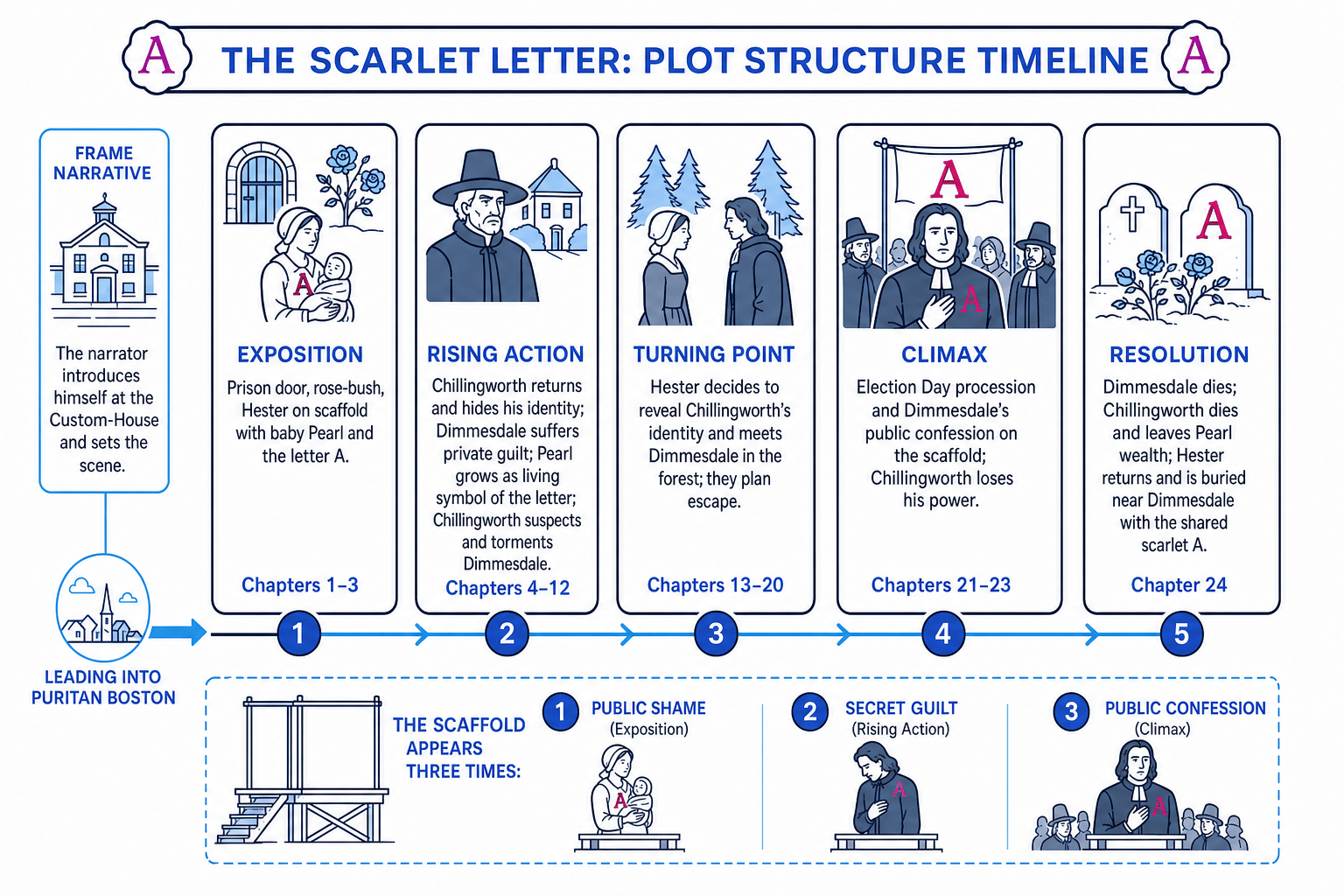
The diagram below shows the big movement of the plot: from public shame, through hidden guilt, to public confession and aftermath.
Plot-shape vocabulary
You do not need to force these words into every paragraph, but they are useful for organising your understanding.
Plot structure
Exposition introduces the setting, characters and central problem. Rising action develops the conflict. The climax is the most intense turning point. The resolution shows the consequences after the climax.
In The Scarlet Letter, the exposition is Hester’s public punishment. The rising action is Dimmesdale’s hidden guilt and Chillingworth’s revenge. The climax is Dimmesdale’s public confession. The resolution is the aftermath of his death and Hester’s return.
1. Exposition: the prison, the letter and the scaffold
The main plot begins with Hester Prynne leaving prison, carrying her baby Pearl. She has been found guilty of adultery, but the father of the child is unknown. As punishment, she must stand on a scaffold, a raised platform used for public shame, and wear the embroidered scarlet letter “A” on her chest.
Hawthorne describes the letter as appearing “in fine red cloth” on “the breast of her gown”. This makes the letter both a punishment and a visual symbol. A symbol is an object, person or place that represents a larger idea. The letter literally stands for adultery, but across the novel it comes to carry many meanings: shame, identity, strength, suffering and social judgement.
Hester’s husband, Roger Prynne, appears in the crowd after being absent for years. He hides his identity and later calls himself Roger Chillingworth. Hester refuses to name Pearl’s father, saying “Never!” and protecting Arthur Dimmesdale, the young minister who is secretly guilty.
Forgetting who knows what
At the start, the town knows Hester has sinned, but it does not know Dimmesdale is Pearl’s father. Chillingworth quickly suspects there is a hidden partner in guilt, but he keeps his own identity as Hester’s husband secret.
2. Rising action: secrecy, revenge and inner punishment
After the scaffold scene, Chillingworth visits Hester in prison and demands that she keep his identity secret. He becomes a physician and settles in Boston. His new name matters: “Chillingworth” suggests coldness, emotional cruelty and a life drained of warmth.
Dimmesdale, meanwhile, becomes increasingly weak and tormented. He is respected by the community as a holy minister, but privately he is guilty and frightened. Hawthorne creates dramatic irony, which means the reader knows something important that many characters do not. We know Dimmesdale is guilty, while the Puritan congregation continues to admire him.
Chillingworth moves closer to Dimmesdale and acts as his doctor. However, his “care” becomes psychological torture. Hawthorne compares him to someone digging into another man’s heart “like a miner searching for gold”, which shows that Chillingworth’s investigation is invasive and morally corrupt.
Pearl also grows up during this section. She is not just Hester’s child; she becomes a living reminder of the scarlet letter. Hawthorne calls her “the scarlet letter in another form”, making her part of the novel’s symbolism.
3. The middle scaffold scene: secret guilt
In Chapter 12, Dimmesdale goes to the scaffold at night. This is a crucial structural moment because it mirrors Hester’s public punishment, but changes it. Hester had to stand there in daylight; Dimmesdale stands there in darkness, unable to confess openly.
Pearl asks whether he will stand there with Hester and her “to-morrow noontide”. He refuses. This shows the gap between private guilt and public truth. The plot is moving towards confession, but Dimmesdale is not ready yet.
Motif
A motif is a repeated image, object, place or idea that gains meaning each time it returns. The scaffold is a major motif because it appears at key stages of shame, secrecy and confession.
Linking the scaffold scenes to structure
-
In the first scaffold scene, Hester is exposed publicly while Dimmesdale remains outwardly respectable. This creates a structural contrast between visible shame and hidden guilt.
-
In the night scaffold scene, Dimmesdale finally stands where he should have stood earlier, but only in darkness. The setting shows that his confession is still incomplete.
-
In the final scaffold scene, Dimmesdale stands publicly with Hester and Pearl. His cry of “At last!” signals that the delayed confession has finally happened.
-
The repeated scaffold therefore turns the plot into a moral progression: Hawthorne shows that concealed sin damages the soul more deeply than public shame.
4. Hester’s changing position
As years pass, Hester lives on the edge of town and supports herself through needlework. She also helps the poor and sick. The community’s view of her slowly changes. In Chapter 13, people begin to say the letter means “Able” because “so strong was Hester Prynne”.
This does not mean Puritan society becomes generous or modern. Hester is still isolated. However, Hawthorne shows that identity is not fixed by one public label. The letter “A” begins as a punishment imposed by society, but Hester’s endurance changes how it is read.
Use the letter as a plot marker
When revising, track what the scarlet letter means at different stages: first Adultery, then public shame, then Hester’s ability, and finally a mysterious emblem on the shared grave.
5. Turning point: the forest meeting
A turning point is a moment when the direction of the plot changes significantly. The key turning point comes when Hester decides she can no longer let Chillingworth secretly torment Dimmesdale. She reveals that Chillingworth is her husband.
Hester and Dimmesdale meet in the forest, away from the town. The forest contrasts with Puritan Boston: it is less controlled, more private and more emotionally honest. They plan to escape together to Europe with Pearl after Dimmesdale delivers the Election Sermon.
For a moment, Hester removes the scarlet letter. Hawthorne writes that “the stigma gone” and “her beauty” returns. But Pearl refuses to approach until Hester puts the letter back on. Plot-wise, this stops the forest scene from becoming a simple happy escape. Symbolically, Pearl insists that Hester cannot simply remove the past.
6. Climax: Election Day and Dimmesdale’s confession
The climax is the point of greatest intensity. In The Scarlet Letter, this is Dimmesdale’s public confession on Election Day.
At first, escape seems possible. Then Hester learns that Chillingworth has arranged to travel on the same ship, so he would continue to control them. Dimmesdale gives a powerful Election Sermon, but afterwards he mounts the scaffold and calls Hester and Pearl to him.
He finally admits his guilt before the community. He says, “At last!—at last!—I stand upon the spot where, seven years since, I should have stood.” This line is vital because it links the climax directly back to the opening punishment scene. The plot has come full circle.
Dimmesdale dies shortly after confessing. Pearl kisses him, and Hawthorne writes that “a spell was broken”. This suggests that Pearl’s strange, symbolic role is released once the truth is spoken.
7. Resolution: aftermath and the final emblem
The resolution shows what happens after the central conflict has reached its climax. Chillingworth loses his purpose once Dimmesdale has confessed and died. He withers and dies within a year, leaving wealth to Pearl.
Pearl leaves for Europe and appears to live a happy adult life. Hester also leaves Boston, but later returns to her old cottage and puts the scarlet letter on again. This is important: she is no longer forced to wear it in the same way, but she chooses to return as someone who understands suffering and can counsel other women.
The novel ends with Hester being buried near Dimmesdale. Their shared tombstone bears the words: “On a field, sable, the letter A, gules.” In heraldic language, this means a red letter A on a black background. The final image keeps the letter’s meaning unresolved: it is still about sin, but also about memory, identity and human sympathy.
The plot in one paragraph
Hawthorne frames the story through a narrator who discovers the scarlet letter, then takes us back to Puritan Boston. Hester Prynne is punished for adultery by standing on a scaffold with her baby Pearl and wearing the letter “A”, while she refuses to name Arthur Dimmesdale as the father. Her husband returns secretly as Roger Chillingworth and devotes himself to discovering and tormenting Dimmesdale. Over seven years, Hester becomes stronger, Pearl grows into a living symbol of the letter, and Dimmesdale’s guilt destroys him. Hester reveals Chillingworth’s identity, meets Dimmesdale in the forest, and plans an escape with him. On Election Day, however, Dimmesdale publicly confesses on the scaffold and dies. Chillingworth dies soon after, Pearl inherits his wealth, and Hester eventually returns to Boston, where the letter remains as a complex symbol of sin, suffering and endurance.
In the exam
-
Use plot events as evidence, not as the whole answer: make a point, refer briefly to the event, then analyse Hawthorne’s method and meaning.
-
Remember that The Scarlet Letter is in Component 2, so it is open book with a clean copy allowed, but you still need secure plot knowledge to find relevant moments quickly.
-
When writing about structure, use the three scaffold scenes: public shame, secret guilt and public confession give you a clear way to discuss the whole novel.
Check yourself
- Why does Dimmesdale’s night scaffold scene not count as a full confession?
- How does Chillingworth’s role change after he returns to Boston?
- What changes about the meaning of the scarlet letter by the end of the novel?