What you'll learn
- How The Scarlet Letter is set up: plot, setting, form and narrative voice.
- Why the scarlet “A”, the scaffold and the Puritan community matter so much.
- How to connect overview knowledge to Edexcel IGCSE Literature assessment.
- How to avoid writing context without analysis.
The novel at a glance
Nathaniel Hawthorne’s The Scarlet Letter was published in 1850, but it is set much earlier, in seventeenth-century Puritan Boston. The story centres on Hester Prynne, a woman punished for adultery — a sexual relationship outside marriage — by being forced to wear a scarlet letter “A” on her clothing.
For Edexcel International GCSE English Literature, The Scarlet Letter is studied as a literary heritage text in Component 2, Section B. This section is open book, so you may use a clean copy of the text in the exam. However, “open book” does not mean “easy”: you still need close knowledge, precise references, and strong analysis of Hawthorne’s methods.
Literary heritage text
A literary heritage text is a work from an earlier literary tradition that has lasting cultural and literary significance. In this exam, you need to show secure understanding of the text, analyse language/form/structure, and link relevant context to meaning.
The starting point: public shame and hidden guilt
The novel begins outside a prison. Hawthorne immediately links the new Puritan colony with punishment: among its “earliest practical necessities” are a cemetery and a prison. This creates a severe moral atmosphere before Hester even appears.
A Puritan was a Protestant Christian who wanted strict religious reform and moral discipline. In the novel, Puritan Boston is shown as a society where religion, law and public reputation are tightly connected.
Hester is displayed on the scaffold with her baby, Pearl. The letter is described in Chapter 2, “The Market-Place”, as “fine red cloth” with “fantastic flourishes of gold-thread”. This matters because the punishment is not plain or hidden: it is made beautiful, visible and public.
The central conflict
Hawthorne builds the novel around a contrast between public punishment and private guilt. Hester’s sin is visible on her clothing; Dimmesdale’s is hidden inside him.
Plot overview: the scaffold pattern
A scaffold is a raised public platform used for punishment, confession or execution. In The Scarlet Letter, the scaffold becomes one of the novel’s most important structural features.
Structure means the way a writer arranges a text: the order of events, repeated scenes, contrasts and patterns. Hawthorne uses three major scaffold scenes to organise the moral journey of the novel.
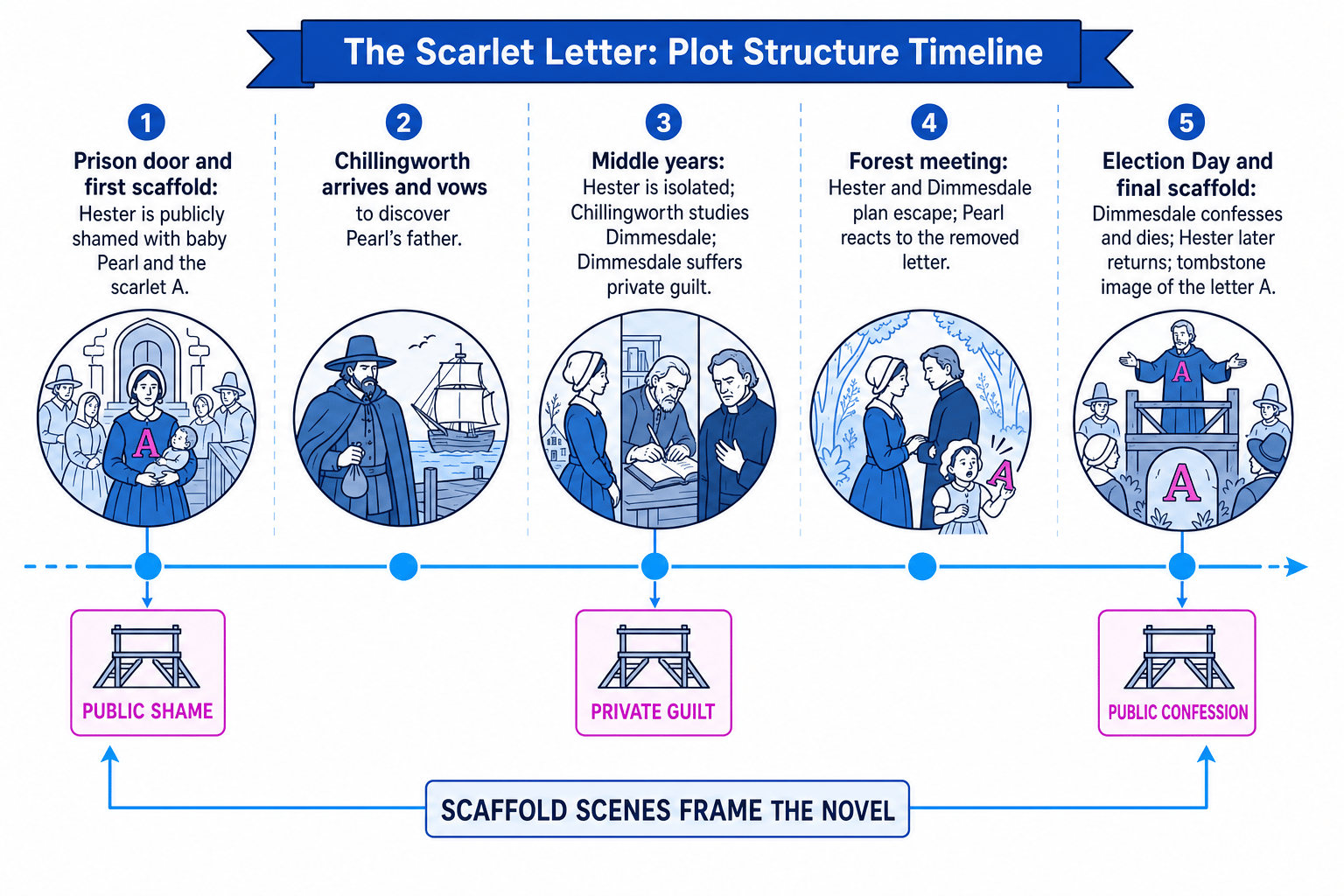
The three scaffold scenes move from Hester’s public shame, to Dimmesdale’s secret guilt, to his final public confession. This gives the novel a clear moral shape.
Tracing the scaffold pattern
-
In Chapter 2, Hester stands on the scaffold while Dimmesdale remains outwardly respected. The structure separates visible guilt from hidden guilt, making the reader aware that public judgement is incomplete.
-
In Chapter 12, “The Minister’s Vigil”, Dimmesdale stands on the scaffold at night with Hester and Pearl. Pearl asks whether he will stand there with them “to-morrow noontide”, so Hawthorne contrasts a private moment of guilt with the public confession Dimmesdale still avoids.
-
In Chapter 23, “The Revelation of the Scarlet Letter”, Dimmesdale finally moves towards the scaffold and confesses before the community. His action completes the structural pattern: what was secret becomes public.
-
The pattern helps you argue that the novel is not only about “sin”, but about the painful difference between being judged by society and facing the truth before God, the community and oneself.
Main characters in overview
Hester Prynne is the novel’s central figure. She is punished by society, but she is also presented with dignity, strength and independence. Over time, the community’s view of her changes: in Chapter 13, “Another View of Hester”, people even say that the “A” means “Able”.
Arthur Dimmesdale is the respected minister who secretly shares Hester’s guilt. His suffering is inward: Hawthorne uses his physical weakness and emotional torment to explore conscience.
Roger Chillingworth is Hester’s husband, who returns to Boston and conceals his identity. He becomes obsessed with discovering and punishing Pearl’s father. His revenge gradually corrupts him.
Pearl is Hester’s child. She is not just a realistic child character; she also works symbolically. Hawthorne famously describes her in Chapter 7, “The Governor’s Hall”, as “the scarlet letter endowed with life!” In other words, Pearl is a living reminder of Hester’s sin, punishment and love.
Form: a romance, not just a realistic novel
The full title is The Scarlet Letter: A Romance. Here, romance does not simply mean a love story. In nineteenth-century literary terms, a romance is a form of prose fiction that allows heightened symbolism, moral patterning, mystery and coincidence.
A symbol is an object, person, place or action that represents a larger idea. The scarlet letter is the central symbol of the novel, but its meaning changes. It begins as a label of shame, but later becomes connected with strength, identity and endurance.
An allegory is a story in which characters or events suggest a second level of moral or spiritual meaning. The Scarlet Letter is not a simple one-to-one allegory, but it often encourages us to read people and places symbolically: Hester can suggest endurance, Dimmesdale hidden guilt, Chillingworth revenge, and Pearl living consequence.
Reading the changing letter A
-
In Chapter 2, the letter is introduced as a public punishment: “On the breast of her gown” appears the “letter A”. Hawthorne turns an abstract moral judgement into a visible symbol on Hester’s body.
-
The detail of “gold-thread” complicates the punishment. The letter is meant to shame Hester, but its beauty also suggests her creativity, defiance and individuality.
-
Pearl develops the symbol further when she is called “the scarlet letter endowed with life!” The symbol is no longer only cloth; it becomes connected to motherhood, love and living consequence.
-
By Chapter 13, when people say the letter means “Able”, the symbol has changed through the novel’s structure. Hawthorne shows that meaning is not fixed: society can label a person, but time and character can alter that label.
Narrative voice and ambiguity
The narrative voice is the “voice” that tells the story. Hawthorne uses a thoughtful, sometimes ironic third-person narrator: the narrator is not Hester, Dimmesdale or Chillingworth, but someone outside the action who comments on them.
The novel also has a framing section, “The Custom-House”, where the narrator claims to have found “a certain affair of fine red cloth” and an old manuscript. A frame narrative is a story setup that presents the main story as discovered, remembered or retold. This gives the novel a feeling of historical distance.
Hawthorne often uses ambiguity, which means deliberate uncertainty or openness to more than one interpretation. For example, near the end, readers are not given one simple, fully settled explanation of what appears on Dimmesdale’s chest. This uncertainty is part of the novel’s power: Hawthorne wants you to think about guilt, truth and interpretation, not just collect plot facts.
Setting and context
Context means the historical, social, religious and biographical circumstances that help us understand a text. The key contextual point is that Hawthorne, writing in 1850, looks back at Puritan New England from a later perspective. He is fascinated by Puritan seriousness, but also critical of cruelty, public shaming and moral rigidity.
The setting matters because Boston is not just a background location. It shapes the plot. A community that believes sin must be exposed creates Hester’s punishment; a culture that prizes spiritual authority makes Dimmesdale’s secrecy especially destructive.
Turning context into a paragraph dump
Do not write a long paragraph about Puritans and then forget the novel. Link context to Hawthorne’s choices: the prison, the scaffold, the public crowd, religious language, and the pressure on reputation.
Big ideas to carry into later study
You will explore themes in more detail elsewhere, but for an overview you should keep these central ideas in mind:
- Sin and guilt: Hester’s guilt is publicly marked; Dimmesdale’s is inward and corrosive.
- Judgement and hypocrisy: the community punishes Hester, but it cannot see the full truth.
- Identity and transformation: the meaning of the scarlet letter changes as Hester’s life changes.
- Revenge: Chillingworth’s desire to punish Dimmesdale damages his own humanity.
- Nature and society: the town often represents law and judgement, while the forest allows more private, emotional truth.
How to use this overview in the exam
In Component 2, Section B, you need to write with clear personal understanding of the whole text. This is AO1. You also need to analyse Hawthorne’s language, form and structure — for example, symbolism, the scaffold pattern, narrative voice and ambiguity. This is AO2. Because The Scarlet Letter is a literary heritage text, relevant context also matters: you should connect Puritan beliefs, public punishment and Hawthorne’s later viewpoint to your interpretation. This is AO4.
A strong paragraph usually moves through: point, short evidence, method, effect, and link back to the question. The overview helps you choose the right “big moment” quickly: prison door, first scaffold, Dimmesdale’s vigil, forest meeting, final scaffold, or Hester’s return.
Open book does not mean quotation hunting
Use your clean copy to check exact wording, but revise the locations of key moments. If you spend the exam searching from scratch, you will lose thinking and writing time.
In the exam
-
Start from the question, then choose one or two major moments that fit it: the scaffold scenes, the letter’s changing meaning, or the contrast between town and forest.
-
Keep quotations short and precise. Analyse Hawthorne’s method — symbol, structure, narrative voice, contrast or ambiguity — rather than retelling the plot.
-
Use context only when it sharpens your point about the text: Puritan law, public shame, religious authority and Hawthorne’s later critical perspective.
Check yourself
- How do the three scaffold scenes change from the beginning to the end of the novel?
- What different meanings can the scarlet letter “A” take on as the story develops?
- How does Hawthorne’s later perspective on Puritan Boston affect the way we judge the community?