What you'll learn
- How to turn a Great Expectations question into a clear argument.
- How to build paragraphs that cover AO1, AO2 and AO4 naturally.
- How to use short, accurate quotations from the open-book text without wasting time.
- How to adapt a model plan to different character and theme questions.
What makes a model essay?
A model essay is not a paragraph you memorise and force into every question. It is a clear, developed answer that shows you understand Dickens’s novel and can explain how he creates meaning.
For Great Expectations, you answer in Component 2: Modern Drama and Literary Heritage. This section is open book, meaning you may use a clean copy of the novel in the exam. However, “open book” does not mean “no revision”: you still need to know the key moments, chapters and quotations well enough to find them quickly.
Model essay
A model essay is a high-quality example answer that uses a clear argument, precise textual references, analysis of Dickens’s methods, and relevant context.
A strong Great Expectations essay usually does three things at once: it shows close knowledge of the novel, analyses Dickens’s language/form/structure, and links ideas to relevant Victorian context.
The essay’s job
Your essay should prove a personal argument about Dickens’s choices — not simply retell what happens to Pip.
The structure below shows how a strong answer can move from the question to a developed conclusion.
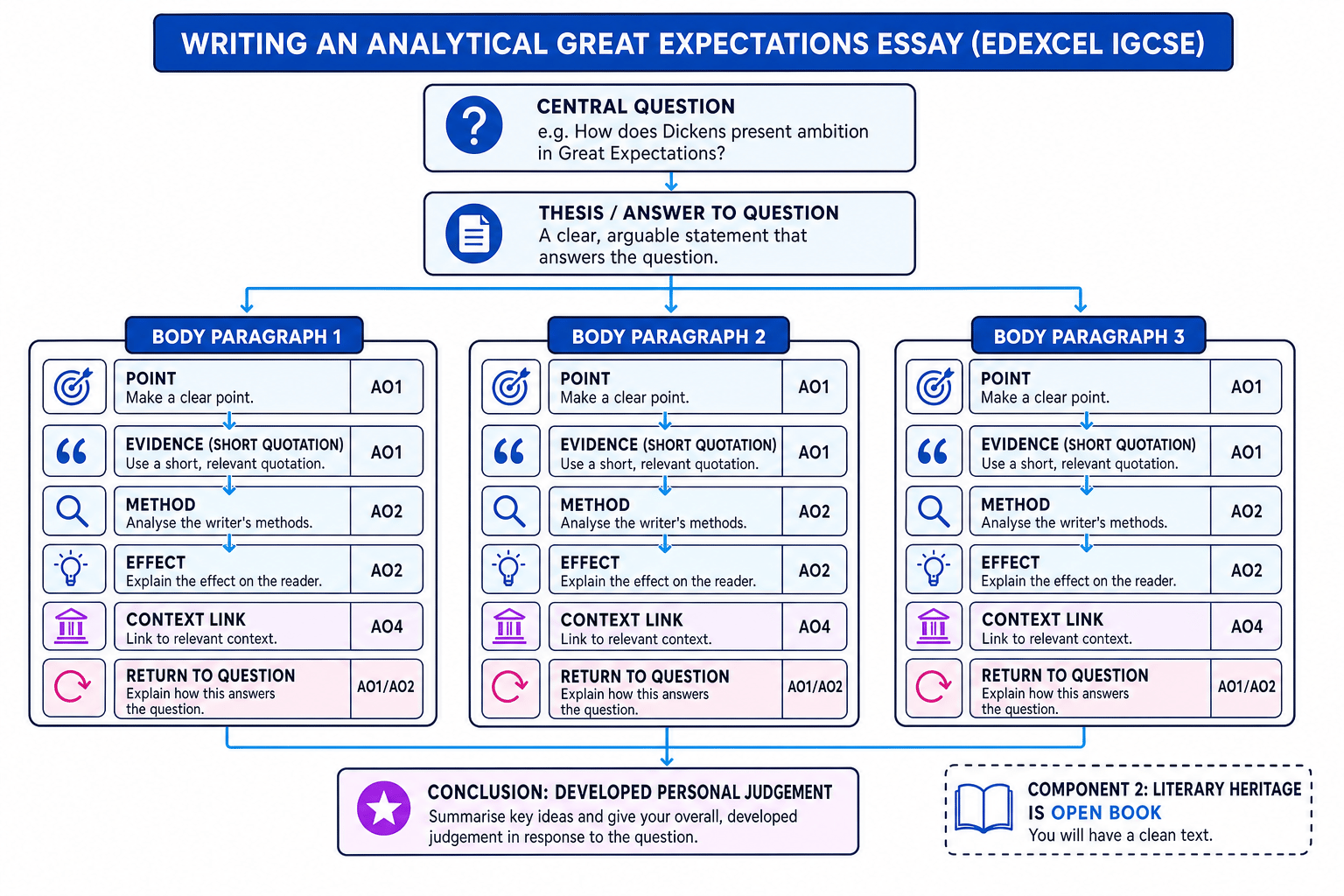
Step 1: Read the question as an invitation to argue
Most Great Expectations questions ask how Dickens presents a character, relationship, setting or theme.
Presentation
Presentation means the way a writer constructs an idea through events, language, imagery, characterisation, narrative voice, structure and context.
So if the question asks, “How does Dickens present social class?”, it is not asking for everything you know about Victorian class. It is asking what Dickens seems to be saying about class, and how he makes the reader think or feel that.
Unpacking a question on social class
-
Narrow the focus: social class in Great Expectations includes wealth, gentility, education, manners, labour, shame and respectability.
-
Decide Dickens’s attitude: Dickens does not simply admire higher status. He often shows that “gentlemanly” appearance can hide selfishness, while working-class characters such as Joe may show deeper moral goodness.
-
Choose moments across the novel: Pip’s shame after Satis House in Chapter 8, Joe’s uncomfortable London visit in Chapter 27, and Magwitch’s revelation in Chapter 39 all help build the argument.
-
Identify useful methods: Dickens uses first-person retrospective narration, contrast, irony and symbolism to expose the false values Pip learns.
Step 2: Shape a thesis, not just a topic
A thesis is your central argument: your answer to the question in one or two sentences. It should be arguable, not obvious.
Weak thesis: Dickens presents social class as important.
Better thesis: Dickens presents social class as a damaging illusion because Pip learns to value status above love, before discovering that real worth comes from loyalty, compassion and moral courage.
Thesis
A thesis is the main argument your whole essay will prove. Each paragraph should develop part of it.
Turning an idea into a thesis
-
Start with the basic idea: Pip wants to become a gentleman because he feels ashamed of being “common”.
-
Add Dickens’s judgement: the novel criticises this ambition because it makes Pip ungrateful and emotionally blind.
-
Add development: Pip’s values change after Magwitch’s return, when he learns to care for the man he first feared.
-
Turn it into a thesis: Dickens presents ambition as morally dangerous when it is based on class shame, but he also uses Pip’s growth to show that self-knowledge and compassion are possible.
Use the whole novel
A strong plan often uses one early moment, one middle moment and one later turning point. This helps you avoid writing only about Pip’s childhood or only about the ending.
Step 3: Plan paragraphs around Dickens’s methods
A method is a deliberate writer’s choice. In Great Expectations, useful methods include narrative voice — the voice telling the story — and symbolism, where an object, place or character represents a bigger idea.
The novel is narrated by an older Pip looking back on his younger self. This is called retrospective narration: a narrator tells past events with later knowledge and judgement. It allows Dickens to show both Pip’s childish feelings and his adult regret.
Here is a model plan for the question: How does Dickens present ambition in Great Expectations?
| Paragraph focus | Evidence | Method | What it proves |
|---|---|---|---|
| Pip’s ambition begins in shame | Pip notices his “coarse hands” and “common boots” after visiting Satis House in Chapter 8 | Adjectives and retrospective narration | Dickens shows ambition growing from humiliation and class prejudice |
| Ambition damages Pip’s relationships | Joe says, “I’m wrong in these clothes” during his London visit in Chapter 27 | Contrast between Joe’s honesty and Pip’s artificial gentility | Dickens suggests social ambition can make Pip reject genuine love |
| Magwitch’s return exposes false gentility | Magwitch says, “I’ve made a gentleman on you!” in Chapter 39 | Irony and plot reversal | Dickens reveals that Pip’s status depends on a criminalised outsider, challenging Victorian respectability |
| Pip’s moral education changes him | Pip sees Magwitch as “a much better man than I had been to Joe” near the end of the novel | First-person reflection | Dickens values compassion above class ambition |
Retelling the plot
Do not write, “Pip goes to Satis House, then he goes to London, then Magwitch returns.” Instead, explain how each moment develops Dickens’s message about ambition, class or moral growth.
Step 4: Write paragraphs that zoom in and zoom out
A strong paragraph should zoom in on a short quotation, then zoom out to the whole novel and context.
AO1 is shown through your understanding and references. AO2 is shown when you analyse Dickens’s language, form or structure. AO4 is shown when context helps explain the meaning, not when it is bolted on as random history.
Building a paragraph on Pip’s ambition
-
Make a precise point: Pip’s ambition begins less as confidence and more as shame after Estella teaches him to see himself through class prejudice.
-
Select short evidence: after his first visit to Satis House, Pip looks at his “coarse hands” and “common boots” in Chapter 8.
-
Analyse Dickens’s method: the adjectives “coarse” and “common” turn ordinary signs of labour into signs of inferiority, showing that Pip has absorbed Estella’s snobbery.
-
Link to form and context: because adult Pip narrates retrospectively, Dickens can expose the pain and foolishness of Victorian ideas of gentility.
-
Combine the thinking into a paragraph: Dickens first presents Pip’s ambition as the result of humiliation rather than natural selfishness. After Estella mocks him at Satis House, Pip looks at his “coarse hands” and “common boots”. The paired adjectives suggest that Pip now sees his body and clothing as evidence of low status. Ordinary signs of work become, in his imagination, marks of shame. Through retrospective narration, Dickens allows the older Pip to reveal how quickly a child can internalise class prejudice. This criticises a society in which Miss Havisham’s decaying upper-class world appears more desirable than Joe’s loving forge.
Device-spotting
Do not just write, “Dickens uses adjectives.” Always explain what the words make the reader understand about Pip, society or Dickens’s message.
Step 5: Use context only when it sharpens the argument
Context means the circumstances surrounding the text: the society Dickens writes about, the values of the period, and the experiences or debates that shape the novel.
For Great Expectations, useful context includes Victorian class anxiety, ideas of the “gentleman”, harsh criminal justice, transportation, poverty, and respectability. But context must be connected to Dickens’s choices.
Adding context to Magwitch
-
Begin with the textual point: Magwitch’s line “I’ve made a gentleman on you!” shocks Pip because his wealth comes from the transported convict he once feared.
-
Connect to context: in Dickens’s society, criminals and the poor were often treated as morally inferior, while gentlemen were assumed to be respectable.
-
Explain Dickens’s challenge: by making Magwitch Pip’s secret benefactor, Dickens overturns those assumptions and suggests that generosity can exist outside respectable society.
Bolted-on context
A sentence like “Victorian England had different social classes” is too general. Better context explains how class prejudice shapes Pip’s shame or how transportation shapes Magwitch’s exclusion.
Step 6: Model introduction and conclusion
For a question on ambition, a model introduction might sound like this:
Throughout Great Expectations, Dickens presents ambition as morally dangerous when it is driven by shame and social insecurity. Pip’s desire to become a gentleman begins after Estella makes him feel “common”, but it leads him to undervalue Joe’s love and mistake gentility for goodness. Through Magwitch’s return, Dickens challenges Victorian ideas of respectability and suggests that true moral worth is measured by loyalty and compassion, not class.
Notice that this introduction answers the question immediately. It names Dickens’s overall message and hints at the essay’s route through the novel.
A model conclusion might sound like this:
By the end of the novel, Dickens does not simply condemn Pip’s ambition; he educates him through suffering and remorse. Pip’s movement from shame about his “common boots” to recognising Magwitch as “a much better man than I had been to Joe” shows a complete change in values. The novel finally rejects shallow gentility and presents moral growth as the true “great expectation”.
Adapting the model to other questions
You can adapt the same structure to many Great Expectations questions.
If the question is about Pip’s development, remember that the novel is a Bildungsroman — a novel about a character’s growth and moral education. Use early fear on the marshes, shame at Satis House, corruption in London, and later repentance.
If the question is about Miss Havisham, focus on symbolism. Her decaying wedding dress and stopped life show emotional imprisonment. Pip describes how “the bride within the bridal dress had withered like the dress” in Chapter 8, which makes her personal grief seem physically built into Satis House.
If the question is about Magwitch, focus on Dickens’s challenge to social judgement. He first appears as “a fearful man” in Chapter 1, but later becomes a figure of loyalty and sacrifice. This structural change forces the reader, like Pip, to rethink moral worth.
Short quotations are stronger
Use brief quotations you can analyse closely: “coarse hands”, “common boots”, “I have no heart”, “What have I done!”, “made a gentleman on you”. Long copied passages usually lead to less analysis.
In the exam
-
Spend a few minutes planning a thesis and three whole-novel points before you begin writing.
-
Use your clean copy to check short quotations, but do not waste time hunting for perfect lines; accurate brief references are enough.
-
In every paragraph, move from point → evidence → method → effect → context → link back to the question.
Check yourself
-
Can you write a one-sentence thesis for a question on Pip’s ambition or social class?
-
Can you explain how “coarse hands” and “common boots” reveal more than just Pip’s appearance?
-
Can you add context about Victorian gentility or criminal justice without turning it into a history paragraph?