What you'll learn
- How to turn a The Scarlet Letter question into a clear, arguable essay plan.
- How to choose moments from across the whole novel, not just one memorable scene.
- How to build paragraphs that cover close knowledge, methods and context.
- How to adapt ready-made plans for common themes such as guilt, punishment, symbolism and Puritan society.
Why essay plans matter for The Scarlet Letter
In Edexcel International GCSE English Literature, The Scarlet Letter is a Component 2 literary heritage text. That means the exam is open book: you may use a clean copy of the novel. However, open book does not mean “easy”. You still need to know the novel well enough to move quickly to the right chapters, choose brief evidence, and build an argument.
Essay plan
An essay plan is a compressed map of your answer: your main argument, your paragraph order, the evidence you will use, and the writer’s methods you will analyse.
A good plan stops you from simply retelling the plot. Hawthorne’s novel is full of symbols, repeated scenes and moral questions, so your plan should show how ideas develop across the whole text.
Plan for an argument, not a tour
Your essay should not move through the novel saying “first this happens, then this happens”. It should answer the question by showing how Hawthorne shapes the reader’s response to sin, guilt, punishment, identity or society.
Use this planning flow whenever you meet a question on The Scarlet Letter.
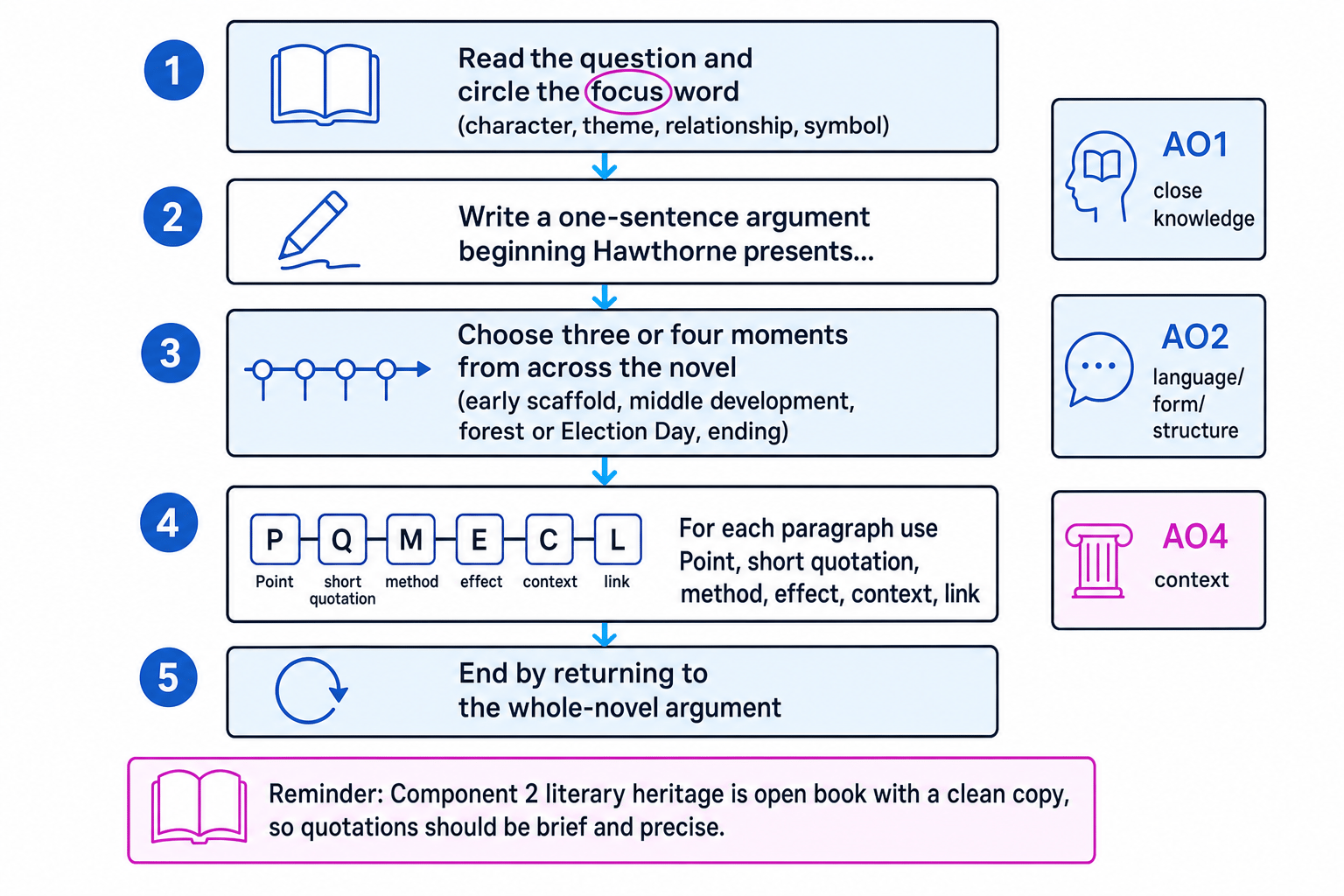
Know what the examiner is rewarding
The assessment objectives are the skills the mark scheme rewards. For The Scarlet Letter, you need close knowledge and a personal response, precise analysis of Hawthorne’s language, form and structure, and relevant context.
In practice, that means:
- you know the novel well enough to select meaningful references;
- you analyse methods, meaning the writer’s choices of language, form or structure;
- you connect ideas to context, especially Puritan Boston, public punishment, religion, gender expectations and Hawthorne’s later nineteenth-century viewpoint.
Use the open book wisely
Because the exam allows a clean copy, you can check exact wording, but you should still memorise flexible short quotations such as “They said that it meant Able”, “Be true! Be true! Be true!” and “the scarlet letter endowed with life”.
Step 1: Turn the question into a thesis
Thesis
A thesis is your one-sentence answer to the question. It should make a judgement about what Hawthorne presents and why it matters.
Weak thesis: “Hawthorne presents guilt in many ways.”
Stronger thesis: “Hawthorne presents hidden guilt as more spiritually destructive than public shame, especially through Dimmesdale’s collapse and Hester’s painful but strengthening honesty.”
The stronger version gives you a direction. It already suggests contrast, character development and a whole-novel argument.
Turning a guilt question into a thesis
Question: How does Hawthorne present guilt in The Scarlet Letter?
-
Separate the key idea into forms of guilt. Hester’s guilt is made public through the embroidered “letter A”, while Dimmesdale’s guilt is secret, inward and physically destructive.
-
Choose the main contrast. Hawthorne makes public shame brutal, but he presents concealed guilt as even more corrosive because Dimmesdale’s reputation prevents confession.
-
Shape the judgement into a thesis. You could write: Hawthorne presents guilt as a force that must be confronted openly; through Hester’s endurance and Dimmesdale’s suffering, he suggests that secret sin damages the soul more deeply than public disgrace.
Step 2: Choose moments from across the whole novel
A strong plan usually needs three or four moments from different points in the novel. This proves whole-text knowledge and helps you discuss structure, which means how Hawthorne arranges events, repetitions and contrasts.
For The Scarlet Letter, very useful structural patterns include:
- the three scaffold scenes: Hester’s public punishment, Dimmesdale’s night vigil, and Dimmesdale’s final confession;
- the changing meaning of the scarlet letter, from “Adulteress” to “Able” and beyond;
- the contrast between Puritan public spaces and the forest;
- the repeated link between Pearl and the letter.
Selecting a whole-novel route for Dimmesdale
Question: Explore the importance of Dimmesdale in the novel.
-
Begin with his public role. In the early scaffold scene, Dimmesdale tells Hester that “better were it so” for the guilty man to stand beside her than “to hide a guilty heart through life”. This creates dramatic irony because he is secretly speaking about himself.
-
Develop his private suffering. Later, Chillingworth’s language about disease — “A bodily disease... may, after all, be but a symptom of some ailment in the spiritual part” — links Dimmesdale’s physical weakness to spiritual guilt.
-
Use the repeated scaffold structure. Dimmesdale’s midnight vigil shows a partial confession, but it happens in darkness, not in the public daylight where Hester suffered.
-
End with his final revelation. The closing confession supports the narrator’s moral command: “Be true! Be true! Be true!” Your plan can argue that Dimmesdale’s importance lies in showing the cost of hypocrisy and concealment.
Step 3: Build each paragraph properly
A paragraph should not be a quotation with a comment attached. Aim for this sequence:
point → evidence → method → effect → link
Your point answers the question. Your evidence should be short. Your method names what Hawthorne is doing, such as symbolism, contrast, irony, repeated structure, religious imagery or narrative voice. Your effect explains what the reader understands or feels. Your link returns to the question.
Building a paragraph on the scarlet letter as a symbol
Question focus: the importance of the scarlet letter
-
Make a point about change. Hawthorne presents the letter not as a fixed punishment, but as a symbol whose meaning changes as Hester changes.
-
Choose brief evidence. Early on, the letter has “the effect of a spell”, separating Hester from “ordinary relations with humanity”. Later, the community says it means “Able”.
-
Analyse method and effect. The noun “spell” makes the letter seem almost supernatural, as if society’s judgement has trapped Hester in an identity. By contrast, the later reinterpretation “Able” shows Hawthorne using symbolism to expose how unstable public judgement can be.
-
Add context without dumping it. In a Puritan society where moral law and civic punishment overlap, the community tries to define Hester through shame; Hawthorne’s changing symbol questions whether society has the right to fix a person’s identity forever.
-
Link to the question. The letter is important because it becomes the central symbol through which Hawthorne explores punishment, reputation and moral growth.
Naming methods without analysing them
Do not write, “Hawthorne uses symbolism” and move on. Always explain what the symbol suggests, how its meaning changes, and how it shapes the reader’s view of the character or theme.
Ready-to-adapt essay plans
These are not scripts to memorise. Treat them as flexible routes. In the exam, adjust the wording so every paragraph answers the exact question.
Plan A: Hester as punished and powerful
Possible question: How does Hawthorne present Hester Prynne?
Thesis: Hawthorne presents Hester as publicly punished by Puritan society, yet gradually strengthened by endurance, motherhood and moral independence.
Paragraph route:
-
Opening punishment: Hester is displayed on the scaffold with the “letter A” on her breast. The public setting shows how Puritan society turns private sin into communal spectacle.
-
Embroidery and resistance: The letter is made with “elaborate embroidery and fantastic flourishes of gold thread”. The visual excess suggests Hester does not simply accept the community’s attempt to reduce her to shame.
-
Motherhood and Pearl: Hester cries, “God gave me the child!” Pearl becomes both punishment and blessing, later described as “the scarlet letter endowed with life”.
-
Transformation: The community eventually says the A means “Able”. However, Hester’s strength is hard-won, and Hawthorne does not pretend society has treated her justly.
Plan B: Dimmesdale and hidden guilt
Possible question: Explore how Hawthorne presents Dimmesdale’s suffering.
Thesis: Hawthorne uses Dimmesdale to show that secret guilt destroys the self because public holiness conflicts with private sin.
Paragraph route:
-
Dramatic irony: Dimmesdale urges confession while hiding his own guilt. His phrase “to hide a guilty heart through life” foreshadows his own torment.
-
Physical and spiritual collapse: Chillingworth’s role as “leech” connects bodily illness with moral disease. The language of sickness makes guilt feel invasive.
-
Public admiration versus private truth: The more Dimmesdale confesses indirectly to being sinful, the more the congregation reveres him. Hawthorne exposes the danger of a society that values appearance over honesty.
-
Final confession: The final scaffold scene completes the structure. Dimmesdale’s revelation supports the moral insistence: “Be true! Be true! Be true!”
Plan C: The scarlet letter as a changing symbol
Possible question: Why is the scarlet letter important in the novel?
Thesis: The scarlet letter is important because Hawthorne makes it a changing symbol of shame, identity, social judgement and moral ambiguity.
Paragraph route:
-
Initial meaning: At first, the A is a public label for adultery. Its placement on Hester’s breast makes punishment visible and bodily.
-
Isolation: The letter has “the effect of a spell”, separating Hester from ordinary human relationships. This shows the psychological power of public shame.
-
Pearl as living symbol: Pearl is “the scarlet letter endowed with life”, so the symbol becomes active, questioning and unpredictable.
-
Unstable meaning: “They said that it meant Able” shows that meaning changes over time. The final image, “On a field, sable, the letter A, gules,” leaves the symbol mysterious rather than neatly solved.
Plan D: Criticism of Puritan society
Possible question: How does Hawthorne present Puritan society?
Thesis: Hawthorne presents Puritan society as morally serious but harsh, exposing how religious certainty can become cruelty when it is enforced through public shame.
Paragraph route:
-
Opening setting: The colony immediately needs “a cemetery” and “a prison”. This structural opening suggests that punishment and death are built into the society from the start.
-
The crowd’s cruelty: The women’s harsh judgement of Hester shows how public morality can become public aggression, especially towards women.
-
Authority and religion: Governors and ministers control Hester’s life and Pearl’s future, showing a society where civic and religious power are intertwined.
-
Alternative spaces: The forest offers a contrast to the town. It becomes a place of emotional honesty, but not a simple escape from moral consequences.
Context dump
Avoid dropping in a paragraph about Puritans with no analysis. Context should explain Hawthorne’s choices, such as why public shame, religious authority and gender judgement matter in a particular scene.
Planning your conclusion
A conclusion should be brief but thoughtful. Do not introduce a new quotation. Return to your thesis and sharpen it.
For example, for an essay on guilt, you might conclude that Hawthorne does not present sin as simple rule-breaking. Instead, he explores what happens when society punishes visibly but fails to heal inwardly. Hester survives public shame, while Dimmesdale is almost destroyed by secrecy.
In the exam
-
Spend 5 minutes planning your thesis, three or four paragraph points, and the chapters or scenes you will use.
-
Use the clean copy strategically: check short quotations and wording, but do not waste time searching for perfect long extracts.
-
Keep linking back to the question by using phrases such as “therefore Hawthorne presents...”, “this develops the idea of...” and “this would make the reader question...”.
Check yourself
- Can you write a one-sentence thesis for a question on Hester, Dimmesdale, Pearl or the scarlet letter?
- Can you name three moments from different parts of the novel for a theme such as guilt or punishment?
- In each paragraph, have you linked a short quotation to a method and to Hawthorne’s wider message?