What you'll learn
- How Hawthorne uses symbolism, imagery and ambiguity to make the scarlet letter mean more than “adultery”.
- How the novel’s historical romance form affects the way you should read events.
- How repeated scaffold scenes, settings and delayed revelations shape the whole story.
- How to turn language, form and structure into precise AO2 analysis for Edexcel IGCSE.
First: what do “language, form and structure” mean?
Before analysing The Scarlet Letter, separate the three big areas clearly.
Language, form and structure
- Language means Hawthorne’s word choices: imagery, symbolism, metaphor, colour, tone, sentence style and patterns of meaning.
- Form means the kind of text and narrative method: here, a historical romance with a frame narrative and a reflective third-person narrator.
- Structure means how the text is arranged: openings and endings, repeated scenes, contrasts between settings, pacing, delayed revelations and turning points.
In Edexcel Component 2 Section B, The Scarlet Letter is a literary heritage text. The exam is open book, so you may use a clean copy, but you still need to know the novel well enough to select short, accurate quotations quickly.
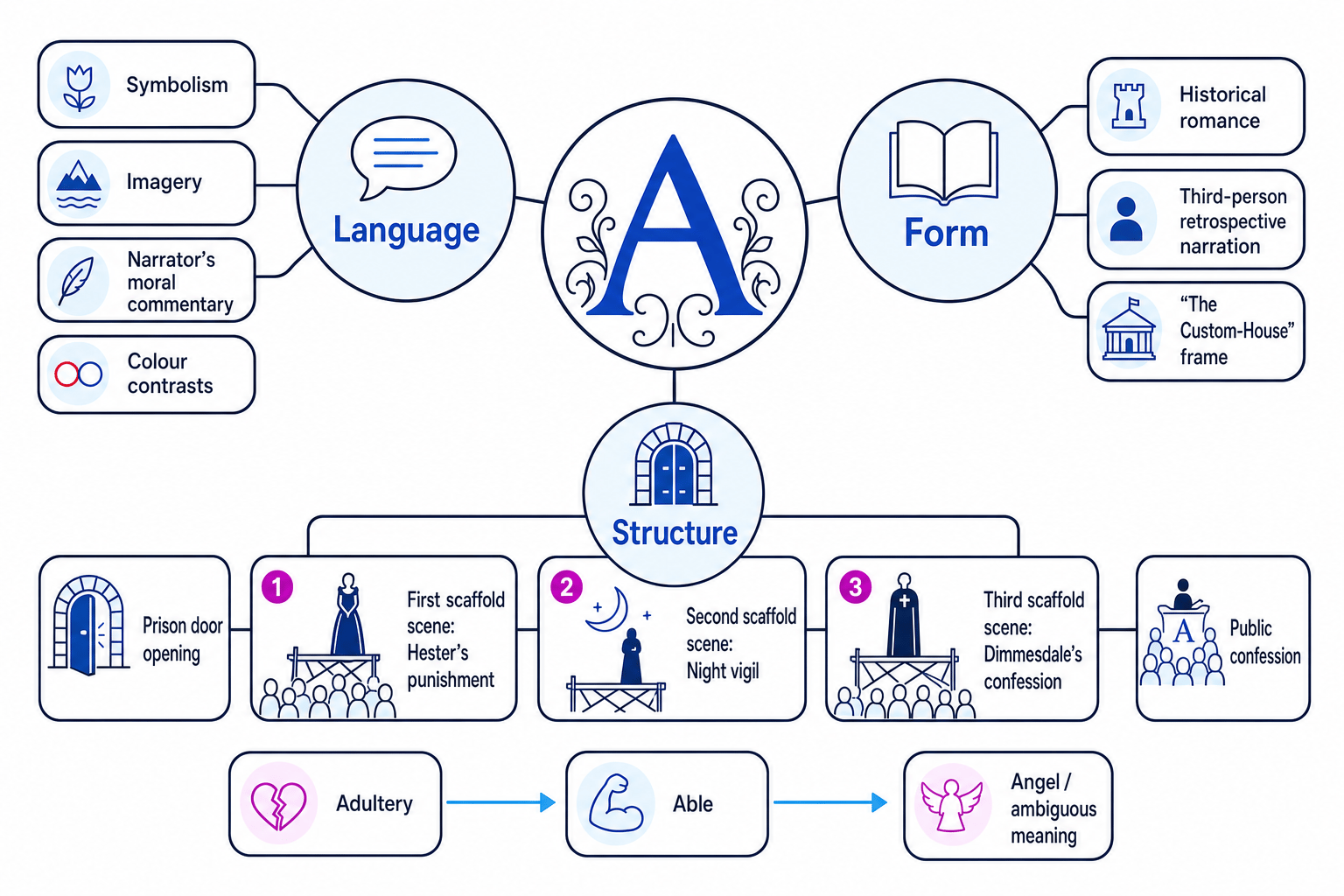
The big AO2 idea
Hawthorne rarely lets a symbol have one simple meaning. His language, form and structure keep asking whether sin, guilt and identity are fixed by society — or changed by time, sympathy and truth.
Language: symbols that refuse to stay simple
A symbol is an object, person, place or image that stands for a larger idea. The most important symbol in the novel is, obviously, the scarlet letter “A”.
At first, Puritan society wants the “A” to mean one thing: Hester’s adultery and shame. But Hawthorne’s language immediately complicates it. In Chapter 2, the letter is made from “fine red cloth” with “fantastic flourishes of gold thread”. The punishment is visually beautiful, not plain or ugly.
That matters because the Puritan community values plainness, discipline and public moral control. Hester’s embroidery turns the badge of shame into something expressive and artistic.
Ambiguity
Ambiguity means a word, image or event has more than one possible meaning. In The Scarlet Letter, ambiguity is central: the letter “A” can suggest sin, artistry, strength, angelic meaning, or a mystery that cannot be fully solved.
Later, the community itself changes its reading of the sign. In Chapter 13, people say the letter means “Able”, because Hester has become associated with charity and endurance. The novel ends with the heraldic image: “On a field, sable, the letter A, gules.” In simple terms, that means a red letter A on a black background — but even at the end, the symbol remains compressed and mysterious.
Analysing the scarlet letter as a symbol
-
Choose a focused point: Hawthorne makes the scarlet letter both a punishment and a form of self-expression, so the reader cannot see Hester only through Puritan judgement.
-
Select precise evidence: In Chapter 2, the letter is made of “fine red cloth” and decorated with “fantastic flourishes of gold thread”.
-
Name the method and analyse the words: The colour symbolism of “red” suggests sin, danger and visibility, but “gold” and “flourishes” suggest beauty, artistry and confidence. The contrast makes the badge morally complicated.
-
Explain the effect: The reader sees that Hester’s identity is not fully controlled by the town’s punishment. She transforms the sign into something partly her own.
-
Link to the wider novel: This prepares us for the way the letter’s meaning shifts from “Adultery” to “Able”, showing that public labels can change over time.
Treating symbols like one-word codes
Avoid writing “the letter A symbolises adultery” and stopping there. That is true at the start, but too simple for Hawthorne. Better answers track how the symbol changes, conflicts with itself, and affects the reader’s judgement.
Imagery: prison, rose, forest and light
Imagery means descriptive language that appeals to the senses or creates a mental picture. Hawthorne often builds meaning through strong visual contrasts.
The novel begins with a prison door. In Chapter 1, the prison is called the “black flower of civilized society”. This is a metaphor: Hawthorne compares the prison to a flower, but a diseased or unnatural one. The phrase suggests that even a supposedly ideal religious community quickly produces punishment, exclusion and suffering.
Next to the prison grows the wild rose-bush, which may offer “some sweet moral blossom”. The opening therefore places punishment and mercy side by side.
Juxtaposition
Juxtaposition means placing two contrasting things close together so that the reader compares them. Hawthorne juxtaposes the prison door and the rose-bush to contrast human judgement with natural sympathy.
The forest is another important setting. The town is linked with surveillance, law and public shame. The forest is more private, natural and emotionally free — but it is also morally uncertain. Pearl says that the “sunshine does not love” Hester because it is “afraid of something on your bosom”. When Hester removes the letter in Chapter 18, “forth burst the sunshine”. The light seems to respond to Hester’s emotional release.
Reading the prison and rose imagery
-
Identify the contrast: Hawthorne opens with the prison, a place of punishment, and the rose-bush, a living natural image.
-
Analyse the metaphor: Calling the prison the “black flower of civilized society” suggests that punishment grows out of civilisation itself. The word “black” carries ideas of darkness, severity and moral corruption.
-
Analyse the rose-bush: The phrase “some sweet moral blossom” suggests hope, compassion or beauty surviving beside harsh judgement.
-
Explain the structural effect: Because this image appears at the very beginning, it frames the whole novel as a conflict between rigid law and possible mercy.
The narrator’s voice: moral, reflective and sometimes uncertain
A narrator is the voice that tells the story. The Scarlet Letter uses a third-person narrator: the story is told using “he”, “she” and “they”, not mainly through Hester’s own “I”.
However, the narrator is not neutral. He comments, judges, reflects and sometimes generalises about human nature. For example, Hawthorne writes: “No man, for any considerable period, can wear one face to himself, and another to the multitude, without finally getting bewildered as to which may be the true.”
This is an aphorism: a concise statement that sounds like a general truth. It is also built on a metaphor of “faces”, suggesting public and private identities.
The narrator’s sentence style is often long, formal and balanced. This creates a serious, sermon-like tone, fitting the Puritan setting, but it also allows Hawthorne to be ironic about Puritan certainty.
Irony
Irony is when there is a gap between appearance and reality, or between what is said and what is really meant. In the novel, Dimmesdale appears holy while secretly guilty, and the community often misreads the signs around it.
Analysing the narrator’s generalisation
-
Focus on the idea: The narrator presents hidden guilt as psychologically damaging, not just religiously sinful.
-
Use the quotation: “No man... can wear one face to himself, and another to the multitude” describes a divided identity.
-
Analyse the method: The metaphor of “one face” and “another” turns hypocrisy into a physical image. It suggests that Dimmesdale’s public holiness and private guilt become impossible to keep separate.
-
Link to effect: The reader understands Dimmesdale’s suffering as internal fragmentation. Hawthorne makes secrecy feel destructive before the final confession confirms it.
Form: a historical romance, not just a realistic novel
A historical romance is a narrative set in the past that uses history, atmosphere, symbolism and heightened moral conflict. Here, “romance” does not simply mean a love story.
Hawthorne sets the novel in seventeenth-century Puritan Boston, but he is not writing plain historical realism. The meteor, the mysterious mark on Dimmesdale’s chest, Pearl’s almost symbolic role and the shifting meaning of the “A” all belong to romance form: they invite interpretation rather than offering simple facts.
Calling it only a love story
Do not say the novel’s form is “romance” because it is about Hester and Dimmesdale’s relationship. In literary terms, Hawthorne’s romance form allows symbolic, psychological and sometimes supernatural ambiguity.
The novel also has a frame narrative. A frame narrative is an outer story that introduces or encloses the main story. In “The Custom-House”, the narrator claims to find “a certain affair of fine red cloth” and then identifies it: “It was the capital letter A.” When he places it on his breast, he feels something like “burning heat”.
This frame makes the letter feel like a historical object, but also like something strangely alive. Before the main plot even begins, Hawthorne teaches the reader to treat the “A” as an object that demands interpretation.
Linking romance form to Pearl
-
Start with form: In a realist novel, Pearl might mainly function as Hester’s child. In Hawthorne’s romance form, she also becomes symbolic.
-
Use evidence: Pearl is described as “the scarlet letter in another form; the scarlet letter endowed with life!”
-
Analyse the method: This metaphor turns Pearl into a living version of Hester’s visible sign. She embodies both the consequence of sin and the energy of love, beauty and truth.
-
Explain the effect: The reader sees Pearl as more than a character in the plot. She becomes part of the novel’s moral design, constantly forcing adults to face what they conceal.
Structure: repeated scaffold scenes
The novel’s most important structural pattern is the repetition of the scaffold scene.
A scaffold is a raised platform used for public punishment. Hawthorne returns to it three times:
- Chapter 2: Hester stands there publicly with Pearl and the letter.
- Chapter 12: Dimmesdale stands there secretly at night with Hester and Pearl.
- Chapter 23: Dimmesdale finally stands there publicly and confesses.
This repeated structure turns the scaffold into a stage of truth. Each return brings Dimmesdale closer to public acknowledgement.
Structural repetition
Structural repetition is when a writer repeats a scene, setting, image or situation at different points in a text. The changes between each repetition show development.
Tracing the scaffold pattern
-
Compare the first and second scaffold scenes: In Chapter 2, Hester’s shame is public, while Dimmesdale’s guilt is hidden. In Chapter 12, he stands on the same platform, but only at night, so his confession is incomplete.
-
Notice the change in audience: The first scene has the whole town watching Hester. The second scene is secret and private. The third scene returns to public daylight, making truth unavoidable.
-
Use precise evidence: In Chapter 23, Dimmesdale says, “At last!—at last!—I stand upon the spot where, seven years since, I should have stood.”
-
Analyse the effect of repetition: The phrase “at last” shows delayed confession. The scaffold structure makes the ending feel morally necessary because the novel has been moving back to this place from the beginning.
Structure: secrecy, delay and revelation
Hawthorne also structures the novel around delayed truth. The reader gradually understands the relationships between Hester, Dimmesdale and Chillingworth, but public knowledge lags behind private reality.
This creates tension because the community thinks it can read sin from outward signs. Hester’s letter is visible, but Dimmesdale’s guilt is hidden. Chillingworth appears as a physician, but his “care” becomes revenge.
A useful structure sentence
Try this phrase in essays: “Hawthorne structures the novel so that public signs and private truths develop at different speeds.” Then prove it with Hester’s visible letter and Dimmesdale’s delayed confession.
The ending keeps some ambiguity. After Dimmesdale reveals himself, witnesses disagree about what they saw on his chest. This matters: even at the climax, Hawthorne refuses to turn moral truth into a simple physical fact.
The final tombstone image — “On a field, sable, the letter A, gules” — gives the novel a compressed ending. Hester and Dimmesdale are joined by the same symbol, but the meaning of that symbol is still not fully settled.
Putting it together in analysis
A strong paragraph should not list techniques. It should connect method to meaning.
For example:
Hawthorne uses structural repetition to show that hidden sin demands eventual revelation. The scaffold first exposes Hester in Chapter 2, while Dimmesdale remains publicly respected; however, the repeated return to the scaffold in Chapters 12 and 23 gradually brings his private guilt into the open. His final words, “At last!—at last!”, emphasise delay through repetition, suggesting that confession should have happened “seven years since”. The structure therefore makes Dimmesdale’s death feel like the consequence of prolonged concealment, while also criticising a society that punished Hester publicly but failed to recognise male guilt.
In the exam
-
Use the open-book clean copy strategically: find short quotations quickly, but do not waste time copying long passages.
-
For AO2, always name the method and explain its effect: symbol, metaphor, frame narrative, narrator, structural repetition, contrast, ambiguity.
-
Link language, form and structure to the novel’s big concerns: public judgement, private guilt, changing identity, truth, punishment and mercy.
Check yourself
- How does the meaning of the scarlet letter change between Chapter 2 and Chapter 13?
- Why are the three scaffold scenes structurally important?
- How does Hawthorne’s romance form create ambiguity rather than simple realism?