What you'll learn
- How to choose short quotations that unlock big ideas in The Scarlet Letter.
- Which quotes are most useful for Hester, Dimmesdale, Chillingworth, Pearl and Puritan society.
- How to move from quotation to analysis of Hawthorne’s methods.
- How to use the open-book exam wisely without wasting time quote-hunting.
What makes a quotation “key”?
A key quotation is not just a famous line. It is a short phrase or sentence that helps you discuss character, theme and Hawthorne’s writing methods.
For Edexcel IGCSE, The Scarlet Letter is a Literary Heritage text in Component 2, so you may use a clean copy in the exam. However, you still need to know where your key quotations are and how to analyse them quickly.
Key quotation
A key quotation is a brief piece of textual evidence that reveals something important about a character, theme, symbol or turning point, while giving you language, form or structure to analyse.
A symbol is an object, person, place or action that has a literal role in the story and also represents a bigger idea. The scarlet letter “A” is the central symbol of the novel: it begins as a mark of adultery and shame, but its meaning changes as Hester’s identity develops.
The map below groups the most useful quotation areas by symbol, character and theme. Use it as a memory map, not as a replacement for knowing the chapters.
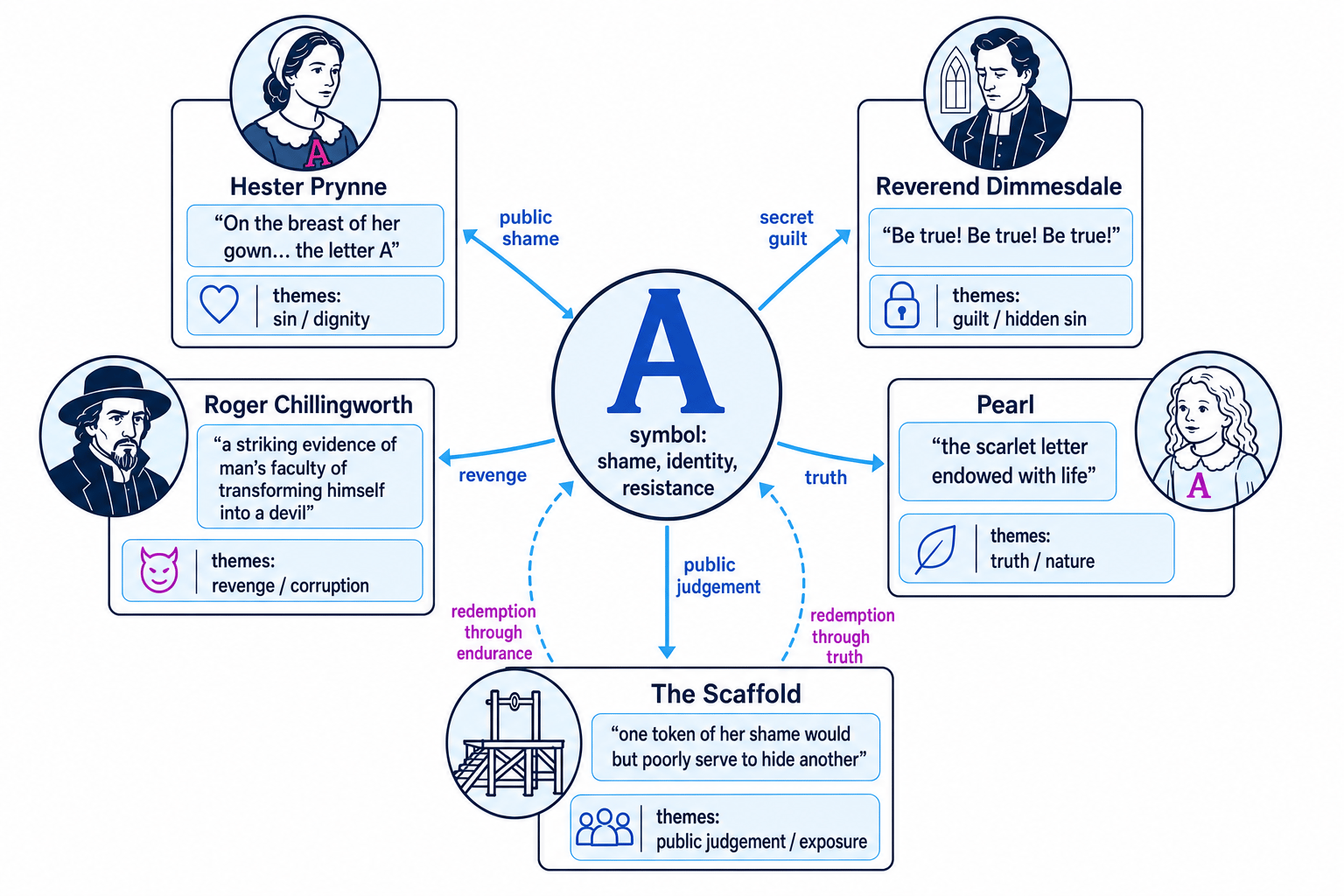
Quotes should work hard
The best quotations help you show knowledge of the text, analyse Hawthorne’s methods, and connect the story to Puritan ideas about sin, punishment and confession.
The scarlet letter: shame that changes meaning
The most important quotation is Hawthorne’s first full description of the letter in Chapter 2:
“On the breast of her gown… appeared the letter A.”
The placement “on the breast” makes Hester’s sin public and bodily: society forces her private life into public view. But the letter is also “surrounded with an elaborate embroidery and fantastic flourishes of gold thread”, which complicates the punishment. Hester turns a symbol of shame into something beautiful and self-fashioned.
Later, in Chapter 13, the meaning shifts:
“They said that it meant Able.”
This is crucial because the community begins to reinterpret Hester. The letter no longer simply means “adulteress”; it becomes associated with strength, usefulness and endurance. Hawthorne uses the changing symbol to show that identity is not fixed by society’s judgement.
Another powerful Chapter 13 quotation is:
“The scarlet letter was her passport into regions where other women dared not tread.”
The metaphor of a “passport” suggests that suffering has given Hester access to forbidden knowledge and independence. This is not simple happiness, but it is a kind of freedom.
Analysing Hester’s embroidered A
-
Start with the exact evidence: Hawthorne places the letter “on the breast” of Hester’s gown, so the punishment is physically displayed over her body and heart.
-
Analyse the method: the “gold thread” and “fantastic flourishes” create a contrast between Puritan shame and artistic beauty.
-
Explain the effect: the reader sees that Hester is punished by society, but she also resists being reduced to that punishment.
-
Link to a theme: the symbol introduces the novel’s wider debate about whether identity is defined by sin, society or personal strength.
Freezing the symbol
Do not say the letter “A” only represents adultery. It begins that way, but Hawthorne makes it shift towards shame, ability, isolation, insight and ambiguous identity.
Public shame and secret guilt
Hester’s shame is public from the start. In Chapter 2, when she holds Pearl on the scaffold, Hawthorne writes:
“one token of her shame would but poorly serve to hide another”
The word “token” means a visible sign. Both the letter and Pearl become signs of Hester’s sin. The irony is that Hester cannot hide one symbol of shame behind another.
Dimmesdale’s guilt is different because it is hidden. In Chapter 17, he tells Hester:
“Happy are you, Hester, that wear the scarlet letter openly upon your bosom! Mine burns in secret!”
This is one of the most useful comparison quotes in the whole novel. The antithesis — a balanced contrast — between “openly” and “secret” shows the difference between Hester’s public punishment and Dimmesdale’s private torment. The verb “burns” makes guilt feel physical, painful and inescapable.
Hawthorne also summarises Dimmesdale’s divided life in Chapter 20:
“No man… can wear one face to himself, and another to the multitude”
The metaphor of “one face” and “another” shows hypocrisy as a split identity. Dimmesdale is admired as a holy minister, but inwardly he feels corrupt.
Connecting public shame and secret guilt
-
Compare Hester and Dimmesdale: Hester wears her guilt “openly”, while Dimmesdale says his “burns in secret”.
-
Analyse the contrast: Hawthorne suggests that public punishment is cruel, but hidden guilt may be even more spiritually destructive.
-
Link to structure: the novel begins with Hester on the scaffold and moves towards Dimmesdale’s final public confession, so the plot itself pushes hidden sin into the open.
-
Connect to context: in a Puritan society that values confession and moral discipline, secrecy becomes a source of intense psychological suffering.
At the end of the novel, the narrator gives the moral:
“Be true! Be true! Be true!”
The repetition and imperative command make the message forceful. Hawthorne suggests that concealment damages the soul, even if public judgement is also harsh.
Do not oversimplify Hawthorne’s moral
Hawthorne often sounds moral and direct, but the novel is full of ambiguity. It is safer to write “Hawthorne seems to suggest…” than to claim the novel gives one simple lesson.
Hester: dignity, endurance and rebellion
Hester is never presented only as a sinner. She is isolated, but she is also strong, thoughtful and increasingly independent.
In Chapter 13, Hawthorne writes:
“The world’s law was no law for her mind.”
This is a brilliant quote for Hester’s rebellion. The contrast between “world’s law” and “her mind” shows that Hester outwardly lives under Puritan rules, but inwardly questions them.
In Chapter 17, she tells Dimmesdale:
“Thou shalt not go alone!”
This short declaration shows her loyalty and courage. The old-fashioned “shalt” sounds firm and almost vow-like. Hester becomes active, protective and decisive.
When she removes the letter in the forest, Hawthorne writes in Chapter 18:
“The stigma gone, Hester heaved a long, deep sigh”
A stigma is a mark of disgrace. The phrase shows how heavily the letter has burdened her. Yet the forest scene is temporary: Hester cannot simply escape society forever.
Dimmesdale: the divided minister
Dimmesdale is useful for essays on guilt, hypocrisy, religion and confession. Hawthorne describes him in Chapter 11 as a:
“subtle, but remorseful hypocrite”
This is a precise judgement. “Hypocrite” shows the gap between his public holiness and private sin, but “remorseful” makes him more sympathetic. Hawthorne does not present him as purely evil.
Another key Chapter 11 quotation is:
“the agony with which this public veneration tortured him”
“Public veneration” means public admiration or worshipful respect. The irony is painful: the more people praise Dimmesdale, the more guilty he feels.
In Chapter 17, Dimmesdale says:
“Of penance, I have had enough! Of penitence, there has been none!”
Penance means outward acts of punishment or religious discipline; penitence means true inward repentance. The contrast shows that Dimmesdale has suffered, but he has not achieved spiritual peace because he has not confessed honestly.
Chillingworth: revenge and corruption
Chillingworth is the clearest example of revenge destroying the person who practises it. In Chapter 3, he becomes obsessed with discovering Hester’s partner:
“He will be known!—he will be known!—he will be known!”
The repetition shows fixation. The dashes make the sentence feel pressured and relentless, as if revenge has taken control of him.
In Chapter 14, Hawthorne describes him as:
“a striking evidence of man’s faculty of transforming himself into a devil”
This quotation is extremely useful because it states the effect of revenge directly. The verb “transforming” suggests a gradual moral change: Chillingworth is not born monstrous, but becomes so through his “devil’s office” of tormenting Dimmesdale.
Also in Chapter 14, Chillingworth says:
“Let the black flower blossom as it may!”
The “black flower” is a dark metaphor for evil, revenge or spiritual corruption. It also contrasts with the rose-bush near the prison door in Chapter 1, which offers a possible “sweet moral blossom”. Hawthorne uses natural imagery to show both hope and corruption.
Pearl: living symbol and truth-teller
Pearl is both a child and a symbol. In Chapter 6, Hawthorne describes her as:
“a lovely and immortal flower, out of the rank luxuriance of a guilty passion”
The contrast between “lovely” and “guilty” captures Pearl’s role. She is innocent and beautiful, but she is also born from what Puritan society calls sin.
In Chapter 7, she is described as:
“the scarlet letter in another form; the scarlet letter endowed with life!”
This is one of the most important Pearl quotations. She is a living reminder of Hester’s adultery, but also much more than a punishment. The exclamation mark gives the description emotional force.
In Chapter 16, Pearl says:
“the sunshine does not love you”
This personification — giving human qualities to a non-human thing — makes nature seem morally sensitive. Pearl instinctively notices that Hester’s hidden pain affects how she belongs in the world.
Near the end, after Dimmesdale confesses, Hawthorne writes:
“Pearl kissed his lips. A spell was broken.”
This suggests that truth releases Pearl from being merely symbolic. She can become fully human once the secret is publicly acknowledged.
Puritan society and setting
For context, remember that Puritan society is strict, religious and concerned with public moral discipline. Hawthorne establishes this world immediately in Chapter 1:
“a cemetery, and another portion as the site of a prison”
The new colony begins with death and punishment. This makes the setting feel severe before Hester even appears.
The prison-door scene also prepares us for the novel’s main conflict: society tries to define people by sin, while Hawthorne explores the hidden complexity of human feeling.
Use short embedded quotations
In essays, you do not need long chunks. A sentence like Hawthorne shows Hester’s exclusion through the “sphere by herself” created by the letter is usually sharper than copying four full lines.
Final quotation to remember
The novel ends with the mysterious image:
“On a field, sable, the letter A, gules.”
These are heraldic terms: “sable” means black and “gules” means red. The final image keeps the letter alive even at the grave. Hawthorne does not completely solve the symbol; he leaves it powerful, compressed and ambiguous.
In the exam
-
Use your clean copy to check exact wording, but learn the chapter locations of five or six major quotations so you can find them quickly.
-
Embed short phrases into your own sentences, then analyse Hawthorne’s method: symbolism, metaphor, contrast, repetition, structure or narrative voice.
-
Always link the quotation back to the question, especially through big ideas such as sin, guilt, confession, identity, punishment, revenge and Puritan society.
Check yourself
-
Which three quotations best show the changing meaning of the scarlet letter “A”?
-
How could you compare Hester’s public shame with Dimmesdale’s secret guilt?
-
Which Chillingworth quotation shows that revenge corrupts the revenger?