While The Scarlet Letter is a richly woven psychological romance, its narrative power relies on a highly disciplined, deliberate architectural layout. To score highly in your Edexcel IGCSE English Literature exam, you must show the examiners that you understand how Nathaniel Hawthorne structures his novel, rather than treating it merely as a chronological series of events (AO2).
This guide focuses on the three structural pillars of the text: the Three Scaffold Scenes (Chapters 2, 12, and 23).
What you'll learn
- How Hawthorne uses a symmetrical triadic structure to chart the psychological and spiritual journeys of his characters.
- To analyze key language, motifs, and dramatic contrasts within Chapters 2, 12, and 23.
- How to link these pivotal chapters to the historical and religious context of 17th-century Puritan Boston (AO4).
The Symmetrical Structure of the Novel
Hawthorne’s narrative structure is remarkably geometric. The novel contains twenty-four chapters, and its entire plot is anchored by three major public scenes set on the scaffold (the pillory) in the center of Boston.
Triadic Structure
A triadic structure is a literary framework divided into three distinct, symmetrical parts or acts. In The Scarlet Letter, these three parts are anchored by the scaffold scenes occurring at the beginning (Chapter 2), the exact middle (Chapter 12), and the end (Chapter 23) of the novel.
These three chapters divide the narrative into three distinct phases of guilt, isolation, and redemption. By comparing who is on the scaffold, the time of day, and the reactions of the community, we can trace the development of the novel's core themes.
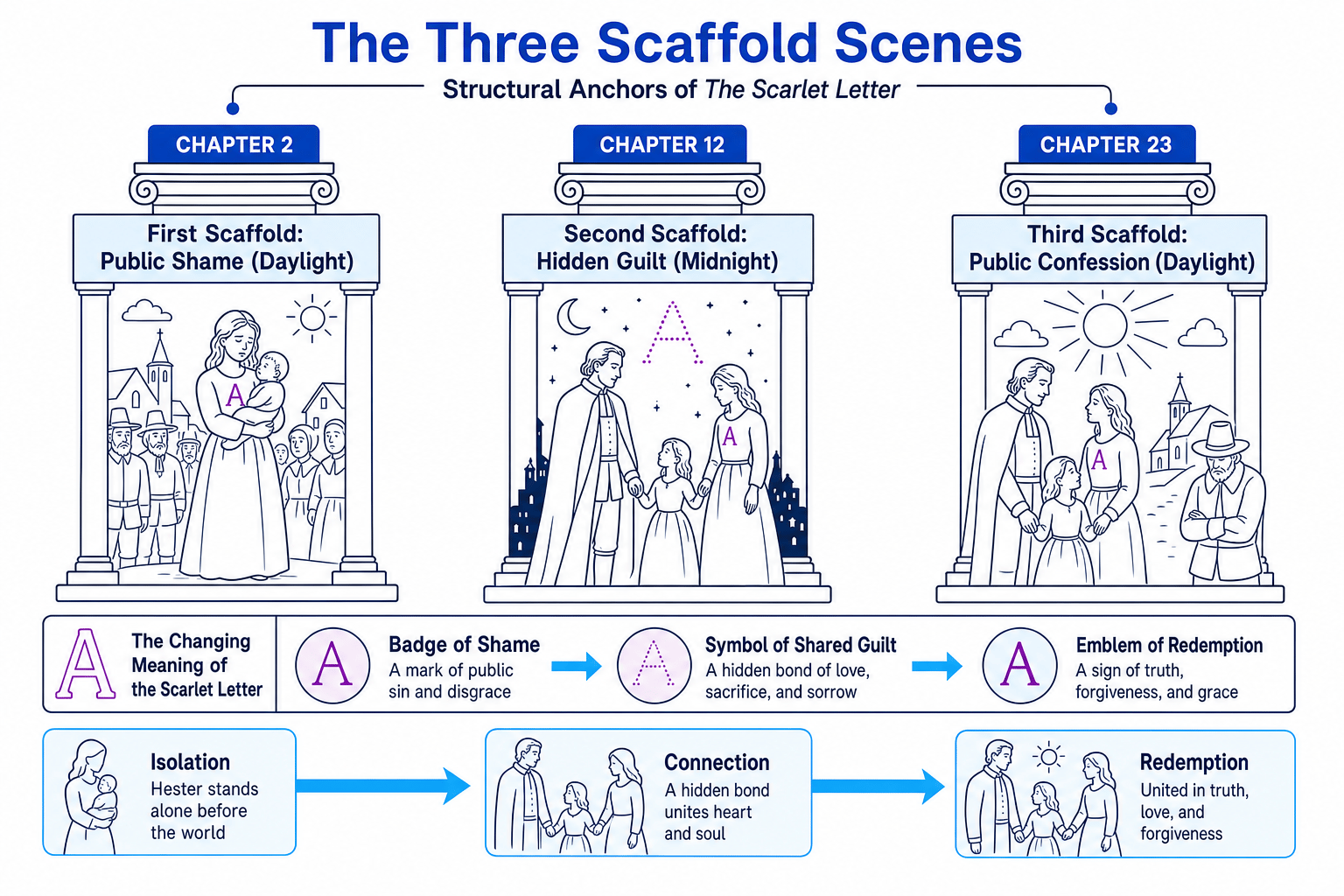
Chapter 2: The Market-Place (The First Scaffold)
In Chapter 2, Hawthorne establishes his exposition. Hester Prynne emerges from the prison-door carrying her infant daughter, Pearl, and ascends the scaffold to face public ignominy.
Key Narrative & Symbolic Functions
- The Setting of Public Judgment: The scaffold is located "under the heavy weight of the Puritan populace's eyes." This introduces the collective, unforgiving gaze of the community.
- The Introduction of the Scarlet Letter: We see the letter "A" for the first time. It is not a dull badge of shame, but rather "of fine red cloth, surrounded with an elaborate embroidery and fantastic flourishes of gold-thread." Hester’s artistry defies the drab, grey uniformity of her Puritan judges.
- Character Contrast: Hester stands alone with "natural dignity and force." She refuses to be crushed, stepping forth "into the open air" as if by her own free will.
Daylight as Truth
The first scaffold scene takes place in the harsh, blinding light of midday. In Hawthorne's symbolic vocabulary, daylight represents public exposure and objective truth. Hester has no secrets left to hide from society; her sin is fully illuminated, which paradoxically gives her the freedom to begin her moral redemption.
Chapter 12: The Minister’s Vigil (The Second Scaffold)
Chapter 12 sits at the precise mathematical center of the novel. Seven years have passed since Hester first stood on the scaffold. Arthur Dimmesdale, consumed by silent, unconfessed guilt, ascends the scaffold in the dead of night.
Key Narrative & Symbolic Functions
- The Internalization of Guilt: Unlike Hester, who suffered publicly, Dimmesdale suffers in private. His vigil is an act of self-punishment that lacks the courage of true public confession. He shrieks in agony, yet the town sleeps, unaware.
- The Hidden Union: Hester and Pearl return from the deathbed of Governor Winthrop and join hands with Dimmesdale on the platform. This creates an electric, vital connection. Pearl asks the critical structural question: "Wilt thou stand here with mother and me, to-morrow noontide?" Dimmesdale refuses, promising instead to stand with them on "the great judgment day."
- The Cosmic Symbolism: A meteor streaks across the sky, painting a giant red letter "A" in the clouds. To the guilt-ridden minister, this is a highly personalized sign of his own sin; to the superstitious Puritan community, it is interpreted as "Angel," marking the death of Governor Winthrop. Hawthorne uses this dual interpretation to expose how the human mind projects its own realities onto nature.
Watch the Observers
Always pay attention to Roger Chillingworth’s position in these scenes. In Chapter 12, Chillingworth stands at the foot of the scaffold, illuminated by the meteor’s unnatural light. His smile is described as "arch-fiend"-like. He has become a parasite feeding on Dimmesdale's secret, and he knows that a midnight vigil does nothing to break his psychological hold over the minister.
Chapter 23: The Revelation of the Scarlet Letter (The Third Scaffold)
The final scaffold scene provides the climax and resolution of the novel. Immediately following his triumphant Election Sermon, Dimmesdale, physically collapsing, turns away from the civic procession and leads Hester and Pearl up to the scaffold in broad daylight.
Key Narrative & Symbolic Functions
- The Defeat of Chillingworth: As Dimmesdale moves toward the scaffold, Chillingworth tries to stop him, crying, "There was no one place... where thou couldst have escaped me,—save on this very scaffold!" By publicly confessing, Dimmesdale escapes Chillingworth’s malice. Confession is his path to spiritual liberation.
- The Public Confession: Dimmesdale tears open his ministerial band to reveal what the onlookers believe to be his own self-inflicted scarlet letter. He dies in Hester's arms, having finally achieved the honesty Pearl demanded in Chapter 12.
- The Breaking of the Curse: Pearl kisses her father, and Hawthorne writes that "a spell was broken." Her tears fall upon his cheek, acting as a baptism that welcomes her into the human fold, freeing her from her role as a wild, symbolic messenger of grief.
Analysing Structural Development
To achieve high marks in AO2 (Analysis of Language, Form, and Structure), you must go beyond explaining what happens in each chapter. You need to demonstrate how Hawthorne systematically develops motifs across these key chapters.
Here is a step-by-step walk-through of how to analyze the structural contrast of lighting across the scaffold scenes.
Analysing structural contrast (lighting)
Task: Analyse how Hawthorne uses the contrast between daylight and darkness across the scaffold scenes to convey Dimmesdale’s psychological state.
- Identify the structural pattern: Look at the lighting in the three scenes. Chapter 2 is set in "the unshrinking daylight"; Chapter 12 is set in "the shadow of night" illuminated by a fleeting, unnatural meteor; Chapter 23 is set in the full "golden light" of the afternoon sun.
- Examine the language and metaphor of the midpoint scene: In Chapter 12, Dimmesdale can only hold hands with his family under cover of darkness. The "false light" of the meteor reveals his hypocrisy. He wishes for connection but fears the "daylight-space." Hawthorne uses this darkness to symbolize Dimmesdale’s spiritual cowardice and divided self.
- Contrast with the final resolution: In Chapter 23, the confession occurs in the "noon-day sun." The bright light of day symbolizes truth, transparency, and God's judgment. By bringing his secret into the light, Dimmesdale aligns his inner soul with his outer life.
- Formulate the analytical connection: Write an analytical paragraph demonstrating how this shift in lighting mirrors Dimmesdale's transition from agonizing hypocrisy (darkness/hiding) to redemptive authenticity (sunlight/exposure).
Ignoring the Community
Students often focus exclusively on the main characters during these chapters. Do not forget the Puritan crowd. In Chapter 2, they are cold and judgmental; in Chapter 12, they are absent and asleep; in Chapter 23, they are awestruck and bewildered. Tracking the crowd's reaction is vital for your AO4 (Context) marks, as it reveals Hawthorne’s critique of the rigid, collective Puritan mindset.
In the exam
- Focus on the "How": If a question asks about guilt, confession, or hypocrisy, structure at least one of your main body paragraphs around the transition between these key scaffold chapters. Frame your point around Hawthorne's structural choices rather than just the plot.
- Use precise structural terms: Incorporate words like triadic symmetry, climax, narrative catalyst, structural mirror, and resolution to demonstrate sophisticated technical knowledge (AO2).
- Integrate context seamlessly: When discussing the scaffold, mention its historical purpose as an instrument of Puritan penal justice designed to enforce conformity (AO4), contrasting it with Hawthorne’s 19th-century Transcendentalist emphasis on individual conscience.
Check yourself
- Why does Pearl refuse to kiss Dimmesdale in Chapter 12, but willingly kisses him in Chapter 23?
- How does Roger Chillingworth's reaction to the scaffold change from Chapter 2 to Chapter 23?
- What are the major differences in the way Hester and Dimmesdale experience public shame on the scaffold?