In Pearson Edexcel International GCSE English Literature (Specification 4ET1), The Merchant of Venice is assessed in Component 2, Section B (Literary Heritage). This is an open-book exam, meaning you will have a clean copy of the play with you. However, to secure the highest marks, you must understand how Shakespeare uses structural contrasts, language, and the context of Elizabethan England to construct his central themes.
What you'll learn
- How to analyze the structural contrast between Venice and Belmont.
- How to evaluate the tense conflict between legalistic justice and divine mercy.
- How to contextualize the presentation of prejudice, xenophobia, and marginalization.
- How to track the motifs of wealth, risk, and structural deception across the play.
The Structural Framework: Venice versus Belmont
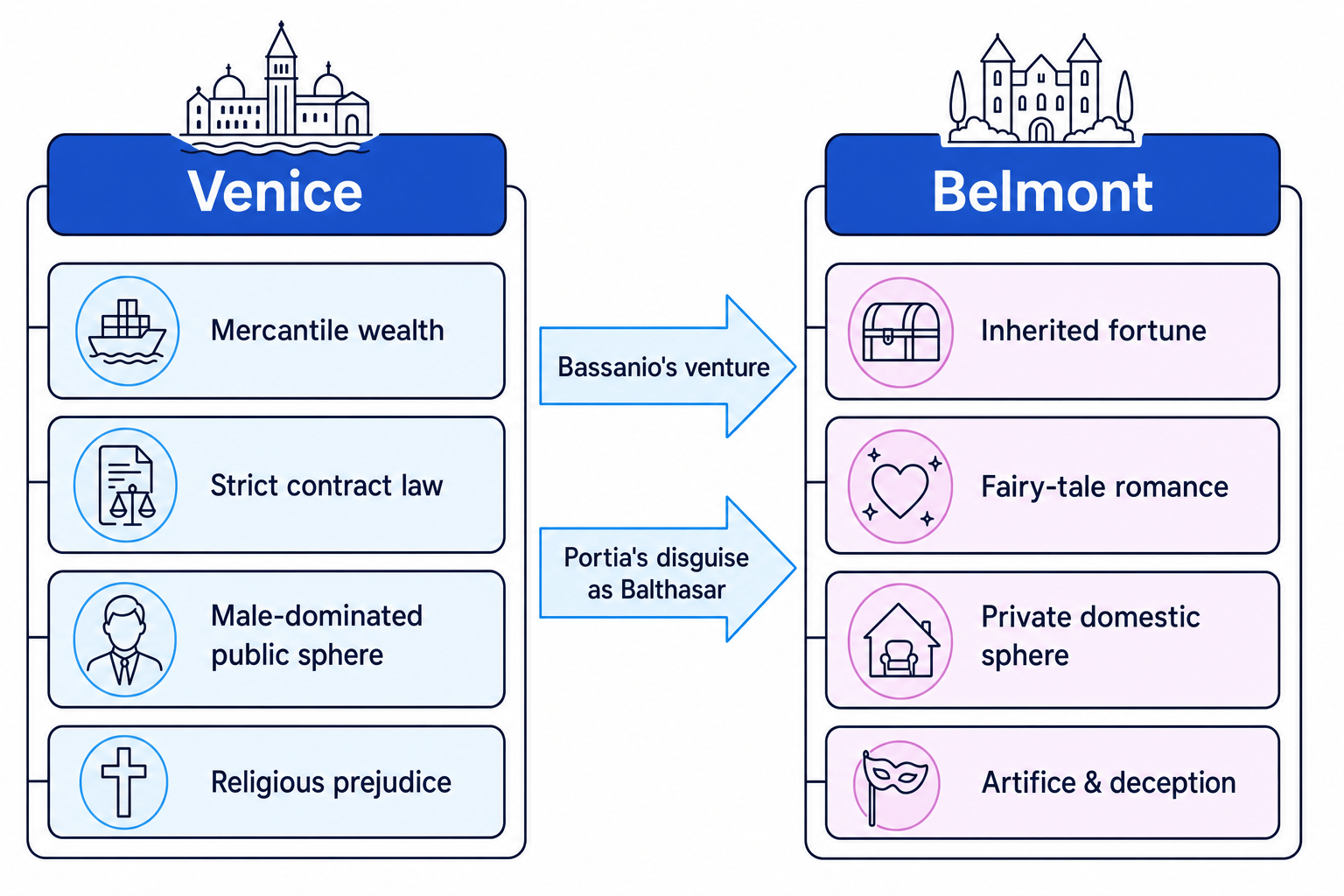
To understand any theme in The Merchant of Venice, you must first understand the play's geography. Shakespeare structures the drama around a physical and symbolic divide between two distinct settings: Venice and Belmont.
Dichotomy
A dichotomy is a division or contrast between two things that are represented as being entirely different or opposed to one another.
Venice is a bustling, multicultural, male-dominated commercial center governed by strict contract law, financial speculation, and religious tension. Belmont, by contrast, is a mythical, green, idealized estate dominated by music, romance, and aristocratic leisure.
However, Shakespeare presents this dichotomy only to subvert it: Belmont is not a pure escape. It is entirely funded by Venetian commerce, and its domestic conflicts (such as Portia's marriage trials) are resolved through cold, legalistic contracts and deceit.
Justice versus Mercy
The climax of the play in Act 4, Scene 1 centers on the conflict between justice (the strict letter of the law) and mercy (charitable forgiveness). This thematic clash is framed by the religious and legal structures of Shakespeare’s era.
The Old Law versus the New Covenant
For an Elizabethan audience, the court scene represented a debate between the Old Testament legal tradition—associated with the Jewish concept of lex talionis (the law of retaliation, or "an eye for an eye")—and the New Testament Christian covenant of grace and forgiveness.
Lex Talionis
The principle of retributive justice, often expressed as "an eye for an eye," where the punishment directly corresponds to the degree and nature of the offense.
- Shylock’s Stance: Shylock demands the strict execution of his bond: "I stand here for law" (Act 4, Scene 1). To Shylock, if the state does not enforce the contract, the very foundation of Venetian commerce and international credibility will collapse.
- Portia’s Stance: Disguised as the young doctor of law, Balthasar, Portia argues that justice must be tempered with mercy. She states that mercy is "an attribute to God himself" and that "in the course of justice, none of us / Should see salvation."
The Hypocrisy of Mercy
While Portia’s speech on the "quality of mercy" is beautiful, the play's resolution exposes a deep moral ambiguity. When Shylock is defeated on a legal technicality, the Christian characters offer him "mercy" on highly coercive terms. He is spared his life, but must convert to Christianity and bequeath all his wealth to Lorenzo and Jessica—effectively destroying his religious, cultural, and personal identity.
The Paradox of Venetian Mercy
Shakespeare shows that the dominant Christian society's mercy is conditional and weaponized. They use the legal system to subjugate Shylock under the guise of benevolence, highlighting the hypocrisy of their moral superiority.
Prejudice, Outsiders, and Intolerance
The Merchant of Venice is deeply preoccupied with how societies treat marginalized outsiders. As a Jewish man in a fiercely anti-Semitic Christian state, Shylock is subjected to systemic hostility.
Anti-Semitism in Elizabethan Context
Historically, Jews were expelled from England in 1290 and were not officially readmitted until the mid-17th century. An Elizabethan audience would have been highly familiar with anti-Semitic stereotypes, often viewing Jews as villainous caricatures. Shakespeare, however, complicates this simplistic reading by giving Shylock a voice of profound, humanizing rage.
In Act 3, Scene 1, Shylock delivers his famous speech defending his shared humanity:
"Hath not a Jew eyes? Hath not a Jew hands, organs, dimensions, senses, affections, passions? [...] If you prick us, do we not bleed? If you tickle us, do we not laugh? If you poison us, do we not die? And if you wrong us, shall we not revenge?"
Here, Shakespeare utilizes a rhetorical sequence of parallel rhetorical questions to challenge the audience's prejudices.
Siding blindly with one party
Do not write about Shylock as a simple, innocent victim, nor as a monstrous villain. Shakespeare deliberately paints him with complexity. He is a victim of cruel societal prejudice (Antonio spat on him and called him a "dog"), but he is also driven by a bloodthirsty desire for revenge that rejects all appeals to human decency.
Wealth, Risk, and Deception
The play equates financial speculation with romantic ventures. Bassanio explicitly refers to his courtship of Portia as a "venture" and describes her hair as a "golden fleece," casting himself as Jason on a quest for wealth.
The Symbolism of the Caskets
The three caskets (gold, silver, and lead) in Act 2 serve as a moral test of how characters evaluate worth.
- Gold: "Who chooseth me shall gain what many men desire." This represents shallow materialism. Prince Morocco chooses it, only to find a skull inside—symbolizing that external beauty and wealth hide death.
- Silver: "Who chooseth me shall get as much as he deserves." This represents self-centered pride and arrogance, chosen by the Prince of Arragon.
- Lead: "Who chooseth me must give and hazard all he hath." This represents true love, which requires absolute self-sacrifice and risk. Bassanio correctly chooses lead, recognizing that true value lies beneath a humble appearance.
The Ring Plot as a structural device
The final act's ring plot is not just light comedy. By forcing Bassanio and Gratiano to give away the rings they swore to keep, Portia and Nerissa demonstrate that even the most sacred oaths and legal bonds in Belmont are fragile, mirroring the legalistic traps of Venice.
Worked Example: Analyzing Theme in a Passage
When writing an essay for Edexcel IGCSE English Literature, you must weave together three Assessment Objectives: AO1 (textual knowledge and argument), AO2 (close analysis of language, form, and structure), and AO4 (contextual awareness).
The following worked example demonstrates how to build a high-scoring analytical paragraph on the theme of Justice versus Mercy.
Analyzing Portia's Mercy Speech
Task: Analyze how Shakespeare presents the theme of mercy in Portia's famous speech in Act 4, Scene 1:
"The quality of mercy is not strained; It droppeth as the gentle rain from heaven Upon the place beneath."
-
Formulate a clear thematic point (AO1): Start by identifying the conceptual argument of the passage.
Drafting your point: Shakespeare presents mercy as an innate, divine quality that cannot be forced or coerced, contrasting it directly with Shylock’s rigid legalistic demands for justice.
-
Analyze Shakespeare's linguistic and structural methods (AO2): Look closely at the imagery and grammatical structure of the quotation.
Analyzing the language: The word "strained" means forced or constrained. By asserting that mercy is "not strained," Portia argues that it must flow naturally. The simile "It droppeth as the gentle rain from heaven" compares mercy to natural precipitation. Rain is universal, life-giving, and completely out of human control, which emphasizes that mercy is a divine gift rather than a transaction. The soft, sibilant sounds ("strained," "droppeth," "gentle") create a peaceful, harmonious tone that contrasts sharply with the harsh, aggressive legal arguments of the court scene.
-
Integrate contextual and dramatic significance (AO4 & AO1): Link the analysis back to the historical context of the play and the dramatic irony of the scene.
Synthesizing context: For an Elizabethan audience steeped in Christian theology, Portia's language mirrors biblical descriptions of God's grace. However, there is a profound layer of dramatic irony here. Portia, disguised as a male lawyer, uses this speech to establish her moral authority before she ruthlessly applies the letter of Venetian law to destroy Shylock. Thus, while the speech champions divine mercy, the play's dramatic action reveals how the Venetian state uses law to enforce cultural conformity and exclude the religious outsider.
In the exam
- Focus on the prompt's thematic keywords: If the question asks about "justice," do not just write a generic essay about Shylock. Frame your essay around how justice is contrasted with mercy, and how different characters define "what is just."
- Track character developments: Themes are not static. Show how the theme of prejudice evolves from Antonio's initial casual cruelty, to Shylock's radicalization, to the final trial scene.
- Incorporate structural contrasts: Always show how the shifts between Venice and Belmont highlight the themes of wealth, deception, and the limits of law.
- Utilize your open book wisely: Since you have the text, do not waste time searching for long, obscure quotes. Locate short, high-impact quotations (like "All that glisters is not gold" or "I stand for judgment") and spend your time analyzing their linguistic layers.
Check yourself
- How does the "hazard" of the lead casket mock Bassanio's actual behavior in borrowing money from Antonio?
- In what ways does Shylock's argument that "the pound of flesh... is dearly bought; 'tis mine" expose the moral corruption of Venice's slave economy?
- Why is it structurally significant that the play ends in Belmont (Act 5) rather than in the courtroom of Venice?