Welcome to your study notes on the characters of William Shakespeare’s The Merchant of Venice. In this guide, we will look beyond simple "good versus evil" labels to explore how Shakespeare constructs highly complex, deeply flawed, and fascinating characters.
Because this play is assessed under Component 2, Section B (Literary Heritage), you are allowed a clean copy of the text in the exam. This means you do not need to memorize massive blocks of text, but you do need to know exactly how to navigate your play to find precise evidence to support your arguments.
What you'll learn
- How to analyze Shylock's dual presentation as both a victim of systemic prejudice and a ruthless antagonist.
- How Portia navigates her restricted female agency through disguise, intellect, and prejudice.
- The structural function of character foils and how the contrast between Venice and Belmont shapes the characters.
Understanding Characterization: The Venice vs. Belmont Divide
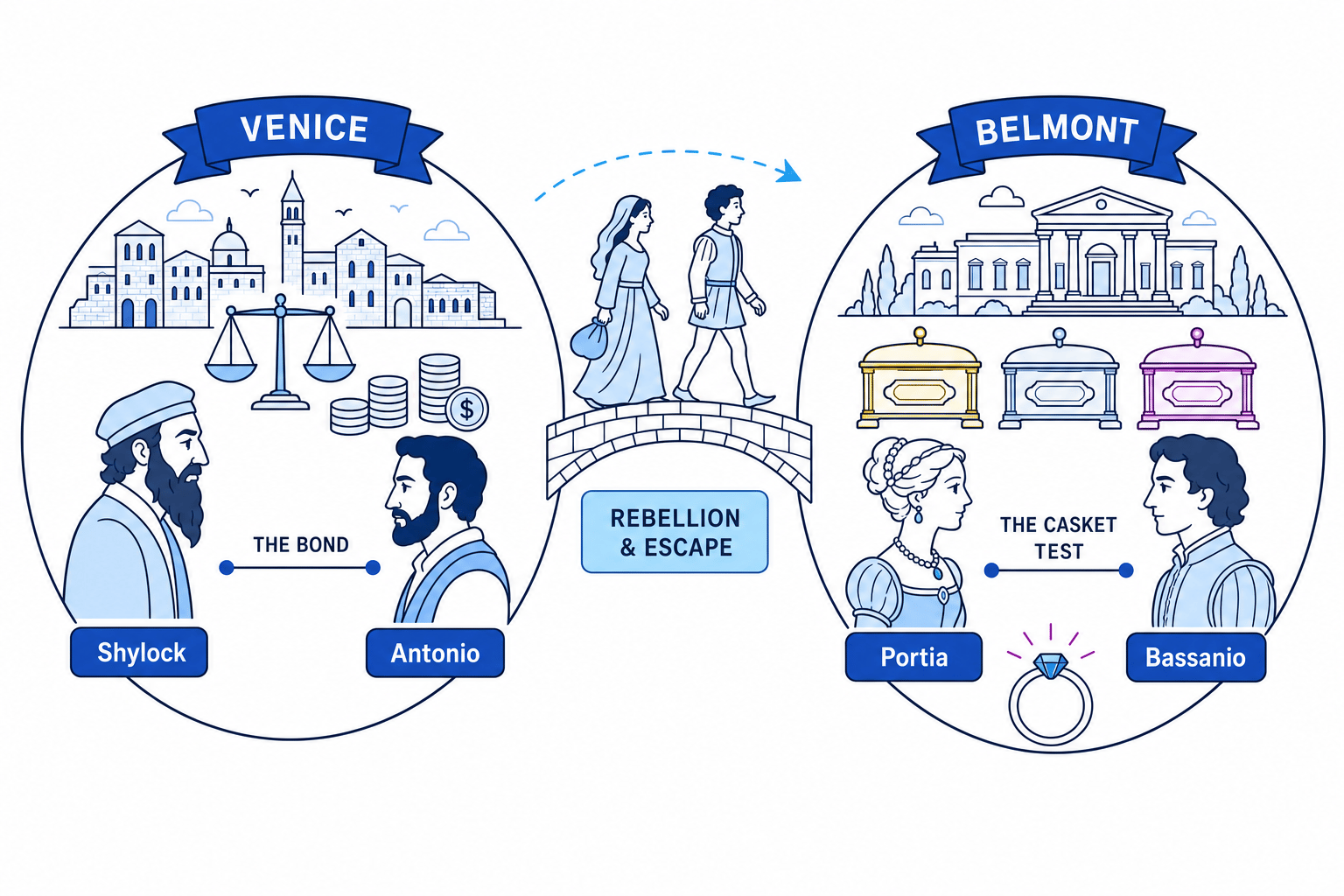
To understand the characters in The Merchant of Venice, we must first understand how Shakespeare uses setting to mirror their inner worlds and dramatic purposes. The play operates across two distinct settings: Venice and Belmont.
Dramatic purpose
The dramatic purpose of a character refers to the specific function they serve in advancing the plot, developing the play's themes, or eliciting a specific emotional and intellectual response from the audience.
Foil
A foil is a character who contrasts sharply with another character (usually the protagonist) to highlight particular qualities, virtues, or flaws in that character.
In this play, characters are structurally split across geographical lines:
- Venice is a public, male-dominated world of commerce, legal contracts, and racial/religious tension. Characters here (like Shylock and Antonio) are driven by rigid laws, financial transaction, and deep-seated animosities.
- Belmont is a private, green, fairy-tale world of romance, music, and wealth. Characters here (like Portia and Bassanio) speak in lyrical, poetic verse and navigate the idealized rules of love and legacy.
However, Shakespeare continuously subverts these boundaries. Belmont is not entirely pure (it is built on inherited wealth and exclusion), and Venice is not entirely heartless.
Shylock: Victim, Villain, or Caricature?
Shylock is one of the most debated characters in the theatrical canon. To an Elizabethan audience in 1596, Shylock would initially have been viewed as a comic, villainous caricature. Today, modern audiences often view him as a tragic figure, a victim of relentless anti-Semitic abuse. To score high marks (especially under AO4: Context), you must explore how Shakespeare's writing supports both interpretations.
The Victim: A Product of Cruelty
Shylock is subjected to horrific verbal and physical abuse by the Christian characters. He is called a "dog," a "cur," and a "misbeliever" by Antonio, who has "spit upon [his] Jewish gaberdine" (Act 1, Scene 3).
Shylock’s famous monologue in Act 3, Scene 1 is a powerful plea for shared humanity:
"Hath not a Jew eyes? Hath not a Jew hands, organs, dimensions, senses, affections, passions?"
By using a series of rhetorical questions, Shylock exposes the hypocrisy of Christian Venice. He argues that his desire for revenge is not an inherent vice, but a lesson taught to him by his Christian oppressors: "The villainy you teach me I will execute" (Act 3, Scene 1).
The Villain: The Ruthless Creditor
While we sympathize with Shylock’s suffering, Shakespeare does not present him as a saint. Shylock is legalistic, cold, and obsessive. His immediate reaction to his daughter Jessica's elopement is deeply unsettling, as he seems to value his lost money as much as his lost daughter:
"I would my daughter were dead at my foot, and the jewels in her ear!" (Act 3, Scene 1)
In the courtroom (Act 4, Scene 1), he rejects multiple offers of twice the monetary value of the bond, demanding instead a literal "pound of flesh" from Antonio. This reveals that his quest for justice has devolved into a murderous obsession with vengeance.
The Paradox of Shylock
Shylock cannot be neatly categorized as purely good or purely evil. His villainy is a direct consequence of the systemic prejudice he experiences. He uses the Christians' own legalistic tools to demand a cruel vengeance, ultimately leading to his own tragic downfall.
Portia: The Golden Maiden with a Steel Will
Portia is the heroine of the play, but she is far more complex than a standard fairy-tale princess. She possesses immense wealth and intellect, yet she begins the play entirely trapped by her deceased father’s will—unable to choose her own husband.
Agency
Agency is the capacity of an individual to act independently, make their own free choices, and exert power over their own life.
Constrained Agency and the Caskets
In Act 1, Scene 2, Portia laments: "I may neither choose who I would, nor refuse who I dislike; so is the will of a living daughter curbed by the will of a dead father."
Despite this restriction, Portia uses her wit to navigate her circumstances. She mocks her foreign suitors with sharp, satirical humor, displaying a deeply nationalistic and xenophobic attitude (AO4 context). For example, when the Prince of Morocco chooses incorrectly, she remarks: "Let all of his complexion choose me so" (Act 2, Scene 7), reflecting the racial prejudices of Elizabethan society.
Disguise and the Power of "Balthazar"
When Bassanio’s life is threatened by Shylock's bond, Portia takes matters into her own hands. She escapes the domestic sphere of Belmont, disguises herself as a young male lawyer named Balthazar, and enters the courtroom of Venice.
By adopting a male persona, Portia gains the legal and social agency denied to her as a woman. In her famous "quality of mercy" speech (Act 4, Scene 1), she argues that mercy is "twice blest: It blesseth him that gives and him that takes."
When Shylock refuses to show mercy, Portia systematically dismantles his case using a hyper-literal interpretation of Venetian law:
"This bond doth give thee here no jot of blood; The words expressly are 'a pound of flesh'"
Over-simplifying Portia's morality
Many students write about Portia as the absolute voice of Christian mercy and justice. However, remember that Portia shows no mercy to Shylock once she gains the upper hand. She strips him of his wealth, his livelihood, and forces him to convert to Christianity, destroying his identity. Her justice is just as legalistic and ruthless as Shylock’s.
Antonio: The Melancholic Merchant
Antonio is the titular "Merchant of Venice." He is a wealthy trader whose mood dominates the opening of the play: "In sooth, I know not why I am so sad" (Act 1, Scene 1).
Antonio's Devotion to Bassanio
The cause of Antonio's melancholy is never explicitly named, but many literary critics and modern productions interpret it as unrequited romantic love for Bassanio. When Bassanio asks him for money to woo Portia, Antonio immediately risks his own life by signing Shylock’s dangerous bond, declaring: "My purse, my person, my extremest means / Lie all unlocked to your occasions" (Act 1, Scene 1).
Hypocrisy and Prejudice
While Antonio is fiercely loyal and generous to his Christian friends, he is viciously cruel to Shylock. He proudly admits that he is likely to spit on Shylock and call him a dog again. This stark hypocrisy is central to Shakespeare's exploration of Christian Venetian society: the same man who is willing to die out of love for his friend is entirely comfortable dehumanizing a social outsider.
Worked Example: Analyzing Character Dynamics in Action
Let’s walk through how to analyze a crucial interaction between Shylock and Antonio to show how Shakespeare builds character conflict and reveals theme.
Analyzing Shylock and Antonio's confrontation in Act 1, Scene 3
The Passage:
Shylock: Signior Antonio, many a time and oft In the Rialto you have rated me About my moneys and my usances. Still have I borne it with a patient shrug, For sufferance is the badge of all our tribe. You call me misbeliever, cut-throat dog, And spit upon my Jewish gaberdine...
The Task: Analyze how Shakespeare presents the relationship between Shylock and Antonio in this passage, focusing on language, method, and context.
The Analytical Steps:
- Establish the literal and dramatic context (AO1): Explain what is happening in this moment. Bassanio has asked Shylock for a loan of 3,000 ducats, with Antonio acting as the guarantor. Shylock uses this moment to directly confront Antonio about his past hypocrisy and abuse, shifting the power dynamic from merchant-creditor to victim-accuser.
- Analyze Shakespeare's linguistic choices and imagery (AO2): Look closely at the noun "usances" (lending money with interest) and the verb "rated" (berated/scolded). Shylock highlights that Antonio's hatred is fueled not just by religious difference, but by economic competition. Note the animalistic imagery in "cut-throat dog" and the violent verb "spit." This graphic language exposes the visceral, physical nature of Antonio's prejudice.
- Analyze the structural contrast and rhythm (AO2): Point out the contrast between Shylock's "patient shrug" and Antonio's active violence. The metaphor "sufferance [endurance] is the badge of all our tribe" highlights Shylock’s collective historical consciousness. He is not just speaking for himself, but for all Jewish people who have historically endured persecution.
- Relate to historical and societal context (AO4): Connect this to Elizabethan England, where Jews had been officially banished since 1290, and usury was considered a sin by Christians but was one of the few livelihoods open to Jewish people in Europe. Antonio's hypocrisy is laid bare: he despises the practice of usury, yet he is perfectly willing to exploit Shylock's capital when he needs to rescue Bassanio.
Minor Characters and their Thematic Functions
To achieve top marks, you must also be able to discuss how secondary characters function as foils or mirrors to the main characters.
Jessica: The Rebel Daughter
Jessica, Shylock's daughter, abandons her father's house, steals his gold and jewels, and elopes with the Christian Lorenzo.
- Foil to Portia: While Portia remains fiercely loyal to her dead father's strict wishes (the casket test), Jessica actively rebels against her living father, calling her home a "hell" (Act 2, Scene 3).
- Thematic function: Her escape highlights the fracturing of Shylock's domestic life and prompts his final, ruthless spiral into revenge. However, even though Jessica converts to Christianity, the other Christians still mock her background, showing that her conversion does not fully erase her "outsider" status.
Bassanio: The Romantic Opportunist
Bassanio is often played as a dashing young romantic, but his motives are highly questionable. He begins the play deeply in debt and views Portia as a financial solution: "In Belmont is a lady richly left, / And she is fair" (Act 1, Scene 1). Note how her wealth is mentioned before her beauty.
Although he successfully chooses the correct casket by rejecting outward gold and silver, his romantic quest is entirely funded by Antonio's life-threatening bond with Shylock.
Look for the double meanings
Always look for economic language in the love scenes and romantic language in the financial scenes. Bassanio "woos" Portia like a financial venture, while Antonio and Shylock's legal bond reads like a dark, passionate, twisted marriage of hatred.
In the exam
When writing about characters in your Edexcel IGCSE exam, keep these three structural strategies in mind:
- Never treat characters as real people. Always refer to them as constructs built by Shakespeare to explore ideas. Use active verbs: "Shakespeare constructs Shylock to challenge..." or "Shakespeare uses Portia's disguise to expose..."
- Track the character's arc. Characters are not static. Show how they change (or fail to change) from the exposition, through the rising action, to the resolution. For example, compare Portia's passive sadness in Act 1 with her absolute judicial dominance in Act 4.
- Integrate context (AO4) naturally. Do not dump historic facts about Elizabethan Jews or Venetian law in a separate paragraph. Instead, weave them directly into your language analysis. Explain why an Elizabethan audience might laugh at Shylock's loss, and why a modern audience might find it tragic.
Check yourself
Before moving on to the Themes guide, make sure you can answer these questions:
- How does the setting of Belmont contrast with Venice, and how does this affect the presentation of Portia versus Shylock?
- What linguistic methods does Shylock use in his "Hath not a Jew eyes" speech to assert his humanity?
- In what ways does Portia's behavior in the courtroom scene undermine her earlier speech about the "quality of mercy"?
- How does Jessica's rebellion against Shylock parallel or contrast with Portia's obedience to her father?