To understand the tension, conflicts, and characters in The Merchant of Venice, you must step back into the world of the late 16th century. In your Edexcel IGCSE English Literature exam (Component 2, Section B), you are assessed on AO4: the relationship between the text and its historical, social, and cultural context.
This guide will break down the essential contextual pillars of the play and show you exactly how to integrate them into a top-grade analytical essay.
What you'll learn
- The realities of antisemitism in Elizabethan England and how it shaped the presentation of Shylock.
- The economic conflict between Christian ideals of charity and the rise of Venetian capitalism (specifically usury).
- The social and gender expectations governing women in the Renaissance, and how Portia navigates them.
- How to seamlessly weave historical context (AO4) with close language analysis (AO2) in your exam.
What is "Context" in an English Literature Essay?
Before looking at historical dates, it is important to understand what context actually is.
Context (AO4)
Context is the environment in which a text was written and received. It includes the historical events, social attitudes, religious beliefs, and literary traditions of the author’s time, and how those factors influence our understanding of the text's characters, themes, and language.
Many students make the mistake of "bolting on" context—dropping a random fact about the 16th century at the end of a paragraph without linking it to the language of the play. In the Edexcel IGCSE exam, context must be integrated naturally to explain why characters speak and behave the way they do.
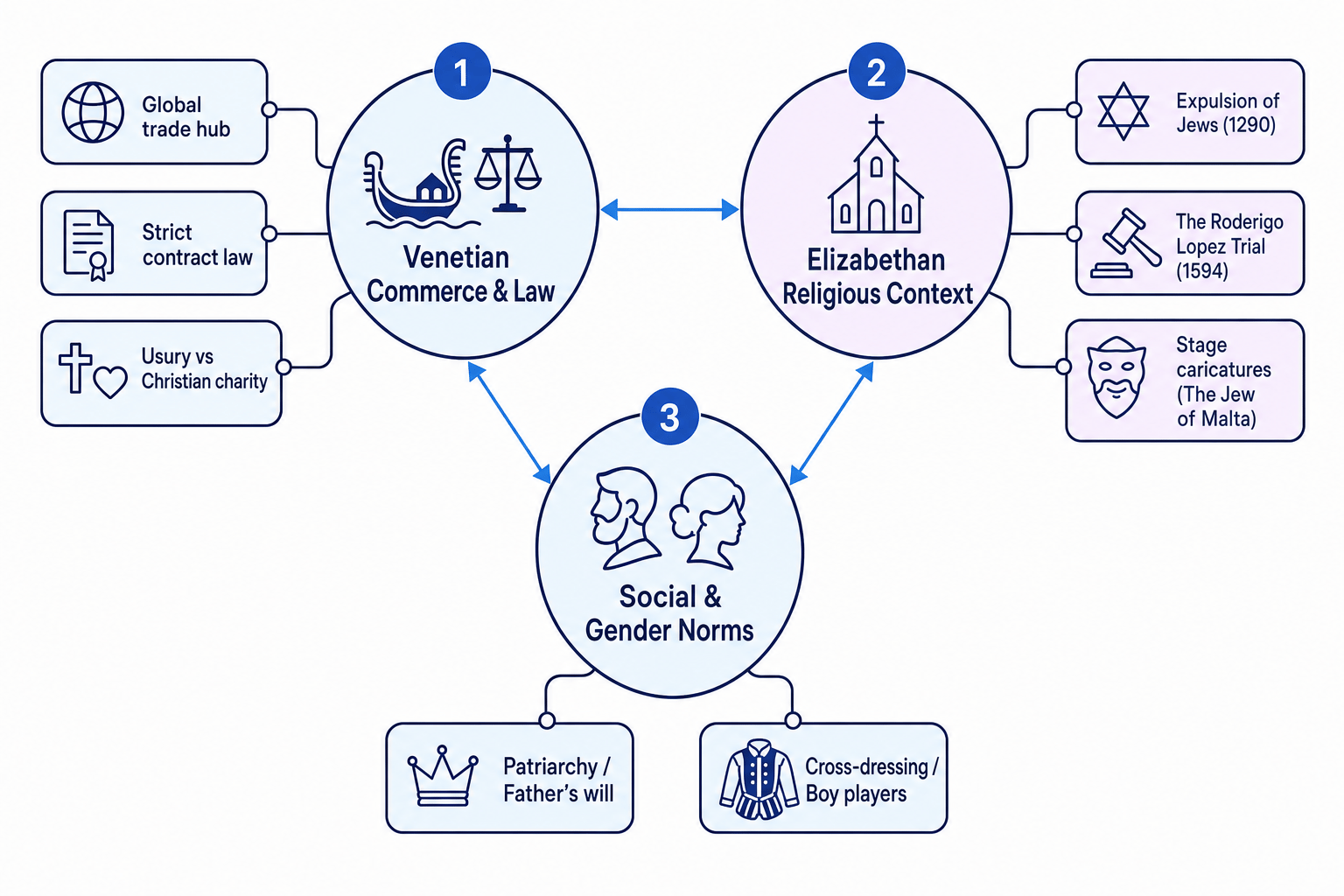
1. Elizabethan Antisemitism and Shylock
To a modern audience, the prejudice Shylock faces is deeply uncomfortable, and he is often played with great tragic sympathy. However, Shakespeare’s original Elizabethan audience had a very different perspective on Jewish people.
The Expulsion and Absence of Jews
In 1290, King Edward I signed the Edict of Expulsion, which banished all Jewish people from England. For over 300 years—including the entirety of Shakespeare's life—it was illegal to practice Judaism in England.
Consequently, most Elizabethans had never actually met a practicing Jewish person. Their understanding of Jewish culture was built entirely on caricature, religious prejudice, and medieval myths, such as "blood libel" (the false accusation that Jews killed Christian children for religious rituals).
The Roderigo Lopez Trial (1594)
Just a few years before Shakespeare wrote The Merchant of Venice (around 1596–1598), a major historical scandal gripped London. Roderigo Lopez, a Portuguese Jewish doctor who had converted to Christianity, served as Queen Elizabeth I’s personal physician. He was accused of conspiring with Spanish agents to poison the Queen.
Despite thin evidence, Lopez was found guilty of high treason and executed in 1594 amid a wave of intense public antisemitism. The public hysteria surrounding this trial made Jewish villains highly popular and profitable on the London stage.
Literary Precedent: The Jew of Malta
Shakespeare was not writing in a vacuum; he was competing with other playwrights. Christopher Marlowe's play The Jew of Malta (c. 1589) featured a Jewish villain named Barabas. Barabas is a flat, unrepentant caricature who poisons wells, murders nuns, and boasts of his cruelty.
While Shakespeare's Shylock shares some features with Barabas, Shakespeare made Shylock a far more complex, human, and multi-dimensional character.
Shylock: Caricature vs. Human
While Shakespeare utilised popular antisemitic tropes to satisfy his audience (such as Shylock’s demands for literal justice and his association with greed), he also challenged these stereotypes by giving Shylock moments of profound, raw humanity, most notably in the "Hath not a Jew eyes?" speech (Act 3, Scene 1).
2. Economics: Venice, Capital, and Usury
Shakespeare chose to set his play in two distinct, contrasting locations: Venice and Belmont. To understand the economic tensions of the play, we must understand why Venice was the perfect setting.
Venice as a Mercantile Superpower
In the 16th century, Venice was not just a romantic city of canals; it was a global hub of trade, wealth, and cosmopolitan diversity. It was a republic built entirely on maritime commerce. Because it relied on merchants from all over the world (including Jews, Turks, and Moors), Venice had to maintain strict, impartial commercial laws. If foreign investors felt the Venetian courts favored their own citizens, international trade would collapse. This is why Antonio and Portia repeatedly acknowledge that the Duke cannot simply rip up Shylock's bond (Act 3, Scene 3).
The Conflict of Usury
The primary clash between Antonio and Shylock is not just religious; it is economic. Antonio lends money out of friendship and Christian charity, without charging interest. Shylock charges interest on his loans.
Usury
Usury is the practice of lending money and charging interest on the principal loan. In the medieval and Renaissance periods, usury was widely considered a grave sin by the Christian Church.
According to Christian theology of the time, money was "barren" (it could not naturally reproduce). Therefore, making money "breed" through interest was unnatural and sinful. However, because Jews were barred from most professions and land ownership in Europe, moneylending was one of the few livelihoods legally open to them. This economic reality forced them into a role that Christians simultaneously relied upon and despised.
Confusing modern interest with historical usury
Don't judge the characters by modern banking standards. Today, charging interest is normal. In Shakespeare's time, Antonio's refusal to charge interest ("He lends out money gratis" - Act 1, Scene 3) was viewed as highly virtuous and Christian, while Shylock’s moneylending was viewed as predatory and spiritually corrupt.
3. Social Structures: Gender and Patriarchy
While Venice is a masculine world of courts and contracts, Belmont is an aristocratic, feminine world of music and romance. However, both worlds are governed by rigid Elizabethan social rules.
The Limits of Female Agency
Elizabethan England was a deeply patriarchal society. Women had very few legal rights; they were essentially the property of their fathers until they married, at which point they became the property of their husbands.
We see this directly in Belmont. Even though Portia is a wealthy, intelligent heiress, she cannot choose her own husband. She is bound by the "will of a dead father" through the lottery of the three caskets (gold, silver, and lead).
The Concept of Cross-Dressing
To save Antonio, Portia and Nerissa must disguise themselves as young male lawyers (Balthasar and his clerk).
On the Elizabethan stage, all female roles were played by young boy actors whose voices had not yet broken, as women were legally prohibited from acting professionally. Therefore, an Elizabethan audience would watch a boy actor playing a woman (Portia) who then disguises herself as a young man (Balthasar).
Thematically, this disguise highlights the limitations placed on women. For Portia to enter the public sphere of law, intellect, and authority, she must shed her female identity and adopt the guise of a man.
Putting Context into Practice: Analytical Writing
In your exam, you should never write a paragraph containing only historical facts. Instead, use context to explain the effects of Shakespeare’s language and structural choices.
Here is a worked example showing how to build a context-integrated paragraph analyzing Shylock's defense of his bond in Act 1, Scene 3.
Analyzing Shylock's defense of usury
Analyze how Shakespeare uses language and context to present the conflict between Antonio and Shylock in Act 1, Scene 3.
-
State your analytical point (AO1): Start with a clear, direct answer to the prompt that introduces both characters' perspectives.
Example: Shakespeare uses the financial negotiations in Act 1, Scene 3 to highlight the deep ideological clash between Christian mercy and the mercantile realities of Venetian usury.
-
Introduce precise evidence (AO1): Quote directly from the text to establish the conflict.
Example: Shylock defends his financial practices by comparing his interest-bearing loans to Jacob’s breeding of Laban's sheep, arguing that profit is honorable: "thrift is blessing, if men steal it not."
-
Analyze the literary and dramatic methods (AO2): Examine Shakespeare's choice of words, metaphors, and biblical illusions.
Example: By employing a biblical allusion to the Book of Genesis, Shylock attempts to give his financial practices spiritual legitimacy. The noun "thrift" is deliberately chosen to reframe what Christians viewed as greedy exploitation into a virtue of careful resourcefulness and stewardship.
-
Integrate specific historical context (AO4): Explain how an Elizabethan audience would have reacted to this language based on their contemporary beliefs.
Example: This argument would have deeply unsettled an Elizabethan audience, who viewed usury as a sinful, unnatural manipulation of "barren metal." By having Shylock use Christian scripture to defend moneylending, Shakespeare dramatizes the deep religious hypocrisy each side accused the other of harboring. Antonio's immediate dismissal of Shylock's story ("The devil can cite Scripture for his purpose") reflects the prevailing Elizabethan view that Jewish theological interpretations were inherently deceptive.
In the exam
- Never dump history: Avoid writing long paragraphs of historical background that don't quote the play. Every piece of context must directly explain a specific word, character choice, or scene.
- Remember it is open-book: You have a clean copy of The Merchant of Venice in the exam room. Do not waste time memorizing huge chunks of text. Instead, practice finding specific key scenes (like the Casket scenes, the Trial scene, or Shylock's early confrontations) quickly.
- Use evaluative language: Instead of writing "Elizabethans hated Jews," write "Shakespeare navigates the deeply ingrained antisemitic prejudices of his contemporary audience by..." This shows the examiner you are thinking about the playwright's conscious craft.
- Compare settings: Remember that Venice and Belmont are structural devices. Venice represents law, commerce, and isolation; Belmont represents harmony, mercy, and community. Contrast these locations to hit high marks for structure (AO2) and setting (AO4).
Check yourself
- Why did the 1594 execution of Roderigo Lopez make Jewish characters popular on the Elizabethan stage?
- How does the literal law of Venice tie into its status as a global trade hub, and why does this prevent the Duke from simply helping Antonio?
- What is usury, and why did the contemporary Christian church consider it a sin?