To score highly in your Edexcel IGCSE English Literature exam, you cannot just treat The Merchant of Venice as a series of events. You must understand how Shakespeare constructs his plot to contrast themes of justice, mercy, wealth, and love.
What you'll learn
- How the parallel worlds of Venice and Belmont shape the play's structure.
- The mechanics of the "Bond Plot" and the "Casket Plot," and how they collide.
- How to analyze the structural turning points that Shakespeare uses to build dramatic tension.
1. The Dual-Plot Structure
At first glance, The Merchant of Venice seems to tell several different stories at once: a dispute over a loan, a fairy-tale choice between three chests, a runaway daughter, and a trick involving gold rings.
Shakespeare organizes these events using a specific structural technique.
Dual Plot
A dual plot (or double plot) is a dramatic structure where two distinct stories run alongside each other in the same play. These plots usually feature different characters and settings but are linked by shared themes and eventually merge at a dramatic climax.
In this play, Shakespeare balances two primary plots and two secondary plots:
- The Bond Plot (Primary): Centered in the commercial world of Venice. Antonio, a Christian merchant, signs a dangerous contract with Shylock, a Jewish moneylender, to secure a loan for his friend Bassanio.
- The Casket Plot (Primary): Centered in the romantic estate of Belmont. Portia, a wealthy heiress, is bound by her dead father’s will to marry whichever suitor correctly chooses between three caskets (gold, silver, and lead).
- The Elopement Plot (Secondary): Jessica (Shylock’s daughter) runs away with Lorenzo (a Christian), stealing her father's ducats and gold.
- The Ring Plot (Secondary): Portia and her lady-in-waiting, Nerissa, disguise themselves as male lawyers to save Antonio, then demand their own wedding rings from their husbands as payment, testing their loyalty.
Structural Symmetry: Venice vs. Belmont
The play moves back and forth between two main locations. This structural alternation highlights the deep contrast between the two worlds:
| Venice (The Bond Plot) | Belmont (The Casket Plot) |
|---|---|
| Atmosphere: Realistic, tense, anxious, competitive. | Atmosphere: Fairy-tale, musical, romantic, peaceful. |
| Values: Mercenary, legalistic, transactional. | Values: Generous, loyal, merciful. |
| Dominant Imagery: Money, merchandise, ledgers, bonds, knives. | Dominant Imagery: Music, gold, silver, lead, light, natural beauty. |
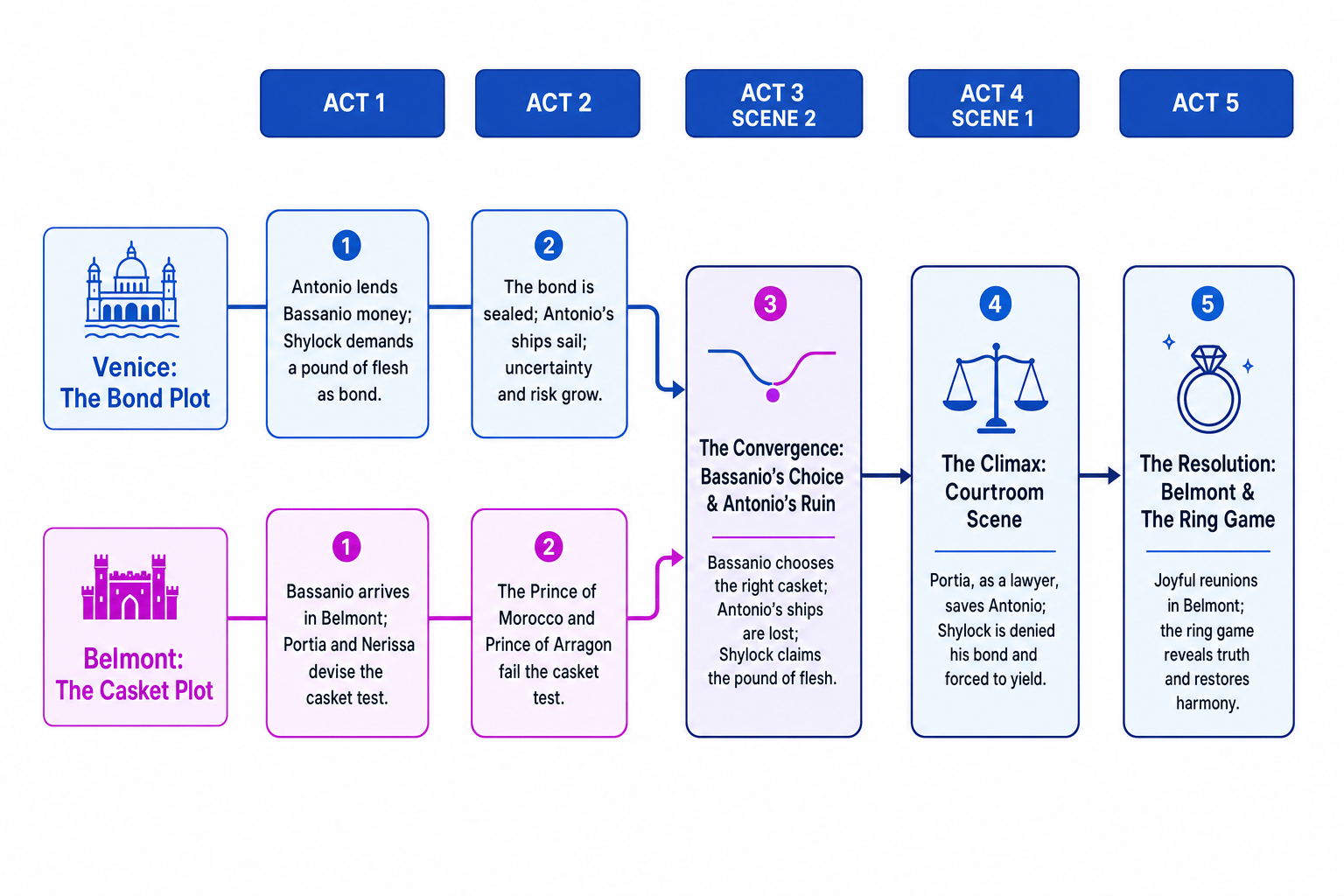
2. Chronological Breakdown: How the Plots Collide
Let's look at how these narratives progress, intersect, and resolve across the five acts of the play.
Act I: The Catalyst
We meet Antonio in Venice, who is inexplicably sad ("In sooth, I know not why I am so sad"). His friend Bassanio requests a loan of 3,000 ducats so he can travel to Belmont to woo the wealthy heiress Portia. Because Antonio’s wealth is tied up in overseas cargo ships, they turn to Shylock.
Shylock agrees to lend the money on one condition: if Antonio cannot repay the debt within three months, Shylock can claim "a pound of your fair flesh, to be cut off and taken in what part of your body pleaseth me." Antonio confidently signs this "merry bond."
Meanwhile, in Belmont, we find Portia frustrated by her deceased father's lottery. Suitors from all over the world are arriving to try their luck, but none have succeeded yet.
The structural catalyst
The initial loan of 3,000 ducats is the structural hinge of the entire play. It is the action that links Venice directly to Belmont: Antonio's financial risk in Venice funds Bassanio's romantic quest in Belmont.
Act II: Complications and Rising Action
The tension rises in both locations:
- In Belmont: The Prince of Morocco chooses the gold casket (deceived by outer appearance: "All that glisters is not gold"). The Prince of Arragon chooses the silver casket (deceived by self-importance). Both fail.
- In Venice: Jessica escapes Shylock’s house with Lorenzo, taking a casket of Shylock's gold and jewels. This deepens Shylock’s resentment of Christians, setting up his desire for revenge.
Act III: The Crisis and Intersection
This is the dramatic turning point of the play. In Act III, Scene 2, the two plots collide directly.
First, Bassanio arrives at Belmont and successfully chooses the lead casket ("hazard all he hath"), winning Portia's hand.
However, this moment of pure romantic triumph is immediately shattered. A messenger arrives from Venice with a letter from Antonio. All of Antonio’s ships have been wrecked, the bond has forfeited, and Shylock is demanding his pound of flesh. Bassanio must rush back to Venice, funded by Portia’s wealth, to try and save his friend.
Act IV: The Climax (The Courtroom Scene)
The action moves entirely to the Venetian courtroom. Shylock refuses double the money and demands his legal right to the pound of flesh.
When all seems lost, Portia arrives disguised as "Balthasar," a young doctor of law. She initially appeals to Shylock's mercy ("The quality of mercy is not strained..."). When he refuses, she uses the letter of the law against him: he may take the flesh, but if he spills even one drop of Christian blood, or takes more or less than an exact pound, his life and property are forfeit under Venetian law.
Shylock is defeated, stripped of his wealth, and forced to convert to Christianity.
Confusing Portia's argument
Do not write that Portia defeats Shylock simply by being merciful. She defeats him by using strict, literal legalism—the very weapon Shylock tried to use against Antonio.
Act V: The Resolution
The play returns to Belmont. The dark, life-threatening tension of Venice is dissolved through music, poetry, and comedy.
Portia and Nerissa tease their husbands for giving away their betrothal rings in the courtroom, before finally revealing that they were the disguised lawyers. The play ends with news that three of Antonio’s merchant ships have safely returned to port after all.
3. Structural Analysis: Act III, Scene 2
In your exam, you will need to demonstrate knowledge of AO2 (how language, form, and structure shape meaning). Let's look at how to analyze a crucial structural pivot point.
Analyzing structural shifts in Act 3 Scene 2
Analyze how Shakespeare structures the shift from joy to crisis when Salerio delivers Antonio's letter to Bassanio in Belmont.
-
Identify the structural juxtaposition: Analyze the contrasting emotional states. The scene begins with Bassanio's successful choice of the lead casket, marked by romantic imagery and shared vows (the giving of Portia's ring). The sudden entrance of Salerio with Antonio’s letter acts as an abrupt structural intrusion, physically bringing the cold, transactional reality of Venice into the romantic refuge of Belmont.
-
Examine the language of physical alteration: Observe how Shakespeare uses physical changes to signal the structural shift to the audience. Portia notices Bassanio’s sudden pallor as he reads the letter: "There are some shrewd contents in yon same paper / That steals the colour from Bassanio's cheek." The word "steals" reminds us of the thefts in Venice (Jessica stealing Shylock's gold) and highlights how Venice constantly drains the vitality of Belmont.
-
Link the structural shift to the play's central themes (AO1/AO4): Show how this structural collision highlights the conflict between friendship (male civic loyalty in Venice) and romantic love (marital commitment in Belmont). Bassanio admits to Portia that his wealth was entirely built on a lie: "I have engaged myself to a dear friend, / Engaged my friend to his mere enemy, / To feed my means." The repetition of "engaged" structurally links the marital engagement Bassanio has just secured with Portia to the lethal financial engagement Antonio has made with Shylock.
In the exam
- Track the dramatic arc: When writing about any character or theme (e.g., Shylock's villainy or Portia's power), always explain where in the plot's structure their key moments occur. A character's behavior in Act I is very different from their position in Act IV or V.
- Do not forget Act V: Many students write essays that stop at the courtroom scene (Act IV). Shakespeare chose to end the play in Belmont with the Ring Plot. This structural choice is vital for restoring the play's status as a comedy (which structurally demands a harmonious resolution, usually ending in marriage).
- Analyze the setting shifts: Always mention where a scene is set. Contrast the economic, legal constraints of Venice with the lyrical freedom of Belmont to show your understanding of Shakespeare's structural design (AO2).
Check yourself
- Why is the transition between Venice and Belmont structurally important to the themes of the play?
- What structural role does Jessica's elopement play in accelerating the danger of the "Bond Plot"?
- How does the "Ring Plot" in Act V help resolve the dramatic tension created in the Act IV courtroom scene?