What you'll learn
- How The Merchant of Venice fits into the Edexcel IGCSE Literature course.
- The play’s main plot strands: the bond, the caskets, and the rings.
- Why Shakespeare mixes romance, comedy, danger, and prejudice.
- How to turn “overview” knowledge into AO1, AO2, and AO4 analysis.
The play at a glance
The Merchant of Venice is a play by William Shakespeare, probably written in the late 1590s. It is set mainly in Venice, a wealthy trading city, and Belmont, Portia’s more romantic and apparently harmonious world.
Play
A play is a dramatic text written to be performed by actors. When you analyse a play, you should think about dialogue, entrances and exits, disguise, stage action, audience response, and how scenes are arranged.
For Edexcel IGCSE English Literature 4ET1, The Merchant of Venice belongs to Component 2, Section B: Literary Heritage. This exam is open book, so you are allowed a clean copy of the text. That does not mean the text “does the work for you”: strong answers still need precise references, a clear personal argument, and close analysis of Shakespeare’s methods.
The big picture
At its simplest, the play asks what happens when love, money, law, mercy, revenge, and prejudice become tangled together.
A useful overview map
The play can feel complicated because several plots happen at once. It helps to see the two main locations and the three main plot strands together: the bond plot, the casket plot, and the ring plot.
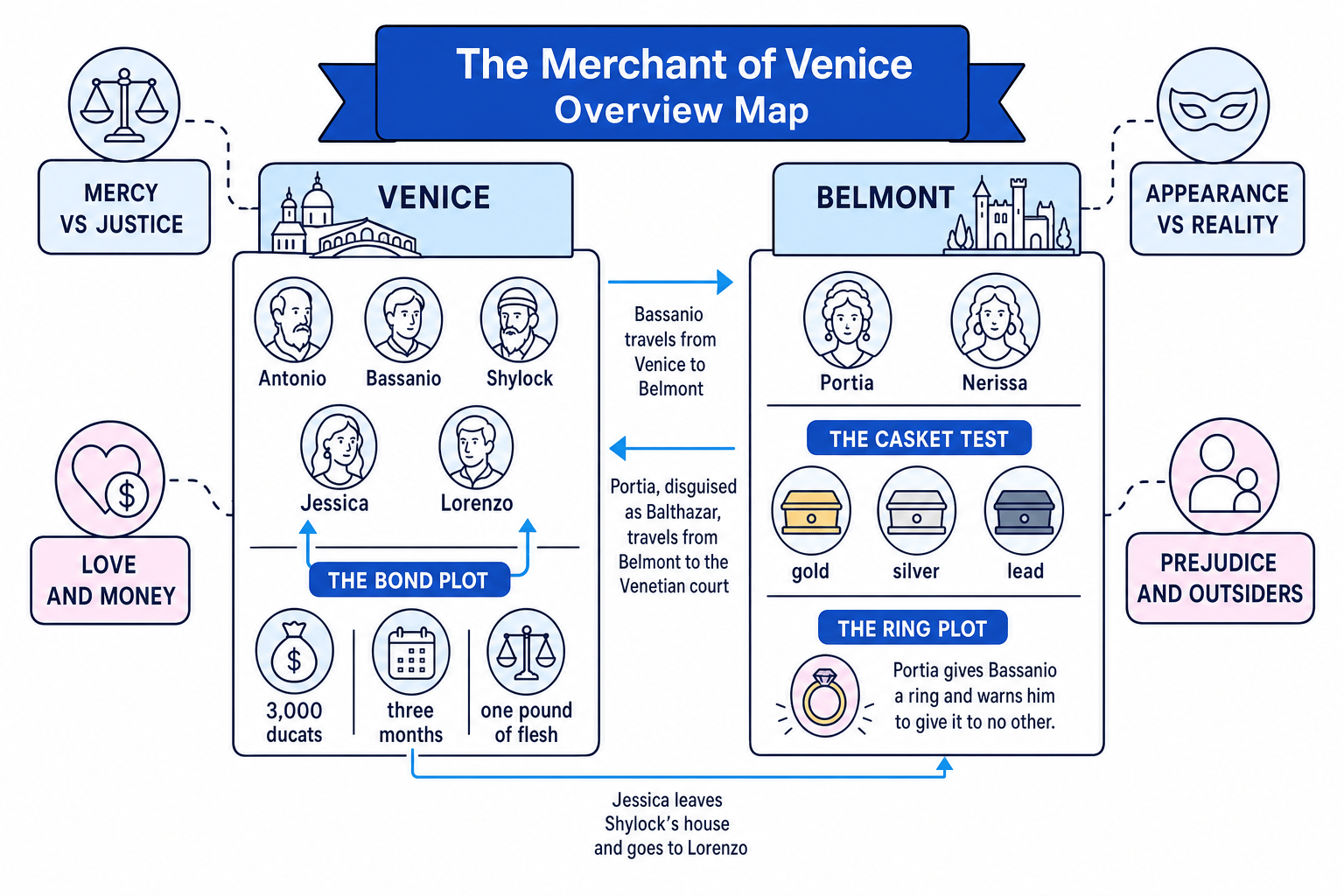
The two main settings
Venice: law, trade, risk, and prejudice
Venice is presented as a commercial city where reputation, credit, contracts, and law matter. Antonio is a merchant whose money is tied up in ships. Bassanio needs money to travel to Belmont and woo Portia. Shylock lends money and insists on the legal bond.
Venice is also a place of social division. Shylock is Jewish in a Christian society that insults and excludes him. This matters because the play’s conflict is not just personal; it is also shaped by religious prejudice and social power.
Context
Context means the social, historical, and cultural conditions around a text. In this play, useful context includes Elizabethan attitudes to Jews, Christian teaching about mercy, Venice as a trading power, and patriarchal expectations about marriage and inheritance.
Belmont: romance, choice, and appearance
Belmont is Portia’s home. It seems more poetic, musical, and romantic than Venice, but it is not free from control. Portia’s dead father has created the casket test, meaning Portia cannot simply choose her own husband.
The caskets introduce one of the play’s central ideas: appearances can deceive. The gold casket promises “what many men desire”, but the correct choice is the plain lead casket, which demands that the chooser “give and hazard all he hath”.
The three main plot strands
1. The bond plot
Bassanio asks Antonio for money so he can court Portia. Antonio borrows from Shylock. The agreement is that if Antonio cannot repay 3,000 ducats after three months, Shylock may take “an equal pound / Of your fair flesh”.
Bond
A bond is a formal legal agreement. In the play, the bond becomes a symbol of strict justice without mercy.
The bond plot creates the play’s darkest tension. Shylock repeatedly insists, “I will have my bond”, while Portia later argues, “The quality of mercy is not strained.” Shakespeare makes the audience weigh law against compassion.
2. The casket plot
Portia’s suitors must choose between gold, silver, and lead. Morocco chooses gold and fails. Arragon chooses silver and fails. Bassanio chooses lead and wins Portia.
The casket plot is not just a fairy-tale puzzle. It develops the theme of appearance versus reality. Bassanio says, “So may the outward shows be least themselves”, showing that he understands outward beauty can be misleading.
Theme
A theme is an important idea explored across a text. It is not usually one word by itself; for example, not just “justice”, but “the conflict between justice and mercy”.
3. The ring plot
After Bassanio wins Portia, she gives him a ring and tells him not to part with it. Later, disguised as a male lawyer called Balthazar, Portia saves Antonio in court. She then tests Bassanio by asking for the ring as payment.
This creates comedy, but it also raises questions about loyalty, marriage, and power. Portia’s disguise gives her authority in a male-dominated legal world.
Dramatic irony
Dramatic irony happens when the audience knows something a character does not. In the ring plot, the audience knows Balthazar is Portia, but Bassanio does not.
Genre: comedy with uncomfortable darkness
Shakespeare’s play is usually classed as a comedy, but that does not mean every part is funny.
Shakespearean comedy
A Shakespearean comedy is a play that usually moves towards marriage, reconciliation, disguise, mistaken identity, and social restoration. It can still contain cruelty, danger, and serious moral questions.
The ending includes marriages and music in Belmont, which fits comic form. However, Shylock’s forced conversion and humiliation in Act 4 make the ending morally uneasy. A strong IGCSE answer can recognise both sides: the play has a comic structure, but it also exposes disturbing prejudice.
Calling it simply a happy ending
Do not write that everyone is happy at the end. Belmont is restored for the Christian characters, but Shylock is broken by the court’s judgement, so the ending is more complex than a simple celebration.
The central conflicts
Mercy versus justice
The court scene in Act 4 is the dramatic centre of the play. Shylock demands the exact terms of the bond. Portia argues that mercy is morally superior to legal revenge: “The quality of mercy is not strained.”
Antithesis
Antithesis is a contrast between opposing ideas. The play repeatedly sets mercy against justice, love against money, and appearance against reality.
Portia’s speech presents mercy as “gentle rain from heaven”, using a metaphor to suggest that mercy is natural, generous, and blessed. However, the court later treats Shylock harshly, which complicates the Christian characters’ claim to moral superiority.
Love and money
The play constantly connects love with finance. Bassanio needs money to woo Portia. Jessica steals money and jewels when she leaves Shylock. Portia is both a romantic heroine and a wealthy heiress.
This does not mean love is fake in the play, but Shakespeare makes you ask whether love can ever be separated from wealth, status, and inheritance.
Prejudice and outsiders
Shylock is both a villainous figure in parts of the play and a victim of Christian abuse. His famous question, “If you prick us, do we not bleed?”, forces the audience to recognise his humanity. Yet he also declares, “The villainy you teach me I will execute”, linking his revenge to the cruelty he has suffered.
A thoughtful answer avoids making Shylock too simple. Shakespeare presents him as wrong to seek Antonio’s flesh, but also shows that Venetian society has helped create his bitterness.
How overview knowledge becomes analysis
In the exam, overview knowledge is useful only when you turn it into an argument about Shakespeare’s choices.
Linking plot, method, and meaning
Imagine the question asks how Shakespeare presents justice in the play.
- Start with the plot conflict: Shylock wants the law to enforce the bond, so justice appears strict, literal, and contractual.
- Add precise evidence: Shylock’s repeated phrase “I will have my bond” shows his fixation on the legal agreement rather than forgiveness.
- Analyse the method: the repetition of “bond” makes the word sound obsessive and reduces Antonio to the terms of a contract.
- Develop the contrast: Portia’s “The quality of mercy is not strained” introduces a Christian ideal of mercy that should rise above revenge.
- Complicate the argument: the court’s punishment of Shylock makes the Christian characters’ mercy look limited, so Shakespeare leaves the audience with an uneasy view of justice.
Form, structure, and language: the basics
Form, structure, and language
Form means the type of text and its dramatic features; structure means how the text is organised; language means Shakespeare’s word choices, imagery, and patterns of speech.
For The Merchant of Venice, useful form points include disguise, court-room drama, comic marriage plot, and stage spectacle. Useful structure points include the movement between Venice and Belmont, the build-up to Act 4, and the calmer final act. Useful language points include legal vocabulary, religious imagery, repeated references to money, and images of flesh, blood, and bonds.
A simple way to organise your thinking
When revising any scene, ask: Where are we? What plot strand is active? Which conflict is being tested? What does the audience know or feel at this point?
Key moments to know first
You do not need to memorise the whole play before you begin studying it, but you should know the main sequence:
- Antonio is sad in Venice; Bassanio asks for help to woo Portia.
- Antonio borrows money from Shylock and agrees to the pound-of-flesh bond.
- Portia’s suitors attempt the casket test.
- Jessica leaves Shylock’s house and marries Lorenzo.
- Bassanio chooses the lead casket and wins Portia.
- Antonio’s ships are reported lost, so Shylock demands the bond.
- Portia disguises herself as Balthazar and defeats Shylock in court.
- The play ends in Belmont with the ring test and the return to marriage comedy.
Misquoting the casket line
The famous line is “All that glisters is not gold”, not “all that glitters”. Shakespeare’s wording matters, especially when you are analysing appearance and reality.
Why this play matters for your exam
Because this is Component 2, you can use your clean copy, but you still need confident knowledge. The strongest answers usually do three things at once: they show close knowledge of the play, analyse Shakespeare’s dramatic methods, and connect ideas to relevant context without turning the essay into a history lesson.
For this text, AO1 means building a clear argument with accurate references. AO2 means explaining how Shakespeare’s language, form, and structure shape meaning. AO4 means using context, such as Christian ideas of mercy or Elizabethan prejudice against Jewish people, to deepen your interpretation.
In the exam
- Use the open book wisely: find short, precise quotations, but do not waste time copying long passages.
- Keep linking methods to meaning: if you mention repetition, metaphor, disguise, or contrast, explain what it makes the audience think or feel.
- Make your argument balanced: especially with Shylock, justice, mercy, and the ending, avoid one-sided claims.
Check yourself
- Can you explain the bond plot, casket plot, and ring plot in your own words?
- Why is the play called a comedy even though Act 4 is so dark?
- How does Shakespeare use the contrast between Venice and Belmont?