What you'll learn
- How a strong Macbeth essay is built for Edexcel IGCSE English Literature.
- How to move from a question to a clear argument, plan, paragraph and conclusion.
- How to blend AO1, AO2 and AO4 without writing separate “context sentences”.
- How to avoid common essay mistakes, especially plot retelling and device-spotting.
The Macbeth essay: what the examiner wants
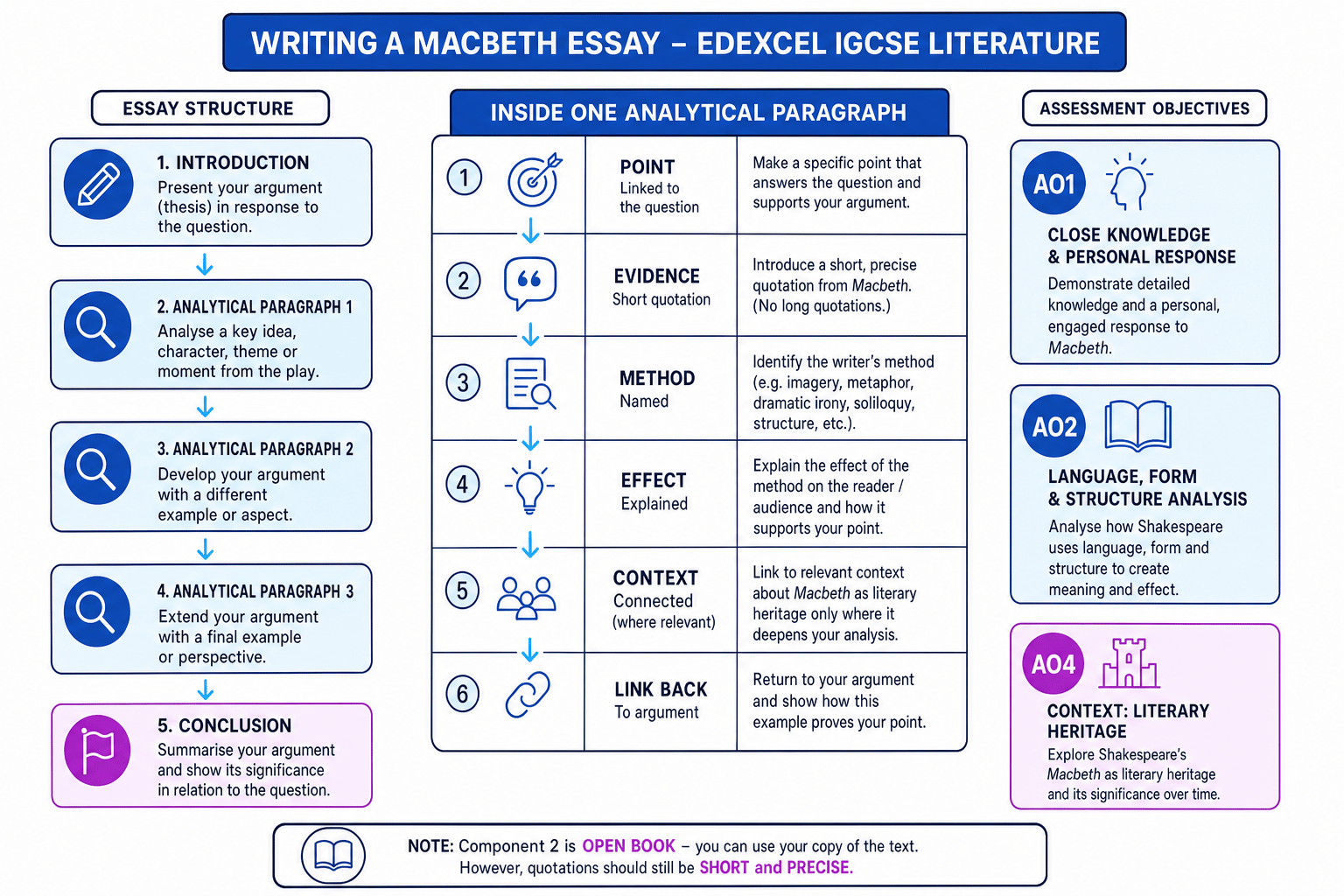
In Edexcel International GCSE English Literature, Macbeth appears in Component 2, Section B: Literary Heritage. This section is open book, so you may use a clean copy of the play in the exam.
However, open book does not mean “copy out long quotations”. The best essays still use short, precise references and spend most of the time analysing Shakespeare’s choices.
Assessment objectives
For Macbeth, you are mainly assessed on AO1, AO2 and AO4: your knowledge and argument, your analysis of Shakespeare’s language/form/structure, and your understanding of relevant context.
You do not need to write about AO3 for Macbeth. AO3 is for comparing anthology poems, not this section.
Start with the question, not the story
A model essay does not simply tell the examiner what happens in the play. It answers the exact question.
If the question is about ambition, your essay should not become a general character study of Macbeth. If the question is about Lady Macbeth’s power, your essay should not drift into a whole plot summary of the murder of Duncan.
Thesis
A thesis is your overall argument in one or two sentences. It directly answers the question and gives your essay a clear direction.
A weak thesis might say:
Shakespeare shows ambition in Macbeth.
This is true, but it is too general. A stronger thesis says something more precise:
Shakespeare presents ambition as a corrupting force that first tempts Macbeth with power, then destroys his morality, relationships and sense of meaning.
That gives you a route through the whole essay.
Turning a question into a thesis
Question: How does Shakespeare present ambition in Macbeth?
- Identify the focus of the question: it asks about ambition, not just Macbeth as a character.
- Decide Shakespeare’s overall message: ambition is not simply “bad”; it becomes dangerous when it overrules morality, loyalty and order.
- Shape this into an argument: Shakespeare presents ambition as a force that begins as private desire — “black and deep desires” — but grows into tyranny, guilt and spiritual emptiness.
- Check that the thesis can be developed across the play: you could discuss Macbeth’s early temptation, the murder of Duncan, then Macbeth’s later despair in “Life’s but a walking shadow”.
Use the wording of the question
Echo the question’s key words in your thesis and topic sentences. This keeps your argument focused and makes your answer feel controlled.
Building an essay plan
A strong Macbeth essay usually has:
- A short introduction with your thesis.
- Three or four analytical paragraphs.
- A brief conclusion that returns to Shakespeare’s overall message.
Analytical paragraph
An analytical paragraph is a paragraph that makes one clear point, supports it with textual evidence, analyses Shakespeare’s methods, and links back to the question.
For example, on ambition, you might plan:
| Paragraph | Focus | Possible evidence |
|---|---|---|
| 1 | Macbeth’s ambition begins as hidden desire | “Stars, hide your fires” |
| 2 | Lady Macbeth intensifies and manipulates that ambition | “When you durst do it, then you were a man” |
| 3 | Ambition leads to violence and moral corruption | “I am in blood / Stepped in so far” |
| 4 | Ambition finally leaves Macbeth empty and nihilistic | “Life’s but a walking shadow” |
Plan by argument, not chronology
Your essay can follow the order of the play, but each paragraph must prove part of your argument. Do not write “first this happens, then this happens” unless you are also explaining why it matters.
Writing the introduction
Your introduction should be short. You do not need a biography of Shakespeare or a long explanation of Jacobean society.
A good introduction does three things:
- Names the focus of the question.
- Gives a clear argument.
- Hints at Shakespeare’s wider purpose.
For example:
Shakespeare presents ambition in Macbeth as a dangerous force that corrupts natural loyalty and moral judgement. Through Macbeth’s movement from “valiant cousin” to tyrant, Shakespeare suggests that unchecked desire for power disrupts both the individual conscience and the order of the state.
This works because it is specific, relevant and arguable.
Starting too broadly
Avoid openings such as “In Shakespeare’s time, people believed in witches” unless the question actually leads you there. Context should support your argument, not replace it.
Writing analytical paragraphs
A useful structure is:
Point → Evidence → Method → Effect → Link
This is not a rigid formula, but it helps you remember what an examiner is looking for.
Method
A method is a choice made by the writer. In Macbeth, this could include language methods such as metaphor or imagery, dramatic methods such as soliloquy or dramatic irony, and structural methods such as contrast, foreshadowing or repetition.
Effect
The effect is what Shakespeare’s method makes the audience think, feel or understand. It should connect to meaning, not just say “this makes the reader want to read on”.
Model paragraph: ambition
Shakespeare first presents Macbeth’s ambition as something secretive and morally disturbing. After Duncan names Malcolm as heir, Macbeth asks, “Stars, hide your fires; / Let not light see my black and deep desires” in Act 1 Scene 4. The contrast between “light” and “black” creates imagery of moral darkness, suggesting that Macbeth already recognises his desires as sinful. Shakespeare also uses the imperative “hide” to show Macbeth actively trying to conceal his ambition, not only from others but almost from divine judgement. This is important in a Jacobean context because kingship was associated with God-given order, so Macbeth’s private wish to overtake Duncan would seem unnatural and threatening. Shakespeare therefore presents ambition as dangerous before Macbeth has even acted on it: the corruption begins in the imagination.
Notice how the paragraph does not just name a technique. It explains how the technique builds Shakespeare’s meaning.
Improving analysis of a quotation
Quotation: Macbeth describes “vaulting ambition, which o’erleaps itself” in Act 1 Scene 7.
- Start with meaning: Macbeth knows that ambition is his only real motive for killing Duncan; he has no moral justification.
- Analyse the metaphor: “vaulting” suggests a rider jumping too far and losing control, so ambition is presented as energetic but unstable.
- Connect to structure: this comes before the murder, so Shakespeare foreshadows Macbeth’s downfall before the crime takes place.
- Link to the question: ambition is shown as self-destructive because it pushes Macbeth beyond moral and political limits.
Using context without forcing it
Context
Context means the historical, social, political or literary background that helps explain meanings in the play. For Macbeth, useful context may include Jacobean beliefs about kingship, witchcraft, gender expectations and the Divine Right of Kings.
Context should be woven into analysis. It should not feel like a separate history paragraph.
Weak context:
In Jacobean times people believed in witches. Shakespeare wrote Macbeth for King James I.
Better context:
The witches’ chant “Fair is foul, and foul is fair” would have unsettled a Jacobean audience because witchcraft was associated with moral inversion and rebellion against God’s order.
This is better because it links context to quotation, method and effect.
Do not overstate context
Avoid claiming that “everyone in Shakespeare’s time believed exactly the same thing”. It is safer to write “many Jacobean audience members may have…” or “a Jacobean audience would likely…”
Analysing form and structure
Form
Form means the type of text and how it is presented. Macbeth is a tragedy: a drama in which a high-status character falls because of a fatal flaw and destructive choices.
Structure
Structure means how the text is organised across scenes, acts and the whole play, including contrasts, turning points, foreshadowing and repeated motifs.
For Macbeth, structural comments are often powerful. You might write about:
- Macbeth’s movement from loyal warrior to isolated tyrant.
- The repeated motif, or recurring image, of blood.
- The contrast between Macbeth’s early hesitation and later brutality.
- Lady Macbeth’s shift from control to guilt and madness.
- The play’s tragic structure, ending in Macbeth’s death and Malcolm’s restoration.
Motif
A motif is a repeated image, idea or symbol that develops meaning across a text.
The blood motif is a good example. After Duncan’s murder, Macbeth asks, “Will all great Neptune’s ocean wash this blood / Clean from my hand?” In Act 5, Lady Macbeth cries, “Out, damned spot!” Shakespeare structurally returns to blood imagery to show that guilt cannot be washed away physically because it is psychological and spiritual.
Model paragraph: guilt
Shakespeare presents guilt as a psychological punishment that cannot be escaped. Immediately after Duncan’s murder, Macbeth asks, “Will all great Neptune’s ocean wash this blood / Clean from my hand?” The hyperbolic reference to “great Neptune’s ocean” suggests that Macbeth’s guilt feels vast and impossible to cleanse. Blood becomes a motif for moral stain, and Shakespeare later echoes this through Lady Macbeth’s desperate command, “Out, damned spot!” in Act 5 Scene 1. Structurally, the movement from Macbeth’s panic to Lady Macbeth’s sleepwalking shows guilt spreading through the marriage and destroying the confidence that helped cause the murder. For a Jacobean audience, the inability to cleanse blood would also suggest that regicide is not merely a political crime but a sin against divine order.
Hyperbole
Hyperbole is deliberate exaggeration used for effect. Macbeth’s reference to an entire ocean exaggerates the scale of his guilt.
Writing about characters in a model essay
When answering a character question, do not just describe personality. Track how Shakespeare presents the character and why.
For example, if the question is about Lady Macbeth, you might consider:
- Her desire to reject expected femininity: “unsex me here”.
- Her manipulation of Macbeth’s masculinity: “When you durst do it, then you were a man”.
- Her practical control after Duncan’s murder.
- Her later collapse into guilt: “Out, damned spot!”
A strong argument might be:
Shakespeare presents Lady Macbeth as powerful but not invulnerable: she can suppress pity and manipulate Macbeth in the early acts, but she cannot escape the psychological consequences of regicide.
Calling Lady Macbeth simply evil
Lady Macbeth is ruthless, but a better essay explores complexity. Shakespeare presents her as ambitious, persuasive, unnatural to Jacobean gender expectations, and eventually broken by guilt.
Writing a conclusion
Your conclusion should not repeat every point. It should answer: so what is Shakespeare ultimately saying?
A model conclusion for an ambition essay might be:
Ultimately, Shakespeare presents ambition as a force that becomes destructive when separated from conscience and rightful order. Macbeth’s tragedy is not that he desires greatness, but that he allows that desire to override loyalty, morality and kingship. By the end of the play, his power has brought him neither security nor meaning, making his fall a warning against the pursuit of authority without moral restraint.
This gives a final judgement and links back to the whole play.
Mini model essay plan: the supernatural
Question: How does Shakespeare present the supernatural in Macbeth?
Possible thesis:
Shakespeare presents the supernatural as a disturbing force that tempts Macbeth, confuses moral boundaries and exposes his own hidden ambition.
Possible paragraph route:
- The witches establish disorder from the opening: “Fair is foul, and foul is fair.”
- Their prophecies awaken Macbeth’s ambition: “All hail, Macbeth, that shalt be king hereafter!”
- The dagger soliloquy blurs supernatural temptation and psychological disturbance: “Is this a dagger which I see before me”.
- The apparitions mislead Macbeth through equivocal language: “none of woman born / Shall harm Macbeth”.
Equivocation
Equivocation means using deliberately ambiguous language that can be understood in more than one way. The witches’ prophecies mislead Macbeth because they sound reassuring but hide dangerous double meanings.
The best essays are argumentative
A model essay does not need to mention everything you know. It selects the best evidence to prove a clear argument about Shakespeare’s message.
In the exam
- Spend a few minutes forming a thesis and choosing three or four precise moments from the play.
- Use your clean copy to check short quotations, but do not waste time hunting for perfect long extracts.
- In every paragraph, explain Shakespeare’s method and effect before adding context where it genuinely deepens the point.
Check yourself
- Can you write a one-sentence thesis for a question on guilt, ambition or the supernatural?
- Can you turn one quotation into analysis of method, effect and meaning?
- Can you include Jacobean context without letting it take over the paragraph?