Writing an outstanding essay on Shakespeare's The Merchant of Venice is about more than just remembering the plot or listing poetic devices. For the Edexcel IGCSE English Literature specification (Component 2, Section B), you are assessed on your ability to combine close literary analysis with an understanding of the play's socio-historical context. Because this is an open-book exam, you do not need to memorise entire pages of text, but you do need to know how to locate, select, and dissect the most powerful evidence to construct a persuasive argument.
This guide will break down the exact formula for a Grade 9 essay, showing you how to turn raw ideas into a sophisticated, cohesive literary analysis.
What you'll learn
- How to balance your analysis to satisfy the three key Assessment Objectives (AO1, AO2, and AO4) equally.
- How to construct a thesis-driven essay plan that moves beyond a simple chronological retelling of the plot.
- The technique of writing "integrated paragraphs" where language analysis and historical context work together.
- A step-by-step walkthrough of building a high-level analytical paragraph on the theme of mercy.
The Foundation: Understanding the Assessment Objectives
To write a model essay, you must first understand how your work is evaluated. In Component 2, Section B (Literary Heritage), your essay is assessed on three distinct skills, which are weighted equally:
- AO1 (Demonstrate a close knowledge and understanding): This is your ability to maintain a critical, academic style and present an informed personal response. It involves choosing precise, relevant textual references (quotations) to support your points.
- AO2 (Analyse language, form, and structure): This requires you to look closely at Shakespeare's craft. You must explain how he uses specific words, literary methods, and structural choices to create meaning and affect the audience.
- AO4 (Explore relationships between text and context): This involves showing how the play relates to the context in which it was written (late Elizabethan England) and how it is received by different audiences.
Thesis Statement
A thesis statement is a one- or two-sentence summary of your core argument. It appears in your introduction and directly answers the essay prompt, setting up the line of inquiry you will pursue in your body paragraphs.
Avoid 'Device Spotting'
Do not simply list literary devices like "metaphor" or "iambic pentameter" without explaining their impact. A model essay always links the technique (AO2) back to the character's motivation (AO1) and the broader ideas of Elizabethan society (AO4).
The Anatomy of an Integrated Paragraph
High-scoring essays do not separate analysis from context. They do not write "one paragraph on language, then one paragraph on history." Instead, they use an integrated paragraph structure where every element feeds into the next.
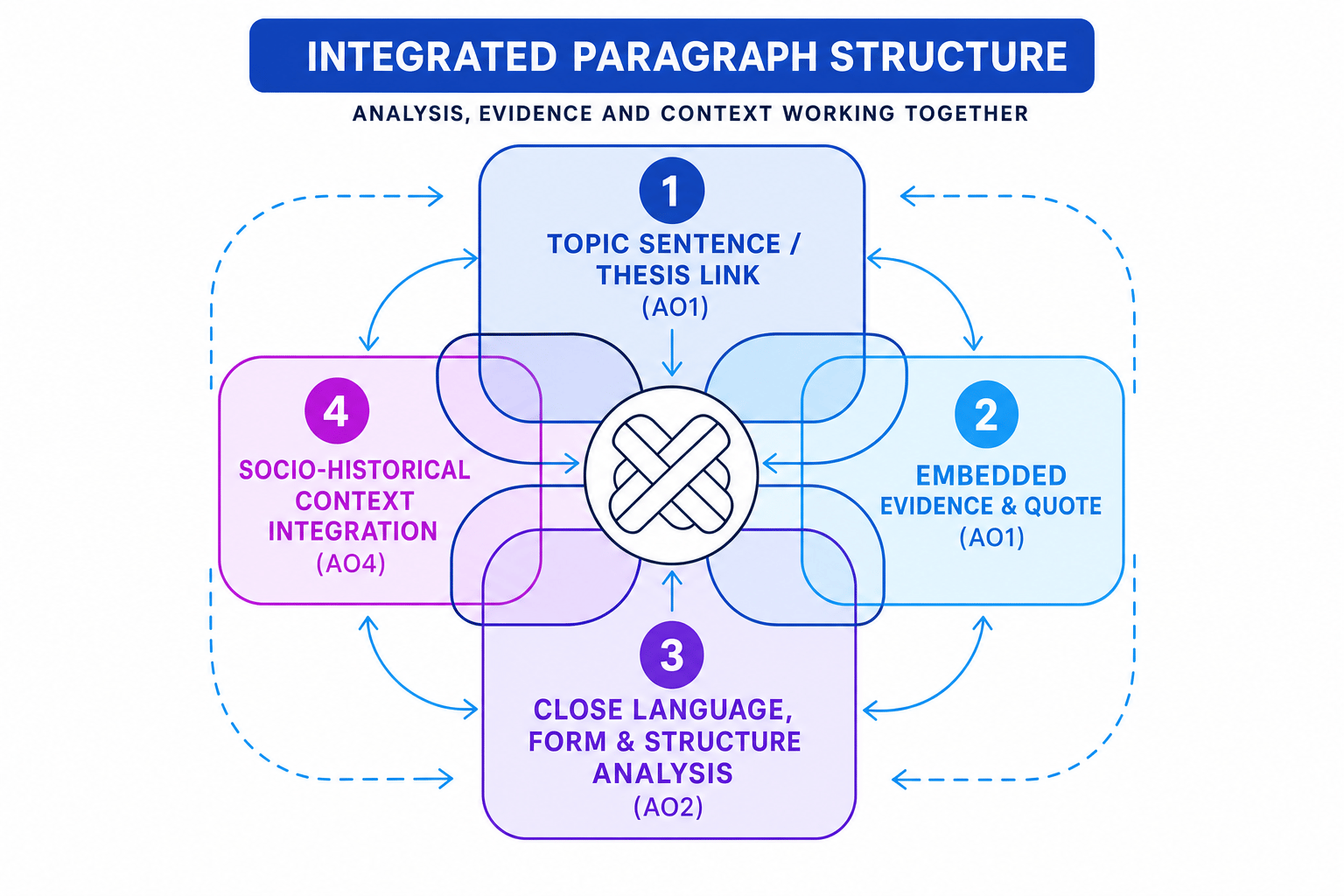
This visual shows how the elements of a successful paragraph are interwoven:
- The Point (AO1): A clear, thesis-driven topic sentence that introduces a conceptual idea rather than a plot point.
- The Evidence (AO1): Short, precise quotations embedded naturally into your sentence structure.
- The Method Analysis (AO2): A deep dive into specific words, imagery, structural patterns, or dramatic techniques used by Shakespeare.
- The Contextual Link (AO4): An explanation of how this language reflects Elizabethan attitudes, religious tensions, or legal structures.
- The Resolution: A concluding sentence linking back to your main thesis and the essay prompt.
Embedding Quotations
Instead of writing: Shylock says, "I will have my bond." This shows he is stubborn. Try embedding it: Shylock’s obsessive repetition of "I will have my bond" underscores his legalistic stubbornness... This keeps your academic voice fluent and authoritative.
Worked Example: Writing an Integrated Paragraph
Let us walk through the process of writing an analytical paragraph.
Essay Prompt: Explore the presentation of mercy and justice in 'The Merchant of Venice'.
Drafting an analytical paragraph on mercy
-
Formulate a thesis-driven point (AO1): Begin with a clear argument that addresses the conflict between strict law and moral mercy.
Drafting: "Shakespeare presents mercy not merely as a moral virtue, but as a complex political and religious tool used by the Christian characters to assert moral superiority over Shylock."
-
Integrate precise evidence (AO1): Introduce Portia's courtroom speech in Act 4, Scene 1, embedding a short, highly-focused quotation.
Drafting: "During the trial scene, Portia, disguised as the young lawyer Balthazar, appeals to Shylock by stating that 'The quality of mercy is not strained; / It droppeth as the gentle rain from heaven'."
-
Analyse language, form, and structure (AO2): Identify a literary device or structural choice and analyze its specific effect on the audience.
Drafting: "The simile comparing mercy to 'gentle rain' evokes a natural, divine order, suggesting that mercy is an effortless, life-giving force that flows directly from God. By delivering this speech in blank verse (unrhymed iambic pentameter), Shakespeare elevates the concept, giving Portia's words a rhythmic, solemn weight that contrasts sharply with the rigid prose of legalistic debate."
-
Embed contextual understanding organically (AO4): Connect this analysis to the religious and social realities of Elizabethan England.
Drafting: "To an Elizabethan audience, heavily influenced by Christian theology, Portia's insistence that mercy is 'an attribute to God himself' would resonate deeply. It mirrors the New Testament theology of divine grace, which the dominant Christian culture of the era championed over what they perceived as the cold, retributive justice of the Old Testament—a framework they frequently associated with Jewish law."
-
Synthesize into a cohesive paragraph: Combine these steps and add a concluding sentence that ties the analysis back to the main question.
Polished Final Version: "Shakespeare presents mercy not merely as a moral virtue, but as a complex religious and political tool used to assert Christian moral authority. During the trial scene, Portia appeals to Shylock by stating that 'The quality of mercy is not strained; / It droppeth as the gentle rain from heaven'. The simile comparing mercy to 'gentle rain' evokes a natural, divine order, suggesting that mercy is a free-flowing, life-giving force rather than something forced by legal coercion. By delivering this speech in elevated blank verse, Shakespeare gives Portia's argument a solemn, musical weight that contrasts with the harsh prose of the court. To an Elizabethan audience, Portia's claim that mercy is 'an attribute to God himself' would resonate as an endorsement of New Testament grace over Old Testament law. However, this creates a profound dramatic irony: while Portia eloquently champions mercy as a universal virtue, the Christian state ultimately denies this very mercy to Shylock, forcing his conversion and stripping him of his livelihood."
The Context Dump
A common pitfall is writing a paragraph of pure historical facts (e.g., explaining the banishment of Jews from England in 1290) without linking it back to Shakespeare's language or dramatic choices. Context must always serve your analysis of the text, not replace it.
Mastering the Open-Book Exam
Because you are allowed a clean copy of the play in the exam, your preparation should focus on structural planning and theme tracing rather than memorization.
The Danger of Having the Text
Many students waste precious time searching through the play to find the "perfect" quote. This disrupts the flow of your writing and limits the depth of your analysis. You must know the play well enough to locate your key scenes in seconds.
Use your reading time to highlight or note down structural pivots. For instance, notice how the play's structure alternates between the commercial, public world of Venice (associated with gold, contracts, and law) and the pastoral, private world of Belmont (associated with music, love, and mercy). High-scoring essays analyze this structural contrast to show how Shakespeare explores the tension between wealth and human value.
In the exam
- Deconstruct the prompt immediately: Identify the key terms in the question (e.g., "power," "isolation," "prejudice") and write down your 2-to-3 main arguments before you even open your text.
- Write a sharp, definitive introduction: State your thesis clearly. Do not simply repeat the question; show the examiner how you plan to answer it.
- Be selective with your evidence: Choose short, multi-layered quotes (2–5 words) that contain rich literary features. It is better to analyse three words deeply than to quote three full lines of text with only superficial comments.
- Balance your AO coverage: Regularly check that each body paragraph contains a strong point (AO1), precise linguistic or structural analysis (AO2), and a meaningful link to contextual pressures or audience reception (AO4).
- Conclude with a focus on the playwright’s message: In your conclusion, explain why Shakespeare wrote the play this way. What moral or social lesson was he trying to convey to his contemporary audience, and why does it still resonate today?
Check yourself
- Can you explain the difference between a plot-focused topic sentence and a thesis-driven topic sentence?
- Why is it a mistake to write an entire paragraph solely focusing on the historical context of 16th-century Venice?
- Look at Act 1, Scene 3 (where the bond is first agreed). What structural or linguistic techniques does Shakespeare use there that you could analyze in an essay about Shylock’s desire for revenge?