Welcome to your study guide for Jane Austen's masterwork, Pride and Prejudice (1813). As part of your Pearson Edexcel International GCSE English Literature course (Specification 4ET1, Component 2, Section B: Literary Heritage), you will explore this sparkling, witty "novel of manners" that goes far deeper than a simple romance.
This overview introduces you to the essential foundation of the novel, guiding you through its structural architecture, main characters, crucial historical context, and Austen's unique narrative techniques.
What you'll learn
- How Austen uses a structured, three-volume framework to orchestrate character transformation and plot progression.
- The definition and impact of Austen's key literary techniques, particularly free indirect discourse and irony.
- How the constraints of Regency society, especially financial survival and gender inequality, drive the novel's conflicts.
The Genre and Context: More Than a Romance
To understand Pride and Prejudice, you must first understand the world in which Austen wrote. The novel is set during the Regency period (roughly 1811–1820), a sub-era of the Georgian period characterized by strict social hierarchies, class consciousness, and rigid gender roles.
Novel of Manners
A novel of manners is a realistic genre of fiction that recreates a social world, analyzing and satirizing the customs, values, conduct, and etiquette of a specific social class—most often the wealthy gentry or aristocracy.
Austen's focus is on the provincial gentry (landowning families who did not have noble titles but did not have to work for a living). For women of this class, marriage was not merely a romantic dream; it was a financial necessity.
Due to the laws of entailment, land and wealth were passed down through male heirs only. Because the Bennet family has five daughters and no sons, their estate (Longbourn) will pass to their tedious cousin, Mr. Collins, upon Mr. Bennet's death. This leaves the girls facing social ruin and poverty if they do not marry well.
The Marriage Market
In Austen’s world, marriage is a transaction. Your analysis should always balance the emotional connections between characters with the harsh economic realities of the Regency marriage market (AO4).
The Structure of the Novel: The Three-Volume Arc
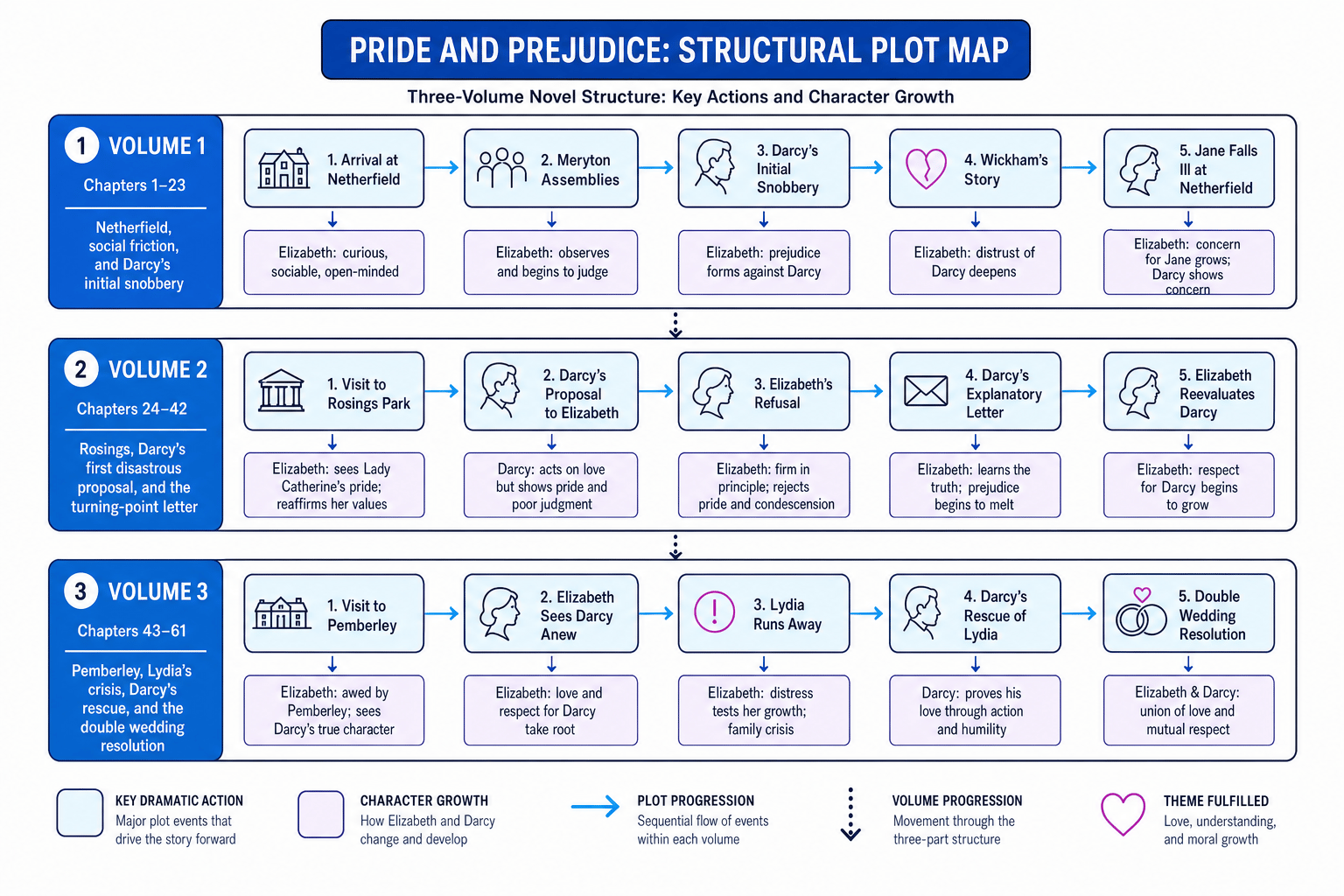
In the nineteenth century, novels were originally published in three separate physical books, known as a three-volume novel (or a "triple-decker"). Austen structured her plot beautifully to match this physical layout, creating a symmetrical journey of errors, realizations, and resolutions.
Volume I (Chapters 1–23): The Setup of Pride and Prejudice
This volume establishes the central conflicts. It introduces the Bennet family, the arrival of the wealthy Mr. Bingley at Netherfield, and his proud friend, Mr. Darcy. Here, the initial impressions are cemented: Darcy is deemed excessively proud, while Elizabeth's prejudice against him takes root, fueled by Darcy's early snub of her at the Meryton assembly ("She is tolerable; but not handsome enough to tempt me") and the manipulative lies of George Wickham. It culminates in Elizabeth’s refusal of the ridiculous Mr. Collins's marriage proposal.
Volume II (Chapters 24–42): The Crisis and Turning Point
The action shifts to Kent (Rosings Park and Hunsford). Elizabeth visits her newly married friend Charlotte Lucas (who married Mr. Collins for financial security). Here, Elizabeth encounters Darcy again, culminating in his disastrous, arrogant first marriage proposal. Elizabeth rejects him fiercely, accusing him of ruining her sister Jane's happiness with Bingley and destroying Wickham's prospects.
The structural pivot of the entire novel occurs in Chapter 35, when Darcy delivers a explanatory letter to Elizabeth. This letter forces Elizabeth to confront her own blindness and prejudice.
Volume III (Chapters 43–61): Resolution and Transformation
The final volume takes us to Derbyshire (Pemberley, Darcy’s estate) and back to Longbourn. Seeing Darcy in his natural element—and hearing his housekeeper's glowing praise—allows Elizabeth to see his true, generous nature.
The plot reaches its climax with the crisis of Lydia’s elopement with Wickham, which threatens to ruin the family's reputation permanently. Darcy's secret, heroic intervention to pay off Wickham and secure the marriage proves his moral growth and genuine love for Elizabeth, clearing the path for their mutual declaration of love and the final double wedding (Jane and Bingley, Elizabeth and Darcy).
Symmetry in Austen
Notice how Austen mirrors events! Elizabeth rejects two proposals (Mr. Collins and Mr. Darcy) in the first half of the novel, before accepting two proposals (Darcy's second, and cheering on Bingley's proposal to Jane) in the second half. Pointing out this symmetry in your essays directly targets AO2 (structure).
Narrative Voice: Austen’s Technical Brilliance
To score highly in your Edexcel exam, you must go beyond talking about the characters as if they are real people; you must analyze how Austen tells their story (AO2). Two narrative tools dominate Pride and Prejudice: Irony and Free Indirect Discourse.
Satire and Irony
Austen is a master of satire (the use of humor, irony, or exaggeration to expose and criticize people's stupidity or vices). Irony occurs when there is a discrepancy between what is said and what is meant, or between expectations and reality.
- Verbal Irony: Characters (especially Mr. Bennet) say the opposite of what they actually feel to highlight the absurdity around them.
- Dramatic Irony: The reader knows things that the characters do not. For example, we realize Darcy is falling in love with Elizabeth long before Elizabeth herself does.
Free Indirect Discourse
This is one of Austen's greatest contributions to the development of the English novel.
Free Indirect Discourse
Free indirect discourse is a narrative technique where a third-person narrator slips seamlessly into a character's internal thoughts, feelings, and voice without using direct tags like "she thought" or "he said."
Instead of writing: Elizabeth thought, "I am so embarrassed by my mother," or She thought that her mother was acting foolishly, Austen blends the narrator's voice with Elizabeth's mind:
"Good Heaven! what must have been his sensations... her mother's head-long, mistaken generosity..."
This technique allows the narrator to maintain an objective distance while granting us intimate access to Elizabeth’s subjective, often mistaken, point of view. It makes the reader share Elizabeth’s prejudices and go through the same process of self-correction.
Worked Example: Analyzing the Opening Line
Let’s practice analyzing Austen's narrative method. One of the most famous lines in English literature is the opening sentence of Pride and Prejudice.
Analyzing the opening sentence of the novel
Question: Analyze how Austen introduces the themes of marriage, class, and social expectation in the opening sentence of the novel: "It is a truth universally acknowledged, that a single man in possession of a good fortune, must be in want of a wife."
- Step 1: Identify the central narrative method and establish the tone. The sentence uses profound verbal irony and satire. While it presents itself as an objective, philosophical maxim ("universally acknowledged"), it actually voices the desperate, subjective gossip of the provincial mothers of Longbourn (like Mrs. Bennet) who are on the hunt for wealthy suitors.
- Step 2: Zoom in on specific word choices (diction) and their effects. Look at the phrasing "universally acknowledged." The word "universally" is a comic exaggeration (hyperbole). The universe does not care about this; only a very small, anxious sub-section of English country society does. This establishes a mocking, satirical narrative distance.
- Step 3: Analyze the syntactical structure and power dynamics. The sentence sets up the wealthy "single man" as the active subject, but grammatically positions him as the passive target of society's expectations ("must be in want of..."). The modal verb "must" suggests a natural law, but in reality, it is the family of the unmarried women who are in desperate "want" of his money.
- Step 4: Connect the analysis to context (AO4). This satirical opening exposes the grim transactional nature of the Regency marriage market. By instantly linking "fortune" with "wife," Austen signals to the reader that in this society, marriage is fundamentally an economic arrangement masked by social pleasantry, framing the entire narrative's struggle between financial security and romantic love.
Key Theme: Pride versus Prejudice
It is a common mistake to think Darcy represents only "Pride" and Elizabeth only "Prejudice." In truth, both characters exhibit both flaws, and their journey is about shedding these limitations to achieve self-knowledge.
| Character | How they show Pride | How they show Prejudice |
|---|---|---|
| Elizabeth Bennet | She is proud of her own quick wit and "fine eyes," believing herself to be an infallible judge of character. | She instantly judges Darcy as cold and arrogant, believing Wickham's slander without checking the facts because it flatters her ego. |
| Fitzwilliam Darcy | He is proud of his noble lineage, vast wealth (£10,000£10,000£10,000 a year from Pemberley), and social standing, looking down on the Bennets' low-class connections. | He pre-judges Elizabeth's entire family as unworthy, assuming Jane does not truly love Bingley because of her reserved behavior. |
Both characters must undergo a psychological transformation. For Darcy, this means learning humility; for Elizabeth, this means learning that her first impressions are often deeply flawed.
Viewing Darcy as the sole villain of the opening acts
Many students write that Darcy is the "villain" of the early chapters due to his pride. Remember: Austen presents Darcy’s pride as a shield for his social awkwardness and a product of his upbringing. He is not a villain; he is a flawed protagonist whose internal moral compass is fundamentally noble.
In the exam
When answering a question on Pride and Prejudice, make sure you follow these strategies:
- Focus on the "How" (AO2): Never just retell the story. Always name Austen's methods (e.g., her use of irony, letters as a plot device, character foil pairings like Jane/Elizabeth or Darcy/Wickham) and explain their effects on the reader.
- Anchor your analysis in Context (AO4): Do not treat the novel like a modern romantic comedy. Always frame the characters' decisions (especially Charlotte Lucas’s marriage or Lydia’s elopement) within the strict financial and moral laws of Regency England.
- Trace Character Arcs: Show how characters change. A top-tier essay looks at the progression from pride/prejudice to self-awareness, using the structural shifts of the three volumes to track this growth.
Check yourself
- Why is the law of entailment so critical to understanding Mrs. Bennet’s frantic efforts to marry off her daughters?
- What major turning point occurs in Chapter 35, and how does it change Elizabeth's perspective on both Darcy and Wickham?
- How does the character of Charlotte Lucas act as a thematic contrast (a "foil") to Elizabeth's views on marriage?