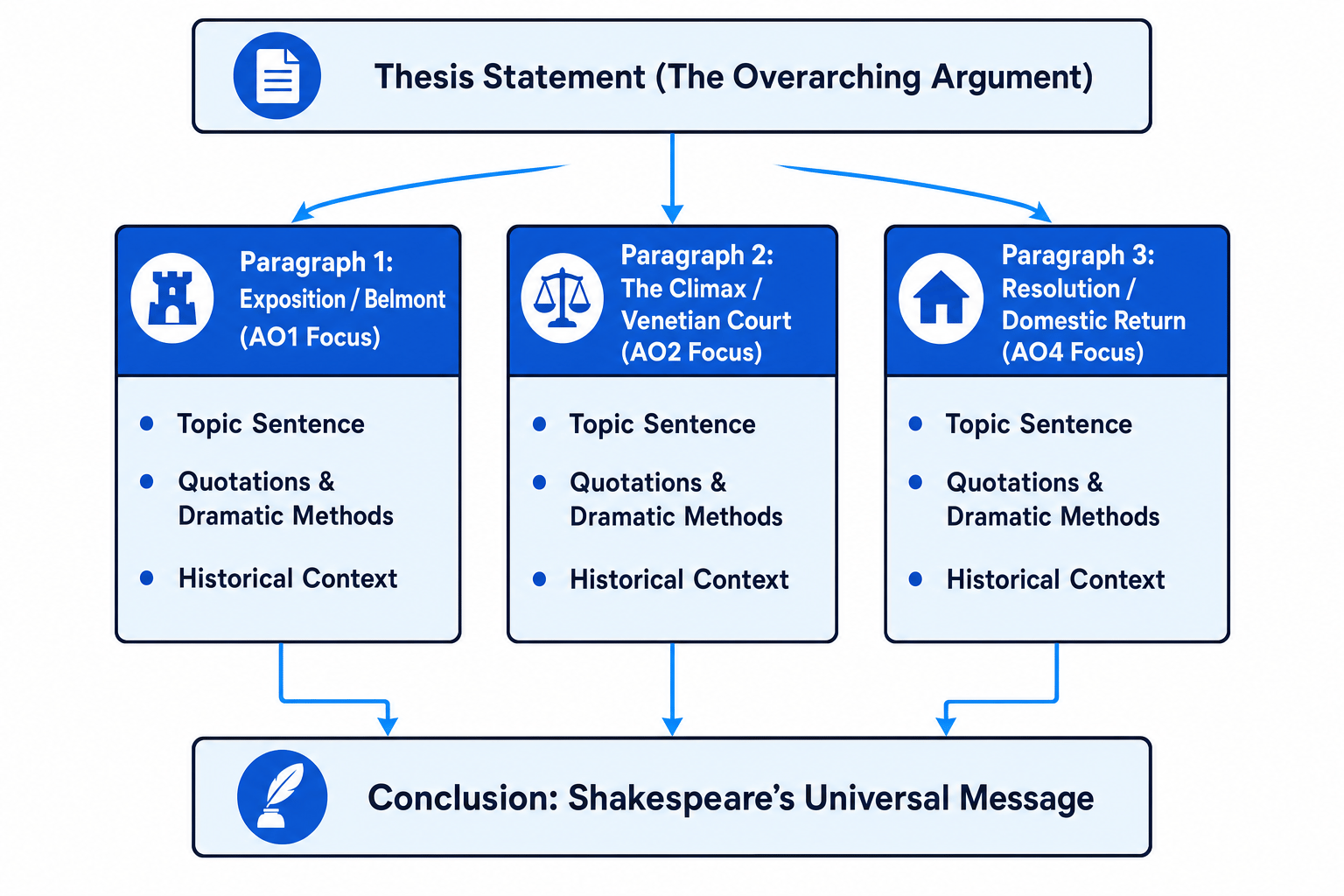
Step-by-Step Essay Planning Strategy
To plan efficiently under exam conditions, you must follow a repeatable system. Don't simply open your book to Act 1 and look for random quotes. Instead, follow this four-step strategy to construct an elite-level outline.
Step 1: Deconstruct the Prompt
Look closely at the keywords in the question. Is it asking about a character (e.g., Shylock, Portia, Bassanio), a relationship (e.g., Antonio and Bassanio, Portia and Nerissa), or a core theme (e.g., justice versus mercy, prejudice, wealth)? Circle the operative words and note the AOs required. For this literary heritage section, you must integrate contextual understanding (AO4) alongside your analysis of Shakespeare's stagecraft (AO2).
Step 2: Formulate your Thesis Statement
Before you draft your paragraphs, write down your core argument. Do not write a generic sentence like "In this essay, I will discuss how Shylock is presented." Instead, express a clear viewpoint. For example: "While Shakespeare presents Shylock as a malevolent villain who demands a literalist reading of the law, he simultaneously reveals how Venetian prejudice and marginalisation drive his desire for vengeance."
Step 3: Map the Dramatic Arc
Choose three distinct moments in the play that show how your character or theme develops. A top-tier structure usually looks like this:
- Beginning (Exposition / Setup): How is the character/theme introduced? What are the underlying tensions? (Usually set in Belmont or Act 1 Venice).
- Middle (Rising Action / Climax): How does the tension peak? (Usually the trial scene in Act 4, Scene 1).
- End (Resolution): What is the final state of the character or theme? How does Shakespeare resolve the play's dual settings (Venice vs. Belmont)? (Usually Act 5).
Step 4: Populate with "PEEEL" Elements (with AO Integration)
For each of your three moments, jot down:
- A Topic Sentence that acts as a mini-argument.
- A specific Quotation (which you can quickly look up in your clean text copy).
- The Dramatic Method used (e.g., prose vs. blank verse, dramatic irony, legalistic rhetoric, religious allusion).
- The Contextual Connection (AO4) and what it teaches the audience about Shakespeare's society.
The Open-Book Trap
Having access to the play text in Component 2 can be dangerous. Many students waste precious minutes hunting down long passages or trying to read entire scenes. Use your plan to record the exact Act and Scene of your chosen quotes before you open your text. Treat the play as a dictionary: only look up what you already know is there.
Worked Example: Planning a Thematic Essay
Let’s look at how to put this method into action with a real exam prompt.
Planning an essay on Justice and Mercy
Prompt: Explore how Shakespeare presents the conflict between justice and mercy in The Merchant of Venice.
Here is how you would construct a top-tier essay plan step-by-step:
-
Deconstruct the prompt and draft a Thesis Statement:
- Analysis: The prompt requires comparing "justice" and "mercy." In Venice, justice is associated with the strict, unyielding law and contracts. Mercy is presented as a Christian virtue, but its application is highly selective.
- Thesis Statement: "Shakespeare presents justice and mercy as deeply polarized concepts, mapping them onto the religious conflict between Venetian Christians and the Jewish Shylock. Ultimately, the play exposes the hypocrisy of the state, demonstrating that Venetian 'mercy' is weaponized as an instrument of domination rather than offered as true Christian charity."
-
Plan Paragraph 1 (The Exposition: The Bond and Legalism):
- Focus: The setting of the contract in Act 1, Scene 3.
- Topic Sentence: At the start of the play, legalistic justice is established as the economic lifeblood of Venice, standing in direct opposition to moral compassion.
- Evidence: Shylock's demand for "an equal pound / Of your fair flesh" and Antonio's confident signing of the "merry bond."
- Method: Metaphor of "fair flesh" highlighting the dehumanizing nature of Venetian trade, contrasted with the oxymoron "merry bond."
- Context (AO4): Venice was a famous global trading hub relying on a reputation for absolute contract enforcement to attract foreign merchants.
-
Plan Paragraph 2 (The Climax: The Courtroom Confrontation):
- Focus: Portia's courtroom speech and Shylock's demand for the letter of the law in Act 4, Scene 1.
- Topic Sentence: During the trial, Portia attempts to elevate mercy above secular justice, but her celebrated defense of compassion is undercut by Shylock's absolute refusal to yield.
- Evidence: Portia's famous monologue: "The quality of mercy is not strained; / It droppeth as the gentle rain from heaven."
- Method: Natural imagery ("gentle rain") and religious allusions ("an attribute to God himself") to present mercy as divine.
- Context (AO4): Reflects the contemporary Tudor legal debates between the "Common Law" (strict, literal application) and "Equity" (the Court of Chancery, which allowed judges to apply mercy and fairness).
-
Plan Paragraph 3 (The Resolution: The Weaponization of Mercy):
- Focus: The conclusion of the trial in Act 4, Scene 1 and its aftermath.
- Topic Sentence: In the play’s climax, the court's definition of mercy is exposed as a hypocritical tool used by the Christian majority to strip Shylock of his identity and wealth.
- Evidence: Portia's technical turnaround ("This bond doth give thee here no jot of blood") and Antonio's demand that Shylock "presently become a Christian."
- Method: Sharp dramatic shift in legal rhetoric; irony that the Christians demand mercy from Shylock but show him none when they gain the upper hand.
- Context (AO4): Forced conversions of Jewish people were viewed by Elizabethan audiences as acts of spiritual salvation, but modern audiences see it as cultural annihilation. This dual perspective highlights the shifting reception of Shakespeare's work.
The 'Character Profile' Trap
A common mistake when planning is to divide your paragraphs by character (e.g., Paragraph 1: Shylock; Paragraph 2: Portia; Paragraph 3: Antonio). This leads to a fragmented, narrative response. Instead, always structure your paragraphs around the chronological development of a theme or the changing relationships between characters across the play.
Form and Structure Planning Tips
When analyzing Shakespeare, never limit your comments to language alone. You must plan structural points to access high-level marks for AO2.
- Versus Prose: Note when characters use blank verse (unrhymed iambic pentameter) versus prose. Shylock often speaks in highly rhythmic, repetitive prose when expressing his anger or distress (e.g., "Hath not a Jew eyes?" in Act 3, Scene 1), contrasting with the fluid, poetic blank verse of the wealthy Christian elite in Belmont.
- The Dual Setting (Venice vs. Belmont): Your plan should address how Shakespeare uses structural geography. Venice is characterized by commerce, law, contracts, and masculine anxiety. Belmont is characterized by music, fairy-tale casket lotteries, wealth, and female-driven domestic power. How does the movement between these two worlds affect the presentation of justice and romance?
The 'Golden Quote' Technique
When planning, select "Golden Quotes"—short, highly concentrated phrases that can be analyzed from multiple angles. For instance, Shylock's line "I will have my bond" (Act 3, Scene 3) is only five words, but it structurally reinforces his obsessive, legalistic mindset (repetition of "bond" throughout the play) and his rejection of Christian mercy.
In the exam
To ensure your essay is structured and flows flawlessly, use the first 5–8 minutes of the exam to execute this exact sequence:
- Unpack the Prompt: Highlight the key thematic words and character names in the question.
- Draft your Thesis Statement: Write this down in full at the top of your answer booklet before you write anything else. It will keep your mind focused.
- Map 3 Chronological Nodes: Jot down a 3-paragraph plan tracking the play's dramatic arc (Beginning, Climax, Resolution).
- Locate and Verify Quotes: Open your copy of the text, find the page numbers for the three key quotes you want to use, and mark them with your fingers or a scrap of paper so you do not waste time searching for them mid-write.
- Stick to the Plan: As you write, cross off each section of your plan. Do not deviate into writing plot summary.
Check yourself
Before sitting your next practice paper, test your planning readiness with these questions:
- Can you draft a thesis statement in under two minutes for an essay on "prejudice in Venice"?
- What are three distinct scenes from different acts of the play that you would use to track the development of Portia's character?
- How would you link the legalistic climax of the courtroom scene in Act 4 to the historical Elizabethan legal system (AO4)?