To secure a top grade in your Edexcel IGCSE English Literature exam (Component 2, Section B), you must be able to treat The Merchant of Venice not just as a story, but as a carefully constructed piece of drama. This means analyzing Shakespeare’s deliberate choices in language (the words and imagery characters use), form (the play’s genre and medium), and structure (how the scenes and plots are ordered).
In the exam, you will be assessed on your ability to analyze these elements (AO2) and connect them to the play’s historical and social context (AO4).
What you'll learn
- How to identify and analyze Shakespeare's shifting use of verse and prose.
- How the geographical structure of the play contrasts the worlds of Venice and Belmont.
- How the intertwining plots build dramatic tension up to the trial scene climax.
- How to analyze key linguistic techniques, such as biblical imagery, mercantile metaphors, and rhetorical syntax.
Form: Genre and Medium
When looking at the form of The Merchant of Venice, we first have to examine its genre. Written around 1596–1598, the play is traditionally classified as a comedy. However, modern audiences and critics often refer to it as a "problem play" because of its dark, tragic undertones.
Comedy (Renaissance)
In Shakespearean drama, a comedy is a play that moves from chaos to order, typically ending in marriages, reunions, and a celebratory mood. Unlike tragedy, which ends in death, comedy seeks social reconciliation.
While The Merchant of Venice ends with three happy couples in the moonlit gardens of Belmont (satisfying the structural demands of comedy), the painful isolation and forced conversion of Shylock in Act 4 cast a long, tragic shadow over the final act.
Verse vs. Prose
Shakespeare wrote his plays using two distinct linguistic forms: blank verse and prose. Paying attention to when and why characters switch between these forms is one of the easiest ways to score high marks for structural analysis.
Blank Verse
Blank verse is unrhymed poetry written in iambic pentameter. An "iamb" is a metrical foot consisting of one unstressed syllable followed by one stressed syllable (da-DUM). "Pentameter" means there are five of these feet per line, creating a heartbeat-like rhythm: “In sooth, I know not why I am so sad” (1.1.1).
Prose
Prose is ordinary, conversational language without a regular rhythmic or metrical structure. On the printed page of your play text, prose is easily spotted because it runs all the way to the right-hand margin, rather than breaking into neat poetic lines.
Traditionally, Shakespeare used blank verse for high-status noble characters (like Portia, Antonio, and Bassanio) and elevated emotional moments, while prose was reserved for lower-status comedic characters (like Launcelot Gobbo). However, in The Merchant of Venice, this boundary is beautifully and subversively crossed:
- Shylock frequently speaks in prose, even when dealing with nobles. This gives his speech a sharp, pragmatic, and business-like quality. When he is emotionally unraveled in Act 3, Scene 1, his use of prose conveys raw, realistic human passion rather than structured aristocratic refinement.
- Portia speaks in prose in Act 1, Scene 2 when she is gossiping privately with Nerissa about her suitors. Here, prose signals intimacy, wit, and a temporary release from her rigid courtly duties.
The Power of Metre
A switch from verse to prose (or vice versa) always signals a shift in power, status, or emotional intensity. Look out for these transitions in your exam extract.
Structure: The Architecture of the Play
The structure of The Merchant of Venice relies on two main pillars: its dual geographical settings and its three interwoven plotlines.
The Contrast of Venice and Belmont
The play is structurally divided between two distinct locations. This geographical split mirrors the psychological and thematic conflicts of the play:
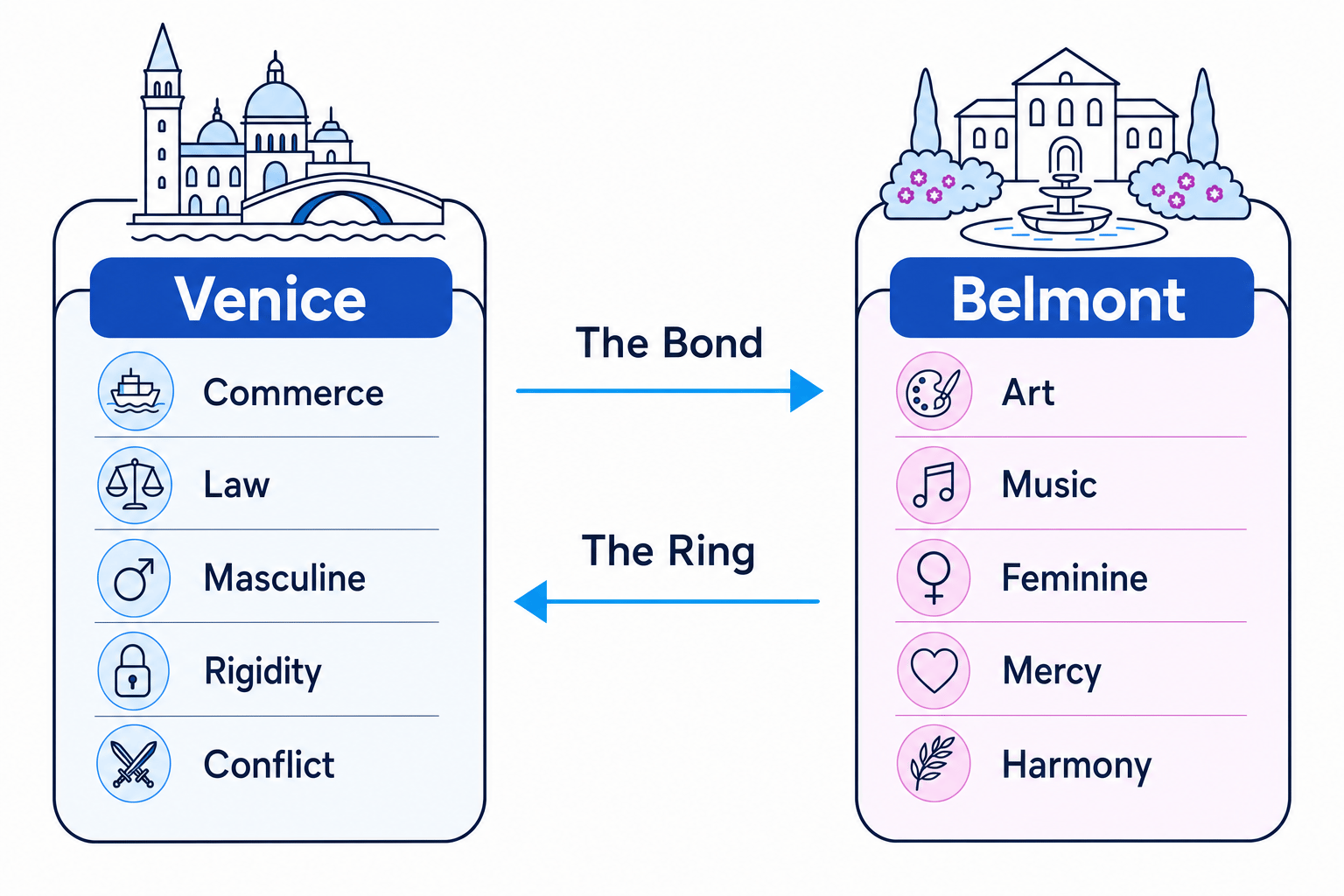
- Venice is a real-world, bustling, multi-cultural trading hub. It is a masculine, public sphere governed by cold commerce, contracts, strict laws, and bitter racial/religious divisions.
- Belmont (literally meaning "beautiful mountain") is a fictional, fairytale-like country estate. It is a feminine, private sphere characterized by music, romance, mercy, and apparent harmony.
These two worlds are not completely separate, however. The structural movement of the play involves characters traveling between them to resolve their problems. The cold, legalistic threat of Venice (the bond) invades Belmont, forcing Portia to disguise herself as a Venetian lawyer to save Antonio. Conversely, the ring plot brings the play's final resolution back to the romantic gardens of Belmont in Act 5.
The Intertwined Plots
The play’s narrative structure is a tapestry of three main plots that run parallel and constantly intersect:
- The Bond Plot: Antonio borrows money from Shylock on behalf of Bassanio, signing away a "pound of flesh" as collateral.
- The Casket Plot: Portia’s deceased father has set a test of three caskets (gold, silver, and lead) to determine who she must marry.
- The Ring Plot: Portia and Nerissa disguise themselves as men, save Antonio, and demand the rings they gave their husbands as tokens of love.
Plot Intersections
Notice how Bassanio's need to participate in the Casket Plot in Belmont is what directly triggers the Bond Plot in Venice. The plots are not isolated; they rely on one another to drive the dramatic action forward.
Language: Rhetoric, Metaphor, and Motifs
Shakespeare uses distinct language styles to distinguish his characters and highlight the play's central themes of wealth, justice, and mercy.
Mercantile vs. Romantic Imagery
In Venice, the language is saturated with the vocabulary of the marketplace. Characters use mercantile metaphors to describe even their most personal relationships:
- Bassanio describes Portia in Act 1, Scene 1 not just as a woman he loves, but as a "lady richly left" and compares her to a prize: "hang on her temples like a golden fleece."
- When Bassanio chooses the correct casket, Portia describes her surrender to him in financial terms, wishing she were "trebled twenty times myself" and "exceeding in the estate of riches."
By contrast, the language of Belmont in Act 5, Scene 1 is steeped in lyrical, celestial imagery and references to classical mythology:
- Lorenzo says to Jessica, "Look how the floor of heaven / Is thick inlaid with patens of bright gold," comparing the stars to gold plates, but here the gold is spiritual and aesthetic, not financial.
Shylock’s Rhetorical Language
Shylock’s language is highly distinctive. Unlike the lyrical, metaphor-heavy language of the Venetian Christians, Shylock’s speech is characterized by:
- Repetition and Symmetry: He frequently repeats key words ("my bargains," "my bond," "three thousand ducats") to emphasize his singular focus on law and commerce.
- Biblical Allusions: He draws extensively on Old Testament stories (such as Jacob and Laban in Act 1, Scene 3) to justify his business practices, showing his deep cultural identity and isolating him linguistically from the Christian characters.
Reducing Shylock to a caricature
Students often write that Shylock is purely a villain or purely a victim. Avoid this binary view! Shakespeare uses complex, multi-layered language to make Shylock both deeply unsympathetic (his cold insistence on the pound of flesh) and profoundly human (his brilliant, defensive rhetoric).
Worked Example: Analyzing a Key Speech
Let's walk through how to analyze a passage for Language, Form, and Structure using Shylock's famous monologue from Act 3, Scene 1. This passage is a prime example of how Shakespeare uses structural and linguistic choices to convey complex character dynamics.
SHYLOCK: He hath disgraced me, and hindered me half a million, laughed at my losses, mocked at my gains, scorned my nation, thwarted my bargains, cooled my friends, heated mine enemies—and what’s his reason? I am a Jew. Hath not a Jew eyes? Hath not a Jew hands, organs, dimensions, senses, affections, passions? Fed with the same food, hurt with the same weapons, subject to the same diseases, healed by the same means, warmed and cooled by the same winter and summer as a Christian is? If you prick us, do we not bleed? If you tickle us, do we not laugh? If you poison us, do we not die? And if you wrong us, shall we not revenge? If we are like you in the rest, we will resemble you in that.
Analyzing Shylock's Speech
Here is how you can systematically unpack the language, form, and structure of this speech to construct a high-scoring analytical response.
-
Step 1: Identify and analyze the Form. First, note that Shylock is speaking in prose here. Although this is one of the most famous and emotionally charged speeches in the play, Shakespeare denies Shylock the "noble" form of blank verse. By using prose, Shakespeare gives the speech an urgent, conversational, and direct quality. It sounds like a real man speaking from the depths of raw grief and anger, rather than an actor delivering stylized poetry.
-
Step 2: Examine the Rhetorical Structure. Look at how the speech is structured around parallel syntax and rhetorical questions. The speech begins with a list of parallel clauses detailing Antonio’s offenses ("laughed at my losses, mocked at my gains..."), building a rhythmic accumulation of grievances. Shylock then transitions into a series of rapid-fire rhetorical questions: "Hath not a Jew eyes? ... If you prick us, do we not bleed?" This structural device forces the listener (and the Elizabethan audience) to answer "yes," systematically breaking down the perceived boundaries between Christian and Jew.
-
Step 3: Analyze the Imagery and Diction (Language). Examine Shylock’s choice of vocabulary. Instead of using abstract theological or philosophical terms, Shylock uses basic, universal physical vocabulary: "hands, organs, dimensions, senses," "food," "weapons," "diseases." By appealing to the shared physical reality of the human body, Shylock strips away social and religious divisions. However, look closely at the shift in the final lines. The list of shared physical vulnerabilities culminates in a logical pivot to violence: "And if you wrong us, shall we not revenge?" The language of shared humanity is ultimately weaponized to justify copying Christian brutality.
-
Step 4: Connect the Analysis to Context (AO4). In Elizabethan England, Jews were heavily marginalized and had been officially expelled from the country since 1290. An Elizabethan audience would likely have viewed Shylock as a comic or monstrous villain. However, by structuring Shylock's argument as an undeniable logical appeal to shared humanity, Shakespeare's language subtly challenges the audience's prejudices, creating a moment of intense dramatic discomfort that complicates the play's classification as a simple comedy.
In the exam
When writing about language, form, and structure in The Merchant of Venice:
- Do not "spot" devices without explaining their effects. Identifying a metaphor or a rhetorical question gets you very few marks unless you explain how it shapes the audience's understanding of the character or theme.
- Comment on the visual layout. Since the exam is open-book, look closely at the page. If the text shifts from verse to prose, write about it! It shows the examiner you are thinking about the play's structural mechanics.
- Trace structural echoes. If you are writing about Portia in the trial scene, try to link her cold, legalistic language there to the earlier, warmer language of Belmont to show her adaptability and control.
- Anchor your context (AO4) to linguistic choices. Do not just write a history essay about Elizabethan attitudes toward money or religion. Always ground these context points in specific words, metaphors, or structural contrasts (e.g., contrasting the strict legal system of Venice with Elizabethan courtly structures).
Check yourself
- Why does Shakespeare have Shylock speak primarily in prose, even when interacting with Christian nobles who speak in blank verse?
- How does the structural contrast between the physical settings of Venice and Belmont reinforce the thematic conflict between justice and mercy?
- Which of the three main plotlines (the Bond, the Caskets, or the Rings) functions as the primary vehicle for resolution in Act 5, and why is this structural choice significant?