Choosing the right quotation to analyse can make the difference between a standard response and a top-grade essay. For the Pearson Edexcel International GCSE (4ET1), Component 2, Section B (The Merchant of Venice) is an open-book exam. This means you will have a clean copy of the play in front of you. However, you cannot spend your precious exam time flipping through pages searching for quotes. You must walk into the exam room knowing exactly which "high-yield" quotes to locate and dissect.
What you'll learn
- How to select "thematically versatile" quotations that apply to multiple essay prompts.
- Methods for breaking down language, form, and structure (AO2) inside Shakespeare's verse and prose.
- How to link your chosen quotes directly to Elizabethan and Jacobean context (AO4).
1. What Makes a "Key Quote"?
Before memorising or highlighting lines, you need to understand what makes a quotation "high-yield". In your English Literature exam, you are assessed on your ability to write a cohesive, analytical essay that addresses three assessment objectives: AO1 (textual knowledge and response), AO2 (analysis of language, form, and structure), and AO4 (understanding of historical and social context).
A key quote is not just a memorable line; it is a compact unit of literary art that contains multiple layers of meaning.
Thematic Versatility
Thematic Versatility is the quality of a quotation that allows it to be used to answer several different essay questions. A highly versatile quote contains language that can illustrate character development, highlight a key theme (such as justice, prejudice, or mercy), and reflect historical context all at once.
Micro-analysis
Micro-analysis is the practice of breaking down a very short, specific part of a quotation (a single word, punctuation mark, sound pattern, or structural device) to explain how it creates meaning, rather than just summarizing the quote's general point.
To achieve top marks, you should avoid "device-spotting" (simply naming a metaphor or simile without explaining its impact). Instead, use your quotes as springboards for deep micro-analysis.
2. The Core Quotations
Let us examine five of the most powerful, versatile quotations from The Merchant of Venice. Each of these can be adapted to almost any essay question on characters or themes.
Quote 1: Antonio’s Melancholy
"In sooth, I know not why I am so sad."
— Antonio (Act 1, Scene 1)
- Structural Placement: This is the literal opening line of the entire play. Shakespeare immediately establishes a mood of unexplained sorrow (melancholy), which hangs over the commercial and social worlds of Venice.
- AO2 (Language & Form): The use of the archaic phrase "In sooth" (meaning "truly" or "in truth") introduces a theme of truth versus deception. The monosyllabic, simple vocabulary creates a flat, weary rhythm, mimicking Antonio's emotional exhaustion.
- AO4 (Context): In early modern England, "melancholy" was seen as a physical illness caused by an imbalance of bodily fluids (humours). However, modern and Elizabethan audiences alike would link Antonio’s sadness to his deep attachment to Bassanio, who is about to leave to court Portia. It highlights the vulnerability of male friendship and homosexual undertones in Venice's patriarchal society.
- Essay Portability: Excellent for essays on Antonio, Friendship, Isolation, or The Opening of the Play.
Quote 2: Shylock’s Separation
"I will buy with you, sell with you, talk with you, walk with you, and so following; but I will not eat with you, drink with you, nor pray with you."
— Shylock (Act 1, Scene 3)
- AO2 (Language, Form & Structure): This line is written in prose, rather than blank verse. In Shakespearean drama, prose is often used for everyday business, low status, or to show a character's blunt, realistic mindset. Note the sharp structural transition from the rhythmic, repetitive lists of commerce ("buy with you, sell with you...") to the absolute refusal of social and spiritual integration ("but I will not..."). The repetition of the preposition "with" creates a drumming effect, emphasizing the friction between transaction and human connection.
- AO4 (Context): Under Elizabethan law and custom, Jewish people were heavily restricted. Although Jews had been expelled from England in 1290, Shakespeare’s audience was familiar with the cultural stereotype of the Jewish "outsider". Shylock's refusal to "eat", "drink", or "pray" with Christians highlights the strict dietary laws (Kashrut) and religious boundaries that kept the communities segregated, emphasizing the religious prejudice of 16th-century Venice.
- Essay Portability: Crucial for essays on Shylock, Prejudice/Intolerance, Religion, Isolation, or Money vs. Humanity.
The Power of Prose vs. Verse
Always pay attention to whether a character is speaking in verse (iambic pentameter, usually used by nobles or in moments of high emotion) or prose (everyday speech, often used by Shylock in business transactions or by servants like Lancelot Gobbo). Commenting on this structural choice is a quick way to score high marks in AO2.
Quote 3: Portia’s Mercy Speech
"The quality of mercy is not strained; / It droppeth as the gentle rain from heaven / Upon the place beneath."
— Portia (Act 4, Scene 1)
- AO2 (Language & Structure): Portia uses a beautiful, lyrical simile comparing mercy to "gentle rain." Rain is natural, unforced, and universally beneficial. The verb "droppeth" implies a effortless, divine movement. By stating mercy is "not strained" (not forced or constrained), she argues that mercy must be given freely, without legal pressure.
- AO4 (Context): Portia's speech is a classic exposition of Christian theology, drawing on the New Testament idea of grace versus the Old Testament emphasis on strict legalism and justice (which the Elizabethan audience would associate with Shylock’s demand for his "bond"). However, there is immense irony here: Portia advocates for mercy, yet she ultimately denies Shylock any mercy once she gains the upper hand in the courtroom.
- Essay Portability: Essential for essays on Portia, Justice vs. Mercy, Religion/Hypocrisy, or The Trial Scene.
Quote 4: Shylock’s Plea for Humanity
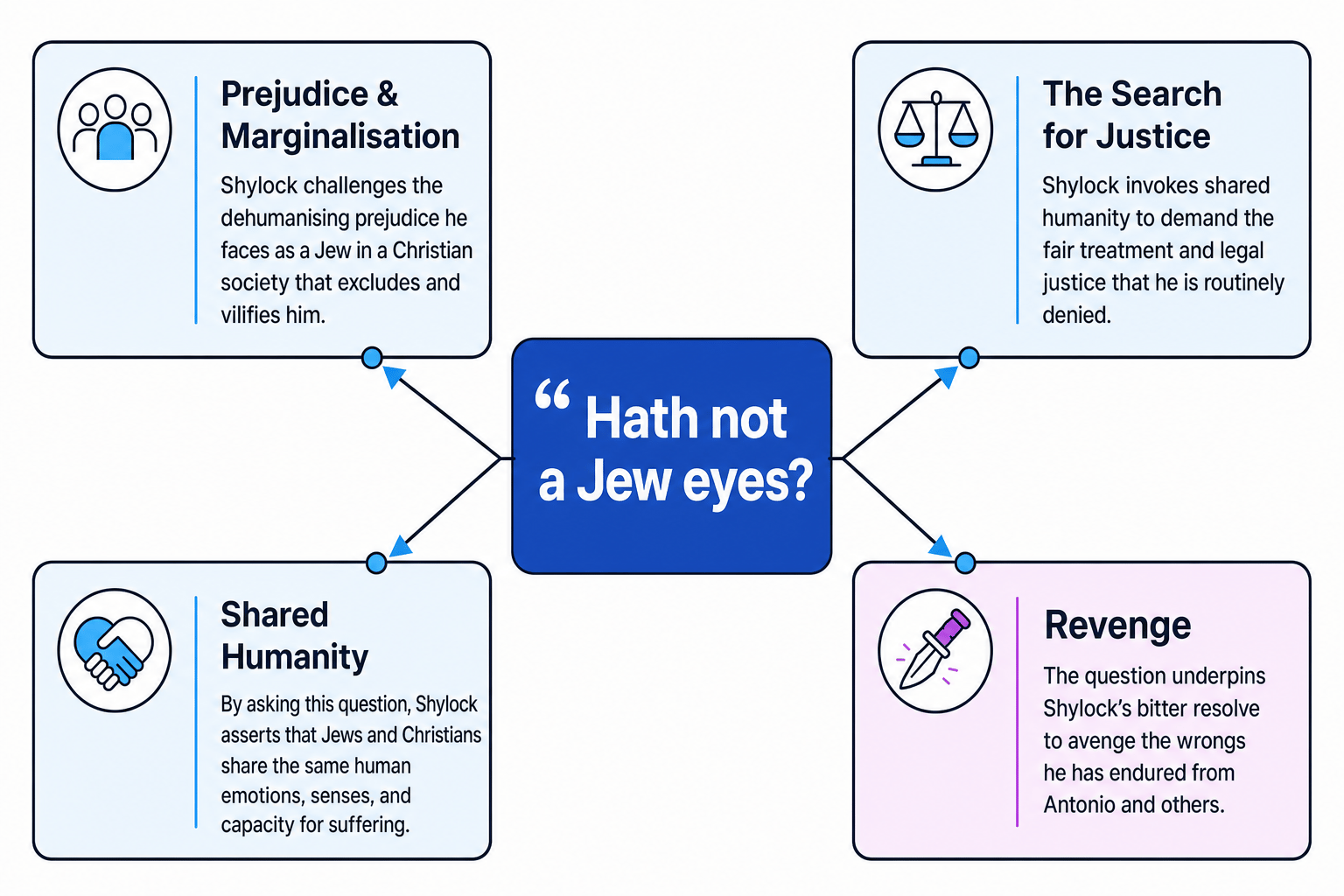
"Hath not a Jew eyes? Hath not a Jew hands, organs, dimensions, senses, affections, passions?"
— Shylock (Act 3, Scene 1)
- AO2 (Language & Form): Shylock uses a rapid succession of rhetorical questions. Instead of making assertions, he asks questions that have only one logical, humane answer, forcing his Christian tormentors (Salarino and Solanio) to acknowledge his humanity. The cumulative list of physical and emotional attributes ("organs, dimensions... passions") reduces humanity to its basic biological and emotional components, showing that underneath religious differences, all humans are identical.
- AO4 (Context): This is one of the most famous monologues in Shakespeare. While an Elizabethan audience may have viewed Shylock as a comic villain or a target for mockery, modern audiences often read this speech as an early plea for human rights and religious tolerance. However, remember the immediate context of this speech: Shylock uses this argument of shared humanity to justify his desire for revenge ("if you wrong us, shall we not revenge?").
- Essay Portability: Perfect for essays on Shylock, Prejudice, Revenge, Empathy/Humanity, or Victim vs. Villain.
Ignoring the Dark Side of Shylock's Speech
Many students treat the "Hath not a Jew eyes?" speech as a pure, noble defense of human rights. Do not fall into this trap! Shylock is not just asking for equality; he is using human equality to argue that he has the same right to bloody vengeance as a Christian. Always analyse the entire argument he makes, including his conclusion that "the villainy you teach me I will execute."
Quote 5: Antonio’s Resignation
"I am a tainted wether of the flock, / Meetest for death"
— Antonio (Act 4, Scene 1)
- AO2 (Language): Antonio uses self-deprecating animal imagery, describing himself as a "tainted wether" (a castrated, weak ram). He is "meetest" (most fit) for death. The metaphor suggests that he views himself as useless, sterile, and separate from the reproductive, heterosexual world of Bassanio and Portia's Belmont.
- AO4 (Context): This reflects the Christian concept of martyrdom and sacrificial love, but it also underscores Antonio's deep sense of social isolation. In a society that highly valued family, legacy, and lineage (themes central to Portia's and Jessica's subplots), Antonio has no wife, no children, and no long-term future.
- Essay Portability: Superb for essays on Antonio, Isolation/Sadness, The Courtroom Scene, or Sacrifice.
3. How to Analyse a Quote Step-by-Step
Let's look at how to unpack a quote in an exam essay. Do not just drop a quote in and move on. You must use the PEEL method (Point, Evidence, Explanation/Method, Link) and expand your explanation using the steps below.
Analyzing a quote's structural and linguistic layering
Analyse Shylock's quote: "I will buy with you, sell with you, talk with you, walk with you, and so following; but I will not eat with you, drink with you, nor pray with you." (Act 1, Scene 3)
-
Identify the structural form and its immediate effect: Note that Shylock is speaking in prose. This represents the cold, pragmatic reality of his commercial life. The contrast between his business relationships and his social/religious life is visually and aurally split by the coordinating conjunction "but".
-
Examine the language and rhythmic devices (AO2): Look closely at the repetition of the pronoun-preposition phrase "with you". It appears seven times in a single sentence. This repetition creates a highly structured, almost legalistic rhythm, showing that Shylock is a man of logic, contracts, and boundaries.
-
Incorporate historical and religious context (AO4): Explain that the refusal to "eat", "drink", or "pray" links directly to the religious segregation of Venice's Ghetto. In Elizabethan England, Jews were viewed with suspicion as theological outsiders. Shylock's words show that segregation was enforced from both sides—it was not just imposed by the Christians, but proudly maintained by Shylock to preserve his faith and dignity.
-
Connect the analysis back to the essay question (AO1): Wrap up by linking these observations to the character's core conflict. Explain that this quote proves Shylock is not just a passive victim of Venetian prejudice, but an active participant in his own isolation, choosing to keep his spiritual identity entirely separate from his financial dealings.
Use Embedded Quotations
Never write: "A quote that shows Shylock is angry is 'Hath not a Jew eyes?'."
Instead, weave your quotes naturally into your own sentences: Shylock’s humanity is asserted through a series of desperate rhetorical questions, asking his tormentors, "Hath not a Jew eyes?" as he demands recognition of their shared physical existence.
In the exam
- Highlight deliberately: Since you are allowed a clean copy of the play, use your reading preparation time to instantly locate these core scenes (Act 1 Scene 3, Act 3 Scene 1, Act 4 Scene 1). Do not waste time reading entire scenes during the exam; look for the "shape" of these key blocks on the page.
- Weave AO2 and AO4 together: Never write a paragraph purely on context, followed by a paragraph purely on language. Use a key quote to anchor both. For example, show how the word "strained" in Portia's speech (AO2) reflects the legal tension between Christian Mercy and the strict Venetian Court of Law (AO4).
- Analyse the form: Don't just talk about the words. Mention whether a character speaks in prose or verse, and explain why Shakespeare made that structural choice at that specific dramatic moment.
Check yourself
- Why does Shylock speak in prose during Act 1, Scene 3, and how does this form support the meaning of his words?
- What animal metaphor does Antonio use to describe himself in Act 4, Scene 1, and what does it reveal about his role in Venice?
- How does the context of Elizabethan anti-Semitism change the way a modern audience might view Shylock’s "Hath not a Jew eyes?" speech compared to an audience in Shakespeare's time?