For your Edexcel IGCSE English Literature exam, you must demonstrate a deep understanding of how Shakespeare shapes meaning through the structure of his plays. In The Merchant of Venice, structure is built on a series of critical shifts between two contrasting worlds: the commercial, legalistic city of Venice and the romantic, musical estate of Belmont.
This guide breaks down the key scenes that form the skeletal structure of the play. We will examine how Shakespeare uses these scenes to escalate tension, develop complex themes of justice versus mercy, and resolve (or leave lingering questions about) the central conflicts.
What you'll learn
- How to trace the dramatic tension across the play's parallel settings.
- How to close-analyse language, form, and context in key scenes (AO2 and AO4).
- How to evaluate Shakespeare's structural design, from the initial bond to the final resolution.
The Structural Blueprint: Venice vs. Belmont
Before diving into individual scenes, you must understand the juxtaposition that governs the play's structure. Juxtaposition is the placement of two contrasting things close together to highlight their differences.
Juxtaposition
Juxtaposition is a literary and structural device where a writer places two contrasting characters, settings, or ideas side by side to highlight their differences, create tension, or reveal deeper thematic meaning.
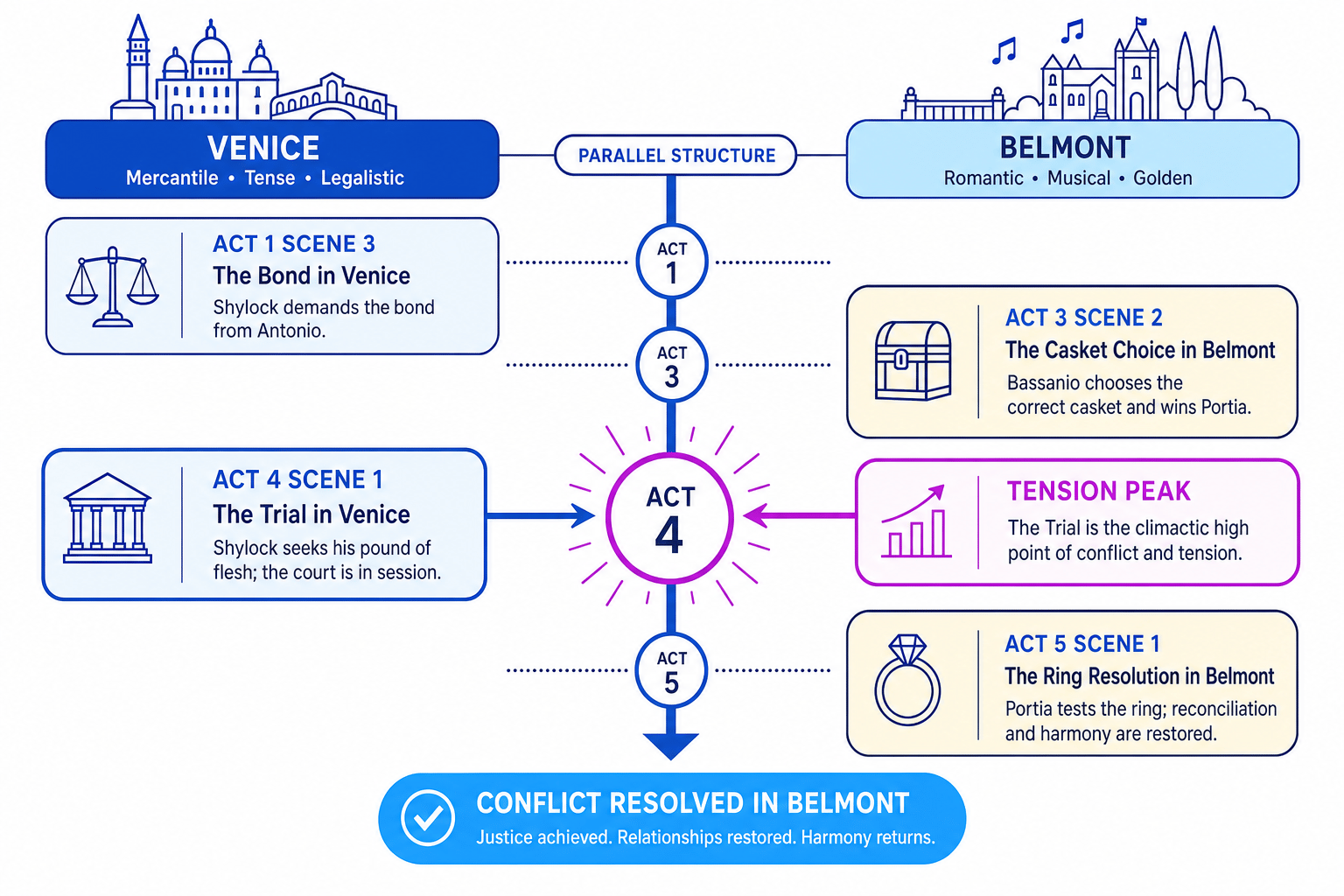
Shakespeare uses a parallel structure to alternate scenes between Venice and Belmont:
- Venice represents the public sphere of male business, law, contracts, and deep-seated religious prejudice. It is a place of literal transactions and rigid, uncompromising rules.
- Belmont represents the private, fairy-tale sphere of music, courtship, wealth, and maternal/paternal legacy. It operates on poetic, symbolic terms rather than financial ones.
The diagram below maps how the dramatic arc of the play oscillates between these two settings, escalating to a peak of tension in the Venetian court before resolving in the harmonious gardens of Belmont.
Act 1, Scene 3: The Bond Scene
This scene acts as the structural inciting incident—the event that hooks the audience and sets the main plot in motion. Here, Bassanio asks Shylock for a loan of 3,000 ducats, with Antonio acting as the guarantor.
The Linguistic Conflict
From the outset of this scene, Shakespeare contrasts Shylock's precise, transactional prose with Antonio’s aristocratic blank verse.
- When Shylock speaks, he initially repeats financial terms: "Three thousand ducats; well." His language is deliberate, cautious, and calculating.
- In his soliloquy (a dramatic speech spoken aloud to the audience to reveal a character's inner thoughts), Shylock reveals his true motivation: "I will feed fat the ancient grudge I bear him." The visceral, animalistic metaphor of "feeding" his grudge highlights that his grievance is deeply personal and historic, driven by Antonio's anti-Semitic abuse.
Context and the "Merry Bond"
Shylock proposes a "merry sport": if Antonio cannot repay the loan on time, the penalty will be a "pound of your fair flesh, to be cut off and taken / In what part of your body pleaseth me."
To an Elizabethan audience (AO4), this proposal would seem bizarre and menacing. Usury (the practice of lending money at interest) was a highly contentious issue. Antonio refuses to take or give interest because he views it as unchristian, yet he agrees to this physical bond out of overconfident arrogance and love for Bassanio.
The Bond as a Symbol
The bond is not just a legal contract; it is a structural device that binds the physical body of the Christian merchant (Antonio) to the legal power of the Jewish moneylender (Shylock). It physicalizes the ideological and religious conflict of Venice.
Analysing Shylock’s rhetoric in Act 1, Scene 3
Analyze how Shakespeare uses language to show Shylock’s resentment of Antonio's hypocrisy in Act 1, Scene 3.
- Locate the specific textual details: Focus on the speech where Shylock confronts Antonio about his past treatment: "Signior Antonio, many a time and oft / In the Rialto you have rated me / About my moneys and my usances..."
- Identify the core method: Shakespeare uses rhetorical questions and animal imagery ("is mischief a dog?", "Hath a dog money?") to expose the hypocrisy of the Christian merchant.
- Analyze the literary effects: The repetition of the dog metaphor highlights how Antonio has dehumanized Shylock ("void your rheum upon my beard / And foot me as you spurn a stranger cur"). By turning Antonio's insults back on him, Shylock uses logic to show that Antonio wants a business favour from someone he treats as less than human.
- Link to context and theme (AO4/AO1): This shifts the audience's understanding of Shylock from a simple villain to a victim of systemic religious prejudice in Venetian society. Under Venetian law, Jews were marginalized and restricted in their livelihoods, which directly fueled Shylock's defensive malice.
Act 3, Scene 2: Bassanio’s Casket Choice
While Venice is consumed by legal disputes and the news of Antonio’s lost ships, Belmont presents a romantic quest. Under the terms of her dead father's will, Portia cannot choose her own husband; suitors must choose between gold, silver, and lead caskets.
Subverting the Patriarchal Structure
Bassanio’s arrival in Belmont marks the first time the two main storylines fully converge. Portia desperately wants Bassanio to succeed. To help him, she orders music to be played while he makes his choice.
Look for the hidden clues
Notice how the rhymes in the song played during Bassanio's choice ("bred", "head", "nourished") all rhyme with "lead". Shakespeare subtly suggests that Portia is using her intellect to subvert her father's rigid patriarchal rules without technically breaking them.
The Rejection of Surface Appearances
Bassanio’s soliloquy as he examines the caskets is highly philosophical:
"The world is still deceived with ornament. / In law, what plea so tainted and corrupt, / But, being seasoned with a gracious voice, / Obscures the show of evil?"
This speech is structurally crucial. It comments directly on the themes of the trial scene to come. Bassanio rejects the gold and silver caskets because he recognizes that outward beauty and rhetoric often mask corruption. He chooses lead, declaring, "thy paleness moves me more than eloquence," winning Portia and her vast fortune.
Act 4, Scene 1: The Trial Scene
This is the dramatic climax of the play. It brings all of the major characters (except those left in Belmont) into the cold, public courtroom of Venice. Here, the rigid letters of Venetian law clash directly with Christian pleas for mercy.
The Power of Portia's Disguise
Portia enters the court disguised as Balthazar, a young doctor of law. This structural device allows Portia to bypass the extreme limitations placed on her gender in Elizabethan society. As a woman, she has no legal standing; as "Balthazar," she holds the power of life and death in her hands.
The "Quality of Mercy" Speech
Portia’s opening appeal to Shylock is one of the most famous speeches in English literature:
"The quality of mercy is not strained, / It droppeth as the gentle rain from heaven / Upon the place beneath..."
- The Method: Portia uses a beautiful simile comparing mercy to rain. Rain is natural, unforced, and universal.
- The Structural Irony: Portia argues that mercy is an attribute of God Himself, and that in seeking justice, none of us "should see salvation." However, this plea is fundamentally asymmetric. She is asking Shylock (a Jewish man who adheres to the Old Testament law of justice and retribution) to show Christian mercy, yet the Venetian court shows him absolutely no mercy when the tables turn.
Misunderstanding Portia's 'Mercy'
Do not view Portia simply as an angel of justice. While her speech on mercy is beautiful, her execution of the law at the end of the scene is ruthless. She uses the absolute letter of the law to strip Shylock of his wealth, his identity, and his religion, forcing him to convert to Christianity. This complex ambiguity is key to securing high marks in AO1 (critical, informed response).
The Turning Point
The tension peaks when Shylock whets his knife, ready to cut the flesh from Antonio's breast. Portia stops him with a single, devastating legal loophole:
"Tarry a little; there is something else. / This bond doth give thee here no jot of blood..."
Portia uses Shylock’s own insistence on the literal wording of the bond ("I stay here on my bond") against him. Because the bond specifies "flesh" but not "blood," Shylock cannot cut the flesh without violating Venetian law, which sentences any alien who attempts to take the life of a citizen to death and asset forfeiture.
Act 5, Scene 1: The Ring Plot and Belmont Harmonies
After the harrowing intensity of the trial scene, Act 5 shifts back to Belmont. Structurally, this scene acts as the resolution, returning the play to its comedic roots and restoring order.
Restoring Harmony through Music
The scene begins with Lorenzo and Jessica sitting under the stars, discussing classical lovers in a lyrical duet ("In such a night..."). Music is introduced as a healing force that restores cosmic order:
"Here will we sit, and let the sounds of music / Creep in our ears. Soft stillness and the night / Become the touches of sweet harmony."
This setting stands in stark contrast to the harsh, shouting match of the Venetian courtroom.
The Ring Plot: A Comic Subversion
However, harmony is not fully restored without a final test. Portia and Nerissa confront Bassanio and Gratiano about the rings they gave away to the "lawyers" in Venice.
The rings symbolize marital fidelity and female authority. By forcing their husbands to confess that they gave the rings away, Portia and Nerissa assert their power over their husbands, proving that they are the intellectual and emotional masters of Belmont.
The Melancholy Ending
Although Act 5 ends with marriages secured and Antonio's ships safely returned, remember that Shylock is entirely absent from this final act. The complete exclusion of Shylock leaves a lingering, melancholic shadow over Belmont's harmony. A highly successful essay will note that the "happy ending" of this comedy is built on the systematic destruction of an outsider.
In the exam
When writing about key scenes in The Merchant of Venice:
- Keep the open-book format in perspective: Do not spend precious minutes flipping through your text looking for random quotes. You should have your key scenes mapped out beforehand. Use the text to verify details, not to discover them.
- Contextualize language (AO4): Always link language techniques to the historical context of Venice (a global trade hub relying on absolute legal consistency) and Elizabethan attitudes toward minority groups.
- Trace character arcs across scenes: Show how a character behaves differently depending on the setting. For example, compare Portia's passive, submissive language in Act 3, Scene 2 ("This house, these servants, and this same myself / Are yours") to her commanding, legalistic authority in Act 4, Scene 1.
Check yourself
- Why is Shylock's use of prose in Act 1, Scene 3 structurally significant compared to Antonio's blank verse?
- How does the song played during Bassanio's casket choice in Act 3, Scene 2 connect to the wider theme of surface appearance versus inner reality?
- What legal loophole does Portia use to defeat Shylock in Act 4, Scene 1, and what does this reveal about her character?