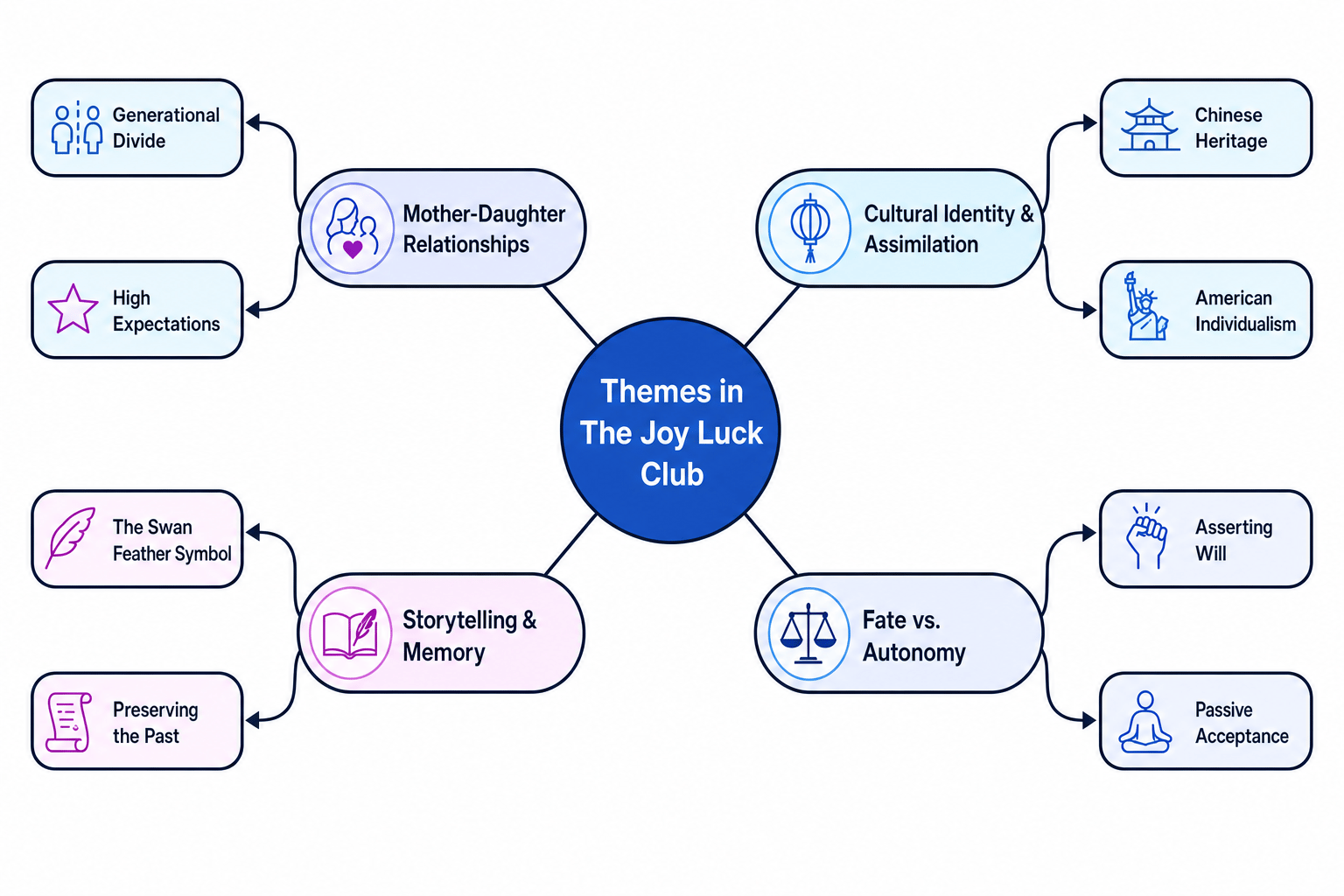
In Pearson Edexcel IGCSE English Literature, exploring the themes of a text means looking at the central ideas, messages, and warnings that the writer conveys. In Amy Tan’s The Joy Luck Club, themes are not static concepts; they are woven into the personal histories, cultural clashes, and psychological struggles of four pairs of Chinese mothers and their Chinese-American daughters.
What you'll learn:
- How the generational and cultural divide shapes the conflict between mothers and daughters.
- The struggle to balance a traditional Chinese heritage with modern American assimilation.
- The role of memory, storytelling, and silence as tools of survival and connection.
1. The Generational and Cultural Divide
At the heart of The Joy Luck Club is the complex relationship between mothers and daughters. This relationship is deeply complicated by two distinct gaps: a generational gap (how age and experience separate parents from children) and a cultural gap (the divide between the immigrant experience and the first-generation citizen experience).
Acculturation
Acculturation is the process of cultural change and psychological adaptation that occurs when two or more cultural groups come into contact. In the novel, the daughters experience rapid acculturation into American society, often at the expense of their mothers’ traditional Chinese values.
The four mothers—Suyuan, An-mei, Lindo, and Ying-ying—grew up in a war-torn, patriarchal, and feudal China before fleeing to America. The four daughters—Jing-mei (June), Rose, Waverly, and Lena—were born and raised in post-World War II San Francisco. This geographical and historical difference creates a major barrier to mutual understanding.
High Expectations and the Burden of Hope
The mothers want their daughters to have lives of unlimited opportunity, free from the suffering they left behind in China. However, this hope often manifests as intense, suffocating pressure:
- Suyuan and Jing-mei: Suyuan pushes Jing-mei to be a child prodigy, leading to a bitter clash over piano lessons in "Two Kinds."
- Lindo and Waverly: Lindo uses Waverly’s success as a national chess champion to boast to others, causing Waverly to feel that her mother is exploiting her talent.
The Paradox of Maternal Love
The mothers' high expectations are driven by deep love and a desire to protect their daughters from feeling powerless. However, the daughters interpret this pressure as a rejection of who they actually are. The conflict is not a lack of love, but a failure to communicate it across cultural boundaries.
2. Identity, Heritage, and "Translation"
The novel constantly explores what it means to be Chinese-American. The characters struggle to reconcile two identities that often seem incompatible.
The Double Lens
Think of having a double identity as wearing two different pairs of glasses at the same time. The mothers look at the world through the lens of traditional Chinese values (filial piety, duty, reading character in the wind). The daughters look through the lens of modern American individualism (personal happiness, speaking up, therapy). When they try to look at each other, the image becomes blurry and distorted.
The Struggle of Translation
This identity crisis is symbolised by the literal and figurative barriers of language. The mothers speak broken English, which leads their daughters to believe their minds are similarly fragmented. Jing-mei reflects that her mother's English was "perfectly clear... but to other people it sounded like chopped onions."
The daughters, conversely, cannot speak fluent Chinese, meaning they cannot "translate" their feelings back to their mothers. This creates a tragic barrier:
- Lindo Jong laments this divide: "I wanted my children to have the best combination: circumstances American, character Chinese... But how could I know these two things do not mix?"
- The Swan Feather: In the prologue to the novel, the mother wants to give her daughter a swan feather and tell her, "This feather may look worthless, but it comes from afar and carries with it all my good intentions." However, she must wait for the day she can speak to her daughter in "perfect English," symbolizing her deferred hope of true emotional translation.
Over-simplifying the Mothers
Do not write off the mothers as simply "strict" or "old-fashioned" villains. To gain top marks in AO1 and AO4, you must show empathy for the mothers. Their desperation for their daughters to succeed is a direct response to the severe trauma, loss, and patriarchal oppression they survived during the Chinese Civil War and the Japanese invasion.
3. Voice, Storytelling, and Memory
In The Joy Luck Club, storytelling is not just a way to pass the time; it is a vital tool for survival, healing, and historical preservation.
Silence vs. Speech
Many of the mothers survived their traumas in China by staying silent. However, they realize that their daughters’ American freedom has left them quiet in a different way—passive, voiceless, and unable to stand up for themselves:
- An-mei Hsu watches her daughter Rose allow her husband Ted to bully her during their divorce. An-mei realizes that her own mother's forced silence as a concubine has passed down to Rose. She urges Rose to "speak up."
- Ying-ying St. Clair observes her daughter Lena living in a passive, transactional marriage where they split every expense. Ying-ying, who lost her "spirit" (her chi) after a traumatic first marriage in China, resolves to pass her tiger-like spirit to Lena to save her from a lifetime of passive unhappiness.
Contextual Anchoring (AO4)
When writing about "voice" and "silence," anchor your analysis in context. In traditional Chinese Confucian culture, women were expected to obey the "Three Obediences" (to father, husband, and son). The mothers have to unlearn this deeply ingrained cultural passivity to teach their daughters how to survive in a competitive, individualistic American society.
4. Fate versus Autonomy
A major thematic tension in the novel is the conflict between fate (the belief that our lives are predetermined by external forces or spiritual alignment) and autonomy (the belief that we have the power to shape our own destiny).
Traditional Beliefs
The mothers frequently refer to Chinese concepts of fate, such as the elements (wood, fire, water, gold, earth), the zodiac signs (the Year of the Tiger, the Year of the Dragon), and the balance of energy.
- Ying-ying believes she was born a Tiger, destined to have a wild, fierce spirit, but she spent decades ignoring her nature because of traumatic life events.
- Lindo changes her own "destiny" when she is betrothed to the spoiled Tyan-yu. Instead of passively accepting her fate, she uses her intelligence and superstition to trick her in-laws into releasing her from the marriage contract while keeping her family's honor intact.
The Daughter's Perspective
The daughters initially view these beliefs as silly superstitions. However, they slowly realize that their lives are indeed being shaped by forces they do not fully understand—specifically, their mothers' psychological legacies. By the end of the novel, characters like Jing-mei learn that finding peace requires embracing their inherited heritage rather than fighting against it.
Analysing Mother-Daughter Conflict
Let us walk through how to construct a high-scoring analytical paragraph on the theme of mother-daughter conflict, focusing on the piano scene in "Two Kinds."
-
State your thesis point (AO1 & AO4):
Start by identifying how the conflict is rooted in a clash of cultural values and maternal projection.
Drafting your point: "Tan presents the physical and emotional conflict between Suyuan and her daughter Jing-mei as a clash between the American dream of individual freedom and the traditional Chinese value of obedience." -
Integrate precise evidence (AO1):
Introduce a quotation naturally into your sentence, ensuring it is attributed to the correct scene.
Drafting your evidence: "This clash reaches its climax during their argument over piano practice, when Suyuan fiercely asserts, 'Only two kinds of daughters... Those who are obedient and those who follow their own mind!'" -
Analyse the writer's methods (AO2):
Identify specific literary techniques used in the quotation (such as dialogue, contrast, or symbolism) and explain their immediate effect.
Drafting your analysis: "The absolute polarity in Suyuan's dialogue—creating a rigid dichotomy between being 'obedient' and 'following [one's] own mind'—highlights her authoritarian parenting style. The word 'only' emphasizes the lack of middle ground in her worldview, showing how she equates a lack of total obedience with a betrayal of family duty." -
Connect to the wider theme and context (AO1 & AO4):
Explain how this specific detail connects to the larger themes of the novel and the cultural/historical background.
Drafting your connection: "Through this conflict, Tan illustrates how the immigrant mother projects her own lost hopes onto her American-born child. Suyuan, having lost everything in Kwelin during the war, views Jing-mei's rebellion not just as laziness, but as a rejection of the safe, successful future that she sacrificed so much to give her. This illustrates the tragic irony that the very freedom the mothers sought for their daughters in America becomes the source of their deepest divisions."
In the exam
- Focus on the prompts: Edexcel prose questions are often structured around a choice of character or theme (e.g., "Explore the theme of identity in The Joy Luck Club"). Make sure your thesis statement directly answers the specific prompt rather than offering a generic summary of the plot.
- Weave context (AO4) into your analysis: Never dump context in a separate paragraph. Integrate it naturally with your discussion of character motivations and themes. For example, explain why Lindo Jong values "invisible strength" by referencing her struggle to survive an arranged marriage in feudal China.
- Trace character arcs: Most themes in The Joy Luck Club show progress. Show the examiner that you understand how a theme changes from the beginning to the end of the novel. For instance, note how Jing-mei begins by resisting her Chinese identity but ends the novel by embracing it during her trip to China.
Check yourself
- Why is the parable of the "Swan Feather" at the beginning of the novel so important to the theme of communication and heritage?
- How does the theme of "voice" differ between the character of Rose Jordan and her mother An-mei Hsu?
- What does Lindo Jong mean when she says she wanted her children to have "circumstances American, character Chinese"?
