What you'll learn
- What “context” means for The Joy Luck Club in Edexcel IGCSE Literature.
- How Chinese history, immigration and American life shape the mothers’ and daughters’ conflicts.
- How to use context without turning your essay into a history lesson.
- Which short quotations help you connect AO1 knowledge to AO4 context.
Context: what does it mean?
Context
Context means the circumstances surrounding a text: the historical events, social attitudes, cultural beliefs, places, traditions and authorial background that help explain how and why the text presents its ideas.
For The Joy Luck Club, context is especially important because the novel moves between China and America, between past and present, and between mother and daughter voices. The book asks: what happens when one generation survives trauma in one culture, then tries to raise children in another?
In Edexcel IGCSE Literature, The Joy Luck Club appears in Component 1: Poetry and Modern Prose, which is closed book. For this prose section, you need strong AO1 knowledge of the text and AO4 understanding of context. That means you should learn short, accurate quotations and connect them to wider ideas.
The golden rule
Context should explain meaning. Do not bolt on facts about China, immigration or Amy Tan. Instead, show how those contexts shape Tan’s characters, conflicts, narrative voices and themes.
Turning context into analysis
- Start with a relevant textual detail: the opening parable ends with the mother wanting to give her daughter a feather and say, “This feather may look worthless, but it comes from afar and carries with it all my good intentions.”
- Link the detail to context: the feather represents immigrant inheritance — something physically small but emotionally heavy because it has crossed countries, languages and generations.
- Analyse Tan’s method: the symbol of the feather contrasts “worthless” with “good intentions”, showing how cultural value can be misunderstood by the American-born daughter.
- Connect to the novel’s meaning: Tan suggests that mothers pass on love through stories and memories, even when their daughters do not immediately understand them.
A quick context timeline
The novel’s conflicts do not come from one single context. Tan brings together wartime China, migration, Chinese-American community life, and late twentieth-century questions about identity.
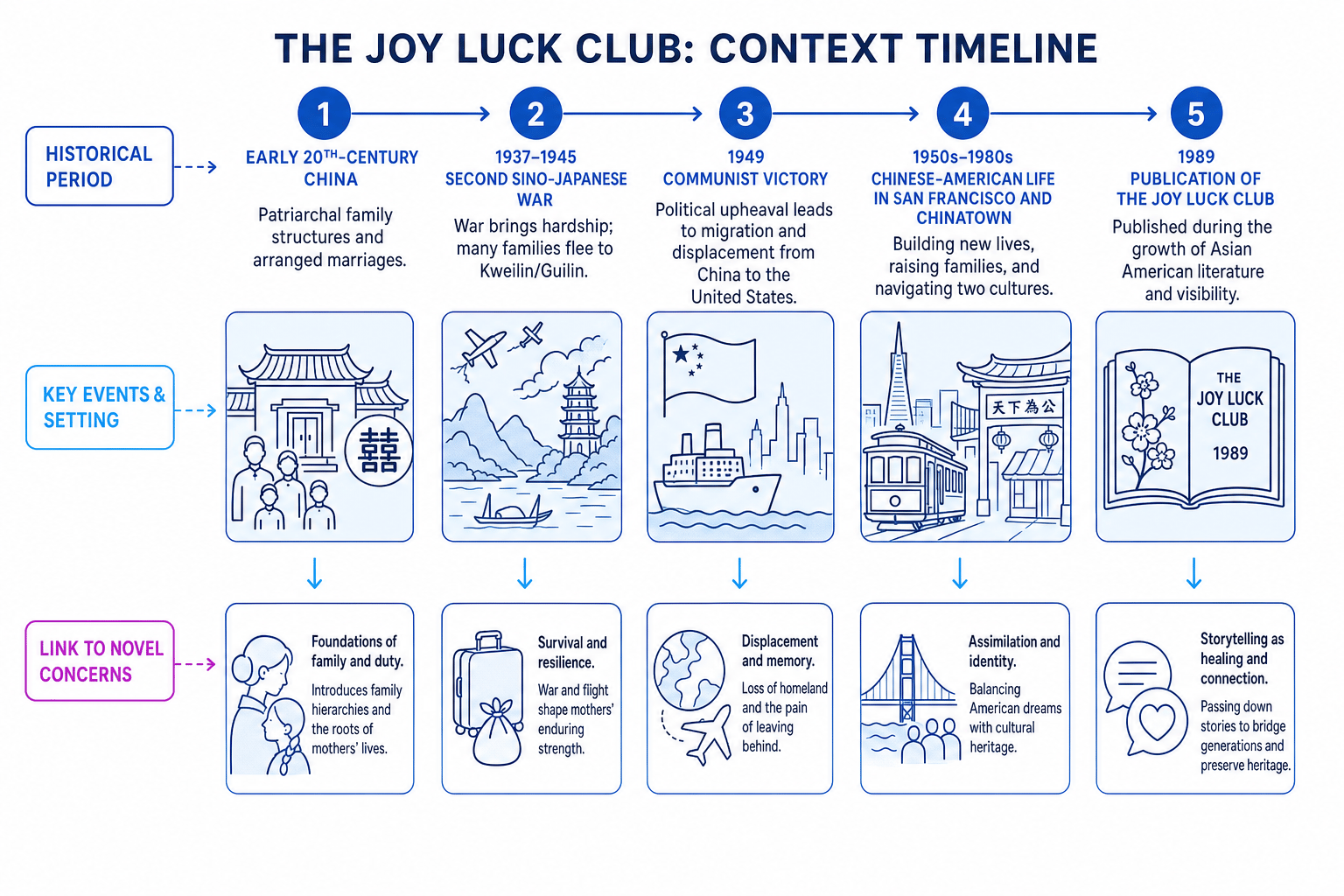
Historical context: war, loss and survival
Several of the mothers’ stories are shaped by the violence and instability of twentieth-century China. The most important historical background is the Second Sino-Japanese War — the war between China and Japan from 1937 to 1945. Suyuan Woo creates the first Joy Luck Club in Kweilin during wartime, when families are fleeing danger and living with uncertainty.
The club is not just a social gathering. It is a survival strategy. The name itself joins two hopeful words, “joy” and “luck”, against a background of fear. Suyuan’s memory of the club shows people deliberately choosing stories, food and games as a way to resist despair.
Tan presents trauma indirectly. Suyuan’s loss of her twin babies is not just a personal tragedy; it belongs to a wider historical world of refugees, forced journeys and impossible choices. This helps you avoid judging characters too simply. The mothers can seem controlling, secretive or harsh, but their behaviour often grows out of survival.
Linking wartime context to Suyuan
- Choose the historical pressure: Suyuan’s past is shaped by war, flight and separation, not by ordinary family difficulty.
- Connect it to a quotation: in Kweilin, she says, “To despair was to wish back for something already lost.”
- Analyse the effect of the wording: “despair” sounds passive, but “wish back” suggests a painful longing for a past that cannot be restored.
- Link to Tan’s purpose: Tan presents storytelling and the Joy Luck Club as ways for women to keep living after loss, rather than as simple nostalgia.
Social context: patriarchy and women’s limited power
Patriarchy
Patriarchy is a social system in which men hold most authority, especially in family, marriage, property and public life.
Many of the mothers’ memories of China are shaped by patriarchal expectations. Girls and women are often expected to obey fathers, husbands, mothers-in-law and family arrangements. Marriage may be treated as a duty between families rather than a romantic choice.
Lindo Jong’s story in “The Red Candle” is central here. Her line, “I once sacrificed my life to keep my parents’ promise,” shows how a daughter’s identity can be swallowed by family obligation. The verb “sacrificed” is powerful: Tan presents the young Lindo as someone whose personal wishes are treated as less important than honour, duty and obedience.
Another useful term is filial piety, meaning respect and duty towards parents and ancestors. In the novel, filial piety can be loving, but it can also become oppressive when children — especially daughters — are forced to obey without being heard.
An-mei Hsu’s reflection that she was taught “to swallow other people’s misery, to eat my own bitterness” also reveals a culture where female suffering is often expected to be silent. Tan’s food-related verbs, “swallow” and “eat”, make suffering seem internalised, as if pain becomes part of the body.
Flattening Chinese culture
Avoid writing as if Tan says “Chinese culture is bad” and “American culture is good”. The novel is more balanced: it criticises oppression, but it also values Chinese storytelling, resilience, family loyalty and inherited wisdom.
Using gender context without oversimplifying
- Begin with the character’s situation: Lindo is trapped by an arranged marriage and family promises made before she can choose for herself.
- Add the context carefully: patriarchal and filial expectations mean her obedience is treated as honourable, even when it costs her freedom.
- Analyse Tan’s presentation: “sacrificed my life” makes duty sound like a kind of death, showing the emotional violence behind respectable traditions.
- Keep the interpretation balanced: Lindo is not presented only as a victim; her clever escape also shows female intelligence and resistance.
Immigration, assimilation and Chinese-American identity
Assimilation
Assimilation means adapting to the dominant culture of a country, sometimes by losing or hiding parts of your original culture.
The daughters grow up in America, mostly in and around San Francisco. They speak English, attend American schools, date and marry in American society, and often misunderstand their mothers’ Chinese beliefs and expressions. The mothers want their daughters to succeed in America, but they fear that success will come at the cost of cultural memory.
Lindo expresses this tension clearly: “I wanted my children to have the best combination: American circumstances and Chinese character.” The phrase “best combination” shows an immigrant hope — that children might benefit from American opportunity while keeping inherited strength. But the novel repeatedly shows that this “combination” is difficult, because the daughters often experience Chinese identity as pressure, embarrassment or criticism.
The American Dream is the belief that anyone can achieve success through effort and opportunity. Jing-mei says her mother believed “you could be anything you wanted to be in America.” Tan presents this dream as inspiring but also pressurising. Suyuan’s ambition for Jing-mei comes from love and hope, yet it also creates conflict in “Two Kinds”.
The central conflict often works like cultural translation: both generations are trying to love each other, but they use different languages, values and expectations.
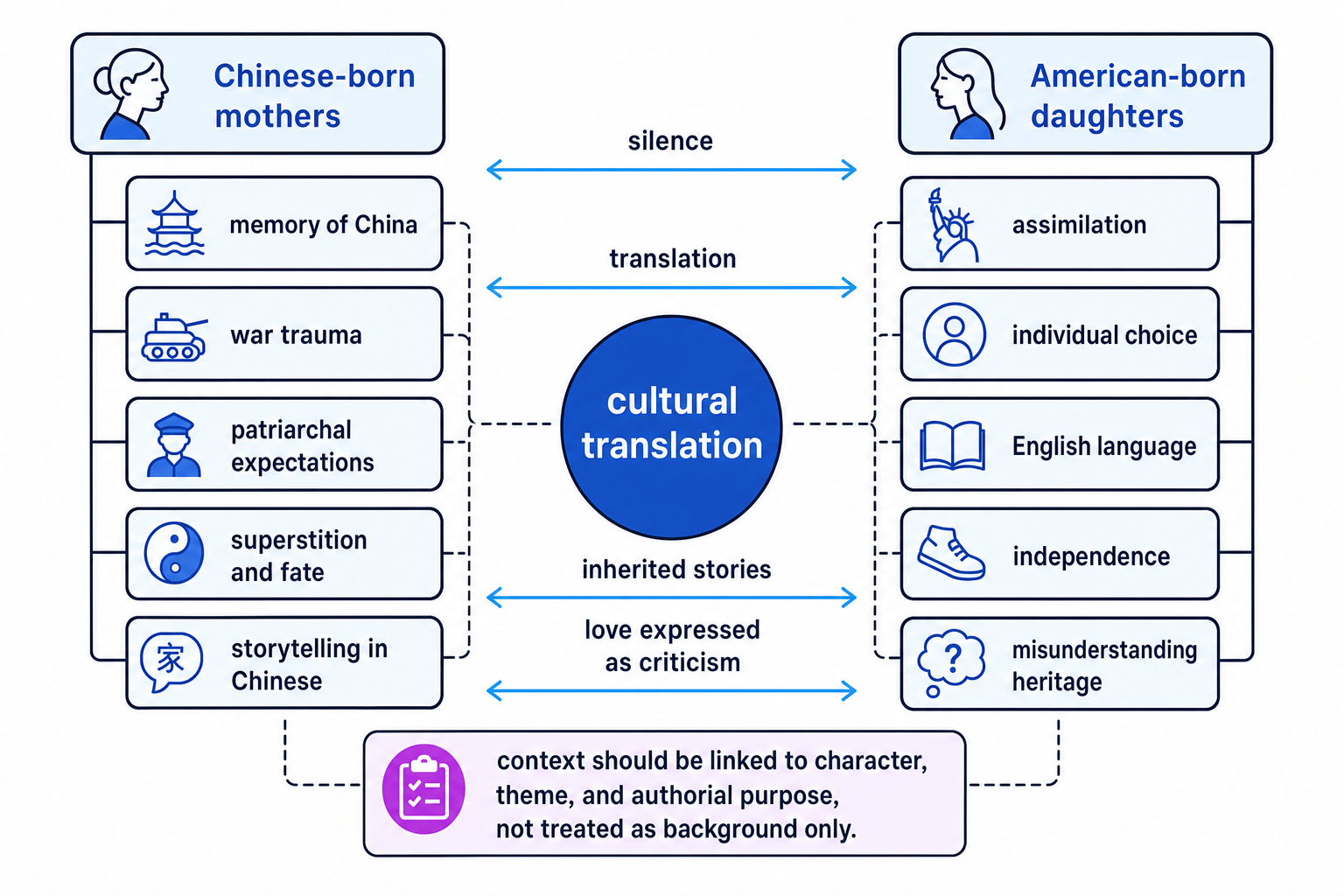
A useful phrase
When writing about the novel, “between two cultures” is helpful, but make it precise. Say whether you mean language, family duty, gender expectations, ambition, marriage, shame, pride or storytelling.
Language, silence and misunderstanding
Language is one of Tan’s most important contextual concerns. The mothers often speak in Chinese-influenced English, while the daughters think and speak in American English. This does not mean the mothers are less intelligent. Instead, Tan shows how power can be lost in translation.
Jing-mei reflects that she and her mother “never really understood one another” and that they “translated each other’s meanings”. This is a key idea for the whole novel. Translation is not only about words; it is about emotional meaning. A mother’s warning may sound like criticism. A daughter’s independence may sound like rejection.
The novel also shows how silence can carry history. The mothers do not always tell their daughters everything because their memories are painful, shameful or difficult to express in English. By the end, storytelling becomes a way to repair this gap.
Calling the mothers ‘broken’
Do not describe the mothers as having “broken English” in a way that makes them seem foolish. If you discuss non-standard English, link it to Tan’s exploration of translation, cultural power and the daughters’ limited understanding.
Literary context: storytelling and multiple voices
The Joy Luck Club is not a straightforward single-narrator novel. It is made of linked stories told by different women. A frame narrative is a structure where one story creates a setting for other stories; here, the Joy Luck Club and the daughters’ inheritance of their mothers’ stories help frame the whole book. A vignette is a short, focused narrative episode, often capturing a memory or turning point.
Tan draws on oral storytelling traditions, family memory, parable and myth. Each section begins with a short parable-like story, such as the woman with the swan feather. These parables make the novel feel like inherited wisdom being passed down — but often in fragments that daughters must learn to interpret.
This structure matters for context. Tan does not present Chinese-American identity as one simple story. She gives us many voices, showing that identity is layered, partial and sometimes contradictory.
Amy Tan and publication context
Amy Tan was born in the United States to Chinese immigrant parents. Her mother, Daisy Tan, had endured a difficult earlier life in China, including separation from children — an experience that helped shape some of the emotional material of The Joy Luck Club. However, you should not treat the novel as autobiography. Tan transforms family history into fiction.
The novel was published in 1989, at a time when Asian American literature was gaining wider visibility. Tan’s focus on Chinese-American women, mother-daughter relationships and immigrant memory challenged narrow stereotypes by presenting complex interior lives.
Biography is not proof
It is fine to mention Amy Tan’s Chinese-American background, but do not write, “Tan experienced this, so the character feels this.” Instead, say Tan’s background may inform her interest in migration, memory and mother-daughter communication.
How to make context exam-worthy
A strong context point usually follows this pattern:
Point → evidence → context → method/effect → link back to the question
For example:
Tan presents immigrant hope as both loving and burdensome. In “Two Kinds”, Jing-mei says Suyuan believed “you could be anything you wanted to be in America.” This reflects the American Dream, especially for immigrants who see America as a place of opportunity after loss and hardship. However, the repeated “you could” also creates pressure, as possibility becomes expectation. Tan therefore shows that Suyuan’s ambition is not simply cruelty: it grows from a mother’s desire to turn past suffering into her daughter’s future success.
In the exam
- Use context to deepen your interpretation of a character’s behaviour; do not add a separate history paragraph.
- Memorise a few short quotations: “good intentions”, “American circumstances and Chinese character”, “eat my own bitterness”, and “you could be anything you wanted to be in America”.
- Keep your argument balanced: Tan criticises oppression and misunderstanding, but she also celebrates resilience, storytelling and cultural inheritance.
Check yourself
- How does wartime China help explain Suyuan’s need to create the Joy Luck Club?
- Why is Lindo’s “American circumstances and Chinese character” quotation useful for discussing assimilation?
- How can you write about patriarchy without suggesting that Tan rejects all Chinese culture?
