What you'll learn
- How Amy Tan presents the four mothers and four daughters as linked, contrasting character pairs.
- How to write about characterisation through voice, memory, symbols and relationships.
- How to avoid oversimplifying the mothers as “strict” or the daughters as “rebellious”.
- How to use short, accurate quotations for a closed-book Edexcel IGCSE response.
Start with the basics: who are the main characters?
The Joy Luck Club is built around eight central women: four Chinese-born mothers and their four American-born daughters. Tan does not give us one single hero. Instead, the novel creates a shared portrait of a community, where each woman’s story helps explain another woman’s pain, strength or misunderstanding.
Characterisation
Characterisation means the methods a writer uses to create a character. This includes what the character says, does, remembers, hides, misunderstands and symbolically represents.
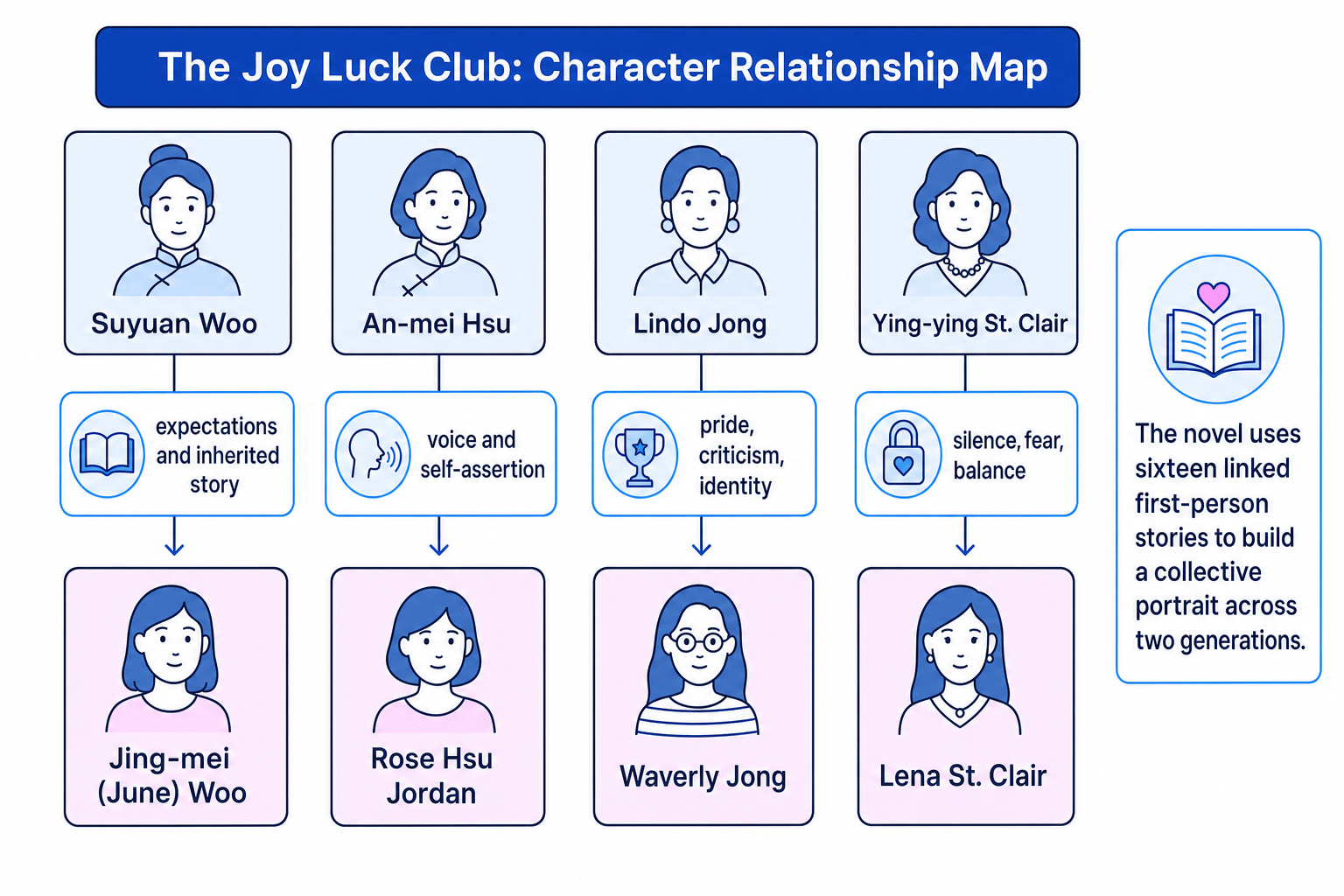
The four main mother-daughter pairs are:
| Mother | Daughter | Main character tension |
|---|---|---|
| Suyuan Woo | Jing-mei “June” Woo | Expectations, memory and inherited identity |
| An-mei Hsu | Rose Hsu Jordan | Silence, suffering and learning to speak |
| Lindo Jong | Waverly Jong | Pride, criticism and cultural identity |
| Ying-ying St. Clair | Lena St. Clair | Fear, passivity and recovering strength |
Use this map to keep the relationships clear as you revise the characters.
Character is relational
In this novel, you rarely understand a character alone. Tan reveals character through relationships: mother and daughter, China and America, silence and speech, past and present.
Tan’s main method: many voices, not one narrator
Narrative voice
Narrative voice is the “voice” telling the story. In The Joy Luck Club, Tan uses multiple first-person narrators, meaning different characters tell their own stories using “I”.
This matters because each character controls only part of the truth. A daughter may misunderstand her mother for years. A mother may hide trauma behind criticism, superstition or silence. The reader gradually pieces together a fuller picture than any one character has at the start.
This structure is especially important for June. Suyuan is dead before the novel fully begins, but she remains central through other people’s memories. Her absence makes her powerful: June has to discover who her mother was after she can no longer ask her directly.
Analysing June’s character arc
-
Start with June’s childhood conflict: in “Two Kinds”, June says, “My mother believed you could be anything you wanted to be in America.” This shows Suyuan’s hope, but also the pressure June feels.
-
Compare this with Suyuan’s harsh phrase “Only two kinds of daughters”: the language divides daughters into obedience or rebellion, making June feel that love depends on success.
-
Move to the adult June at the piano. The pieces “Pleading Child” and “Perfectly Contented” are revealed as “two halves of the same song”, which symbolically joins childhood anger with adult acceptance.
-
Link to character development: June does not simply become obedient. She learns that her identity contains both conflict and connection, especially when she travels to China and says, “It is my family. It is in our blood.”
Suyuan Woo: hope, loss and the mother June must recover
Suyuan is the founder of the Joy Luck Club and June’s mother. Although she dies early, she shapes the whole novel. She represents survival: she has lost her first husband, her home and, most painfully, the twin daughters she had to abandon during war in China.
Tan characterises Suyuan through other people’s memories. This makes her slightly mysterious. To June, she is often demanding and disappointed. To the aunties, she is determined, generous and full of stories.
Her belief in America is summed up by June’s memory that Suyuan thought “you could be anything you wanted to be in America”. This is hopeful, but Tan makes it complicated. Suyuan’s dreams are loving, yet they can feel like impossible expectations to her daughter.
The opening parable’s feather “carries with it all my good intentions”. That phrase fits Suyuan well: she wants to pass on love, history and hope, but the daughter does not always know how to receive them.
Jing-mei “June” Woo: uncertainty to inheritance
June often sees herself as ordinary, especially beside Waverly’s confidence. As a child, she resists the role of prodigy that Suyuan imagines for her. Her painful outburst about Suyuan’s lost babies shows how deeply mother and daughter wound each other.
As an adult, June becomes the bridge between generations. She takes Suyuan’s place at the mah-jong table and later travels to China to meet her half-sisters. This is not a neat “happy ending”; it is a moment of recognition. When June says, “I am becoming Chinese,” Tan presents identity as something discovered through family, memory and story rather than biology alone.
Writing about June
June is useful in essays because she connects the whole novel. You can discuss her as a daughter, narrator, replacement for Suyuan, and symbol of the next generation learning to carry the mothers’ stories.
An-mei Hsu: from bitterness to voice
An-mei’s character is shaped by suffering, but Tan does not present her as weak. As a child, she learns to endure pain. She says she was taught “to desire nothing, to swallow other people’s misery, to eat my own bitterness”. The verbs “swallow” and “eat” make suffering feel physical, as if silence is something forced into the body.
Her mother’s story teaches An-mei the cost of female silence in a patriarchal society. By the end of “Magpies”, An-mei learns that survival requires speech and self-respect: “On that day, I learned to shout.”
That lesson shapes her relationship with Rose. An-mei recognises that Rose’s marriage has made her passive. She wants Rose to stop accepting other people’s decisions and claim a voice of her own.
Rose Hsu Jordan: learning not to disappear
Rose begins as indecisive and fearful of making choices. The death of her brother Bing leaves her haunted by guilt and by questions of fate. Later, in her marriage to Ted, she allows him to make decisions until he uses her passivity against her.
Her turning point comes when she refuses to be erased from the marriage and the house. Her line to Ted, “You can’t just pull me out of your life and throw me away,” shows a new firmness. Tan presents Rose’s growth as the recovery of voice: she is not becoming aggressive, but she is no longer willing to vanish.
Lindo Jong: strategy, pride and hidden strength
Lindo is one of Tan’s most complex characters. As a young girl in China, she is trapped in an arranged marriage, yet she escapes through intelligence rather than open rebellion. She promises herself: “I would always remember my parents’ wishes, but I would never forget myself.”
This balance is central to Lindo. She understands social rules well enough to manipulate them. The phrase “invisible strength”, taught to Waverly, captures Lindo’s style: power does not always announce itself.
As a mother, however, Lindo’s strength becomes a source of conflict. She wants Waverly to inherit “Chinese character” while also having “American circumstances”. Her question, “How could I know these two things do not mix?” shows her pain. She has tried to give her daughter both confidence and cultural grounding, but Waverly often hears only criticism.
Waverly Jong: confidence, competition and insecurity
Waverly is clever, talented and competitive. Her chess success makes her seem powerful, but Tan also shows her insecurity. She learns “the art of invisible strength” from Lindo, yet she uses it partly against her own mother.
The marketplace argument, where Waverly asks, “Why do you have to use me to show off?”, reveals the misunderstanding between them. Waverly sees Lindo’s pride as control. Lindo sees Waverly’s embarrassment as rejection.
Foil
A foil is a character who contrasts with another character, helping the reader notice important qualities in both.
Waverly can work as a foil to June. Waverly appears polished, successful and sharp, while June often feels unsure. But Tan complicates this: Waverly’s confidence hides anxiety, while June’s uncertainty becomes emotional openness.
Comparing Lindo and Waverly
-
Identify the shared trait: both characters value strategy. Lindo survives her arranged marriage through cleverness, while Waverly wins chess through calculation and restraint.
-
Identify the conflict: the same “invisible strength” that links them also separates them, because Waverly interprets Lindo’s watchful pride as interference.
-
Add context carefully: Lindo’s immigrant experience makes family reputation and cultural continuity feel urgent, while Waverly’s American upbringing makes independence feel equally urgent.
-
Shape the comparison: Tan is not asking us to choose one side. She presents love as real but mistranslated across generations.
Ying-ying St. Clair: silence and buried power
Ying-ying is associated with silence, prediction and loss of self. She says, “I was born in the year of the Tiger,” but for much of her life she hides that tiger nature. Her past in China, including emotional betrayal and grief, leaves her passive and ghost-like.
Her relationship with Lena is painful because Lena inherits this passivity. Ying-ying can see the weakness in Lena’s marriage to Harold, just as she can see the unstable table before it collapses. The key question, “Then why didn’t you stop it?”, applies to more than the table: it challenges Lena’s habit of watching disaster happen without acting.
Ying-ying’s character matters because she shows that silence can be inherited. But she also shows that strength can be reawakened.
Lena St. Clair: imbalance and passivity
Lena is sensitive to hidden unhappiness. As a child, she notices fear and tension in her mother. As an adult, she lives in a marriage built on false “equality”, where everything is divided into accounts and lists. The relationship looks modern and fair, but emotionally it is deeply unbalanced.
Tan uses objects around Lena to reveal character. The unstable table is a symbol: an object that represents a larger idea. Its collapse exposes the weakness Lena has been refusing to confront.
Oversimplifying the mothers
Do not write that the mothers are simply “strict” or “traditional”. Tan shows that their behaviour often comes from trauma, survival, love and fear of their daughters losing themselves.
Minor characters: why they matter
The male characters are usually less developed than the women, but they still have important functions.
Canning Woo helps June connect with Suyuan’s past and travel to China. Clifford St. Clair translates for Ying-ying, but his mistranslations also show how easily her true self is hidden. Ted and Harold reveal Rose’s and Lena’s struggles with passivity in marriage. Rich, Waverly’s fiancé, exposes cultural misunderstanding, especially when Waverly anxiously imagines Lindo judging him.
So, when writing about minor characters, ask: what do they reveal about the central women?
Symbols connected to character
Motif
A motif is a repeated image, object or idea that helps develop character or theme.
Tan often attaches characters to motifs: June has the piano and the journey to China; Waverly has chess; Rose has wood and weeds; Lena has the unstable table; Ying-ying has the tiger; the mothers share food, stories and mah-jong.
These motifs are not decoration. They make inner conflicts visible. For example, June’s piano does not just show failure; by the end, it becomes a way to understand the two sides of her relationship with Suyuan.
In the exam
-
For Component 1 modern prose, remember it is closed book: learn a small bank of short, exact quotations for each main character pair.
-
Build paragraphs around character relationships, not isolated personality labels: point → evidence → method or narrative detail → effect → link to context and question.
-
Keep AO4 relevant: mention immigration, generational difference, patriarchal expectations or assimilation only when it explains a character’s choices.
Check yourself
- Which mother-daughter pair would you choose for an essay on silence and voice?
- How does June’s view of Suyuan change between “Two Kinds” and “A Pair of Tickets”?
- What object or motif best reveals Lena’s character, and why?
