Understanding the plot of The Joy Luck Club requires looking beyond a standard, linear timeline. Instead of a single continuous storyline, Amy Tan constructs a complex web of sixteen interconnected stories. By mastering how these narratives weave together, you will be able to write analytical essays that appreciate how Tan's structural choices reflect her themes of cultural identity, generational conflict, and reconciliation.
What you'll learn:
- How the novel's unique four-part, sixteen-chapter structure is organized.
- The main narrative arcs of the four mother-daughter pairings.
- How to trace thematic connections across different geographical and historical settings.
- Key exam strategies for addressing plot and structure in your closed-book Edexcel exam.
The Architectural Design of the Novel
To analyze the plot effectively, you first need to understand the structural terminology. Tan does not use a conventional chronological structure. Instead, she utilizes a vignette-based model within a broader framed narrative.
Vignette
A vignette is a short, evocative literary sketch or episode that focuses on a single moment, character, or theme, rather than relying on a traditional, driving plot line.
Framed Narrative
A framed narrative is a literary technique where an introductory main story (the "frame") sets the stage for a second narrative or a series of shorter stories embedded within it.
In The Joy Luck Club, the frame narrative is set in San Francisco in the late 1980s. It begins with the death of Suyuan Woo, the founder of the San Francisco Joy Luck Club. Her daughter, Jing-mei "June" Woo, is asked to take her mother's place at the mahjong table. From this frame, fifteen other stories unfold, shifting between the mothers' past lives in pre-revolutionary China and the daughters' contemporary lives in America.
The novel is strictly organized into four sections, each containing four chapters:
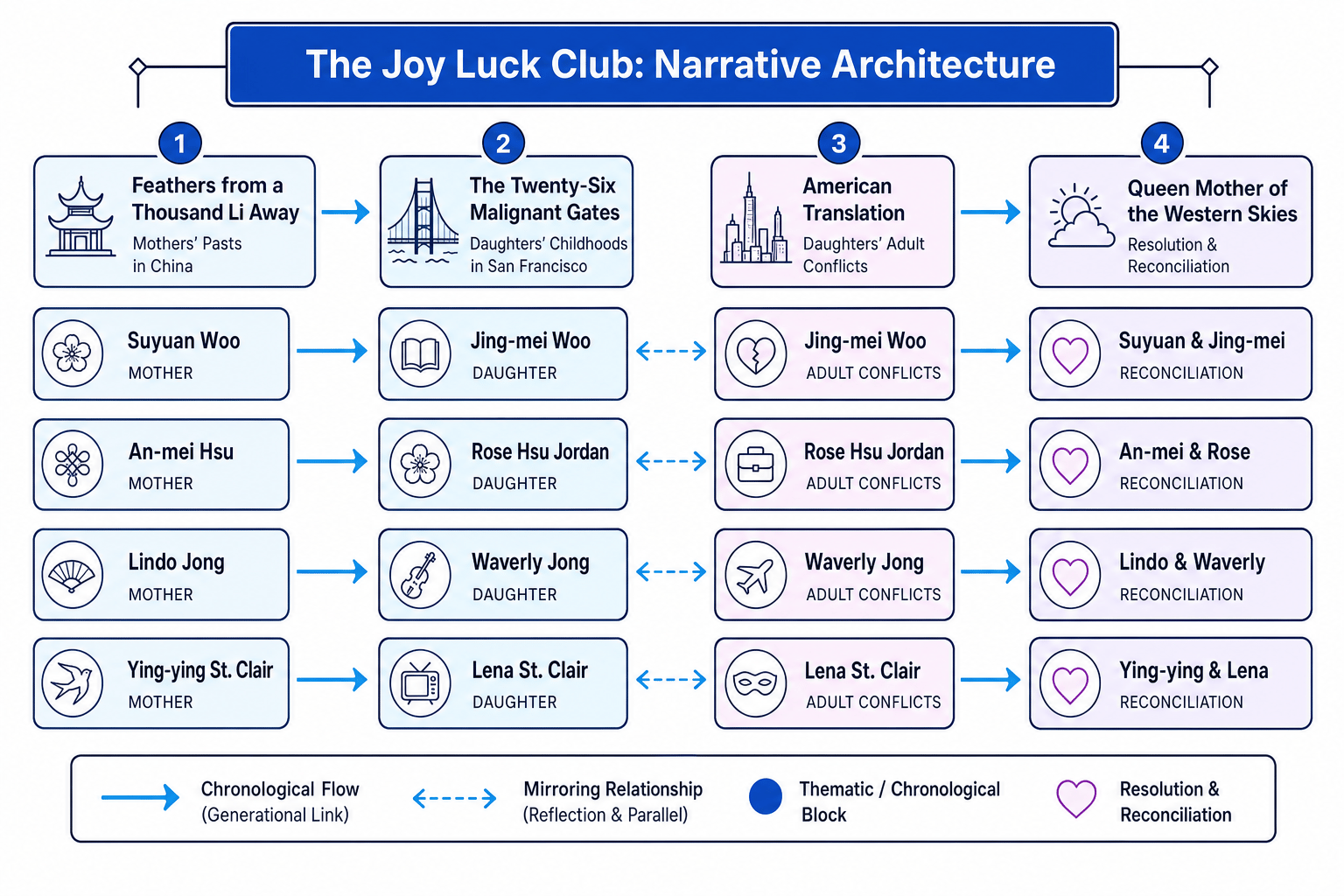
1. Feathers from a Thousand Li Away
This first section introduces the mothers' backstories in China. It establishes the immense suffering, trauma, and societal oppression they fled. We learn about Suyuan leaving her twin babies on the road to Chungking; An-mei witnessing her mother's suicide as a third concubine; Lindo escaping an arranged, abusive marriage; and Ying-ying losing her spirit after her first husband abandoned her.
2. The Twenty-Six Malignant Gates
This section shifts to the daughters' childhoods in San Francisco. It illustrates the cultural and generational divide (diaspora tension) between immigrant mothers and their American-born daughters. The daughters struggle to interpret their mothers' cryptic warnings and high expectations, which they often mistake for overbearing control.
3. American Translation
Here, the focus is on the daughters as adults facing marital, professional, and personal crises. Lena's marriage is fracturing over financial inequality; Rose is paralyzed by her impending divorce; Waverly is terrified of her mother's criticism of her fiancé; and June continues to feel inadequate compared to her peers.
4. Queen Mother of the Western Skies
The final section offers a resolution. The mothers and daughters move toward mutual understanding and reconciliation (the restoration of friendly relations). June travels to China to meet her half-sisters, fulfilling her late mother's lifelong wish and completing the circle of identity.
Chronological vs. Thematic Plotting
While the book jumps across decades and continents, there is a clear chronological spine running through the background of the stories.
The Parallel Journeys
The narrative arc of the novel moves from division to reconciliation. The mothers begin in China (separated from their pasts), the daughters grow up in America (separated from their mothers' heritages), and finally, both generations find peace by translating their histories for one another.
To write highly rewarded essays for Edexcel (AO1 and AO2), you must be able to link these time shifts to the author's intent. Tan uses structural parallelism to show that despite their cultural differences, the daughters are repeating the psychological patterns of their mothers.
Structural Parallelism
Structural parallelism is the deliberate pairing of similar plot points, relationship dynamics, or thematic developments in different parts of a literary work to invite comparison.
The Four Mother-Daughter Plotlines
To avoid getting confused by the large cast of characters, track the plot by pairing each mother with her daughter:
1. Suyuan Woo & Jing-mei "June" Woo
- The Mother's Plot: Suyuan founds the first Joy Luck Club in Kweilin during wartime to maintain hope amidst tragedy. She is forced to abandon her twin daughters on a roadside while fleeing the Japanese invasion. She later immigrates to San Francisco, starts a new family, but dies before she can find her twins.
- The Daughter's Plot: June struggles with feelings of inadequacy, constantly failing to meet her mother's expectations (such as the disastrous childhood piano recital). After Suyuan's death, June takes her seat at the Joy Luck Club, learns her sisters have been found, and travels to Shenzhen.
- The Climax & Resolution: June's meeting with her half-sisters in China serves as the climax of the entire novel. As they embrace, June realizes that her mother's "long-cherished wish" is fulfilled through her, resolving her identity crisis.
2. An-mei Hsu & Rose Hsu Jordan
- The Mother's Plot: An-mei is raised by her grandmother (Popo) because her widowed mother became a concubine to a wealthy merchant, Wu Tsing. An-mei eventually joins her mother, witnesses her tragic suicide by eating opium (which was a sacrifice to secure An-mei's future), and learns to assert her own voice.
- The Daughter's Plot: Rose becomes passive in her marriage to Ted, allowing him to make all the decisions. When he asks for a divorce, she spirals into depression.
- The Climax & Resolution: Guided by her mother's lessons on having "ancestral authority" and standing up for oneself, Rose finally stands up to Ted, refuses to sign the unfair divorce papers, and reclaims her home.
3. Lindo Jong & Waverly Jong
- The Mother's Plot: Lindo is forced into a loveless arranged marriage to Tyan-yu at a young age. Using her wit, she cleverly escapes the marriage without breaking her family's promise by convincing her mother-in-law that a dream warned of their doom.
- The Daughter's Plot: Waverly becomes a childhood chess champion, using her mother's lessons of "invisible strength." As an adult, Waverly is a successful tax attorney but is terrified to tell her mother about her engagement to her white fiancé, Rich.
- The Climax & Resolution: Waverly realizes her mother is not her adversary but a protective ally. They share a moment of understanding over a hair salon appointment, bridging the gap between Lindo's Chinese heritage and Waverly's American life.
4. Ying-ying St. Clair & Lena St. Clair
- The Mother's Plot: Ying-ying grew up as a wild, wealthy girl in Wuxi. After being abandoned by her first, abusive husband, she loses her "spirit" and becomes a passive "ghost." She marries an American, Clifford St. Clair, who constantly misinterprets her.
- The Daughter's Plot: Lena lives in a highly structured, emotionally distant marriage with Harold. They split all household expenses down to the cent, which masks a deeper lack of equality and love.
- The Climax & Resolution: Ying-ying deliberately knocks over a fragile vase in Lena's guest room to shatter Lena's illusion of a balanced marriage. This act of "shattering" forces Lena to confront her marital issues, while Ying-ying reclaims her own lost spirit by guiding her daughter.
Tracing Parallels in the Plot
Let's look at how to construct a comparative structural analysis in an essay. When writing about plot in the Edexcel exam, you must never just summarize what happens. Instead, look at how Tan patterns her plot to reveal deeper meanings (AO2).
Mapping Narrative Parallels
How does Amy Tan use structural parallelism between Lindo Jong's youth in China ("The Red Candle") and Waverly Jong's childhood in San Francisco ("Rules of the Game") to explore the concept of "invisible strength"?
-
Identify the structural link between the two stories: Locate where the parallel concept first appears. In "Rules of the Game," Lindo teaches Waverly "invisible strength," which is "a strategy for winning cold wars." This directly mirrors Lindo’s own survival strategy in "The Red Candle" where she had to hide her true thoughts to escape her arranged marriage.
-
Select and analyze evidence from the mother's plotline: In China, Lindo must obey her mother-in-law while secretly plotting her escape. She notes, "I was red-faced, quite hot, and secure... I made a promise to myself." Her strength is internal and silent; she uses the superstition of the red candle to win her freedom without losing her honor. This is her own version of "invisible strength."
-
Select and analyze evidence from the daughter's plotline: In San Francisco, Waverly applies this lesson to chess: "bite your tongue" and do not reveal your strategy. Waverly wins matches because she learns to control her emotions and anticipate her opponent's moves, a modern, American adaptation of her mother's survival tactics.
-
Compare the characters' outcomes to draw a thematic conclusion: Synthesize these two plots. While Lindo used her invisible strength to escape a oppressive patriarchal structure in China, Waverly uses it to navigate the competitive world of American chess. The parallel plots show that despite their generational clashes, the daughter’s success is built upon the silent resilience passed down by her mother.
<commonmistake title="The "Plot-Summary" Trap">
Many students write essays that read like book reports: "First this happens, then that happens." In your Edexcel exam, this will limit you to lower mark bands. Every time you mention a plot point, immediately connect it to a theme (such as maternal love, trauma, or cultural displacement) and explain why Tan structured it that way. Use active verbs: "Tan structures June's journey to parallel..." or "The juxtaposition of Ying-ying's past and Lena's present highlights..."
In the exam
To achieve the highest marks on Component 1, Section C (Modern Prose):
- Memorize structural turning points: Because the exam is closed-book, memorize key moments where a character's internal change manifests in action (e.g., Rose standing up to Ted in the garden; June finding her sisters in Shenzhen).
- Weave in Context (AO4): Remember that the plot reflects real historical shifts. Connect the mothers' backstories to context like the Second Sino-Japanese War (1937–1945), Chinese patriarchal traditions, and the post-WWII Chinese-American immigrant experience.
- Analyze Narrative Voice: Remember that June narrates four chapters, while the other characters only narrate one or two. This makes June the emotional anchor of the plot, representing the collective voice of the daughters.
- Use Transition Words: Show the examiner you are tracking structure by using phrases like: subsequently, in parallel with, this is juxtaposed with, the structural climax occurs when, or the resolution of this narrative arc.
Check yourself
- How does June's trip to China at the end of the novel resolve not only her own plotline but also her mother Suyuan's lifelong conflict?
- In what ways does Lena's split-expense marriage table in "American Translation" structurally mirror her mother Ying-ying's feelings of imbalance and invisibility in "The Waiting Between the Trees"?
- Why does Amy Tan choose to divide the novel into exactly four parts, and how does this mirror the structure of a game of mahjong?
