What you'll learn
- How to turn a The Joy Luck Club question into a clear argument.
- How to plan 3–4 analytical paragraphs without retelling the whole novel.
- How to use remembered quotations accurately in a closed-book exam.
- How to weave in context so it supports your interpretation, not replaces it.
Why essay planning matters for The Joy Luck Club
The Joy Luck Club is a rich, multi-voiced novel. It has sixteen linked stories, several narrators, movement between China and America, and repeated ideas about mothers, daughters, memory, silence, translation and identity. Without a plan, it is very easy to write a “tour” of the novel rather than an answer to the question.
An essay plan is a brief map of your argument before you start writing. It decides your main point, your paragraph order, your best evidence, and how each paragraph will return to the question.
Assessment focus for this text
For Edexcel IGCSE, The Joy Luck Club appears in Component 1: Poetry and Modern Prose, which is closed book. For Modern Prose, you are mainly rewarded for AO1 — close knowledge, critical style and textual references — and AO4 — understanding the relationship between the text and its context.
A good plan keeps every paragraph connected to the question, while still allowing you to use the novel’s wider patterns: mothers and daughters, Chinese and American values, storytelling, gender expectations and inherited trauma.
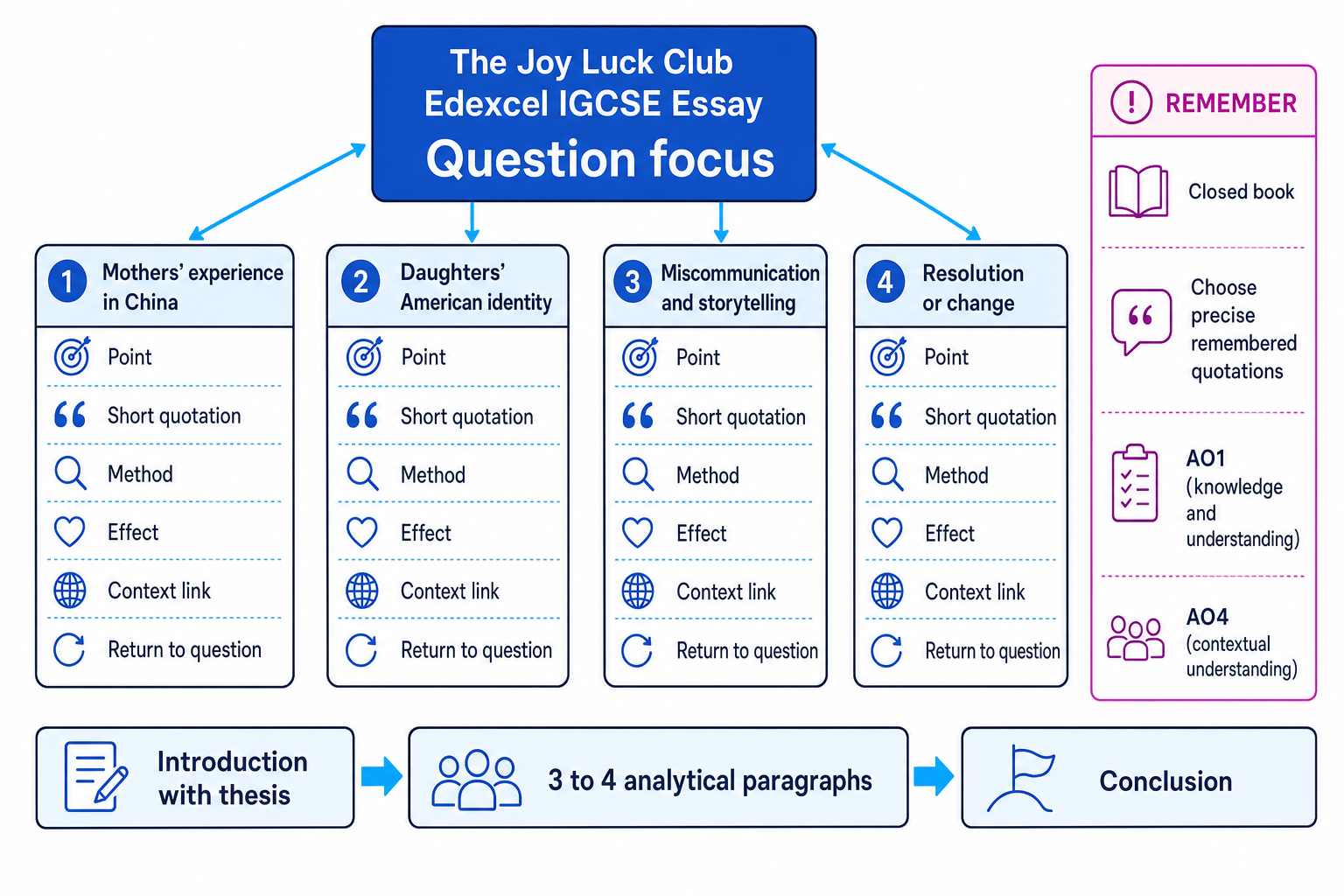
Planning is selection
You are not trying to include everything you know. You are choosing the most useful characters, moments and quotations for the exact question in front of you.
Step 1: Decode the question
To decode a question means to break it into its parts before answering it. Most questions on The Joy Luck Club will ask you to explore a theme, character relationship, or idea across the novel.
Look for three things:
- Focus: the key idea, such as identity, storytelling, mothers and daughters, conflict, suffering, or hope.
- Task: what you must do with that idea, usually “explore”, “present”, or “show”.
- Range: which parts of the novel you can use — often several chapters and more than one family.
A thesis is your overall argument in one or two sentences. It should answer the question directly and show a line of thought.
Turning a theme into a thesis
Question focus: storytelling in The Joy Luck Club.
-
Decide what storytelling does in the novel. It is not just decoration: mothers use stories to pass on painful experience, cultural memory and warnings.
-
Notice the tension. The daughters often misunderstand or resist these stories at first because they are growing up in America and do not share the same language, memories or assumptions.
-
Choose a developing argument. Tan presents storytelling as imperfect but necessary: it can fail in the moment, but it becomes a form of inheritance.
-
Shape the thesis: Tan presents storytelling as the way immigrant mothers transform suffering into guidance, although their daughters often understand this inheritance only gradually.
Writing about the topic, not the question
A question about storytelling is not the same as a question about all mother-daughter relationships. You can discuss mothers and daughters, but every paragraph must link back to storytelling.
Step 2: Build a paragraph route
A paragraph route is the order of your main analytical paragraphs. For The Joy Luck Club, a strong route often moves from misunderstanding to deeper understanding, or from inherited pain to renewal.
A useful structure is:
- Opening argument: introduce the main conflict or idea.
- Development: show a second family or moment that complicates the idea.
- Contextual deepening: connect the idea to Chinese or Chinese-American experience.
- Resolution or change: end with what Tan suggests by the final chapters.
You do not need to discuss all four mother-daughter pairs in every essay. Usually, two or three well-chosen pairs are stronger than four rushed ones.
Use pairs, not lists
Plan around contrasts and links: Suyuan and Jing-mei for inheritance, Lindo and Waverly for identity and pride, An-mei and Rose for voice, Ying-ying and Lena for passivity and recovery.
Step 3: Choose evidence you can actually remember
Because this is a closed-book exam, your quotations should be short, accurate and flexible. A quotation can be just a phrase if it is precise.
Here are useful quotations for planning:
| Quotation | Speaker / moment | Useful for |
|---|---|---|
| “This feather may look worthless” | Opening parable | inheritance, migration, mothers’ hopes |
| “all my good intentions” | Opening parable | love, misunderstanding, cultural transmission |
| “Only two kinds of daughters” | Suyuan in “Two Kinds” | obedience, conflict, generational values |
| “You don’t even know little percent of me!” | Suyuan to Jing-mei | misunderstanding, language, hidden history |
| “I am becoming Chinese” | Jing-mei in “A Pair of Tickets” | identity, resolution, belonging |
| “Together we look like our mother” | Final chapter | inheritance, reconciliation, family |
| “I once sacrificed my life” | Lindo in “The Red Candle” | female oppression, arranged marriage, survival |
| “the art of invisible strength” | Waverly in “Rules of the Game” | strategy, power, mother-daughter influence |
| “American circumstances and Chinese character” | Lindo in “Double Face” | immigrant identity, cultural conflict |
| “swallow other people’s misery” | An-mei in “Magpies” | female suffering, silence, voice |
A method is a writer’s deliberate choice, such as symbolism, motif, narrative voice, structure or contrast. Although this section mainly rewards AO1 and AO4, method language can still make your answer more precise.
For example, the swan feather is a symbol: an object that represents a larger idea. It suggests the mother’s hopes for her daughter, but also the difficulty of passing those hopes across language and migration.
Selecting evidence for a paragraph
Question focus: how Tan presents conflict between mothers and daughters.
-
Choose a moment of direct conflict: Suyuan tells Jing-mei there are “Only two kinds of daughters”, setting up obedience against independence.
-
Add a second quotation that reveals the deeper cause: Suyuan’s “You don’t even know little percent of me!” shows that the conflict comes partly from Jing-mei’s limited understanding of her mother’s past.
-
Link to context: Suyuan’s expectations are shaped by Chinese ideas of parental authority and by immigrant hope for success in America.
-
Form the paragraph point: Tan presents conflict as painful but rooted in love, because the mother’s pressure comes from hopes the daughter cannot yet understand.
Step 4: Plan context as part of the argument
Context means the social, historical and cultural circumstances that shape the text. In The Joy Luck Club, useful context includes Chinese patriarchal traditions, arranged marriage, filial duty, immigration, the trauma of war, and the experience of second-generation Chinese-American daughters.
Do not add context as a separate history paragraph. Instead, attach it to a character’s choices.
For example, Lindo’s “I once sacrificed my life to keep my parents’ promise” makes more sense when you understand the pressure of arranged marriage and family honour. Tan presents Lindo as trapped by patriarchal expectations, but also as intelligent and resourceful within them.
Bolted-on context
Avoid sentences like: “In China, women had no rights. This links to the novel.” That is too vague. Instead, explain exactly how context shapes a character, such as Lindo’s arranged marriage or An-mei’s learned silence.
Plan 1: Mothers and daughters
Possible thesis
Tan presents mother-daughter relationships as strained by language, migration and different ideas of obedience, but ultimately rooted in love, inheritance and the hope that daughters will understand what their mothers endured.
Paragraph route
-
Suyuan and Jing-mei: misunderstanding and expectation
Use “Only two kinds of daughters” to show conflict over obedience. Link to Suyuan’s immigrant hope that her daughter can become successful in America. -
Lindo and Waverly: pride, power and cultural identity
Use “the art of invisible strength” and “American circumstances and Chinese character”. Tan shows that Waverly’s American confidence is partly shaped by lessons from her Chinese mother. -
An-mei and Rose: silence and voice
Use “swallow other people’s misery” to show how women inherit silence. Then argue that An-mei wants Rose to gain the voice she herself had to fight for. -
Jing-mei’s final recognition
Use “I am becoming Chinese” and “Together we look like our mother”. The ending suggests that understanding the mother is also a way of understanding the self.
Best ending for this essay
The final reunion in China is not a neat solution to every conflict, but it gives emotional shape to the novel: the daughter finally recognises that her mother’s story is part of her own identity.
Plan 2: Identity and belonging
Possible thesis
Tan presents identity as divided but not broken. Through the daughters’ struggles between Chinese inheritance and American life, the novel suggests that belonging can be built from mixed, translated and inherited experiences.
Paragraph route
-
The opening parable: identity as inheritance
The feather “may look worthless” but carries “all my good intentions”. The symbol shows how immigrant mothers try to pass on meaning that daughters may not immediately value. -
Jing-mei’s uncertainty about being Chinese
Her journey to China leads to “I am becoming Chinese”. Tan uses physical journey as a structural movement towards self-recognition. -
Lindo’s double perspective
“American circumstances and Chinese character” captures the immigrant desire to combine opportunity with cultural values. The phrase also shows the difficulty of mixing two systems of identity. -
The final image of family resemblance
“Together we look like our mother” suggests that identity is communal, not just individual. Jing-mei finds herself through connection.
Adapting one plan to a different question
Question focus: belonging.
-
Keep the identity thesis, but change the emphasis: belonging should become the main idea, not just cultural identity.
-
Choose moments where characters feel between places: Jing-mei travelling to China, Lindo wanting both “American circumstances and Chinese character”, and the opening parable’s journey from China to America.
-
Make each paragraph answer the same question: not “what is Chinese identity?” but “how do characters come to feel they belong?”
-
End with the final family photograph idea: “Together we look like our mother” shows belonging as recognition across generations.
Plan 3: Female strength and survival
Possible thesis
Tan presents female strength not as simple confidence, but as endurance, strategy and the recovery of voice in societies that often silence women.
Paragraph route
-
Lindo’s strategic survival
“I once sacrificed my life” shows the severity of arranged marriage, but Lindo’s story also reveals intelligence and self-control. She survives by understanding the rules around her. -
An-mei’s inherited pain
“swallow other people’s misery” presents suffering as something women are trained to internalise. The bitter physical image makes silence seem damaging and unnatural. -
Waverly’s “invisible strength”
Tan complicates strength by showing it as quiet, strategic and learned from the mother. Chess becomes a symbol of power, performance and conflict. -
Jing-mei’s final role
By carrying Suyuan’s story to her sisters, Jing-mei becomes part of her mother’s unfinished act of strength.
Do not flatten the mothers
The mothers are not simply “traditional” and the daughters are not simply “modern”. Tan shows both generations as complex: mothers can be controlling but loving; daughters can resist but also inherit strength.
Step 5: Write introductions and conclusions from the plan
Your introduction should not begin with a huge summary of the whole novel. Start with the question’s focus, give your thesis, and briefly signal your route.
A strong conclusion should return to the thesis and show what Tan finally suggests. Do not introduce a completely new character or quotation in the final sentence.
Planning an introduction
Question focus: conflict between mothers and daughters.
-
Start with Tan’s overall presentation: Tan presents conflict between mothers and daughters as painful but also revealing.
-
Add the reason for conflict: The daughters often misunderstand their mothers because they grow up in America, separated from the trauma, language and expectations that shaped the older generation.
-
Signal development: However, through stories such as Suyuan and Jing-mei’s, Lindo and Waverly’s, and An-mei and Rose’s, Tan suggests that conflict can become a route towards inheritance and self-knowledge.
In the exam
- Spend a few minutes planning a thesis and 3–4 paragraph route before writing.
- Use short, accurate quotations; a precise phrase is better than a long, half-remembered sentence.
- Link context to character choices: arranged marriage, immigration, filial duty or Chinese-American identity should explain the text, not distract from it.
- End each paragraph by returning to the exact wording of the question.
- Avoid retelling all sixteen stories; choose the best moments for your argument.
Check yourself
- Can you write a one-sentence thesis for a question on mothers and daughters?
- Which three quotations would you use for an essay on identity?
- How would you link Lindo’s story to context without writing a separate history paragraph?
