What you'll learn
- How Amy Tan uses language to create distinctive mother and daughter voices.
- How the form of The Joy Luck Club is built from linked stories, almost like pieces around a mahjong table.
- How structure — order, repetition, contrast and framing parables — helps the reader connect China, America, mothers and daughters.
- How to turn method-spotting into precise analysis for the Edexcel IGCSE prose question.
First: what do “language, form and structure” mean?
Before you write about techniques, you need to separate three related ideas.
Language, form and structure
- Language means the writer’s choice of words, images, dialogue, sentence patterns and figurative methods such as metaphor or symbolism.
- Form means the overall type and shape of the text: for example, a novel, a linked story-cycle, a first-person memoir, or a framed narrative.
- Structure means how the text is organised: the order of events, shifts in time, repeated patterns, contrasts, openings and endings.
In The Joy Luck Club, these three things constantly overlap. Tan’s language often sounds like spoken memory; the form is made of 16 linked first-person chapters; and the structure moves between China and America, past and present, mothers and daughters.
Form: a novel made from linked stories
The Joy Luck Club is a linked story-cycle: this means a group of individual stories that can partly stand alone, but together form a larger novel. Tan uses four sections, each containing four chapters. This pattern echoes the four players at a mahjong table and the four mother-daughter families at the centre of the novel.
The novel does not have one single narrator. Instead, different women tell their own memories. This matters because the book is about partial knowledge: daughters do not fully understand their mothers, and mothers cannot always explain their pasts.
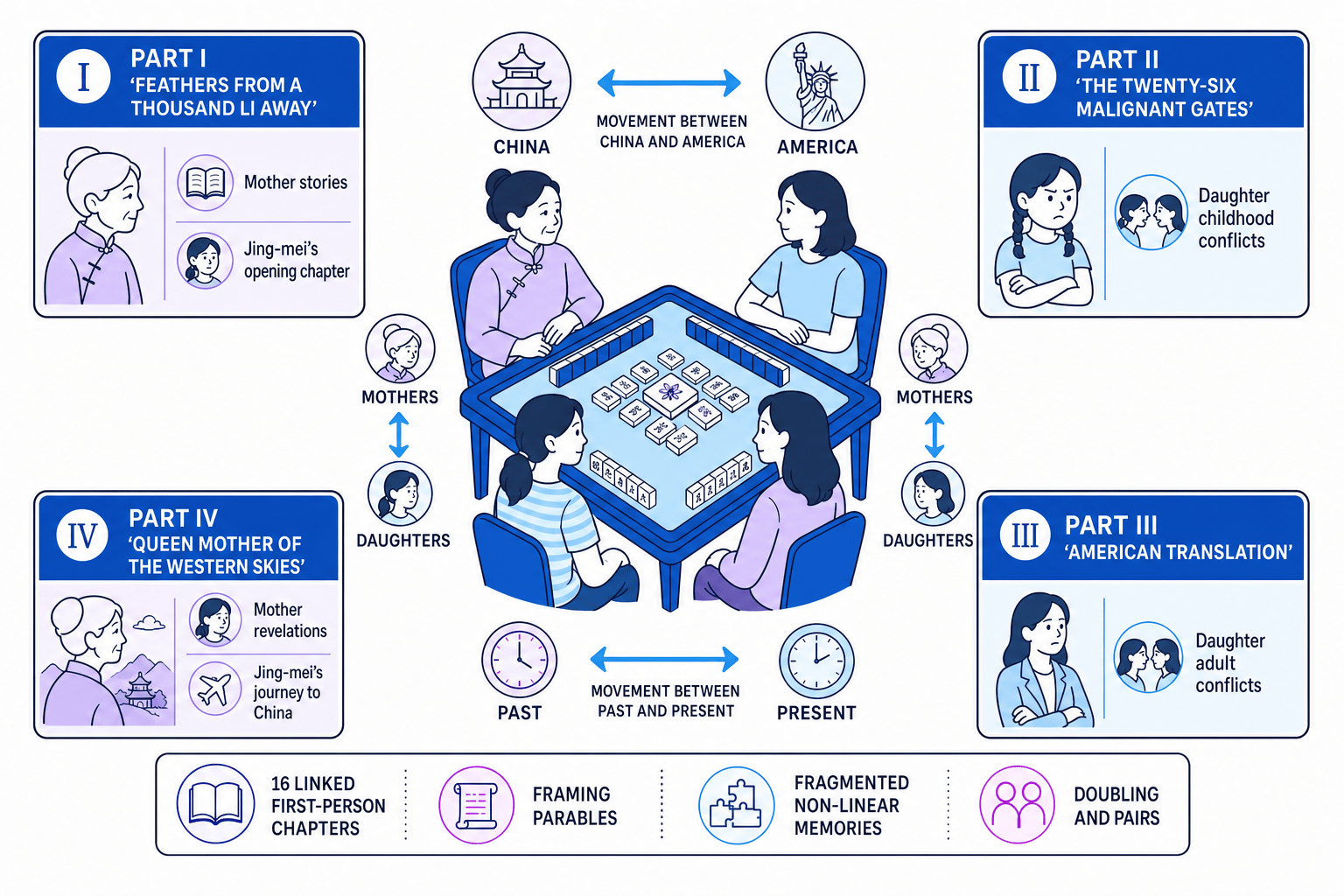
The form is part of the meaning
Tan’s fragmented form mirrors fragmented family knowledge: the reader has to piece together identity, memory and inheritance from many voices rather than from one complete account.
Suyuan’s missing voice
A crucial formal feature is that Suyuan Woo, Jing-mei’s mother, is dead before the novel begins. She never narrates her own chapter directly. Instead, Jing-mei has to reconstruct her mother through stories told by others.
Reading the missing mother’s voice
-
Tan opens Jing-mei’s first chapter with the sentence, “My father has asked me to be the fourth corner at the Joy Luck Club.” The phrase “fourth corner” is literal because Jing-mei is replacing her mother at the mahjong table.
-
The phrase also has a formal meaning: Jing-mei is being asked to fill a missing place in the story. Suyuan’s absence becomes part of the novel’s structure.
-
Because Suyuan’s history is filtered through Jing-mei, her father and the aunties, the reader experiences the same problem Jing-mei faces: understanding a mother through fragments.
-
This links form to meaning. The novel suggests that family identity is not simply given; it has to be assembled from memory, storytelling and listening.
Narrative voice: first-person memory
Most chapters use first-person narration, meaning the narrator speaks as “I”. Tan often uses retrospective narration, where an older narrator looks back on earlier experiences.
This creates two layers at once: the feeling of the child or younger woman at the time, and the wiser understanding of the adult looking back. For example, Waverly begins “Rules of the Game” by saying, “I was six when my mother taught me the art of invisible strength.” The child learns a lesson about silence and strategy, but the adult narrator understands how deeply that lesson shaped her later conflicts with Lindo.
Tan also makes many chapters sound like oral storytelling. The mothers often speak through memories, warnings and sayings. In “The Red Candle”, Lindo begins, “I once sacrificed my life to keep my parents’ promise.” The dramatic first-person statement immediately presents her life as testimony, not just background information.
Language: translation, sayings and conflict
Tan’s language often feels as if it is moving between Chinese and English. She does not simply show “correct” or “incorrect” speech. Instead, she shows how meaning changes when experience is translated across generations.
An idiom is a fixed expression whose meaning is not completely literal. A proverb or aphorism is a short saying that expresses a general truth. The mothers often use proverb-like language because they are trying to compress painful experience into memorable lessons.
For instance, in “Scar”, Popo tells An-mei: “When you lose your face, An-mei, it is like dropping your necklace down a well.” The image explains shame through a physical metaphor. “Face” means honour, reputation and dignity; the “well” suggests something difficult, perhaps impossible, to recover.
Calling the mothers’ English ‘bad’
Avoid writing as if the mothers’ language is simply broken or comic. Tan uses translated idioms, unusual phrasing and direct speech to show cultural distance, emotional urgency and the difficulty of passing on experience.
Dialogue and power
Dialogue often exposes conflict between mothers and daughters. A key example is Suyuan’s argument with Jing-mei in “Two Kinds”: “Only two kinds of daughters,” she shouted in Chinese. “Those who are obedient and those who follow their own mind!”
A binary opposition is a pair of opposites presented as if only two choices exist. Here, Suyuan’s language turns identity into an either/or choice.
Analysing mother-daughter dialogue
-
The phrase “shouted in Chinese” makes language part of the conflict. Jing-mei does not just argue with her mother’s rules; she also feels the pressure of her mother’s culture and expectations.
-
The repetition of “Only” and “two kinds” creates a binary opposition: obedient daughter versus independent daughter. Suyuan’s sentence leaves no middle ground.
-
The contrast between “obedient” and “follow their own mind” reflects a wider tension in the novel between immigrant parental sacrifice and American individualism.
-
The effect is not simply to make Suyuan seem controlling. Tan also shows the fear beneath her words: Suyuan believes that discipline and obedience might protect her daughter and help her succeed.
Figurative language: symbols and motifs
A symbol is an object, action or image that represents a larger idea. A motif is a repeated symbol, image or idea that gains meaning each time it appears.
Tan’s symbols are often ordinary objects — a feather, a chessboard, a piano, a mirror — but they carry emotional and cultural weight.
| Symbol or motif | Where it appears | Method and effect |
|---|---|---|
| Swan feather | Opening parable | The feather “may look worthless” but “comes from afar”; it symbolises the mother’s hopes, loss and “good intentions”. |
| Chess and “invisible strength” | “Rules of the Game” | Chess becomes a metaphor for strategy, silence and mother-daughter power. |
| Piano music | “Two Kinds” | “Pleading Child” and “Perfectly Contented” are revealed as “two halves of the same song”, symbolising a more mature understanding of conflict and reconciliation. |
| Faces and mirrors | “Double Face” and “American Translation” | These images explore double identity, appearance, inheritance and self-recognition. |
How to write about symbols
Do not stop at “the feather symbolises culture” or “the piano symbolises childhood”. Ask: what does the object mean at this moment, to this character, and how does that meaning change later?
Tracking the piano symbol
-
In “Two Kinds”, the piano first represents pressure: Suyuan’s desire for Jing-mei to become a prodigy and Jing-mei’s refusal to be shaped by her mother’s ambition.
-
Later, after Suyuan’s death, Jing-mei plays the two pieces “Pleading Child” and “Perfectly Contented”. The titles create a contrast between childhood hurt and adult acceptance.
-
Jing-mei realises that the pieces are “two halves of the same song”. Structurally, this joins two emotional states that once seemed separate.
-
The symbol therefore changes. The piano is no longer only a sign of failure or rebellion; it becomes a way for Jing-mei to understand her relationship with Suyuan more generously.
Structure: non-linear memory and echoes
A non-linear narrative does not tell events in simple chronological order. The Joy Luck Club moves backwards and forwards between China and America, childhood and adulthood, remembered trauma and present-day conflict.
This structure feels like memory. The past interrupts the present because the daughters’ adult problems often echo experiences their mothers have already lived through.
A framing parable is a short symbolic story placed before a section to guide how we read what follows. The opening parable of the woman and the swan feather prepares us for the whole novel: a mother has hopes for her daughter, but language, migration and time make those hopes difficult to explain.
Juxtaposition: placing stories side by side
Juxtaposition means placing two things next to each other so that the reader compares them. Tan places mother stories and daughter stories near each other so that we notice hidden connections.
For example, the daughters often believe their mothers are old-fashioned or intrusive. But when Tan later reveals the mothers’ histories of war, marriage, shame or loss, the daughters’ conflicts look different. The reader begins to see that advice which sounds harsh may come from fear, survival and love.
Endings, circles and recognition
The novel’s ending in “A Pair of Tickets” gives the structure a circular movement. Jing-mei travels to China and meets her half-sisters, fulfilling part of Suyuan’s “long-cherished wish”.
Following the ending’s structural movement
-
At the start of “A Pair of Tickets”, Jing-mei says, “I am becoming Chinese.” This begins the chapter with uncertainty: she feels identity as something changing, not something already fully understood.
-
The journey to China turns family history from an abstract story into physical experience: names, places, photographs and living sisters.
-
At the end, Jing-mei recognises, “Together we look like our mother.” The structure moves from Suyuan’s absence at the beginning of the novel to a shared image of her presence at the end.
-
This ending does not solve every conflict, but it offers recognition. Tan suggests that identity can be recovered through connection, even when the original storyteller is gone.
Patterns of pairs and doubles
Tan repeatedly uses pairs, halves and doubles: “Two Kinds”, “Half and Half”, “Double Face”, “A Pair of Tickets”, mother and daughter, China and America, obedience and independence.
At first, these pairs often look like opposites. However, Tan’s structure gradually shows that they can also be connected. Jing-mei’s discovery that “Pleading Child” and “Perfectly Contented” are “two halves of the same song” is one of the clearest examples of this pattern.
Pairs become connections
The novel often begins with division — Chinese and American, mother and daughter, past and present — but its structure gradually reveals these as linked halves of a larger identity.
Writing about method in this prose text
For Edexcel IGCSE, The Joy Luck Club appears in Component 1, which is closed book. You need accurate, short quotations and a strong personal response. Although the modern prose question focuses on knowledge, understanding and context, precise comments on language, form and structure make your argument much sharper.
A strong analytical sentence should connect method to meaning:
Tan uses the repeated phrase “Only two kinds” to show how Suyuan’s fear turns motherhood into an either/or choice; the harsh binary reflects the pressure on immigrant families to preserve values while adapting to American life.
Notice that this does not just name a technique. It explains how the language shapes the reader’s understanding of character, conflict and context.
In the exam
-
Learn a small set of flexible quotations, such as “invisible strength”, “Only two kinds of daughters”, “two halves of the same song”, and “Together we look like our mother”.
-
When you mention a method, always add its effect: how does Tan’s choice reveal memory, identity, conflict, inheritance or cultural pressure?
-
Use the novel’s form confidently: refer to the 16 linked first-person chapters, the four-part pattern, the framing parables, and the movement between China and America.
Check yourself
- How does Suyuan’s missing first-person voice affect the way we read Jing-mei’s chapters?
- Why is “two halves of the same song” such an important structural idea?
- Choose one symbol — feather, chessboard, piano or mirror. How does its meaning change across the novel?
