For the closed-book modern prose section of your Pearson Edexcel International GCSE English Literature exam, memorizing a versatile bank of key quotations is essential. Because you cannot take the novel into the exam room, you need short, highly analysis-dense quotes that you can weave naturally into your essays to address AO1 (knowledge and textual reference) and AO4 (historical and cultural context).
What you'll learn:
- How to select and memorize high-impact quotes that serve multiple essay topics.
- How to analyze these quotes to show a deep understanding of maternal sacrifice and cultural conflict.
- How to link language choices directly to the cultural and historical contexts of mid-20th century China and late-20th century America.
Foundations of Quote Selection
When studying a multi-generational, multi-narrator novel like The Joy Luck Club, trying to memorize dozens of long passages is counterproductive. Instead, you must focus on highly flexible quotes.
Motif
A recurring element, image, or idea in a work of literature that has symbolic significance and helps to develop the text's central themes.
The best quotations to memorize are those that contain a motif or represent a major thematic clash. In this novel, the central conflict lies in biculturalism—the experience of navigating two distinct cultures simultaneously.
Biculturalism
The co-existence, integration, or fluency in two different cultures, particularly felt by children of immigrants who balance their heritage culture at home with the dominant culture of their wider society.
Key Quote 1: The Swan Feather
"This feather may look unworthy, but it comes from afar and carries with it all my good intentions." (The Prologue: "Feather from a Thousand Li Away")
This quote is spoken by the anonymous mother in the novel's opening parable, but it serves as a framing device for all sixteen stories.
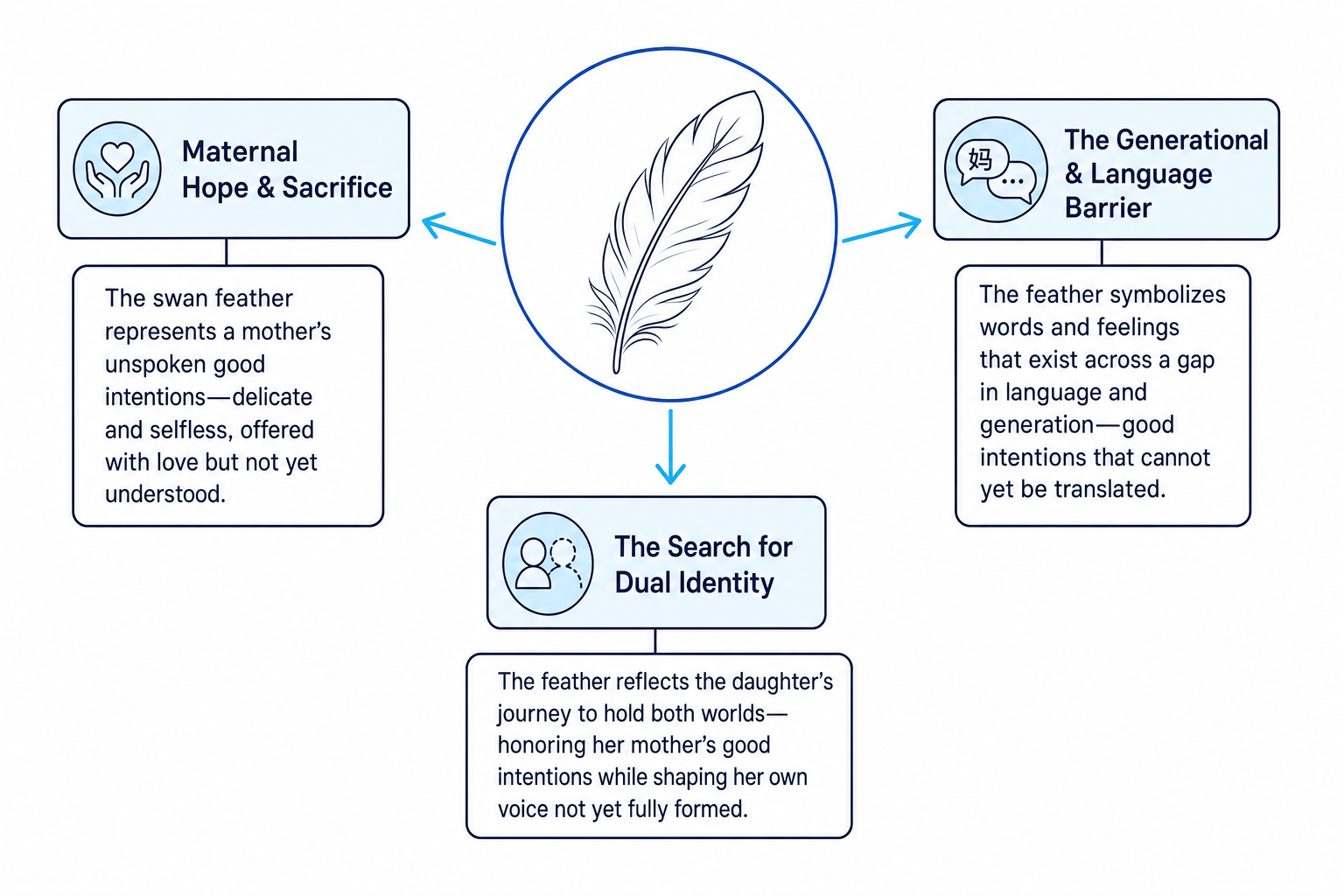
Thematic Connections:
- Maternal Love and Sacrifice: The "good intentions" (yi) represent the pure, unspoken love the mothers have for their daughters. Because they cannot communicate this love in perfect English, they must rely on symbolic tokens.
- The Language and Cultural Barrier: The feather is "unworthy" on its own, but its value lies in its journey ("from afar"). This mirrors the mothers' physical journeys from war-torn China to America, and the psychological journey of trying to pass down their heritage to daughters who do not fully understand its worth.
The Power of the Parable
The swan feather symbolizes the fragile, imperfect communication between mothers and daughters. It is a physical manifestation of hope that survives a traumatic displacement across cultures.
Key Quote 2: The Bicultural Paradox
"I wanted my children to have the best combination: American circumstances and Chinese character." (Suyuan Woo, Chapter 1: "The Joy Luck Club")
This quotation, recalled by Jing-mei after her mother Suyuan's death, encapsulates the central hope—and tragedy—of the first-generation immigrant experience.
Thematic Connections:
- The Immigrant Dream (AO4): "American circumstances" represents the material success, freedom, and endless choices promised by the American Dream. After surviving the horrors of the Japanese invasion of China, Suyuan views America as a land of absolute safety and opportunity.
- The Retention of Heritage: "Chinese character" represents filial piety, inner strength, patience, and the ability to swallow one's own sorrow (chi fan). Suyuan does not want her children to become entirely Westernized; she wants them to retain the core values that allowed her to survive.
- The Paradox: The tragedy of the novel is that "American circumstances" naturally foster individualism and rebellion, which directly clash with the traditional obedience required by "Chinese character."
Ignoring the Context of War
Do not analyze the mothers' strict expectations as simple "pushiness." To achieve high marks in AO4, you must explain that their demands are rooted in the trauma of war, displacement, and survival in pre-revolutionary China. They push their daughters because they know how easily a life can be destroyed.
Key Quote 3: The Generational Divide
"Only two kinds of daughters," she shouted at me. "Those who are obedient and those who follow their own mind!" (Suyuan Woo, Chapter 8: "Two Kinds")
This dramatic climax to the piano-lessons conflict between Suyuan and Jing-mei highlights the pain of mutual misunderstanding.
Thematic Connections:
- The Clash of Values: This quote pits the traditional Chinese expectation of xiao (filial piety and absolute obedience to parents) against the American belief in self-actualization and individual identity ("follow their own mind").
- Language as a Weapon: The use of absolute, binary language ("Only two kinds") shows the rigid boundaries the mothers establish when they feel their control slipping. For Jing-mei, who has been raised in an individualist culture, this boundary is an ultimatum she cannot accept.
Analyzing a Quote in an Essay
In the Edexcel exam, you must show how these quotes work inside a structured argument. Let's walk through how to construct an analytical paragraph using a key quote.
Analyzing the clash of filial piety and autonomy
Analyze how Amy Tan presents the conflict between maternal expectations and daughter autonomy in the chapter "Two Kinds."
- Contextualize the conflict (AO4): Align the struggle with the historical context of the post-WWII Chinese diaspora in America. The mothers carry traditional expectations of filial piety (traditional obedience), while their daughters, born into 1960s/70s America, are deeply influenced by Western individualist social movements that encourage finding one's own voice.
- Select and unpack the linguistic methods (AO1): Examine the quotation: "Only two kinds of daughters... Those who are obedient and those who follow their own mind!" Note the stark dichotomy created by the coordinating conjunction "and." By setting these two paths as mutually exclusive, Suyuan frames self-determination not as a healthy sign of maturity, but as an act of fundamental betrayal.
- Synthesize the effect and author's purpose (AO1): Combine these elements to show that the tragedy of the novel lies in translation. The mother's demand for obedience is actually a desire to protect her daughter from failure, but to the Americanized daughter, it sounds like tyrannical control. This linguistic division mirrors the geographic and cultural distance between their generations.
Memorize short fragments
Instead of memorizing a massive block of text, memorize short, punchy fragments like "American circumstances," "Chinese character," and "two kinds." These are easier to weave directly into your own sentences.
In the exam
- Integrate your quotes: Never drop a quote in as a standalone sentence (this is known as "quote dumping"). Always embed it into your own analytical sentence (e.g., Suyuan's tragic desire to synthesize "American circumstances" with "Chinese character" demonstrates...).
- Address AO4 through the quote: Use words in the quote to pivot to historical context. For example, use the phrase "Chinese character" to discuss the traditional Chinese values of resilience and parental respect that the mothers brought with them when escaping the Sino-Japanese War.
- Show character growth: Highlight how quotes from early in the novel (showing division) contrast with quotes from the end (showing reconciliation, such as Jing-mei realizing, "And now I also see what part of me is Chinese... It is in our blood").
Check yourself
- Can you explain how the "swan feather" acts as a motif throughout the novel, linking the experiences of different mother-daughter pairs?
- How does the quote about "American circumstances and Chinese character" help explain the conflicts in both Waverly Jong's and Jing-mei Woo's stories?
- Why is it historically inaccurate (for AO4) to view the mothers' strictness as merely "unfair parenting"? What specific historical traumas shaped their perspectives?
