What you'll learn
- How The Joy Luck Club is structured across its 16 linked chapters.
- Which chapters are most useful as “anchor chapters” for essays.
- How to connect chapter events to Tan’s methods, themes and context.
- How to choose strong evidence in a closed-book Edexcel IGCSE prose answer.
First: what makes a chapter “key”?
A key chapter is not just a chapter where “a lot happens”. It is a chapter that helps you explain the novel’s biggest concerns: mothers and daughters, storytelling, identity, migration, memory, silence, shame and inheritance.
In The Joy Luck Club, Amy Tan does not tell the story in one straight line. Instead, she gives us 16 first-person narratives arranged in four sections. Each chapter feels like a personal memory, but together they form a bigger pattern.
Narrative structure
Narrative structure means the way a writer organises a story: the order of events, the choice of narrators, the movement between past and present, and the links between different sections.
Tan’s structure matters because the novel is about inheritance: the daughters do not simply “hear” their mothers’ stories — they slowly learn how those stories shape their own lives.
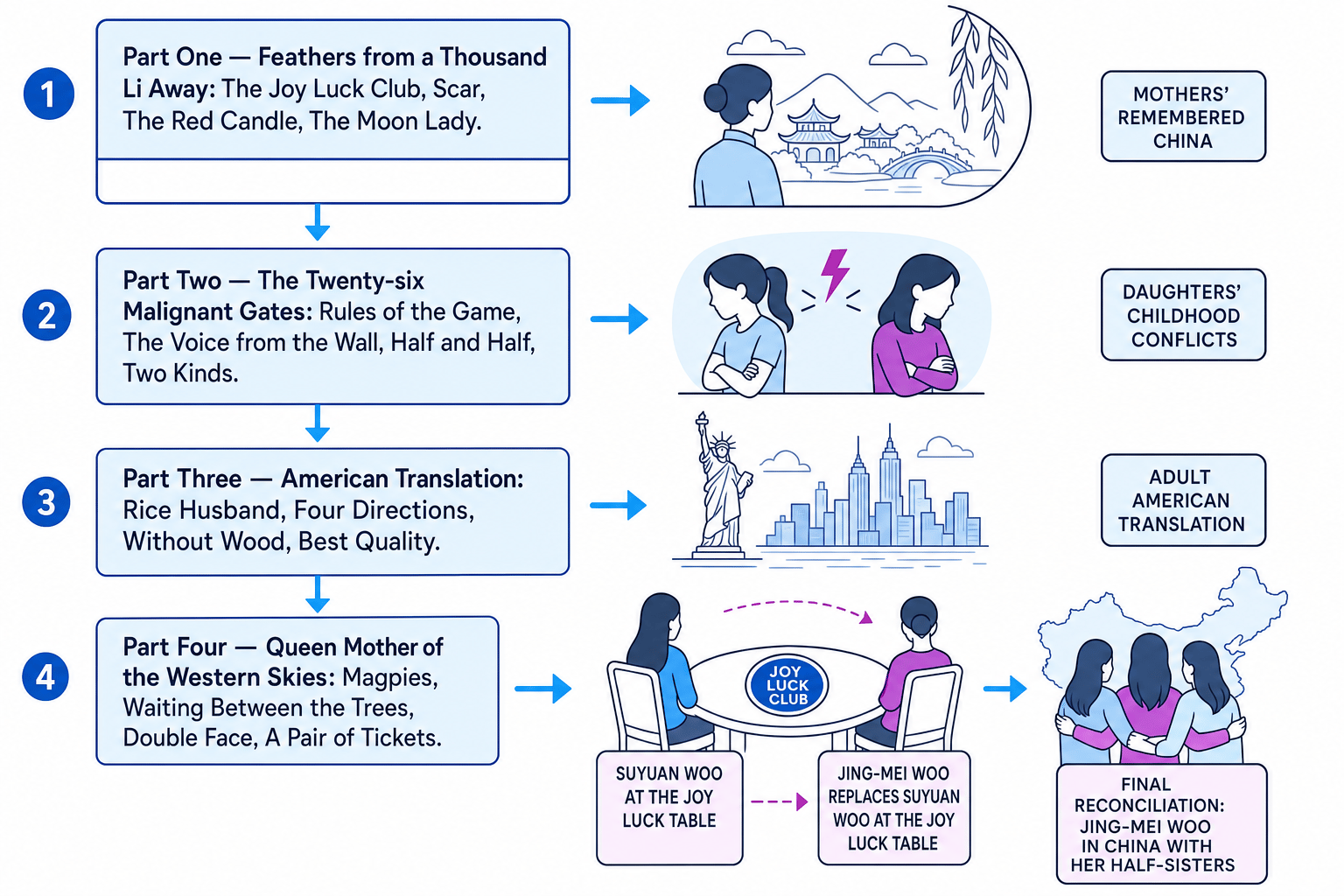
The big structural pattern
The novel moves from the mothers’ memories of China, to the daughters’ childhood conflicts, to adult crises in America, and finally towards partial reconciliation and understanding.
The four-part design
Tan’s four sections work almost like a mah-jong table: different voices take turns, but the meaning comes from the pattern they create together.
Part One: mothers’ stories and origins
Part One introduces the mothers’ pasts and the idea that the daughters have inherited histories they do not fully understand.
Important chapters here include:
- “The Joy Luck Club” — Jing-mei replaces her dead mother, Suyuan, at the mah-jong table.
- “The Red Candle” — Lindo Jong explains how she escaped an arranged marriage while keeping her honour.
- “The Moon Lady” — Ying-ying St. Clair remembers being lost and learning to silence her desires.
The opening chapter is crucial because it establishes Jing-mei’s role as a daughter trying to understand a mother who has died. Her father asks her to be “the fourth corner at the Joy Luck Club”, a phrase that makes her inheritance physical: she must literally sit in her mother’s place.
This chapter also introduces the gap between the immigrant mothers and American-born daughters. Jing-mei recognises that the mothers see daughters “who grow impatient when their mothers talk in Chinese”. Tan uses this contrast in language to show emotional distance as well as cultural distance.
“The Red Candle”: Lindo’s self-possession
“The Red Candle” is one of the strongest chapters for essays on female strength, patriarchy and identity.
Patriarchy
Patriarchy is a social system in which men hold most power, especially in the family, marriage, law and public life.
Lindo is promised in marriage as a child, so her life is controlled by family duty and social expectation. Yet she insists, “I once sacrificed my life to keep my parents’ promise.” The verb “sacrificed” shows how serious and painful this duty is.
However, the chapter is not just about victimhood. Lindo finds a way to escape without publicly shaming either family. Her key realisation is: “I would always remember my parents’ wishes, but I would never forget myself.” Tan makes this a turning point because Lindo learns to balance duty with self-respect.
Why this chapter is so useful
Use “The Red Candle” when an essay asks about strength, female identity, tradition, Chinese social expectations, or the mothers’ difficult pasts.
Part Two: daughters’ childhood conflicts
Part Two shifts to the daughters as children in America. These chapters show how mother-daughter tension begins early, often through misunderstandings about love, obedience and independence.
The strongest chapters are:
- “Rules of the Game” — Waverly learns chess and struggles with Lindo’s pride and control.
- “Half and Half” — Rose connects childhood guilt with adult passivity.
- “Two Kinds” — Jing-mei rebels against Suyuan’s ambitions for her.
“Rules of the Game”: invisible strength
Waverly begins, “I was six when my mother taught me the art of invisible strength.” This phrase is important because it becomes both a survival strategy and a source of conflict.
Motif
A motif is a repeated image, idea or phrase that gains meaning each time it appears.
“Invisible strength” is a motif. It suggests silence, strategy and hidden power. In chess, Waverly learns to plan several moves ahead. In family life, Lindo also uses invisible strength by shaping Waverly’s behaviour through pride, criticism and public display.
The chapter is key because Tan links a game of chess to emotional power. Waverly wants independence, but she also wants her mother’s approval. The final imagined chess battle with her mother suggests that their conflict is psychological as well as domestic.
“Two Kinds”: the central mother-daughter clash
“Two Kinds” is one of the most important chapters in the whole novel. It is often the easiest chapter to use in an exam because the conflict is clear, emotional and closely linked to the American Dream.
Suyuan believes in possibility: “My mother believed you could be anything you wanted to be in America.” The line captures immigrant hope, but it also becomes pressure. Suyuan turns this hope into tests, piano lessons and expectations of genius.
Jing-mei’s rebellion is just as important. She decides, “I won’t be what I’m not.” Tan presents this as a painful attempt to protect her identity, but also as a childish misunderstanding of her mother’s love.
The argument reaches its sharpest point when Suyuan says, “Only two kinds of daughters.” The phrase reduces Jing-mei’s identity to a harsh choice: obedience or defiance. Years later, the two piano pieces, “Pleading Child” and “Perfectly Contented”, are revealed as “two halves of the same song”. Structurally, this ending suggests that conflict and reconciliation are connected.
Analysing a key moment in “Two Kinds”
-
Start with the conflict: Suyuan wants Jing-mei to become a prodigy, while Jing-mei experiences this as pressure rather than love.
-
Select a precise quotation: “Only two kinds of daughters” shows Suyuan dividing identity into two fixed categories.
-
Analyse the method: Tan uses direct speech and the repeated phrase “two kinds” to make the argument feel absolute and emotionally damaging.
-
Link to theme: the scene exposes a clash between immigrant hope and American individualism, because Suyuan sees opportunity while Jing-mei sees control.
-
Link to structure: the later discovery that the piano pieces are “two halves of the same song” softens the conflict and suggests Jing-mei’s adult understanding of her mother.
Oversimplifying Suyuan
Do not write that Suyuan is simply cruel or pushy. A stronger answer shows that her pressure comes from trauma, loss and a fierce belief that America should offer her daughter a better life.
Part Three: adult daughters and “American translation”
Part Three shows the daughters as adults. They are not free from their mothers’ influence; instead, they are repeating patterns of silence, fear or uncertainty in marriages, careers and friendships.
Useful chapters include:
- “Rice Husband” — Lena’s marriage reveals imbalance and emotional accounting.
- “Without Wood” — Rose begins to resist passivity during her divorce.
- “Best Quality” — Jing-mei’s insecurity is contrasted with Suyuan’s belief in her “best quality”.
“Best Quality”: recognising worth
“Best Quality” is especially helpful for essays on self-worth and mother-daughter love. Jing-mei feels inferior to Waverly, especially after Waverly criticises her writing. Suyuan gives Jing-mei a jade pendant and calls it her “life’s importance”.
Symbolism
Symbolism is when an object, person, place or action represents a larger idea beyond its literal meaning.
The jade pendant symbolises value that Jing-mei does not yet understand. It is not just jewellery; it represents Suyuan’s belief that her daughter has inner worth. The chapter matters because Jing-mei’s insecurity is set against Suyuan’s quiet confidence in her.
This also prepares for the ending of the novel. Jing-mei cannot fully understand her mother while Suyuan is alive, but objects, stories and memories continue speaking after her death.
Part Four: mothers’ truths and daughters’ inheritance
Part Four returns to the mothers’ deeper stories, then closes with Jing-mei’s journey to China.
The most important chapters are:
- “Magpies” — An-mei learns that silence can feed oppression.
- “Waiting Between the Trees” — Ying-ying decides to pass strength to Lena.
- “Double Face” — Lindo reflects on Chinese and American identity.
- “A Pair of Tickets” — Jing-mei meets her half-sisters and understands Suyuan differently.
“Double Face”: Chinese and American identity
“Double Face” is a key chapter for cultural identity. Lindo says, “I wanted my children to have the best combination: American circumstances and Chinese character.” This is one of the novel’s clearest statements about immigrant parenting.
The phrase “best combination” shows Lindo’s hope, but the chapter also questions whether identity can be mixed so neatly. Lindo worries that her children have absorbed American freedom but not Chinese loyalty, endurance or family duty.
This chapter is useful because it complicates the novel: Tan is not saying Chinese identity is perfect and American identity is shallow. Instead, she shows the pain of living between cultures.
“A Pair of Tickets”: the ending and reconciliation
“A Pair of Tickets” is the novel’s final chapter and one of the most important structurally. Jing-mei travels to China to meet the twin daughters Suyuan was forced to abandon during wartime.
At the start, Jing-mei thinks, “I am becoming Chinese.” This is not a magical transformation. It is a moment of recognition: she begins to feel that Chinese identity has been part of her all along, even when she did not understand it.
The final image is powerful because the three sisters see their mother in one another: “Together we look like our mother.” Tan uses this ending to make Suyuan present even though she is dead. The mother’s story survives through her daughters.
Why the final chapter matters
The ending does not solve every conflict, but it completes Jing-mei’s movement from confusion to connection. She inherits Suyuan’s story and becomes able to carry it forward.
How to choose chapters in an essay
In the Edexcel IGCSE exam, The Joy Luck Club is assessed in Component 1, Section C, so it is closed book. You need a small set of accurate chapter memories and short quotations you can use flexibly.
A good essay usually uses two or three key chapters in depth, rather than rushing through eight chapters superficially.
Choosing chapters for a theme question
-
Identify the theme in the question. If the question is about mother-daughter conflict, choose chapters where that conflict changes or deepens.
-
Pick one childhood chapter: “Two Kinds” gives you direct conflict, high emotion and the phrase “Only two kinds of daughters.”
-
Pick one adult or ending chapter: “A Pair of Tickets” shows Jing-mei’s later understanding through “Together we look like our mother.”
-
Add one mother’s memory if relevant: “The Red Candle” can explain why the mothers value obedience, endurance and self-respect.
-
Build a line of argument: Tan presents conflict as painful, but also as part of a longer process through which daughters come to understand their mothers’ histories.
Quick chapter bank
Use this as a revision checklist:
- “The Joy Luck Club” — replacement, inheritance, storytelling, Suyuan’s absence.
- “The Red Candle” — arranged marriage, duty, self-respect, female cleverness.
- “Rules of the Game” — strategy, pride, control, “invisible strength”.
- “Two Kinds” — prodigy pressure, rebellion, American Dream, “two halves of the same song”.
- “Best Quality” — insecurity, maternal belief, jade pendant, inner worth.
- “Double Face” — mixed identity, “American circumstances and Chinese character”.
- “A Pair of Tickets” — China, sisters, reunion, “Together we look like our mother.”
In the exam
-
Choose chapters that let you show development: for example, conflict in “Two Kinds” and understanding in “A Pair of Tickets”.
-
Keep quotations short and exact; then spend more time analysing Tan’s method, such as symbolism, direct speech, structure or narrative voice.
-
Link context naturally: mention immigration, wartime loss, arranged marriage or cultural expectations only when they explain a character’s behaviour.
Check yourself
- Which chapter would you use to show Jing-mei misunderstanding Suyuan’s love, and why?
- How does “The Red Candle” help us understand the mothers’ strength?
- Why is “A Pair of Tickets” a fitting final chapter for the novel?
