What you'll learn
- How to turn a broad topic into a sharp theme argument.
- The main themes in The Curious Incident of the Dog in the Night-Time.
- How Stephens links themes to dramatic methods such as structure, staging and voice.
- How to write about themes in an Edexcel IGCSE Literature response.
What is a theme?
A theme is not just “family” or “truth”. Those are topics. A theme is the writer’s developed idea about that topic.
Theme
A theme is a repeated idea in a text that reveals something important about human experience, society, relationships or identity.
So instead of writing, “Truth is a theme,” you might write:
Stephens presents truth as necessary for trust, but also painful when it exposes the damage adults have hidden.
That is much more analytical because it gives you a view of the play, not just a label.
Turning a topic into a theme argument
- Start with a topic: family.
- Ask what the play seems to suggest about it: family love can be real even when parents make serious mistakes.
- Anchor that idea in the text: Ed says, “I love you very much,” but he also confesses, “I killed Wellington.”
- Turn it into an argument: Stephens presents family as loving but fragile, because lies and fear can damage the safety Christopher needs.
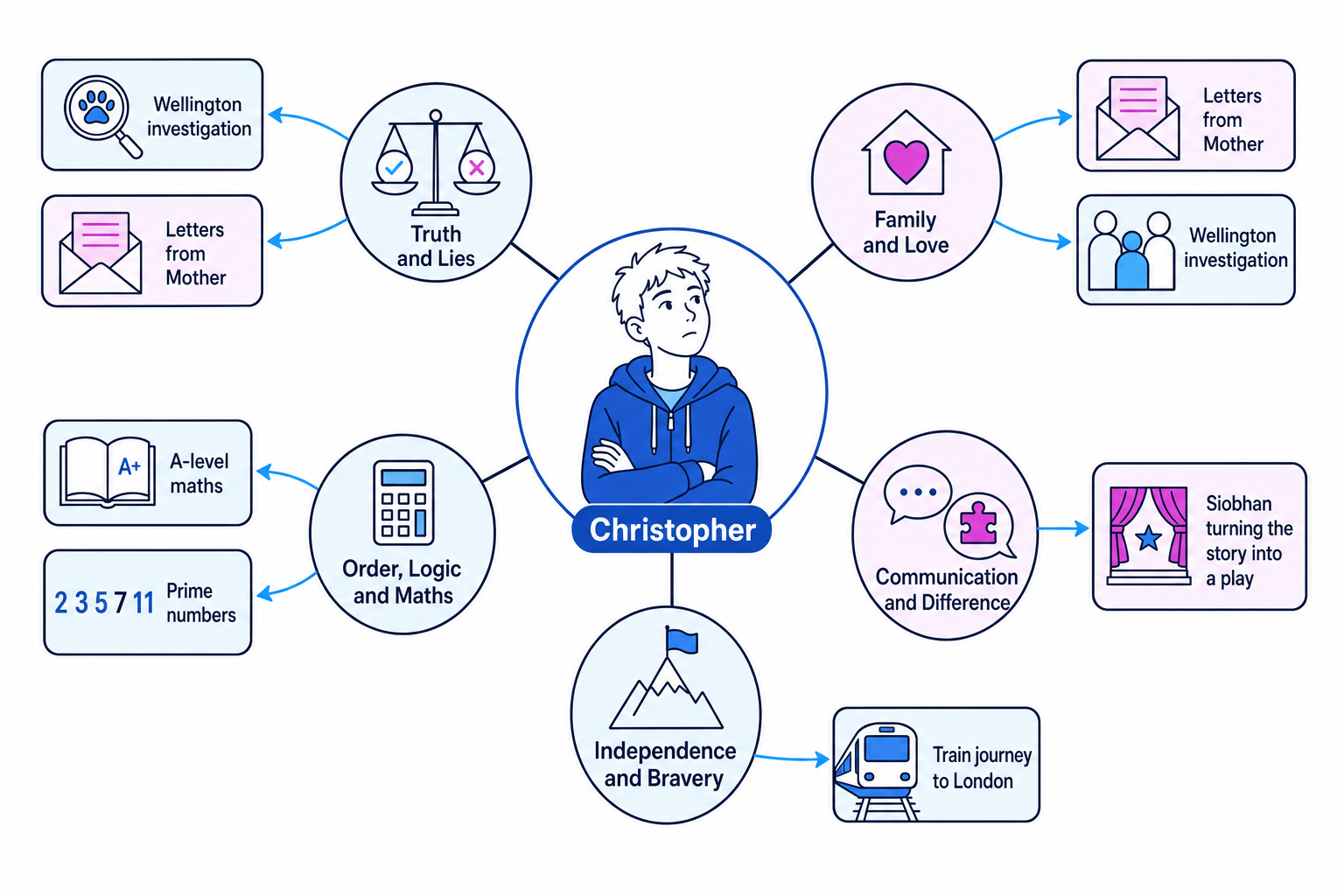
Before we look at the themes one by one, this web shows how the play’s big ideas connect through Christopher’s experiences rather than appearing separately.
Truth, lies and trust
Christopher has a very strict relationship with truth. He says, “I do not tell lies,” and this becomes one of the play’s clearest moral anchors. For him, truth is not flexible or socially convenient: it is the basis of safety.
Stephens contrasts this with the adult world, where people lie, hide things or avoid direct answers. Ed’s lie about Judy being dead is more devastating than a simple mistake because it breaks Christopher’s trust in the person who is meant to protect him. When Ed admits, “I killed Wellington,” the confession links two betrayals: the death of the dog and the false story about Christopher’s mother.
The detective-story structure is important here. At first, Christopher investigates Wellington’s death, but the deeper mystery becomes the truth about his own family. The play therefore shows that truth can solve one problem while creating another: Christopher gains knowledge, but loses his sense of security.
Truth changes the whole plot
The mystery of Wellington is not just a plot device. It exposes the hidden lies inside Christopher’s family and forces him to rebuild trust from the beginning.
Analysing truth and structure
- Make a precise point: Stephens presents truth as both necessary and dangerous, because it reveals facts that Christopher needs but also destroys his trust in Ed.
- Choose short evidence: Christopher’s “I do not tell lies” contrasts with Ed’s confession, “I killed Wellington.”
- Name the method: the contrast between Christopher’s declarative certainty and Ed’s blunt confession creates a moral shock.
- Link to structure: the detective plot shifts from an external mystery about a dog to an internal family crisis.
- Explain the effect: the audience understands why Christopher’s fear of Ed becomes logical, not exaggerated, because truth has changed his whole understanding of home.
Making the lies too simple
Do not just write “Ed is bad because he lies.” A stronger answer recognises that Ed acts from grief, anger and fear, but Stephens still shows that love without honesty becomes unsafe.
Family, love and responsibility
The play does not present family as perfect. Instead, it explores how love can exist alongside failure, anger and guilt.
Ed cares for Christopher in practical ways, but his emotional control collapses. His love is real, yet his decisions are damaging. Judy, too, is not presented as simply cruel. In her letters, she admits, “I was not a very good mother,” which shows guilt and self-awareness. Stephens makes the audience see that parenting Christopher requires patience, honesty and emotional steadiness — qualities both parents struggle to maintain.
This theme is especially powerful because Christopher does not express love in conventional ways. He may dislike being touched, but that does not mean he does not feel deeply. His need for routine, safety and truth is part of how family love must work for him.
Write about family with balance
Aim for complexity: Ed and Judy are flawed, not cartoon villains. Christopher is vulnerable, but he is not helpless. This balanced view helps you sound thoughtful and critical.
Family is also widened beyond biology. Siobhan becomes an important figure because she listens carefully, helps Christopher communicate and gives him space to shape his story. Her role suggests that care is not only about being related; it is also about understanding someone’s needs.
Difference, communication and empathy
Christopher says, “I find people confusing.” This simple statement introduces one of the play’s central concerns: communication is not equally easy for everyone.
Neurodivergent
Neurodivergent describes a person whose brain processes information, emotions or social situations differently from what society often treats as “typical”. The play does not need you to reduce Christopher to a diagnosis; focus on how his experience is dramatised.
Christopher often finds figurative language difficult. His statement “Metaphors are lies” shows his preference for literal meaning. A metaphor is a comparison where one thing is described as another, such as saying “the classroom was a zoo.” Christopher sees this as inaccurate because the classroom is not literally a zoo.
Stephens turns this difference into a theatrical strength. Christopher’s direct narration, lists, precise details and logical explanations allow the audience to enter his way of seeing the world. Instead of asking us to judge him from outside, the play asks us to adjust our own assumptions.
Stagecraft also matters. In performance, sound, lighting, movement and ensemble work can create the pressure of crowds, noise and sensory overload. This means the audience does not just hear that Christopher is overwhelmed; they experience something of that overwhelm.
Writing as if Christopher has no emotions
Christopher’s communication is different, not empty. He cares about Wellington, wants truth, feels fear, seeks his mother and takes pride in success. Avoid language that makes him sound robotic or less human.
Order, logic and chaos
Christopher introduces himself through knowledge: “I know all the countries of the world and their capital cities. And every prime number up to 7,057.” This tells us that order, memory and pattern are central to his identity.
A useful term here is motif.
Motif
A motif is a repeated image, idea, object or pattern that helps develop a theme.
Maths, prime numbers, maps, timetables and diagrams all work as motifs of order. They help Christopher manage a world that often feels unpredictable. Maths is comforting because problems can have “a straightforward answer,” unlike human relationships, where motives are hidden and emotions contradict logic.
The play repeatedly places Christopher’s order against chaos: the garden after Wellington’s death, the discovery of the letters, the train journey, the crowded station and the conflict between his parents. This contrast helps the audience understand why Christopher needs systems. They are not just hobbies; they are survival tools.
Link maths to meaning
Do not just say “Christopher likes maths.” Explain what maths represents: certainty, control, pattern and a way of thinking that helps him survive emotional chaos.
Independence, bravery and growing up
Christopher’s journey is a coming-of-age story, but not in a simple “he becomes normal” way. He becomes more independent while still needing support and clear boundaries.
His journey to London is structurally important because it turns private investigation into physical action. He has to navigate trains, strangers, signs, noise and fear. When he later says, “I was brave,” the word matters because bravery is not the absence of fear. Bravery means acting despite fear.
By the ending, Christopher can say, “I can do anything.” This is uplifting, but it should not be read as a magically perfect ending. Ed still has to rebuild trust. Judy still has to learn how to care for Christopher day by day. The ending offers hope, not a complete solution.
Tracking Christopher’s independence
- Begin with the early situation: Christopher’s world is local and controlled — home, school, routines and familiar people.
- Identify the turning point: Ed’s confession makes home feel unsafe, so Christopher chooses to find Judy.
- Analyse the journey: the train and London scenes externalise his fear through noise, crowds and confusion.
- Connect to the ending: “I can do anything” shows growth because Christopher now sees evidence of his own courage.
- Keep the interpretation balanced: independence does not mean he no longer needs care; it means he has proved his own capability.
Stories, theatre and seeing differently
Because this is a play adapted from a novel, form is central to the themes. Form means the type of text and how it is presented — here, drama performed by actors in front of an audience.
Stephens uses a play-within-a-play structure, with Siobhan helping Christopher turn his writing into performance. This makes storytelling part of the plot. Christopher’s story gives him a way to organise events that felt frightening or confusing.
There is also metatheatre, which means theatre that draws attention to itself as theatre. When the play shows the process of telling Christopher’s story, it reminds the audience that stories are constructed. That matters because the whole play asks: whose version of events do we trust? How do we understand someone else’s mind? What happens when ordinary language is not enough?
The play makes perspective visible
Stephens does not only tell us Christopher sees the world differently. He uses theatrical form to make the audience watch, hear and feel that difference.
Quick quotation anchors by theme
Use short quotations accurately. In Component 2 Section A, you have a clean copy of the play, but you should still know your key moments so you do not waste time searching.
- Truth and lies: “I do not tell lies”; “I killed Wellington.”
- Communication and difference: “I find people confusing”; “Metaphors are lies.”
- Order and logic: “every prime number up to 7,057”; “a straightforward answer.”
- Family: “I love you very much”; “I was not a very good mother.”
- Independence: “I was brave”; “I can do anything.”
How themes become strong paragraphs
For Edexcel IGCSE, strong drama responses combine close knowledge of the text with analysis of methods. That means you should not only say what happens; you should explain how Stephens presents it through language, structure and stagecraft.
A useful paragraph shape is:
- Make a theme argument.
- Give a short quotation or precise moment.
- Name a method, such as contrast, motif, stagecraft, structure or direct narration.
- Explain the effect on the audience.
- Link back to the question.
In the exam
- Start each paragraph with a clear argument about the theme, not a vague sentence like “Another theme is family.”
- Use your clean copy efficiently: choose short, exact quotations and focus on key scenes rather than hunting for long extracts.
- Track development across the play — beginning, turning point and ending — so your answer feels structured.
- Analyse dramatic methods: dialogue, stage directions, sound, movement, direct address and the play-within-a-play form.
- Keep linking methods to meaning: explain what the audience understands, feels or questions because of Stephens’ choices.
Check yourself
- How does the mystery of Wellington become a larger theme about truth and trust?
- Why is it important not to describe Christopher as emotionless?
- How does the play’s theatrical form help communicate Christopher’s perspective?