What you'll learn
- What “context” means for The Curious Incident of the Dog in the Night-Time.
- How social context, especially neurodiversity and family life, shapes the audience’s response.
- How Haddon’s novel became Stephens’s stage adaptation.
- How to use context in an Edexcel IGCSE paragraph without drifting away from the text.
What is context?
Context
In English Literature, context means the social, historical, cultural, literary and theatrical circumstances surrounding a text. It helps explain how and why a writer’s choices create meaning for an audience.
For this set text, you are studying Simon Stephens’s play, adapted from Mark Haddon’s 2003 novel. Because this is a modern drama text in Component 2, the exam is open book: you may use a clean copy of the play. Your main job is still to analyse the script closely — context should support your points, not replace them.
Context is a lens
Use context to make your analysis sharper. Do not write a separate history paragraph. Instead, connect context to a precise moment, quotation, stage direction, structure, or dramatic effect.
The big picture
The play sits at the meeting point of several contexts: early twenty-first-century Britain, growing public awareness of autism and neurodiversity, detective fiction, and modern theatrical staging.
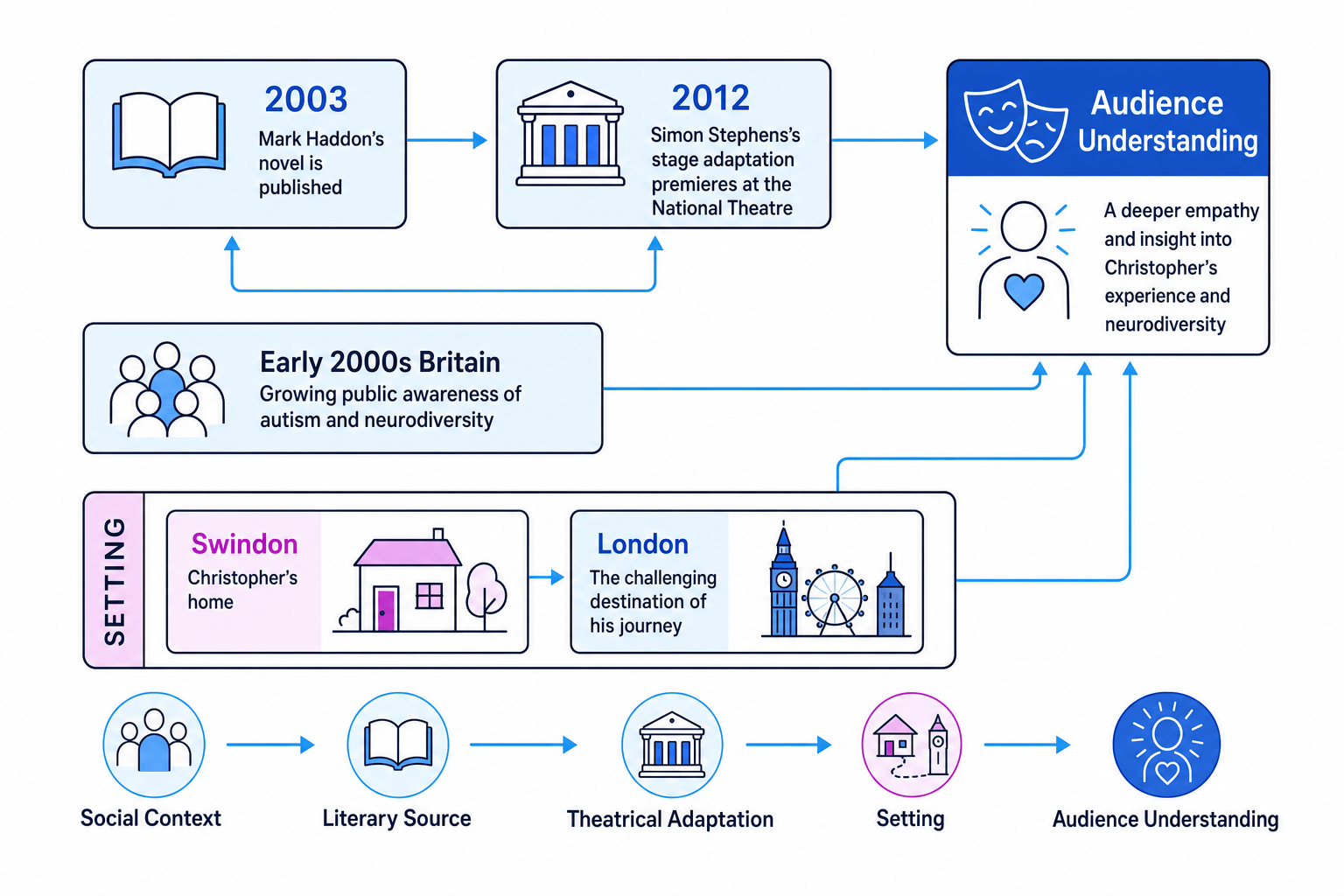
| Context strand | Why it matters in the play |
|---|---|
| Social context | Helps you understand how Christopher is misunderstood by adults, institutions and strangers. |
| Family context | Shows the pressure, love and damage within Christopher’s family. |
| Literary context | The title and opening borrow from detective fiction, then turn the mystery into a story about truth and trust. |
| Theatrical context | Stephens transforms a first-person novel into a staged experience using voice, movement, sound and structure. |
| Setting context | Swindon, trains and London make Christopher’s journey feel ordinary, real and challenging. |
Social context: neurodiversity and communication
Neurodiversity
Neurodiversity is the idea that people’s brains can work in different ways. A neurodivergent person may process communication, sensory information or social rules differently from what society treats as “typical”.
Christopher is never reduced to a medical label in the play. However, he is presented with traits often associated with autism: he values logic, routine, precision and truth; he can find touch, noise and social confusion overwhelming. His line, “I find people confusing”, is simple but important because it directly explains his experience of the world.
The context of growing autism awareness matters here. Haddon’s novel appeared in 2003, when public understanding of autism and Asperger’s was increasing but still often stereotyped. Stephens’s 2012 stage adaptation reaches audiences who may be more familiar with the language of neurodiversity, but the play still challenges easy assumptions.
Christopher’s difference is not presented as a lack of intelligence. In fact, his opening self-description — “I know all the countries of the world and their capital cities. And every prime number up to 7507” — immediately shows memory, precision and mathematical ability. The audience is invited to understand his perspective rather than simply judge his behaviour.
Diagnosing instead of analysing
Avoid writing as if the whole play can be explained by saying “Christopher has autism”. The safer and stronger approach is to say that Stephens presents Christopher as neurodivergent, then analyse the language, structure and staging that create our understanding of him.
Using neurodiversity context in analysis
- Christopher’s statement “I find people confusing” is a plain declarative sentence: it presents confusion as a fact of his experience, not as bad manners or deliberate awkwardness.
- The social context of neurodiversity helps the audience read this line as a difference in processing social behaviour, rather than a personal failure.
- Stephens’s dramatic form can then make that confusion visible through crowded scenes, overlapping voices, movement and sensory pressure, especially in public spaces.
- The effect is that the audience may question the “normal” world around Christopher: society often fails to communicate clearly, patiently or kindly.
Family context: love, care and pressure
The play is also rooted in ordinary family life. Christopher lives with Ed in Swindon after Judy has left. This domestic context matters because the central mystery is not only “Who killed Wellington?” but also “Who can Christopher trust?”
Ed’s confession, “I killed Wellington, Christopher,” is devastating because it breaks the fragile trust between father and son. The line turns the detective plot into a family crisis. Ed is not a cartoon villain: he is loving, exhausted, angry and dishonest. Judy is not simply “bad” for leaving either; the play shows how caring responsibilities, guilt and emotional pressure can damage everyone involved.
This does not mean the context excuses harmful actions. Ed’s violence towards Wellington and his lies about Judy’s letters still matter morally. Context helps you make a balanced judgement: the play presents family love as real, but also flawed and sometimes frightening.
Balanced context
A strong essay can say: context explains why characters struggle, but it does not automatically excuse what they do.
Literary context: detective fiction and the Sherlock Holmes link
The title The Curious Incident of the Dog in the Night-Time is an allusion, meaning a reference to another text. It comes from Arthur Conan Doyle’s Sherlock Holmes story “Silver Blaze”, where Holmes notices the “curious incident” that a dog did not bark.
This literary context matters because Christopher approaches Wellington’s death like a detective. The opening image — “The dog was dead. There was a garden fork sticking out of the dog” — is blunt, visual and shocking. It creates a murder mystery structure.
However, Haddon and Stephens also subvert the detective genre. To subvert a genre means to use its familiar pattern but twist it. The investigation into Wellington’s death uncovers a deeper mystery: the lies within Christopher’s family. The “case” becomes a way to explore truth, betrayal and independence.
Connecting the detective context to structure
- The title’s Sherlock Holmes allusion sets up the expectation of a logical detective story, where clues lead to a solution.
- The opening description of Wellington’s body gives the play an immediate mystery and gives Christopher a clear purpose: he will investigate.
- The structure then shifts: solving the dog’s death reveals Ed’s lie and Judy’s hidden letters, so the real focus becomes family truth rather than crime.
- This makes Christopher’s love of logic moving, because the adult world he investigates is emotionally messy and morally uncertain.
Theatrical context: from novel to stage
Adaptation
An adaptation is a new version of an existing text, often changed into a different form. Here, Stephens adapts Haddon’s first-person novel into a play for performance.
A first-person narrator tells a story using “I”. In the novel, Christopher’s voice controls almost everything we know. On stage, Stephens has to turn that private voice into something an audience can see and hear.
This is where theatrical context becomes important. A play uses dramatic form: dialogue, stage directions, movement, lighting, sound and actors’ bodies. Stage directions are instructions in the script that guide performance. In Curious Incident, the stage can represent Christopher’s mind, not just realistic locations. Maths, maps, trains, crowds and noise can become part of the performance.
Siobhan is especially important in this adaptation because she helps frame Christopher’s writing and supports the audience’s access to his story. The play often feels as if Christopher’s book is being transformed into theatre in front of us.
Linking adaptation to audience effect
- In the source novel, Christopher’s first-person voice gives readers direct access to his thoughts; Stephens must recreate that intimacy in a public theatre space.
- Christopher’s self-introduction, “My name is Christopher John Francis Boone,” establishes identity with precision and control.
- The stage adaptation can then contrast that controlled voice with moments of sensory overload, using dramatic methods such as movement, sound and staging.
- The audience does not just hear that Christopher experiences the world differently; they are encouraged to feel some of that pressure through performance.
Setting context: Swindon, trains and London
The play is set in recognisable contemporary Britain. Swindon is an ordinary town, with ordinary houses, gardens, schools, police officers and train routes. This ordinary setting is important: Christopher’s experiences are not placed in a fantasy world. They happen in everyday spaces.
London becomes a major challenge because it is crowded, noisy and unpredictable. The train journey is not just travel from one place to another; it is a structural journey towards independence. Christopher’s success matters because the world around him has often underestimated him.
The setting also helps Stephens explore control. At home, Christopher knows his routines. In public spaces, especially stations and London streets, the rules are harder to read. That contrast makes his courage clearer.
Setting and independence
Christopher’s journey through real British spaces turns independence into something practical and physical: buying a ticket, reading signs, coping with crowds, and continuing despite fear.
How to include context in a paragraph
A useful pattern is:
Point → evidence → method → context → effect → link to question
For example, you might write:
Stephens presents Christopher as someone whose logical intelligence challenges other people’s assumptions about him. When Christopher says he knows “every prime number up to 7507”, the precise numerical detail establishes his love of order and pattern. In the context of growing awareness of neurodiversity, the line encourages the audience to see difference as a distinctive way of thinking, not as weakness. This makes Christopher’s later journey more powerful because the audience recognises both his vulnerability and his capability.
Notice that the context is only one part of the paragraph. The quotation and method still do the main work.
Context-dumping
Do not begin a paragraph with several sentences about 2003, autism, or the National Theatre unless you quickly connect them to a specific moment in the script. Examiners reward relevant analysis, not background knowledge on its own.
In the exam
- Start from the play: choose a short quotation, stage moment, structural choice or character interaction before adding context.
- Use precise context phrases such as “in the context of neurodiversity”, “as a stage adaptation”, or “through the detective-fiction structure”.
- Remember this Component 2 drama exam is open book, so use your clean copy to find exact wording and stage moments; do not rely on vague memory.
Check yourself
- How does the Sherlock Holmes allusion in the title affect our expectations?
- Why is it better to discuss Christopher as neurodivergent rather than simply “diagnose” him?
- How can the settings of Swindon, the train journey and London link to the theme of independence?